USDT Volume Hit A Record $4.4 Trillion In Q4 2025, Tether Report Shows

bitcoinist2026-02-06 tarihinde yayınlandı2026-02-06 tarihinde güncellendi

Özet

Tether's Q4 2025 report reveals record-breaking growth for USDT, with on-chain transfer volume surging to $4.4 trillion. The number of users grew by 35.2 million, reaching a total of 534.5 million, marking the eighth consecutive quarter of adding over 30 million users. Active users hit an all-time high of 24.8 million. Retail transaction volume also reached a new peak of 2.2 billion, with 88.2% being under $1,000. Despite a bearish crypto market in October, USDT's market cap grew to $187.3 billion, and it outperformed the broader market, gaining 3.5% while major cryptocurrencies declined. Bitcoin was trading around $65,800, down over 9% in 24 hours.

A new report from Tether shows USDT saw growth in several metrics during the last quarter of 2025, including a new record in transfer volume.

Tether’s USDT Set A New Transfer Volume Record In Q4 2025

USDT issuer Tether has released its market report for Q4 2025 and it shows several new records for the largest stablecoin by market cap. First, the number of USDT users increased by 35.2 million during the period, taking the total to 534.5 million.
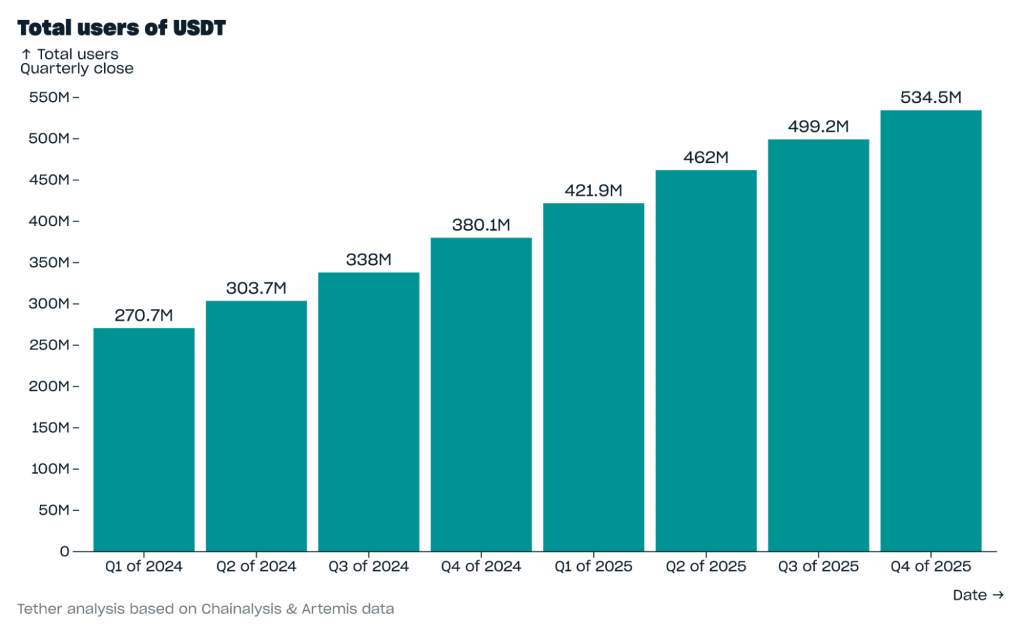
The quarterly growth in USDT users over the last couple of years | Source: Tether

In this count, Tether has included both the users who have received and used USDT for at least 24 hours on-chain, as well as the estimates of users that have received the stablecoin on centralized platforms like exchanges.

From the above chart, it’s visible that Q4 2025 was the eighth consecutive quarter in which Tether’s stablecoin saw growth of more than 30 million users. In terms of active users, the quarter set a new all-time high (ATH) with an average of 24.8 million users receiving USDT at least once inside a 30-day rolling window. “This accounts for 68.4% of all stablecoin monthly active users,” noted the report.

On-chain transfer volume also set a new ATH in this quarter, hitting a value of $4.4 trillion following a jump of $248.6 billion.
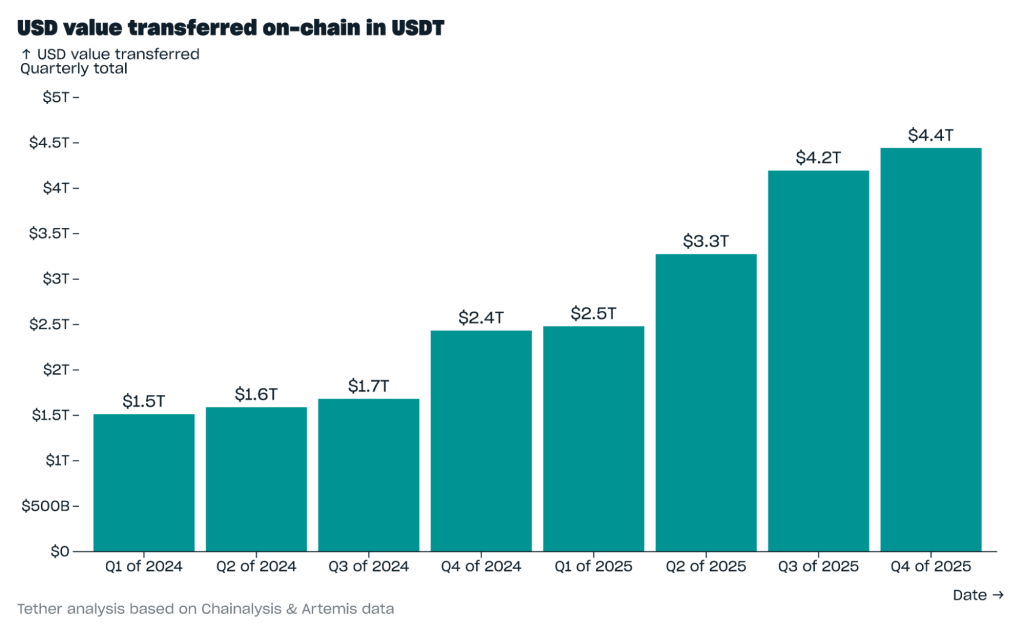
The stablecoin's transaction volume saw a notable rise over the past year | Source: Tether

As displayed in the chart, the USDT transfer volume stood at just $1.7 trillion in Q3 2024, so the sharp jump to $4.4 trillion since then indicates demand for using the stablecoin has seen a notable boost. “Of this $4.4T quarterly total, $2.8T (63.6%) was in transactions where USD₮ was the only asset transferred, and $1.6T (36.4%) was in transactions where multiple assets were transferred (typically in DeFi swaps),” said the report.

There has also been growth in transaction demand among the retail investors, as the number of transfers involving the stablecoin jumped by $313.1 million in Q4 to a new ATH of 2.2 billion. 88.2% of these transactions involved a sum less than $1,000.

The capital invested in the stablecoin itself also saw an increase during the quarter, with the market cap hitting $187.3 billion after inflows of $12.4 billion.
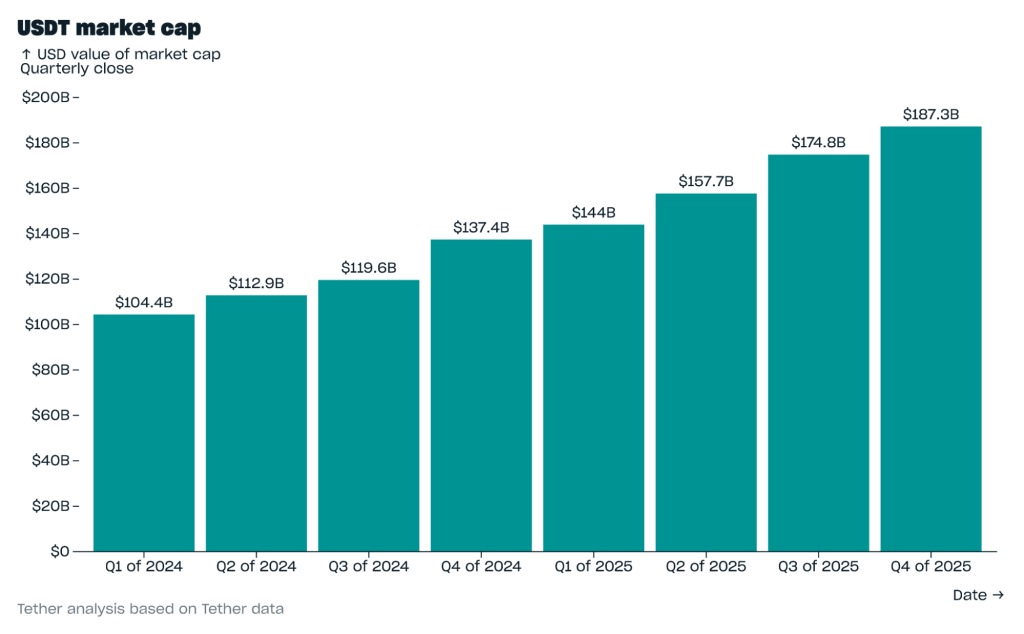
Looks like the token's market cap has seen steady growth | Source: Tether

The growth in the USDT market cap occurred despite the fact that the wider cryptocurrency market saw a bearish transition in October. That said, the downturn still affected the token to some degree as before the market slowdown, its monthly market cap growth rate was sitting at 4.9%, which declined in the aftermath of the liquidation squeeze of October 10th.

Overall, between October 10th and today, USDT has been among the more resilient cryptocurrencies, being up 3.5% while the combined sector has lost more than a third of its market cap. In the same period, USDC, the second largest stablecoin, has seen a drop of 2.6%.

Bitcoin Price

At the time of writing, Bitcoin is trading around $65,800, down more than 9% over the last 24 hours.

The price of the coin seems to have been crashing | Source: BTCUSDT on TradingView


İlgili Sorular

QWhat was the total USDT transfer volume in Q4 2025 according to Tether's report?

AThe total USDT transfer volume in Q4 2025 was $4.4 trillion.

QHow many USDT users were there in total by the end of Q4 2025?

AThere were 534.5 million USDT users by the end of Q4 2025.

QWhat percentage of the $4.4 trillion transfer volume involved transactions where USDT was the only asset transferred?

A63.6% of the $4.4 trillion transfer volume involved transactions where USDT was the only asset transferred.

QHow did the market cap of USDT change during Q4 2025, and what was its final value?

AThe market cap of USDT increased by $12.4 billion during Q4 2025, reaching a final value of $187.3 billion.

QWhat was the Bitcoin price mentioned in the article, and how much did it change in the last 24 hours?

ABitcoin was trading around $65,800 at the time of writing, down more than 9% over the last 24 hours.

İlgili Okumalar

Can Japan Buy Growth with AI? Will the Bond Market Believe It?

Japan's cabinet has introduced the 2026 Basic Policy on Economic and Fiscal Management and Reform, shifting its primary fiscal target. The new framework moves away from the traditional annual primary balance goal and instead prioritizes a stable reduction of the debt-to-GDP ratio. This change is tied to a strategy of increased "responsible proactive fiscal" spending, aiming to boost long-term growth through investments in strategic sectors like AI, semiconductors, energy, and robotics. The government estimates total public and private investment in 62 key technologies could exceed 370 trillion yen by 2040. The market reaction has been mixed and cautious. While equity markets may respond to policy signals, bond markets are focused on fiscal credibility. Concerns center on whether the weakening of the clear primary balance anchor could lead to looser fiscal discipline. If investors doubt that these strategic investments will generate sufficient productivity gains, tax revenue, and nominal growth to outpace rising interest costs, they may demand higher yields on Japanese Government Bonds (JGBs). Recent volatility in the yen and JGB yields, with the 10-year yield briefly reaching 2.9%, reflects this skepticism. The success of this new framework hinges on two factors: whether Japan can achieve a nominal growth rate consistently higher than its long-term interest rates, and whether future budgets demonstrate disciplined control over bond issuance. The government's narrative is that strategic investment is essential to break Japan's cycle of low growth, aging, and labor shortages. However, the bond market will continuously assess the credibility of this plan, pricing the risk that it may represent fiscal expansion rather than a viable growth strategy.

marsbit10 dk önce

Can Japan Buy Growth with AI? Will the Bond Market Believe It?

marsbit10 dk önce

Misjudged A-Shares: Resilience, Expectations, and Confidence

China's A-share market recently faced selling pressure, especially in tech sectors, initially triggered by a global tech sell-off that began in South Korea. However, the article argues this is a case of "mistaken injury" and highlights the market's underlying resilience. This resilience stems from three main pillars: **1) Tech Sector Fundamentals:** Unlike Korea's market dominated by a few memory chip stocks, China's tech sector is diversified across computing, communications, electronics, and semiconductors, supported by dual narratives of global AI supply chains and domestic substitution. Core areas like optical modules and fiber optics continue to show strong earnings growth. **2) "National Team" Support:** State-backed institutions and large corporations have made significant market purchases and announced buybacks, providing liquidity and signaling confidence. This is seen as a stabilizing policy signal, often associated with market bottoms. **3) Broader Market Pillars:** Other major sectors are showing endogenous recovery momentum. Consumer stocks benefit from stabilizing CPI and signs of sector recovery (e.g., liquor price hikes). Cyclical sectors like aluminum have high earnings, potential price increases due to tight supply, and low valuations. The financial sector offers stable dividends and low valuations. The conclusion is that the sell-off was driven by external contagion, not a collapse in fundamentals. With strong policy support and recovering momentum across key sectors, the A-share market possesses the toughness to regain stability.

marsbit41 dk önce

Misjudged A-Shares: Resilience, Expectations, and Confidence

marsbit41 dk önce

The Clarity Act's Journey Through Congress: The Thorny Path of Bipartisan Compromise in the U.S.

The U.S. Congress is struggling to advance the crypto market structure bill known as the Clarity Act, with bipartisan compromise proving difficult. Key hurdles include unresolved disputes over "yield" products and, more critically, the inclusion of strong ethics provisions for elected officials—a non-negotiable demand for many Democrats. While a compromise on yield was reached in May, securing only limited Democratic support in committee, the separate Senate Agriculture Committee version later passed with no Democratic votes due to the ethics impasse. As Republicans push for a full Senate vote in July, demands for ethics rules have expanded, and other contentious issues like developer protections and concerns from law enforcement and large banks further complicate negotiations. Despite consensus on the need for legislation, the path forward is unclear. Recent discussions between senators and White House officials aim to find acceptable ethics language. Some lawmakers question whether a compromise text can garner enough bipartisan support, with one Democrat stating the current proposal lacks the strong ethics provisions required for their vote. Potential short-term goals for the crypto community include symbolic Senate action before the August recess, a longer-term aim for passage by 2026, or establishing a detailed framework that addresses ethics and other compromises. The process remains arduous, relying on the traditional, vote-by-vote effort to build bipartisan support.

marsbit1 saat önce

The Clarity Act's Journey Through Congress: The Thorny Path of Bipartisan Compromise in the U.S.

marsbit1 saat önce

İşlemler

Spot
活动图片




