US Treasury Secretary Urges Congress To Pass Crypto Market Structure Bill This Spring

bitcoinist2026-02-14 tarihinde yayınlandı2026-02-14 tarihinde güncellendi

Özet

US Treasury Secretary Scott Bessent has urged Congress to pass the stalled crypto market structure bill, the CLARITY Act, this spring to provide market reassurance amid recent volatility. He noted that some industry opposition has contributed to instability and emphasized the importance of bipartisan cooperation to advance the legislation. Bessent warned that the opportunity could diminish if Democrats gain control of the House in November. Patrick Witt of the Crypto Council also discussed the bill's progress, highlighting that the Senate Agriculture Committee portion has passed, but the Banking Committee's section remains pending. He called for compromise to address issues like stablecoin regulations without derailing the broader bill, which includes key measures on regulatory clarity and developer protections.

The US Secretary of the Treasury has called for the passage of the long-awaited crypto market structure bill this spring to provide reassurance to the industry amid recent market volatility.

Bessent Calls For Crypto Market Structure Bill

On Friday, Treasury Secretary Scott Bessent urged the US lawmakers to pass the stalled crypto market structure bill soon, highlighting the importance of getting the legislation on President Donald Trump’s desk before the end of the spring legislative window.

In a CNBC interview, Bessent affirmed that part of the recent market volatility was “self-induced” due to the reaction of some industry participants to the bill. He affirmed that some digital assets firms have been blocking it, which hasn’t been “good for the overall crypto community.”

Notably, the long-awaited CLARITY Act has been stalled for nearly a month after the Senate Banking Committee published its bill draft. The legislation was heavily criticized by crypto industry leaders, who slammed multiple of its policies, including key restrictions for stablecoin issuers.

The Treasury Secretary considers that passing the bill would “give great comfort” to the market at a time of significant volatility. Moreover, he pointed out that there’s a bipartisan working group trying to advance the legislation, with democrats “that want to work with republicans on getting a market structure bill.”

However, Bessent noted that the chances of getting a deal done could fall apart if Democrats take control of the House of Representatives in November, highlighting the Biden administration’s crackdown on the industry.

“There’s a lot of innovation that goes on adjacent to crypto, the blockchain, and DeFi. So, I think it’s important to get this clarity bill done as soon as possible and on the president’s desk this spring,” he concluded.

‘More Work To Be Done’

Similarly, Patrick Witt, executive director of the US President’s Council of Advisors for Digital Assets, discussed the progress on the crypto market structure bill on Friday.

Speaking with Yahoo Finance, Witt stated, “We are working hard to address the issues that were raised that led to the postponement of that markup and hopefully get that back on the book soon.”

He highlighted that lawmakers were able to pass the Senate Agriculture Committee’s half of the CLARITY Act, which handles the Commodity Futures Trading Commission (CFTC)’s portion of the bill.

The Crypto Council’s executive director outlined that once the Senate Banking Committee’s portion of the bill is passed, the two pieces of legislation will need to be reconciled before a final vote on the Senate floor. “So, more work to be done, but we are a step closer with the passage of the Ag portion of this a couple of weeks ago,” he said.

Discussing who must bend to advance the bill, Witt affirmed that both sides would have to compromise. “It’s unfortunate that this has become such a big issue, because ultimately, this is not the stablecoin bill that was the GENIUS Act,” he said.

“What we’ve encouraged both sides to do is find a middle ground. Let’s use a scalpel heel here to address this narrow issue of idle yield (...). But let’s not take a chainsaw out of this; let’s not let this derail the bill. There is so much goodness in this bill, no matter what your perspective is,” Witt continued.

He listed some of the “excellent measures” proposed in the bill, including the clear line between the SEC and the CFTC, regulatory jurisdiction, and developer protections, which he considers to be “critical to future-proof this industry from a future Gary Gensler or, God forbid, a Secretary of the Treasury Elizabeth Warren.”

Lastly, he shared that the White House might host another meeting between the banking and crypto industry to discuss the payment of stablecoin rewards.
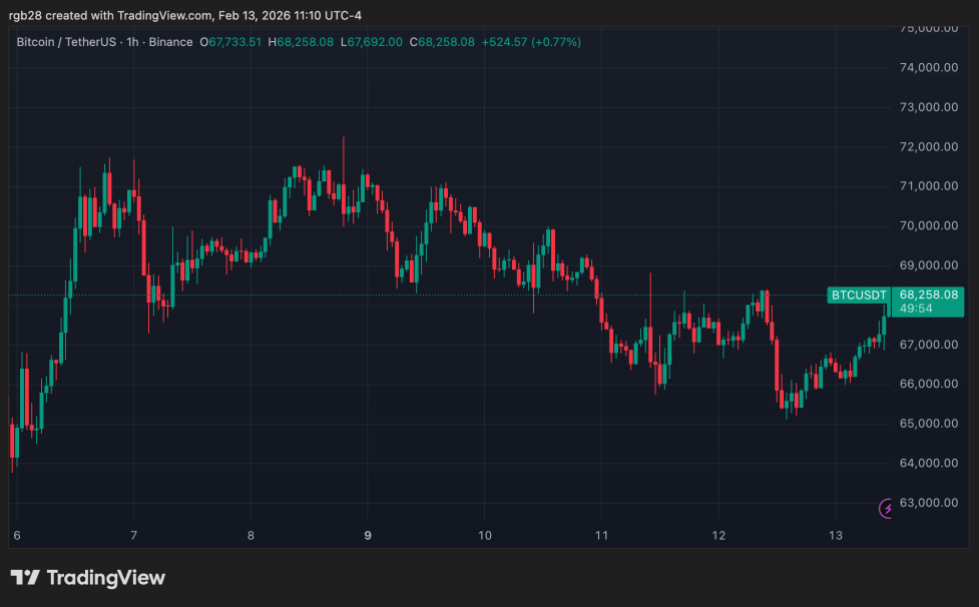
Bitcoin (BTC) trades at $68,258 in the one-week chart. Source: BTCUSDT on TradingView


İlgili Sorular

QWho is urging Congress to pass the crypto market structure bill and when?

AUS Treasury Secretary Scott Bessent is urging Congress to pass the crypto market structure bill this spring.

QWhat is the name of the specific bill that has been stalled in the Senate?

AThe specific bill is called the CLARITY Act.

QAccording to the Treasury Secretary, why is it important to pass the bill quickly?

AHe believes passing the bill would 'give great comfort' to the market during a time of significant volatility and provide regulatory clarity for the industry.

QWhat potential political event could cause the chances of a deal to 'fall apart'?

AThe chances of a deal could fall apart if Democrats take control of the House of Representatives in November.

QWhich two committees' bills need to be reconciled before a final Senate vote?

AThe bills from the Senate Banking Committee and the Senate Agriculture Committee need to be reconciled.

İlgili Okumalar

The "Impossible Triad" Is Fundamentally a Pseudo-Problem

The article argues that blockchain's fundamental limitation is not the scalability trilemma (decentralization, scalability, security), which has been largely solved, but the lack of **privacy** and, until recently, clear **legitimacy**. Blockchain is described as a slow, expensive, globally shared computer whose core value is censorship resistance and verifiability. While ideal for native digital assets like money (e.g., stablecoins), its default transparency acts as a **tax**, exposing all transactions and enabling MEV extraction, which deters serious institutional capital. Simultaneously, its permissionless nature created regulatory ambiguity. The piece contends that **privacy** is the missing critical feature. It rejects the false choice between total transparency and complete anonymity. Modern cryptography (like zero-knowledge proofs) enables **compliant privacy**: users can prove facts (solvency, KYC status, compliance) without revealing the underlying sensitive data (specific holdings, identities). This preserves auditability for regulators and eliminates the leak of financial information. With recent regulatory progress (e.g., the GENIUS Act) addressing legitimacy, adding default, provably compliant privacy becomes a pure upgrade. It transforms blockchain from a costly, public ledger into a confidential settlement layer, finally bridging the gap to mainstream institutional and individual adoption of on-chain finance.

链捕手12 saat önce

The "Impossible Triad" Is Fundamentally a Pseudo-Problem

链捕手12 saat önce

Optical Chips: Collective Capacity Expansion

The global optical chip industry is experiencing a massive wave of expansion driven by surging AI data center demand. Major players across the US, Japan, Europe, and China are aggressively investing to ramp up production capacity. In the US, Coherent is expanding its 6-inch Indium Phosphide (InP) semiconductor fab in Texas, supported by CHIPS Act funding and a $2 billion strategic investment from NVIDIA. Lumentum is building a new factory for InP optical devices, and Nokia is scaling its advanced photonic chip packaging and testing capabilities. NVIDIA's investments aim to secure future supply of critical lasers and optical interconnect products for AI infrastructure. Japan's JX Advanced Metals, a leading InP substrate supplier, plans a multi-billion yen investment to increase its capacity 7-10 times, strengthening its grip on the crucial upstream materials market. In Europe, IQE and Tower Semiconductor settled a patent dispute and signed a multi-year InP epitaxial wafer supply agreement, highlighting that next-generation silicon photonics platforms will integrate high-performance InP components. STMicroelectronics and Sivers Semiconductors are also expanding silicon photonics production and partnerships. China is rapidly building out its domestic supply chain. Dongshan Precision's subsidiary, Source Photonics, announced a $12 billion project to expand optical chip and module production. Companies like Sanan Optoelectronics and Yunnan Germanium are scaling up InP chip manufacturing and substrate production, moving towards vertical integration from materials to modules. While debate continues around the exact future architecture—whether CPO (Co-Packaged Optics), NPO, or pluggables will dominate—analysts like Morgan Stanley argue the underlying driver is unchangeable: the explosive growth in bandwidth demand. This will inevitably increase the volume of optical engines, lasers, and related content per GPU, regardless of the final technical path. The competition for "more light" in the AI era has intensified into a global, full-chain capacity race.

marsbit14 saat önce

Optical Chips: Collective Capacity Expansion

marsbit14 saat önce

İşlemler

Spot
Futures
活动图片