US Treasury Sec To Wall Street: If You Hate Crypto Rules, El Salvador Is Waiting

bitcoinist2026-02-07 tarihinde yayınlandı2026-02-07 tarihinde güncellendi

Özet

U.S. Treasury Secretary Scott Bessent warned crypto firms resistant to clear regulations to “move to El Salvador” during a Senate Banking Committee hearing. His comments highlighted a deepening divide between regulators and parts of the crypto industry, particularly as lawmakers debated the Digital Asset Market Clarity Act. Bessent criticized what he called a “nihilist” segment of crypto that opposes regulatory compromise. The hearing grew heated, with senators raising concerns about stablecoins threatening bank deposits, while crypto advocates warned that strict rules could hinder innovation. Bessent’s remark underscores a choice: operate under U.S. regulations or seek looser oversight elsewhere. Although El Salvador adopted Bitcoin as legal tender, it has since made its use voluntary and maintains a regulated approach, contradicting the idea of a “no rules” environment. Market participants are closely watching the debate, as regulatory clarity could reduce volatility and shape the future of crypto services in the U.S.

Treasury Secretary Scott Bessent put a spotlight on the growing rift between regulators and parts of the crypto industry this week, telling lawmakers that those who resist clear rules “should move to El Salvador.”

The line landed hard during a Senate Banking Committee hearing and was repeated across multiple news outlets as a sign the administration is pushing for firm oversight rather than tolerance for gray areas in markets.

Bessent’s Warning To Industry

Based on reports, Bessent called out what he described as a “nihilist” wing of crypto that would rather scuttle compromise than accept a legal framework.

His remarks came as senators debated the Digital Asset Market Clarity Act, a bill meant to spell out how digital assets fit into existing banking and securities rules.

The episode followed recent moves by major players — including a high-profile platform stepping back from support for the bill — which lawmakers say complicates chances for a quick fix.
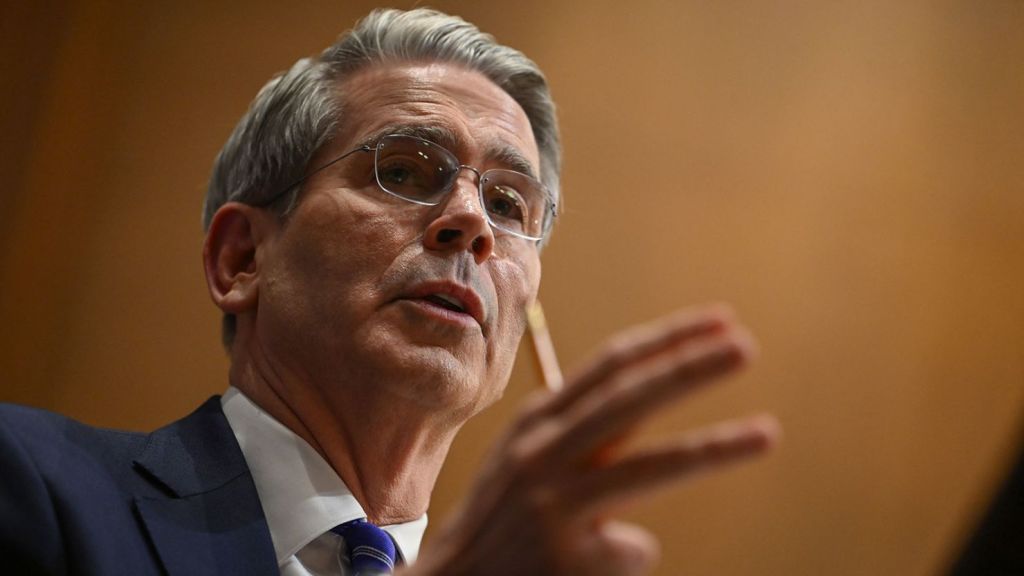
US Treasury Secretary Scott Bessent. Image: Andrew Caballero-Reynolds/AFP/Getty Images

Lawmakers And Lobbyists Take Sides

The hearing did not stay polite for long. Voices rose. Accusations flew. Some senators warned that unchecked stablecoin products could pull deposits out of banks, while crypto advocates argued that heavy-handed rules would stifle innovation.

Bessent suggested that if firms prefer places with looser oversight they can seek them out, naming El Salvador as an example. That rhetorical nudge is more than a talking point — it’s a signal about market access: do business under US guardrails, or accept limits on participation.

BTCUSD currently trading at $65,930. Chart: TradingView

What El Salvador Actually Offers

Reports note that El Salvador’s crypto stance has shifted since it became the first country to make bitcoin legal tender. Lawmakers there approved changes to make Bitcoin acceptance voluntary as part of an IMF-backed deal last year.

The move reduced the mandatory use of Bitcoin while the government said it would still hold and, on occasion, add to its reserves. Those choices mean El Salvador is not a simple “no rules” refuge, even if it appears friendlier to some crypto actors than the US.

Markets And Messaging

Traders watch words like these. Markets respond to certainty, and clarity tends to calm them. When policymakers argue publicly, volatility can spike.

At the same time, a clear path for regulation would let banks plan products and let crypto firms design services that can be sold widely, not just in select jurisdictions.

Some industry executives are lobbying for carve-outs; others want full regulatory recognition. The tension is real and it will shape who stays and who sails elsewhere.

Featured image from Unsplash, chart from TradingView

İlgili Sorular

QWhat did US Treasury Secretary Scott Bessent suggest to crypto firms that resist clear regulations?

AHe suggested that those who resist clear rules should move to El Salvador.

QDuring which congressional hearing did Secretary Bessent make his remarks about crypto regulations?

AHe made the remarks during a Senate Banking Committee hearing.

QWhat is the name of the bill that aims to clarify how digital assets fit into existing financial rules?

AThe bill is called the Digital Asset Market Clarity Act.

QHow has El Salvador's stance on Bitcoin changed since initially making it as legal tender?

AEl Salvador approved changes to make Bitcoin acceptance voluntary as part of an IMF-backed deal, reducing its mandatory use.

QAccording to the article, what is a potential market effect of public arguments among policymakers on crypto regulation?

APublic arguments among policymakers can cause market volatility to spike.

İlgili Okumalar

From South Korea to the United States: Blue-Collar Jobs Are Becoming Increasingly Popular, Thanks to AI

AI is reshaping the labor market's value proposition. The traditional four-year college degree is losing its appeal as a guaranteed career path, while skilled blue-collar trades like electricians, welders, and plumbers are experiencing historic demand and wage premiums. This shift is driven by dual pressures: AI's displacement of certain white-collar roles and a booming need for physical infrastructure and data center construction. Data confirms the trend. In the U.S., vocational school revenue surged, and a significant portion of recent layoffs are AI-related. Surveys show a majority of Gen Z adults plan to pursue blue-collar work, citing better job security against AI automation. Vocational education interest has exploded recently. Experts cite a psychological shift as younger generations seek tangible, AI-resistant careers and avoid high student debt. In many cases, salaries for skilled trades now match or exceed those requiring a bachelor's degree. In South Korea, semiconductor vocational high schools boast near-total employment, with graduates securing high-paying roles at companies like Samsung. The shortage is structural, exacerbated by a retiring baby boomer workforce and massive infrastructure projects. Companies like JPMorgan Chase, Meta, and Lowe's are investing heavily in training programs. However, overcoming historical stigma and a "perception gap" around trade careers remains a key challenge to closing the talent gap.

marsbit37 dk önce

From South Korea to the United States: Blue-Collar Jobs Are Becoming Increasingly Popular, Thanks to AI

marsbit37 dk önce

Qualcomm: AI Hype Subsides, When Will Smartphones Emerge from the Gloom?

Qualcomm reported its Q3 FY2026 results (ending June 2026), with revenue of $9.95B, down 4% YoY but above expectations. Gross margin declined to 53.1%, pressured by rising costs across manufacturing and memory. Key business segments showed mixed performance: Handset revenue fell 19.6% YoY to $5.09B, dragged by an 11% decline in non-Apple Android shipments and weaker high-end mix. Conversely, Automotive revenue surged 61% to $1.59B, and IoT grew 9% to $1.83B. Core operating profit dropped 41% YoY due to margin compression and higher expenses. Management's Q4 FY2026 guidance projects revenue of $9.7B-$10.5B, in line with consensus, but Non-GAAP EPS guidance of $2.05-$2.25 fell short of expectations. Amidst persistent weakness in its core handset market, Qualcomm is pursuing growth in AI, focusing on Edge AI (smartphones, PCs, automotive) and Data Center AI. Its data center strategy includes four pillars: AI accelerators (e.g., AI200), commercial CPUs (Dragonfly C1000), custom silicon, and connectivity solutions. While these initiatives initially boosted its stock, concerns over AI capital expenditure sustainability have since erased those gains. The company targets $5B in data center revenue for FY2027 and $15B for FY2029. The report concludes that with the traditional handset business still under pressure, the data center opportunity is currently viewed as a longer-term option, and a more conservative valuation based on core operations may be warranted until AI contributions materialize.

marsbit42 dk önce

Qualcomm: AI Hype Subsides, When Will Smartphones Emerge from the Gloom?

marsbit42 dk önce

From TPU to Self-Evolving Agents: How Jeff Dean Predicts the Next Step in AI

At the 2026 YC Startup School, Jeff Dean outlined his vision for AI's next phase, shifting focus from simply scaling models to building intelligent, autonomous systems. He believes AI's progress is no longer just about creating smarter models, but about integrating them into systems capable of long-term, iterative work, automated experimentation, and continuous learning. This evolution moves the competition from "who has the bigger model" to "who can best organize intelligence." Dean suggests AI capabilities are now comparable to a junior engineer, enabling the automation of complex workflows. However, the true challenge and opportunity lie in managing these AI "workers" at scale. He emphasizes the importance of **context engineering**—structuring tools, memory, and feedback loops—over raw model power. For startups, this means building deep expertise in niche domains where general models currently fail (near 0-1% success rates), leveraging proprietary data, specialized tools, and domain-specific evaluators. A recurring theme is re-examining fundamental constraints. Dean's past work, like moving Google's search index to memory or creating the TPU, stemmed from questioning outdated assumptions about hardware and cost. He sees similar inflection points today, particularly in **specialized inference hardware** to drastically reduce latency and energy consumption for real-time Agent operation. Notably, he points out that in modern AI systems, the dominant cost is often not computation but **data movement**. Reliable, long-running Agents require robust system design, borrowing concepts from distributed computing like checkpointing, state management, and parallel exploration to handle failures and maintain progress over days or weeks. As AI automates execution, the scarcest human skills will shift to **defining clear specifications**, **judging what problems are worth solving** (taste), and designing effective feedback loops. Ultimately, Dean's framework prioritizes understanding the problem deeply, identifying the true bottlenecks, and systematically building closed-loop systems where AI can not only perform tasks but also improve AI itself.

marsbit42 dk önce

From TPU to Self-Evolving Agents: How Jeff Dean Predicts the Next Step in AI

marsbit42 dk önce

İşlemler

Spot
活动图片





