US SEC Issues Key Crypto Custody Guidelines For Broker-Dealers

bitcoinist2025-12-19 tarihinde yayınlandı2025-12-19 tarihinde güncellendi

In its latest effort to provide clearer regulatory clarity, the US Securities and Exchange Commission (SEC) has published detailed guidelines for broker-dealers on the custody of crypto assets.

SEC Clarifies Crypto Custody Standards For Broker-Dealers

On Wednesday, the SEC’s staff of the Division of Trading and Markets issued a statement addressed its views on the application of paragraph (b)(1) of Rule 15c3-3 to crypto assets that are considered securities, including tokenized versions of an equity or debt security.

Under Securities Exchange Act of 1934, Rule 15c3-3 requires any broker-dealer to “promptly obtain and thereafter maintain physical possession or control of all fully paid and excess margin securities it carries for the account of customers.”

The new guidelines clarify how “any broker-dealer that carries crypto asset securities for customers, including broker-dealers that conduct a traditional securities business” can maintain compliance with this rule despite tokens being on the blockchain.

According to the SEC’s statement, a broker-dealer can consider itself to have “physical possession” of the crypto assets if it has direct access to the asset and the capability to transfer it on the associated distributed ledger technology (DLT).

Broker-dealers must also conduct and document an throughout assessment “of the distributed ledger technology and the associated network where transfers of ownership of a crypto asset security are recorded prior to undertaking to maintain possession of the crypto asset security, and at reasonable intervals thereafter.”

In additions, they must establish, maintain, and enforce “reasonably designed written policies and procedures” to ensure the assets’ security, the protection of private keys, they have adequate plans to address unexpected disruptions to its possession of the crypto assets, including theft, unauthorized used, network attacks, and hard forks.

This circumstance emphasizes that a broker-dealer has policies, procedures, and controls reasonably designed to help ensure that no other person, including the broker-dealer’s customer or a third-party (including the broker-dealer’s affiliate), has access to the relevant private keys and the ability to transfer the asset without the authorization of the broker-dealer.

Meanwhile, the agency explained that “a broker-dealer does not deem itself to possess a crypto asset security if the broker-dealer is aware of any material security or operational problems or weaknesses with the distributed ledger technology and associated network used to access and transfer the crypto asset security or is aware of other material risks posed to the broker-dealer’s business by custodying the crypto asset security.”

SEC’s Path To Clearer Rules

The SEC affirmed that the statement is part of its efforts to provide greater clarity on the application of federal securities laws to crypto assets. Notably, the regulatory agency recently published guidelines to help educate retail investors about the ways they can hold crypto assets and is pushing to modernize its rules to facilitate an positive market environment.

Earlier this month, the US regulator revealed it is evaluating tokenization to modernize the issuance, trading, and settlement of public equities. SEC chairman Paul Atkins asserted that “Distributed ledger technology and the tokenization of financial assets, including securities, have the potential to transform our capital markets.”

Moreover, Atkins recently stated that the Commission could issue innovation exemption rules for crypto firms in early 2026. The agency has been considering the rule exemption since July to “permit novel ways of trading and more narrowly tailored forms of relief to facilitate the building of other components of a tokenized securities ecosystem.”

The change would allow crypto firms to quickly launch products without having to comply with “burdensome prescriptive regulatory requirements that hinder productive economic activity.” Instead, they would “be able to comply with certain principles-based conditions designed to achieve the core policy aims of the federal securities laws.”
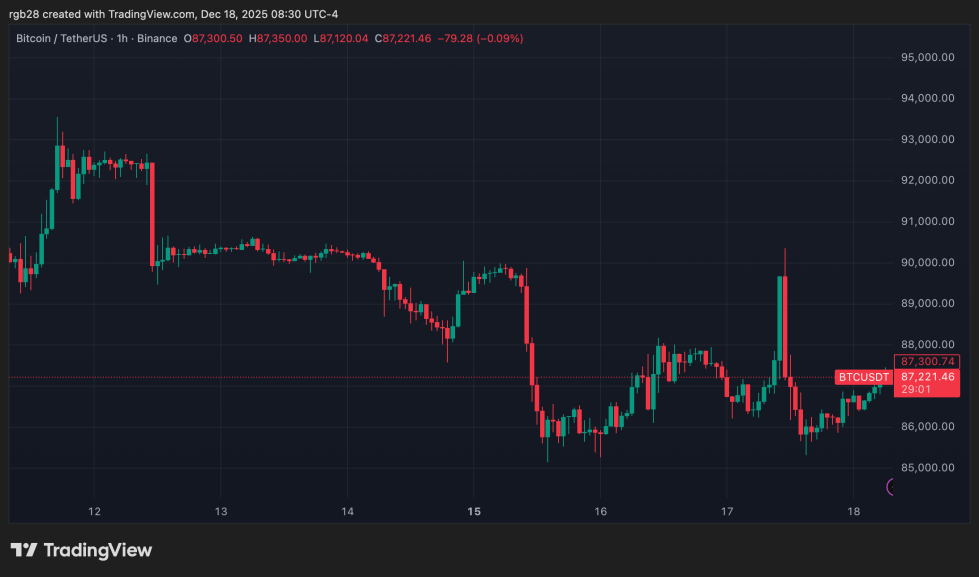
Bitcoin (BTC) trades at $87,221 in the one-week chart. Source: BTCUSDT on TradingView


Trend Kriptolar

İlgili Sorular

QWhat is the main focus of the new SEC guidelines for broker-dealers regarding crypto assets?

AThe guidelines clarify how broker-dealers can maintain compliance with Rule 15c3-3 when custodying crypto assets that are considered securities, including requirements for physical possession, security assessments, and written policies.

QAccording to the SEC, when can a broker-dealer consider itself to have 'physical possession' of a crypto asset security?

AA broker-dealer can consider itself to have physical possession if it has direct access to the asset and the capability to transfer it on the associated distributed ledger technology (DLT).

QWhat must broker-dealers assess and document prior to maintaining possession of crypto asset securities?

AThey must conduct and document a thorough assessment of the distributed ledger technology and the associated network where ownership transfers are recorded, both before custody and at reasonable intervals thereafter.

QWhat potential future regulatory change for crypto firms did SEC chairman Paul Atkins mention?

AHe stated that the Commission could issue innovation exemption rules in early 2026, allowing crypto firms to launch products without burdensome prescriptive requirements while complying with principles-based conditions.

QWhat broader initiative is the SEC undertaking regarding tokenization and distributed ledger technology?

AThe SEC is evaluating tokenization to modernize the issuance, trading, and settlement of public equities, recognizing its potential to transform capital markets.

İlgili Okumalar

In Jinjiang, Fujian, a Storage Super Unicorn Lies Quiet

In Fujian's Jinjiang, a city known for sportswear, lies a quiet semiconductor giant: Fujian Jinhua Integrated Circuit Co. (JHICC). Once a promising domestic DRAM manufacturer alongside Yangtze Memory and ChangXin Memory Technologies (CXMT), its journey was derailed in 2018 when the U.S. placed it on an Entity List and filed criminal charges for alleged trade secret theft. This halted production for years. A turning point came in February 2024 when a U.S. federal court found JHICC not guilty. However, it had lost crucial time. While CXMT soared to become a top-valued A-share company in 2024, JHICC, with an estimated valuation of 80 billion RMB, was just restarting. Its current output is primarily customized DDR4 chips, not the advanced DDR5/HBM demanded for AI, but it still benefits from the broader memory chip upcycle. JHICC's story is tied to Chen Zhengkun, a veteran engineer who left Micron to lead the venture. Founded in 2016 with state-backed funding, JHICC partnered with Taiwan's UMC to develop DRAM technology. Rapid progress was cut short by the U.S. actions, which Micron initiated, partly due to its heavy reliance on the Chinese market. Post-sanctions, Chen's team worked to rebuild the production line with reduced reliance on U.S. technology. According to its records, JHICC achieved small-scale production and revenue growth under immense pressure. It now focuses on the stable "niche" DRAM market (e.g., TVs, routers) with a monthly capacity of ~40,000 wafers, aiming for 60,000 by 2026. It holds over 1,000 patents but remains on the Entity List. For Jinjiang, investing in JHICC was a bold industrial leap. The local government provided unwavering financial and logistical support during the crisis, helping the company survive. JHICC has become the anchor for a growing local semiconductor cluster. Though its scale lags behind domestic peers, JHICC's persistence symbolizes a hard-won foothold in a global market long dominated by Samsung, SK Hynix, and Micron. Having missed one boom, it seeks a place in the new AI-driven memory supercycle.

marsbit19 dk önce

In Jinjiang, Fujian, a Storage Super Unicorn Lies Quiet

marsbit19 dk önce

Must-Watch Events Next Week|CLARITY Act Could Face Senate Vote; SpaceX, Circle to Report Earnings (8.3-8.9)

**Summary: Key Events and Developments to Watch (August 3-9)** The upcoming week is marked by significant financial disclosures, key legislative deadlines, and notable product updates. **Major Financial Events:** Several companies are scheduled to release their Q2 2026 earnings. American Bitcoin (ABTC) will report on August 3, followed by SpaceX and Hut 8 Mining Corp. on August 4, and Circle on August 5. Notably, a significant portion of SpaceX shares (up to 12% of total shares) will be unlocked on August 6 following their earnings release. **Key Legislative Deadline:** The U.S. Senate faces an August 7 deadline to secure 60 votes for the CLARITY Act, a bipartisan bill aiming to establish a federal regulatory framework for cryptocurrencies. The Senate may hold a full vote on the bill during the week. **Economic Data:** The U.S. July Non-Farm Payrolls report will be released on August 7, providing crucial labor market data. **Technology & Product Updates:** * **Shutdowns:** DeFi portfolio tracker Zapper and wallet app Ctrl Wallet will cease operations on August 3. * **Upgrades:** LayerZero will deprecate its v1 relayers on August 3. XRP Ledger's new version 3.3.0, featuring five new functions, is expected next week. * **AI:** Elon Musk announced that the advanced Grok 4.6 AI model is set for release around August 7. * **Bitcoin:** The BIP-110 forced signaling for a potential Bitcoin network change is scheduled to begin around August 8. **Other Notable Events:** Chinese robotics firm Unitree Tech has set its preliminary price inquiry for its IPO for August 5. South Korean exchange Upbit will delist AQT and AERGO tokens on August 3.

marsbit2 saat önce

Must-Watch Events Next Week|CLARITY Act Could Face Senate Vote; SpaceX, Circle to Report Earnings (8.3-8.9)

marsbit2 saat önce

İşlemler

Spot

Popüler Makaleler

US Nasıl Satın Alınır

HTX.com’a hoş geldiniz! Talus Network (US) satın alma işlemlerini basit ve kullanışlı bir hâle getirdik. Adım adım açıkladığımız rehberimizi takip ederek kripto yolculuğunuza başlayın. 1. Adım: HTX Hesabınızı OluşturunHTX'te ücretsiz bir hesap açmak için e-posta adresinizi veya telefon numaranızı kullanın. Sorunsuzca kaydolun ve tüm özelliklerin kilidini açın. Hesabımı Aç2. Adım: Kripto Satın Al Bölümüne Gidin ve Ödeme Yönteminizi SeçinKredi/Banka Kartı: Visa veya Mastercard'ınızı kullanarak anında Talus Network (US) satın alın.Bakiye: Sorunsuz bir şekilde işlem yapmak için HTX hesap bakiyenizdeki fonları kullanın.Üçüncü Taraflar: Kullanımı kolaylaştırmak için Google Pay ve Apple Pay gibi popüler ödeme yöntemlerini ekledik.P2P: HTX'teki diğer kullanıcılarla doğrudan işlem yapın.Borsa Dışı (OTC): Yatırımcılar için kişiye özel hizmetler ve rekabetçi döviz kurları sunuyoruz.3. Adım: Talus Network (US) Varlıklarınızı SaklayınTalus Network (US) satın aldıktan sonra HTX hesabınızda saklayın. Alternatif olarak, blok zinciri transferi yoluyla başka bir yere gönderebilir veya diğer kripto para birimlerini takas etmek için kullanabilirsiniz.4. Adım: Talus Network (US) Varlıklarınızla İşlem YapınHTX'in spot piyasasında Talus Network (US) ile kolayca işlemler yapın.Hesabınıza erişin, işlem çiftinizi seçin, işlemlerinizi gerçekleştirin ve gerçek zamanlı olarak izleyin. Hem yeni başlayanlar hem de deneyimli yatırımcılar için kullanıcı dostu bir deneyim sunuyoruz.

338 Toplam GörüntülenmeYayınlanma 2025.12.11Güncellenme 2026.06.02

US Nasıl Satın Alınır

Tartışmalar

HTX Topluluğuna hoş geldiniz. Burada, en son platform gelişmeleri hakkında bilgi sahibi olabilir ve profesyonel piyasa görüşlerine erişebilirsiniz. Kullanıcıların US (US) fiyatı hakkındaki görüşleri aşağıda sunulmaktadır.

活动图片












