US-Iran War: Why Did Turkey Sell Off 58.4 Tons of Gold in Two Weeks?

marsbit2026-03-30 tarihinde yayınlandı2026-03-30 tarihinde güncellendi

Özet

Turkish Central Bank sold approximately 58.4 tons of gold, worth over $8 billion, within two weeks in March 2026, as a response to a severe financial crisis triggered by the U.S.-Israel military operation against Iran. The conflict led to Iran blocking the Strait of Hormuz, causing oil prices to surge over 40% and cutting off natural gas supplies to Turkey, which relies heavily on energy imports. This resulted in a plunging Turkish lira, massive foreign capital flight, and rapid depletion of foreign reserves. To defend the currency and meet urgent dollar demands, Turkey utilized gold swaps—temporarily exchanging gold for dollars with agreements to repurchase later—rather than outright sales, to avoid market panic and preserve long-term reserves. The move highlights Turkey's vulnerability to energy shocks and its strategic use of gold reserves for liquidity during crises. If the conflict persists, further gold sales may be necessary, adding downward pressure on global gold prices.

Author: Le Ming

A recent figure that has stunned global financial markets has emerged: the Turkish central bank sold off approximately 58.4 tons of gold in just two weeks, worth over $8 billion. Of this, 6 tons were reduced in the week of March 13, and 52.4 tons were sharply cut in the week of March 20.

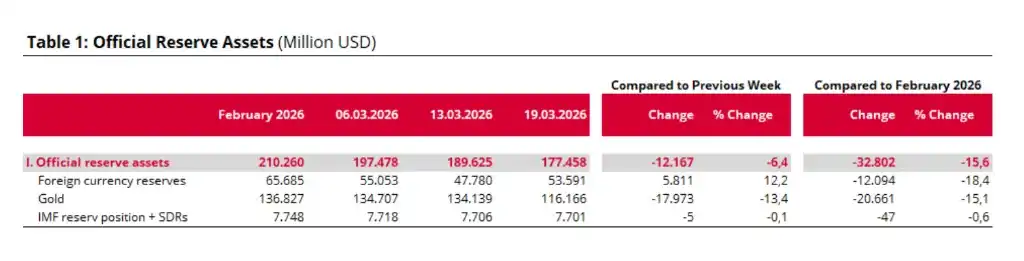
The weekly data from the Turkish central bank clearly outlines this picture: from March 13 to 19, the market value of gold reserves plummeted from $134.1 billion to $116.2 billion, evaporating nearly $18 billion in a single week; meanwhile, foreign exchange reserves (excluding gold) actually increased by $5.8 billion.

Between the decline and the rise, the traces of a "gold for foreign exchange" operation are unmistakable.

Over the past decade, Turkey has been one of the world's most aggressive gold buyers, with gold reserves rising from 116 tons in 2011 to over 820 tons.

Why suddenly sell off such hard-earned assets on a large scale within two weeks?

The answer is three words: to survive.

Trigger: A War That Pushed Turkey into a "Perfect Storm"

On February 28, the United States and Israel jointly launched a military operation codenamed "Epic Fury," launching airstrikes on Iranian nuclear facilities, military bases, and government buildings.

Iran retaliated and effectively blockaded the Strait of Hormuz—a passage for 20% of the world's seaborne oil and 20% of LNG trade.

Brent crude surged from $73 per barrel before the war to over $106, a rise of more than 40%. The International Energy Agency defined it as the "most severe global energy security challenge in history."

For most countries, this was a shock; but for Turkey, it was a survival crisis.

Turkey relies on imports for 90% of its oil and 98% of its natural gas. Every $10 increase in oil prices adds $4.5 to $7 billion to the current account deficit. Based on post-war oil prices, the annual energy import cost could surge by about $15 billion.

An even more fatal blow came on March 24—when Israel airstriked Iran's South Pars gas field, Iran subsequently halted natural gas exports to Turkey. Iran is Turkey's second-largest pipeline natural gas supplier, accounting for about 13% to 14% of its natural gas imports. The 25-year contract for this pipeline is set to expire in July 2026, and the war directly dashed prospects for renewal.

Simply put, Turkey's situation is: its energy bill suddenly doubled, a key gas source was cut off, and no equivalent replacement could be found in the short term.

Transmission Chain: Foreign Exchange Reserves Buckled First

Energy imports require settlement in US dollars, so importers scrambled for dollars, and the lira plummeted.

In the 16 trading days since the conflict began, the lira hit a record low against the dollar 11 times, reaching about 44.35 lira per dollar on March 25.

Behind this was the accelerated withdrawal of foreign investors: in three weeks, foreign capital outflows from Turkish bonds reached $4.7 billion, with $1.2 billion flowing out of the stock market, while carry trade positions shrank from a record $61.2 billion in January to below $45 billion.

The Turkish central bank was thus forced to launch a "lira defense battle." In just the first week of March, it sold over $8 billion in foreign exchange. In the three weeks ending March 19, the central bank cumulatively consumed about $25 to $30 billion in foreign exchange reserves. Net reserves, after deducting swaps, plummeted from $54.3 billion before the war to $43 billion.

Turkey's weekly data fully records this process: foreign exchange reserves (excluding gold) fell from $55 billion on March 6 to $47.8 billion on March 13—first using foreign exchange ammunition. By March 19, foreign exchange reserves rebounded to $53.6 billion, but gold reserves simultaneously plummeted from $134.1 billion to $116.2 billion—foreign exchange ammunition was nearly exhausted, and gold began to be used.

This is a textbook example of an emergency defense sequence: "first use foreign exchange, then use gold."

Figure: Foreign exchange data released by the Turkish central bank
Gold Swaps: Why "Sell" Instead of "Pawn"?

The key to understanding this operation is: more than half of Turkey's gold reduction was done through swaps, not direct sales.

The essence of a gold swap is "exchanging gold for foreign exchange, with redemption upon maturity." The central bank transfers gold to the counterparty (usually a primary investment bank) in exchange for an equivalent amount of US dollars, while signing a forward contract to repurchase the gold at a slightly higher price in the future. It is a short-term financing behavior, not a permanent liquidation.

The central bank chose swaps over outright sales for at least three reasons.

First, to retain long-term positions. If the oil price surge is judged to be a temporary shock, swaps can address the urgent need, and the gold can be redeemed later, avoiding the destruction of a decade of accumulation.

Second, to reduce the impact on gold prices. Directly dumping 60 tons of gold could trigger a cliff-like plunge in the market, in turn causing a significant devaluation of its remaining over $100 billion in gold reserves. Swaps are conducted quietly in the over-the-counter market, with much less impact.

Third, a buffer at the domestic political level. Gold is an "anti-inflation totem" in the hearts of the Turkish people. Announcing large-scale gold sales could easily trigger panic, while swaps can maintain a certain degree of ambiguity technically.

This operation was completed quickly within two weeks thanks to a key pre-arrangement: Turkey stored about 111 tons of gold, worth about $30 billion, at the Bank of England. This gold could be used for foreign exchange intervention without logistical constraints—no need for cross-border physical transport, directly pledged and liquidated in the City of London.

Pressure on Gold Prices

Turkey has a historical pattern: selling gold during crises and buying back after crises.

The 2018 lira crisis, the 2020 pandemic shock, the 2023 earthquake—each time the central bank reduced gold to provide liquidity but resumed accumulation afterward. Analysts generally believe that the operation in March 2026 continues this pattern.

But this judgment has a core premise: the war cannot be prolonged.

Swap agreements come with holding costs and interest. If the war continues, energy prices remain anchored at over $100 for the long term, and Turkey's foreign exchange earning capacity cannot cover the soaring energy bill, then these "temporary swaps" will never be redeemed, effectively becoming "permanent fire sales."

Therefore, in the coming weeks, if the war continues, Turkey will need to continue turning its $135 billion in gold reserves into a lifeline.

Although Turkey prefers to "pledge" gold to obtain foreign exchange liquidity, these transactions still substantially increase the downward pressure on the gold market. In the London over-the-counter market, when the Turkish central bank transfers tens of tons of gold as collateral to international counterparties (such as investment banks) in exchange for US dollars, these financial institutions, to hedge their own position risks, typically conduct corresponding short-selling or selling operations in the spot or futures derivative markets.

Therefore, the liquidity of this batch of gold will eventually be transmitted to the market, indirectly increasing supply and depressing prices.

Conclusion

The Turkish central bank's sale of 60 tons of gold in two weeks is not panic, not speculation, but a rational self-rescue by a country highly dependent on energy imports after its ally bombed its largest energy supplier, facing the triple blow of depleted foreign exchange, a plummeting lira, and a cut-off of natural gas supply.

Figure: The market is frantically shorting the lira, partly betting that the war will not end soon and partly betting that Turkey will ultimately not hold out.
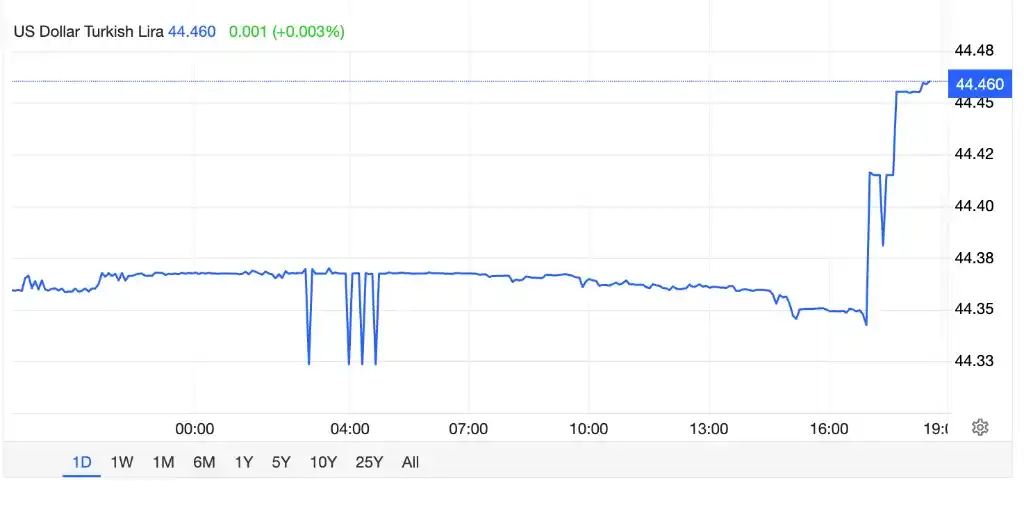
As the war prospects worsen, Turkey still needs to continue to withstand the pressure.


İlgili Sorular

QWhy did Turkey's central bank sell 58.4 tons of gold in just two weeks?

ATo survive a severe financial crisis triggered by the US-Israel war with Iran, which caused a surge in energy import costs, a collapse of the Turkish lira, and a critical depletion of foreign exchange reserves.

QWhat was the immediate trigger for Turkey's financial crisis in March 2026?

AThe US-Israel military operation 'Epic Rage' against Iran, which led to Iran blocking the Strait of Hormuz and cutting off natural gas exports to Turkey, causing oil prices to soar over 40%.

QHow did the Turkish central bank's gold sales operation work, and why was it done through swaps?

AOver half of the gold was减持 via swaps, not direct sales. This 'pawned' the gold to international banks for immediate USD liquidity, with an agreement to buy it back later. This was done to preserve long-term reserves, minimize market impact, and avoid domestic political panic.

QWhat impact did the energy crisis have on Turkey's currency and foreign reserves?

AThe lira hit record lows against the dollar 11 times in 16 trading sessions. The central bank burned through $250-300 billion in foreign reserves in three weeks defending it, forcing it to then use its gold reserves as a last resort.

QHow could the ongoing war turn Turkey's temporary gold swaps into a permanent loss?

AIf the war continues and energy prices remain high, Turkey may be unable to generate enough foreign exchange to redeem the gold from the swap agreements, effectively forcing a permanent sale.

İlgili Okumalar

RWA First Stock's Major Acquisition: Why Buy a 'Traditional' Mortgage Company?

On June 10th, Figure Technology Solutions (Nasdaq: FIGR), a blockchain-native capital markets firm, announced a $717 million acquisition of Kiavi, a leading non-bank lender for residential real estate investors. The deal involves Figure acquiring Kiavi's technology and operations for approximately $538 million, while forming a joint venture with alternative asset manager Sixth Street to purchase Kiavi's existing loan portfolio. Sixth Street also provided a $3 billion forward purchase commitment. This acquisition marks a strategic shift for Figure, known as the "RWA (Real World Asset) first stock," allowing it to expand significantly into the larger market of first-lien mortgages. Kiavi specializes in non-qualified mortgage (Non-QM) loans, such as short-term fix-and-flip (RTL) and rental property (DSCR) loans—a segment traditionally underserved by major banks. The move is expected to increase Figure's first-lien loan origination to over $7 billion annually, aiming for these to constitute about 40% of its business by 2027. Both companies leverage AI for underwriting: Kiavi uses proprietary models to value renovated properties and automate document processing, dominating the fix-and-flip lending space. Figure plans to integrate these assets onto its blockchain platform, Provenance, using its new 'Adaptor' product to standardize and tokenize the loans for institutional investors on its Democratized Prime marketplace. While the integration poses challenges—including merging different asset types, interest rate sensitivity of Kiavi's loans, and post-IPO execution risks—Figure projects the deal to be accretive to earnings with a cash payback period under four years. The transaction is seen as a major step in scaling blockchain-based capital markets, moving RWA tokenization from concept validation toward large-scale operation.

Foresight News16 dk önce

RWA First Stock's Major Acquisition: Why Buy a 'Traditional' Mortgage Company?

Foresight News16 dk önce

Trend in US Stocks: A Post Triggers a 930-Point Rebound, Tonight Belongs to SpaceX

On Thursday (June 11, U.S. Eastern Time), Wall Street staged a textbook V-shaped reversal. The Dow Jones surged 929.97 points (+1.86%) to close above 50,000, while the Nasdaq and S&P 500 rose 2.54% and 1.75%, respectively. The rally occurred despite the hottest PPI report in years, with May data showing a 6.5% year-on-year surge, the highest since 2022. The market ignored the inflation data, focusing instead on reports that former President Trump called off a planned strike on Iran, hinting at a potential multi-party peace agreement draft. This sparked a sharp drop in oil prices, fueling hopes that inflation may have peaked. Sector rotations were stark: previously battered AI hardware and cyclical stocks led the gains, while defensive sectors that hit record highs the prior day were sold off. Chip stocks like Micron and Intel saw sharp rebounds. In contrast, software giant Oracle plunged nearly 10% despite beating earnings, with concerns over cloud revenue and cash flow. Adobe also fell after hours despite raising guidance, as its CFO announced departure. The rally's sustainability is questioned, driven largely by social media posts about unconfirmed geopolitical developments. Inflation risks remain, with pipeline pressures still high. Meanwhile, the market's risk appetite faces a major test with SpaceX's historic IPO. Priced at $135 per share, it aims to raise ~$75 billion with a $1.75 trillion valuation, becoming the largest U.S. IPO ever. It will join the Nasdaq 100 in 15 days, triggering massive index fund buying. However, critics cite extreme valuation (88x sales) and market liquidity concerns.

marsbit39 dk önce

Trend in US Stocks: A Post Triggers a 930-Point Rebound, Tonight Belongs to SpaceX

marsbit39 dk önce

The Trillion-Dollar Valuation Test: Are the Three Super IPOs a Tech Stock Frenzy or a Crypto Market Nightmare?

Trillion-Dollar Valuation Test: Are the Three Mega IPOs a Tech Stock Frenzy or a Crypto Market Nightmare? The capital market in 2026 is witnessing a highly anticipated wave of tech IPOs, centered on SpaceX, OpenAI, and Anthropic. Collectively valued at over $3.5 trillion, their potential listing represents one of the largest such waves in recent years. This raises concerns about market liquidity, valuation bubbles, and potential capital outflows from other assets like crypto. SpaceX's valuation narrative has shifted from rocket launches to becoming a global infrastructure play via its Starlink satellite network, which now drives most revenue. Despite ongoing losses, investors focus on its long-term growth potential. OpenAI and Anthropic represent the core productivity engines of generative AI. Their public listings would offer the first direct investment opportunity in large foundation model companies, potentially triggering a repricing within the AI sector. Market fears of a massive "capital drain" from these IPOs are likely overstated. Historical precedents like Alibaba and Saudi Aramco show that mega-listings primarily cause capital reallocation, not destruction, within the vast equities market. Systemic risk is rarely triggered by IPOs alone. For stock markets, short-term volatility and sector repricing are expected, especially for AI concept stocks. Long-term, these listings could reinforce the tech sector's importance. For crypto, direct competition for speculative capital exists, particularly affecting AI-themed tokens. However, crypto's trajectory remains more tied to its own cycles, macro liquidity, and Bitcoin ETF flows rather than a single IPO event. The real risk lies not in the listings themselves but in the sky-high growth expectations embedded in these valuations. If future revenue, profitability, or commercialization progress disappoints, significant valuation resets could follow, impacting high-growth tech stocks. Ultimately, the market's direction hinges on macroeconomic conditions and whether these companies can deliver on their ambitious promises.

链捕手56 dk önce

The Trillion-Dollar Valuation Test: Are the Three Super IPOs a Tech Stock Frenzy or a Crypto Market Nightmare?

链捕手56 dk önce

Trillion-Dollar Valuation Test: Are the Three Super IPOs a Tech Stock Frenzy or a Crypto Market Nightmare?

Title: Trillion-Dollar Valuations at Stake: Super IPOs of SpaceX, OpenAI, Anthropic – Tech Boom or Crypto Nightmare? TL;DR: A wave of mega-tech IPOs is approaching, featuring SpaceX (targeting a $1.75 trillion valuation), OpenAI (~$852B), and Anthropic (~$965B), with a combined potential valuation exceeding $3.5 trillion. This tests the market's pricing of innovation and sparks debate on liquidity impact. * **SpaceX**'s valuation is now driven more by its Starlink global communications infrastructure than its core rocket business. * **OpenAI & Anthropic** offer the first major public investment opportunities in foundational AI models, potentially repricing the entire AI sector. * Concerns about a market-wide "liquidity drain" are likely overblown; history shows large IPOs mainly cause fund reallocation, not disappearance, and rarely trigger systemic risk. * Crypto markets, especially some AI-themed tokens, may face short-term fund competition, but their long-term trajectory depends more on macro liquidity, regulation, and Bitcoin cycles. * The real risk lies not in the IPOs themselves, but in whether these companies can justify their sky-high valuations with future revenue growth and profitability. Unmet expectations could lead to significant repricing pressure. Ultimately, these IPOs represent a massive market pricing of next-gen tech infrastructure, not a prelude to a market crash. The broader market direction will be determined by macro conditions, corporate earnings, and risk appetite.

marsbit56 dk önce

Trillion-Dollar Valuation Test: Are the Three Super IPOs a Tech Stock Frenzy or a Crypto Market Nightmare?

marsbit56 dk önce

İşlemler

Spot
Futures

Popüler Makaleler

WAR Nasıl Satın Alınır

HTX.com’a hoş geldiniz! WAR (WAR) satın alma işlemlerini basit ve kullanışlı bir hâle getirdik. Adım adım açıkladığımız rehberimizi takip ederek kripto yolculuğunuza başlayın. 1. Adım: HTX Hesabınızı OluşturunHTX'te ücretsiz bir hesap açmak için e-posta adresinizi veya telefon numaranızı kullanın. Sorunsuzca kaydolun ve tüm özelliklerin kilidini açın. Hesabımı Aç2. Adım: Kripto Satın Al Bölümüne Gidin ve Ödeme Yönteminizi SeçinKredi/Banka Kartı: Visa veya Mastercard'ınızı kullanarak anında WAR (WAR) satın alın.Bakiye: Sorunsuz bir şekilde işlem yapmak için HTX hesap bakiyenizdeki fonları kullanın.Üçüncü Taraflar: Kullanımı kolaylaştırmak için Google Pay ve Apple Pay gibi popüler ödeme yöntemlerini ekledik.P2P: HTX'teki diğer kullanıcılarla doğrudan işlem yapın.Borsa Dışı (OTC): Yatırımcılar için kişiye özel hizmetler ve rekabetçi döviz kurları sunuyoruz.3. Adım: WAR (WAR) Varlıklarınızı SaklayınWAR (WAR) satın aldıktan sonra HTX hesabınızda saklayın. Alternatif olarak, blok zinciri transferi yoluyla başka bir yere gönderebilir veya diğer kripto para birimlerini takas etmek için kullanabilirsiniz.4. Adım: WAR (WAR) Varlıklarınızla İşlem YapınHTX'in spot piyasasında WAR (WAR) ile kolayca işlemler yapın.Hesabınıza erişin, işlem çiftinizi seçin, işlemlerinizi gerçekleştirin ve gerçek zamanlı olarak izleyin. Hem yeni başlayanlar hem de deneyimli yatırımcılar için kullanıcı dostu bir deneyim sunuyoruz.

246 Toplam GörüntülenmeYayınlanma 2024.12.11Güncellenme 2026.06.02

WAR Nasıl Satın Alınır

Tartışmalar

HTX Topluluğuna hoş geldiniz. Burada, en son platform gelişmeleri hakkında bilgi sahibi olabilir ve profesyonel piyasa görüşlerine erişebilirsiniz. Kullanıcıların WAR (WAR) fiyatı hakkındaki görüşleri aşağıda sunulmaktadır.

活动图片












