US financial markets ‘poised to move on-chain,’ amid DTCC tokenization greenlight

cointelegraph2025-12-12 tarihinde yayınlandı2025-12-12 tarihinde güncellendi

Özet

U.S. financial markets are advancing toward on-chain tokenization following the SEC's approval of a DTCC pilot program for tokenizing assets like the Russell 1000 index, ETFs, and U.S. Treasuries. SEC Chair Paul Atkins emphasized that this shift will enhance market predictability, transparency, and efficiency. The SEC issued a no-action letter allowing the DTCC to proceed without enforcement risk and is considering an "innovation exemption" to ease regulatory burdens for builders. This move accelerates the adoption of blockchain for settlements, enabling 24/7 trading and reducing intermediaries. Analysts note rapid progress in financial tokenization, with continued funding and regulatory support fueling infrastructure development.

Traditional financial markets are moving rapidly onchain as the US Securities and Exchange Commission chair doubles down on the idea of an “innovation exemption” to accelerate tokenization.

“U.S. financial markets are poised to move on-chain,” wrote Paul Atkins, the chair of the SEC, in a Friday X post, adding that the agency is “embracing new technologies to enable this onchain future.”

His comments come shortly after the SEC issued a “no action” letter to a subsidiary of the Depository Trust and Clearing Corporation (DTCC), enabling it to offer a new securities market tokenization service.

The DTCC plans to tokenize assets including the Russell 1000 index, exchange-traded funds tracking major indexes, and US Treasury bills and bonds, which Atkins called an “important step towards onchain capital markets.”

“On-chain markets will bring greater predictability, transparency, and efficiency for investors,” he said.

However, the green light for the DTCC’s pilot is only the beginning, as the SEC will consider an innovation exemption to enable builders to start “transitioning our markets onchain,” without being burdened by “cumbersome regulatory requirements,” added Atkins.
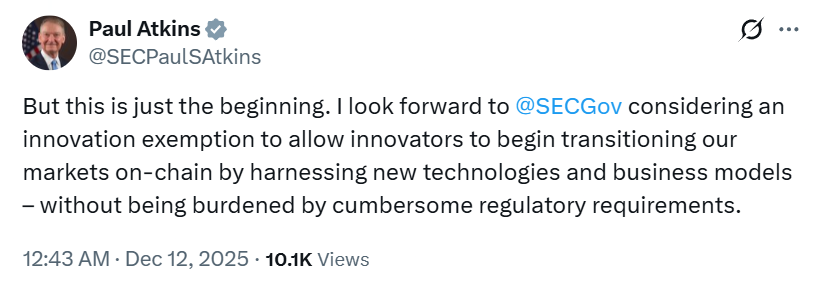
Source: Paul Atkins

Atkins pledged to encourage innovation as the industry moves toward onchain settlement, which would settle transactions on a blockchain ledger, removing intermediaries, enabling 24/7 trading and faster transaction finality.

Related: Crypto nears its ‘Netscape moment’ as industry approaches inflection point

Cointelegraph has contacted the SEC for comment on the details and timeline of an innovation exemption for tokenization.

Atkins first proposed an innovation exemption for tokenization during his remarks at the Crypto Task Force Roundtable on DeFi on June 9.

The SEC’s no-action letter means that the agency won’t take enforcement action if the DTCC’s product operates as described. The DTCC provides clearing, settlements and trading services as one of the most important infrastructure providers for US securities.

Asset tokenization involves minting tangible assets on the blockchain ledger, offering more investor access through fractionalized shares and 24/7 trading opportunities.

Related: Bitcoin treasuries stall in Q4, but largest holders keep stacking sats

DTCC pilot and RWA builders push more TradFi onchain

Crypto analysts have praised the SEC’s move to allow the DTCC’s new market tokenization service, which will award tokenized assets the same entitlements and investor protection mechanisms as traditional assets.

“Not sure people fully appreciate how quickly financial markets are heading towards full tokenization... Moving even faster than I expected,” wrote ETF analyst Nate Geraci, in a Friday X post.

Over the past few months, the SEC issued two no-action letters: one for a Solana-based decentralized physical infrastructure network (DePIN) project, and a second no-action letter in September that allowed investment advisers to use state trust companies as crypto custodians.

Meanwhile, crypto projects continue to raise funds to build the infrastructure necessary for tokenized onchain markets.

On Tuesday, asset tokenization network Real Finance closed a $29 million private funding round to build an infrastructure layer for real-world assets (RWAs) that can boost institutional participation.

Magazine: SEC’s U-turn on crypto leaves key questions unanswered

Trend Kriptolar

İlgili Okumalar

Annual Salary of Millions Competing for Electricians, Meta Rushes to Open Its Own Technical School

The AI boom is facing an unexpected bottleneck: a severe shortage of skilled construction workers and electricians. As tech giants like Meta, OpenAI, and Alphabet race to build massive data centers—such as OpenAI's $16 billion "Stargate" project—they are hitting a critical labor wall. The U.S. needs an estimated 130,000 more electricians, 240,000 construction workers, and 150,000 supervisors by 2030 for AI infrastructure alone, but tens of thousands of electrician jobs go unfilled each year. While AI companies offer high premiums, with electricians earning up to $280,000 annually, worker scarcity still causes massive losses—delays on a single project can cost $14.2 million per month. The complexity of building AI data centers, which require immense power (equivalent to powering hundreds of thousands of homes), sophisticated electrical systems, and advanced liquid cooling solutions, demands highly skilled technicians who are in short supply. To combat this, companies are investing heavily in training. Meta has committed $115 million to a free training school offering tuition, housing, and stipends, targeting 5,000 new workers. OpenAI is partnering with unions to secure skilled labor. These efforts are paying off, with a significant rise in Gen Z interest in trade schools over college. However, the power demands are staggering. AI data centers are driving a rapid surge in electricity consumption, projected to account for up to 12% of U.S. power use by 2028 and raising costs for consumers. Furthermore, the construction boom is project-based, leading to a potential future glut of trained workers once building peaks, which could depress wages industry-wide. The race for AI supremacy now depends as much on skilled hands as on advanced chips.

marsbit4 dk önce

Annual Salary of Millions Competing for Electricians, Meta Rushes to Open Its Own Technical School

marsbit4 dk önce

OpenAI No Longer Sells Its Most Expensive Model for Profit

OpenAI is shifting its business strategy away from promoting its most expensive, flagship models for every task. Recent price cuts—80% for GPT-5.6 Luna and 20% for Terra—signal a deeper change: the company now actively advises users that many tasks don't require the most powerful model. Instead, OpenAI recommends a tiered approach: use the high-end GPT-5.6 Sol for complex planning and analysis, then delegate execution to cheaper models like Luna. This mirrors moves by Anthropic, which recently launched Claude Opus 5 at half the price of its top model, Fable 5. Both companies are de-emphasizing flagship models as primary revenue drivers, using them instead for brand prestige and technological showcases. The industry is entering a "mass-market" phase, similar to automotive, where high-volume, cost-effective models handle daily operations and drive scale. OpenAI's price reductions are partly enabled by AI models themselves optimizing underlying code and infrastructure, creating a self-reinforcing cycle of efficiency gains and cost reduction. Competition is shifting from "who is smartest" to "who offers the best value." The goal is no longer selling individual models but fostering widespread API adoption and ecosystem lock-in. By making AI calls cheap and ubiquitous, companies like OpenAI aim to become the indispensable, utility-like infrastructure powering automated workflows—the "water and electricity" of software, quietly embedded everywhere.

marsbit4 dk önce

OpenAI No Longer Sells Its Most Expensive Model for Profit

marsbit4 dk önce

Will the Fed Definitely Raise Interest Rates in September? How Will Crypto and U.S. Stocks Withstand the Pressure?

The market's expectation for a September Fed rate hike surged dramatically in early August, jumping from under 50% to over 80% within a week. This shift followed a contentious July FOMC meeting, where a 9-3 vote to hold rates revealed growing dissent from hawkish members advocating for an immediate hike to combat persistent inflation. The primary catalyst for this repricing is rising oil prices, driven by renewed geopolitical tensions around the Strait of Hormuz, which threaten global supply. Energy costs directly influence inflation metrics, making the upcoming July CPI report (due August 12th) a critical data point. If it shows inflation reaccelerating, the probability of a September hike will solidify. For Bitcoin and crypto assets, this is typically bearish news. Bitcoin continues to behave as a high-beta, liquidity-sensitive risk asset. A rate hike raises the opportunity cost of holding non-yielding assets and could drive capital toward money markets, pressuring crypto prices in the short term. However, historical patterns suggest that if a hike is perceived as the end of a tightening cycle rather than the start, any negative price impact may be brief. U.S. stocks, particularly crypto-linked equities like Coinbase and growth-oriented tech stocks, are also vulnerable. Higher rates increase discount rates in valuation models, putting pressure on high-multiple companies. This coincides with a pivotal tech earnings season where investor focus has shifted from massive AI capital expenditure to tangible revenue and cash flow generation. Companies with negative cash flow and weak growth narratives could face heightened volatility if borrowing costs rise in September. In summary, a September Fed hike has evolved into a mainstream market scenario. Key factors to watch are oil prices, the July CPI report, and Fed communications, which will determine the final decision and its impact on volatile crypto and equity markets.

marsbit15 dk önce

Will the Fed Definitely Raise Interest Rates in September? How Will Crypto and U.S. Stocks Withstand the Pressure?

marsbit15 dk önce

İşlemler

Spot

Popüler Makaleler

US Nasıl Satın Alınır

HTX.com’a hoş geldiniz! Talus Network (US) satın alma işlemlerini basit ve kullanışlı bir hâle getirdik. Adım adım açıkladığımız rehberimizi takip ederek kripto yolculuğunuza başlayın. 1. Adım: HTX Hesabınızı OluşturunHTX'te ücretsiz bir hesap açmak için e-posta adresinizi veya telefon numaranızı kullanın. Sorunsuzca kaydolun ve tüm özelliklerin kilidini açın. Hesabımı Aç2. Adım: Kripto Satın Al Bölümüne Gidin ve Ödeme Yönteminizi SeçinKredi/Banka Kartı: Visa veya Mastercard'ınızı kullanarak anında Talus Network (US) satın alın.Bakiye: Sorunsuz bir şekilde işlem yapmak için HTX hesap bakiyenizdeki fonları kullanın.Üçüncü Taraflar: Kullanımı kolaylaştırmak için Google Pay ve Apple Pay gibi popüler ödeme yöntemlerini ekledik.P2P: HTX'teki diğer kullanıcılarla doğrudan işlem yapın.Borsa Dışı (OTC): Yatırımcılar için kişiye özel hizmetler ve rekabetçi döviz kurları sunuyoruz.3. Adım: Talus Network (US) Varlıklarınızı SaklayınTalus Network (US) satın aldıktan sonra HTX hesabınızda saklayın. Alternatif olarak, blok zinciri transferi yoluyla başka bir yere gönderebilir veya diğer kripto para birimlerini takas etmek için kullanabilirsiniz.4. Adım: Talus Network (US) Varlıklarınızla İşlem YapınHTX'in spot piyasasında Talus Network (US) ile kolayca işlemler yapın.Hesabınıza erişin, işlem çiftinizi seçin, işlemlerinizi gerçekleştirin ve gerçek zamanlı olarak izleyin. Hem yeni başlayanlar hem de deneyimli yatırımcılar için kullanıcı dostu bir deneyim sunuyoruz.

340 Toplam GörüntülenmeYayınlanma 2025.12.11Güncellenme 2026.06.02

US Nasıl Satın Alınır

Tartışmalar

HTX Topluluğuna hoş geldiniz. Burada, en son platform gelişmeleri hakkında bilgi sahibi olabilir ve profesyonel piyasa görüşlerine erişebilirsiniz. Kullanıcıların US (US) fiyatı hakkındaki görüşleri aşağıda sunulmaktadır.

活动图片













