US CPI Preview: Overall Inflation May Break Through 4% to Hit a Three-Year High, While Core Inflation Could Be Significantly Below Expectations

marsbit2026-06-10 tarihinde yayınlandı2026-06-10 tarihinde güncellendi

Özet

US CPI Preview: Headline Inflation May Top 4%, Hitting Three-Year High, Core Could Fall Short of Expectations. Wall Street's major institutions (Goldman Sachs, UBS, Deutsche Bank, Morgan Stanley) anticipate May's headline CPI year-over-year to rise sharply to the 4.17%-4.3% range from April's 3.81%, largely driven by a significant jump in energy prices due to recent geopolitical tensions. This could mark the highest level since April 2023. In contrast, core CPI (excluding food and energy) is forecast to increase only 0.17%-0.22% month-over-month, notably below the market consensus of 0.27%-0.30%. Key moderating factors include cooling shelter inflation (OER and rent) and weaker auto insurance prices, while used car prices are expected to be flat. However, upward pressures persist within core components. Airfare, IT goods, and some non-shelter services are expected to show strength, partially offsetting the cooling trends. This divergence makes the report complex for markets: high headline inflation from transient energy shocks versus a potentially softer underlying core trend. Market pricing via inflation swaps suggests a slightly higher-than-expected headline print, historically associated with a modest dollar rally post-release. Looking ahead, the trajectory for inflation remains highly dependent on future oil price movements.

Original Author: Long Yue

Original Source: Wall Street News

At 20:30 Beijing time tonight, the US Bureau of Labor Statistics will release the May CPI data. This is also the most watched heavyweight inflation data by the market before the Federal Reserve's new Chairman Wash's policy rate meeting next week.

According to reports from the Chase the Trade desk, Wall Street's four major institutions—Goldman Sachs, UBS, Deutsche Bank, and Morgan Stanley—have released a flurry of preview reports on the eve of the data release. The forecasts from the four institutions vary, but the direction is similar: Overall inflation may be high, but core inflation may not be that hot. Energy prices are pushing up overall CPI, while factors such as rent and auto insurance are suppressing core CPI.

Overall CPI May Rise Above 4% to Hit a Three-Year High, Core CPI Possibly Below Consensus

Looking at the forecasts, the four institutions' predictions for the May year-on-year overall CPI are concentrated in the range of 4.17% to 4.3%, all higher than April's 3.81%. However, the forecasts for the month-on-month core CPI are generally lower than the market consensus.
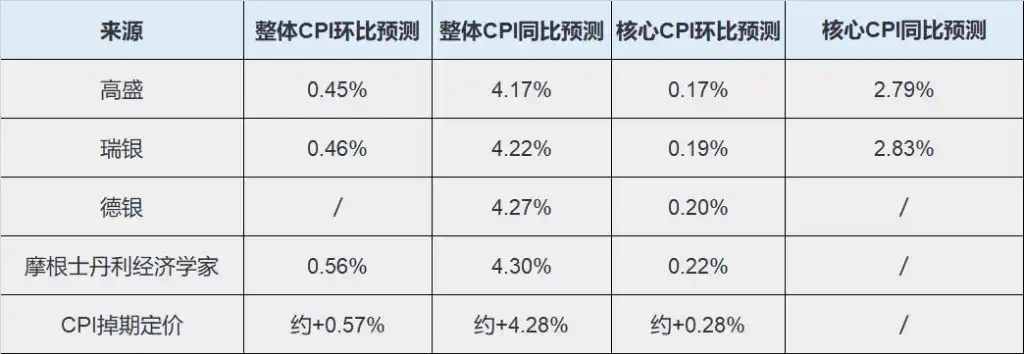
The trends of overall and core inflation show a clear divergence.

The "worrying" part is overall inflation. The year-on-year predictions from Goldman Sachs, UBS, Deutsche Bank, and Morgan Stanley are all above 4%. Deutsche Bank's estimate of 4.27% and Morgan Stanley's estimate of 4.3% are 46-49 basis points higher than April's figure and would be the highest since April 2023.

The "positive" part is core inflation. Excluding food and energy, the month-on-month core CPI may only be 0.17%-0.22%, significantly lower than the market's mainstream expectation of 0.27%-0.30%.

Overall Inflation May Break 4%: Energy Is the "Culprit"

Energy will be the core driver of the potential jump in this inflation reading.

Following the outbreak of the Iran war, US retail gasoline prices have risen sharply, driving a projected month-on-month increase in energy commodity prices of about 6%~7% for May, with the entire energy category seeing a month-on-month increase of nearly 4%. This effect directly pushes the year-on-year overall CPI from 3.81% in April to 4.17%~4.3% in May.

Deutsche Bank's calculations show that energy inflation year-on-year may approach 24%; back in February, this number was only 0.5%.
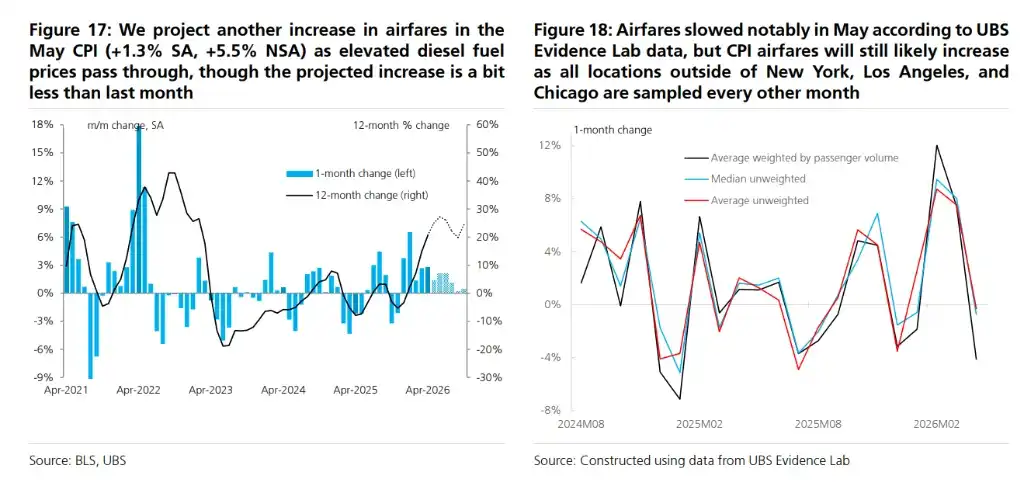
Airfare increases are one of the most direct transmission channels. Rising fuel costs directly increase airline operating costs. Airfare prices in May are expected to rise month-on-month by 1.3%~2%.

The good news is that gasoline prices peaked on May 20th and have since fallen by about 40 cents per gallon. UBS expects this to lead to a month-on-month decline of about 0.13% in the overall CPI for June, with the year-on-year rate falling back to around 3.81%. In other words, May is likely the peak of this round of overall inflation.

Why Core Inflation May Be Lower Than Expected: The Key Lies in Housing Cooling Down Again

Core CPI excludes food and energy. Precisely because these two hottest components are excluded, the May core data will look much more moderate.

Housing carries a very high weight in the US CPI, about 35%.

Both Goldman Sachs and UBS predict that Owner's Equivalent Rent (OER) and primary residence rent in May will increase month-on-month by about 0.22%~0.23%, continuing a slowing trend. In April, these two components rose by 0.53% and 0.55% month-on-month, respectively. Deutsche Bank also lists "housing inflation trends remaining moderate" as one of the reasons for the softness in core inflation.

Because OER itself has a large weight, even a decrease from around 0.5% to just over 0.2% will significantly lower the core CPI reading.

Auto insurance is another cooling point.

Goldman Sachs expects auto insurance prices to fall 0.1% month-on-month in May. Its online data model shows that changes in premiums are giving a downward signal for auto insurance CPI. Deutsche Bank also mentions that auto insurance is expected to be weak again.

There is also no significant upward pressure in used cars. Goldman Sachs expects used car prices to remain flat and new car prices to rise 0.1%; UBS expects used car prices to fall 0.26% and new car prices to fall 0.10%.

This means that several items that have frequently disturbed US core inflation in recent years—housing, auto insurance, used cars—are not giving strong inflation signals this time. In other words, the low May core CPI is not due to a single component "suddenly cooling down."
Core Inflation Is Not Cooling Across the Board: Airfare, IT Goods, and Some Services Still Have Pressure

A core CPI reading below consensus does not mean all core items are cooling.

Airfare is an upward item.

Goldman Sachs expects airfares to rise 2% in May. UBS expects a 1.34% increase. The reason is that jet fuel prices remained high for most of May, which may be passed through to ticket prices.

There is significant divergence in judgments on hotel prices. Goldman Sachs expects hotel prices to rise 0.2%; UBS lowered its lodging forecast based on Smith Travel Research data, expecting the price of lodging away from home to fall 0.77%. However, UBS also notes that CPI measures prices at the time of booking, while STR data is closer to check-in time. This timing difference may bring upside risks, especially potentially reflecting early demand related to the World Cup.

There is also stickiness in goods.

UBS expects core goods prices to rise 0.08% month-on-month, between the 0.11% in March and 0.03% in April. Its assessment is that the impact of tariffs on the 12-month core goods inflation may have slightly passed its peak, but residual pass-through will still keep monthly core goods prices growing slightly positively for the rest of this year.

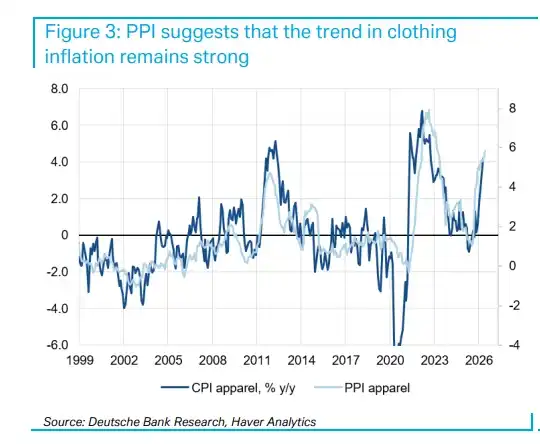
Deutsche Bank also mentions that import prices indicate that IT goods prices still have strong momentum, partly due to global memory chip prices remaining high. Meanwhile, apparel PPI shows that apparel inflation trends remain strong, although import prices are weak, and the momentum in CPI may have slowed compared to previous months.

Services are more complex.

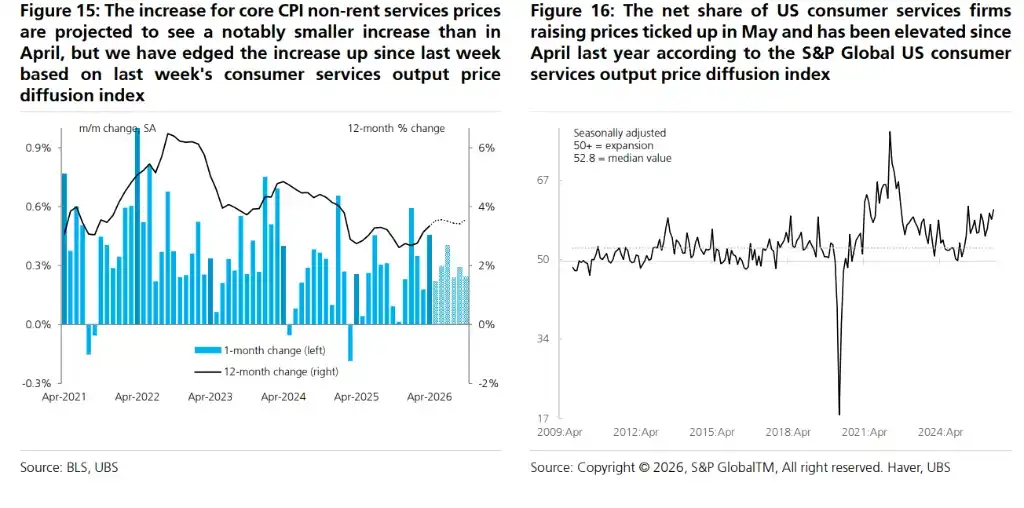
UBS has raised its forecast for non-rent core services prices from 0.17% to 0.21%, citing the S&P Global US Consumer Services Output Price Diffusion Index showing an increase in the proportion of consumer service firms raising prices in May, reaching the second-highest level since 2009, excluding the abnormal pandemic period.
What to Really Watch Tonight Is Not Just an Overall Inflation Above 4%

The surface numbers for May CPI may be high, but breaking them down is more crucial.

If overall CPI is high, primarily driven by gasoline and energy, the market will likely combine that with the decline in gasoline prices in June to judge its sustainability.

If core CPI is significantly lower than expected, the market will continue to examine where the low inflation is coming from: a trend slowdown in housing or a one-off seasonal drag.

If airfare, IT goods, and non-rent services continue to be strong, the significance of the core cooling will be discounted.

Therefore, this CPI might give the market two messages simultaneously:

On one hand, overall inflation has broken through 4% again, potentially even hitting a new high since April 2023.

On the other hand, core inflation might only be around 0.2%, clearly below market consensus.

This is what makes tonight's CPI so difficult to trade: overall inflation looks hot, but core inflation may not be that hot; oil prices push up the overall figure, while housing and auto insurance push down the core.

Inflation Swap Pricing: The Market Is Betting on a Dollar-Rising Surprise

The inflation swap market is currently pricing May overall CPI at 4.27%~4.28%, slightly above the Bloomberg survey median of 4.2%.

The analytical framework of Morgan Stanley strategist Molly Nickolin shows that in the past 12 CPI releases, inflation swap pricing correctly predicted the direction of the year-on-year inflation 9 times before the release. The current pricing implies an upside deviation of about 0.48 standard deviations relative to economists' expectations.

Based on historical backtesting, a 0.48 standard deviation upside surprise typically corresponds to a DXY US Dollar Index increase of about 0.14% within one hour of the release. Among all G10 currencies, the Swedish Krona (SEK) has historically performed the weakest in a "USD-bullish" CPI release day, with the largest average decline.

Looking Ahead: Oil Prices Are the Biggest Variable for the Inflation Path

The path of core CPI in the coming months depends on how long oil prices can be maintained.

The current baseline forecast is: Month-on-month core CPI remains around 0.2%. However, if the Middle East situation persists and the decline in oil prices falls short of expectations, upside risks will become more prominent—high oil prices not only directly push up energy prices but also continue to seep into core inflation through intermediate channels like airfare and transportation.

Deutsche Bank's long-term forecast is more pessimistic: Even if oil prices start to decline in June, overall energy inflation year-on-year will remain above 10% until early 2027 before turning negative. Core services inflation (excluding rent/OER) is also expected to remain above 3% for a long time.


İlgili Sorular

QWhat is the main reason why the overall CPI might exceed 4% in May according to the article?

AThe primary reason is a significant surge in energy prices. Following the outbreak of the Iran war, U.S. retail gasoline prices climbed sharply, driving energy commodity prices up by approximately 6-7% month-over-month in May. This pushed the overall CPI year-over-year rate from 3.81% in April to the predicted range of 4.17% - 4.3% in May.

QWhy is the core CPI for May expected to be significantly lower than market consensus?

AThe core CPI is expected to be lower mainly due to cooling in key categories with high weights, particularly housing. Components like Owners' Equivalent Rent (OER) and primary residence rent are predicted to show slower month-over-month growth around 0.22-0.23%, down from around 0.5% in April. Additionally, factors like auto insurance and used car prices are also providing a cooling effect.

QWhich specific core components are identified as still presenting upward pressure on inflation?

AWithin the core CPI, airfares are an upward component, with forecasts of a 1.34% to 2% month-over-month increase due to high aviation fuel costs. IT goods prices are also cited as having strong momentum, partly due to high global memory chip prices. Furthermore, some non-rent core services show resilience, with a notable share of consumer service firms reporting price increases.

QBased on inflation swap pricing, what market reaction does the article suggest for a potential upside surprise in the CPI data?

ABased on historical analysis by Morgan Stanley, the current inflation swap pricing implies an upside surprise of about 0.48 standard deviations. Historically, such a surprise has been associated with the DXY U.S. Dollar Index rising approximately 0.14% within one hour after the data release. Among G10 currencies, the Swedish Krona (SEK) typically shows the weakest performance on such 'dollar-bullish' CPI days.

QWhat is considered the biggest variable for the future path of inflation according to the article's conclusion?

AThe future path of inflation, particularly core CPI, is highly dependent on oil price movements. Oil prices are identified as the biggest variable. If Middle East tensions persist and oil prices do not decline as expected, there will be significant upside risks, as high oil prices not only directly impact energy costs but also continue to feed into core inflation through channels like airfares and transportation.

İlgili Okumalar

Ethereum Reaches the Milestone of One Million Developers, Sharplink CEO Delves Deep into Ethereum's Future Possibilities

Ethereum Surpasses One Million Developers Milestone: A Look at Its Unshakeable Dominance and Future Joseph Chalom, CEO of Sharplink, reflects on his recent Asia trip where he engaged deeply with Ethereum developers and ecosystem leaders. The most striking takeaway was not just the industry's vibrancy, but the rigorous, long-term vision of local builders. This context brings to life a pivotal statistic: Ethereum has now surpassed one million cumulative developers (1,012,824), with approximately 232,000 remaining active in the past year—a talent pool unmatched by any other crypto ecosystem. The critical question isn't which blockchain is fastest, but where top developers choose to build long-term. Ethereum's answer is unequivocal. Its decade-long lead stems from a unique convergence of technology, institutional culture, economic systems, and composability, cementing its role as the foundational operating system for programmable finance. This massive developer base is tackling the industry's hardest problems, continuously strengthening Ethereum's moat. Key initiatives include: * **The Glamsterdam Upgrade (planned 2026):** Introducing ePBS and Block-level Access Lists for parallel execution and higher throughput while preserving core values like credible neutrality and fair MEV distribution. * **Synchronous Composability:** Projects are working to enable atomic transactions across dozens of Rollups, making them function as one unified chain and eliminating ecosystem fragmentation. * **Post-Quantum Security:** Ethereum is far ahead in preparing for quantum computing threats, with a dedicated foundation working group and testnets targeting a full migration by ~2029—a crucial factor for institutional adoption. Beyond developers, Ethereum's core network effects are its unparalleled composability and unified standards (like EVM and Solidity), which create a powerful flywheel: more developers → better tools → greater liquidity → more institutional participation. Its other decisive advantages include credible neutrality (over 900k validators), a secure modular architecture with interconnected Rollups, and a deeply entrenched culture shaped by top-tier researchers. Ultimately, there's a vast difference between generating short-term activity and becoming the trusted, long-term coordination layer for global native finance. Major institutions prioritize security, trust, and liquidity—areas where Ethereum holds dominant mindshare. The industry's trajectory shows resources consolidating around unified standards, deep liquidity, and developer consensus. After meeting the builders in Seoul and Hong Kong, Chalom is more convinced than ever: Ethereum's unshakeable future is being built right now.

Foresight News13 dk önce

Ethereum Reaches the Milestone of One Million Developers, Sharplink CEO Delves Deep into Ethereum's Future Possibilities

Foresight News13 dk önce

Saylor's Latest Long Read: Bitcoin is Not Money, It's Digital Capital, and Money is Built Upon It

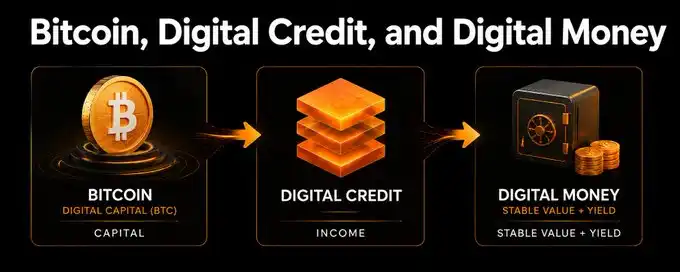
Michael Saylor presents his "Digital Asset Stack" theory, positioning Bitcoin as the foundational layer of digital capital. He argues Bitcoin itself should remain unchanged—no staking, inflation, or protocol alterations. Instead, a five-layer financial architecture should be built atop it: Digital Capital (BTC), Digital Credit (e.g., yield instruments like STRC), Digital Currency (stable, yield-bearing instruments pegged to fiat), Digital Yield (leveraged/structured products), and Digital Equity (e.g., MSTR stock, absorbing residual volatility). Saylor asserts this stack transforms Bitcoin's high-volatility, high-energy capital into tailored products: stable currencies for payments/savings, yield instruments for income seekers, and equity for growth investors. This approach meets diverse needs—corporate treasuries, banks, retirees, emerging market users—without compromising Bitcoin's core properties (scarcity, decentralization). The "killer use case" is rebuilding global money, credit, and capital markets on Bitcoin, bridging the fiat world with a superior digital asset foundation. The system leverages traditional finance principles (risk layering, structured products) while using Bitcoin as the ultimate collateral. This expands Bitcoin's utility, drives adoption, and offers a better monetary experience: digital, yield-bearing, stable-value tools for everyday use.

marsbit25 dk önce

Saylor's Latest Long Read: Bitcoin is Not Money, It's Digital Capital, and Money is Built Upon It

marsbit25 dk önce

Can SK Hynix's Stock Double Again in This Rally?

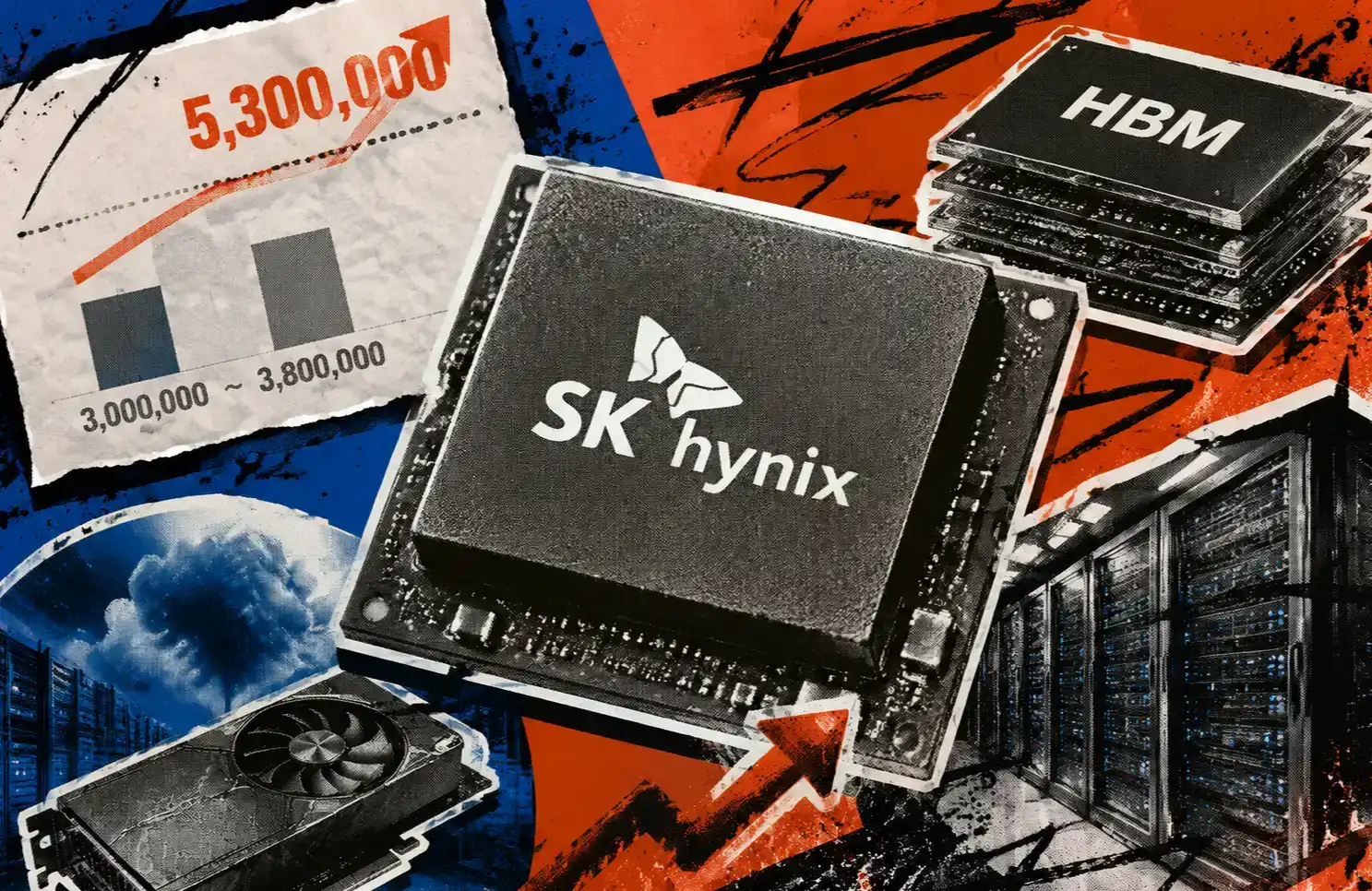
The article discusses the highly optimistic price target of approximately $3,500 for SK Hynix stock, set by Aletheia Capital. This target is significantly above the consensus range of $2,000-$2,520 from major brokerages. The core debate is whether SK Hynix deserves a fundamental re-rating beyond its traditional cyclical discount, based on the long-term impact of AI-driven demand. The $3,500 target hinges on three key assumptions holding simultaneously until at least 2027: 1) Continued shortage and high pricing for HBM (High Bandwidth Memory), a critical component for AI chips; 2) Sustained high prices for standard DRAM, as HBM production consumes capacity and constrains general supply; and 3) Strong AI server demand generating substantial, above-expectation free cash flow. SK Hynix's leading ~58% market share in HBM and its early certification with key clients like Nvidia provide a competitive advantage, allowing it to capture significant supply chain premiums. The HBM shortage is seen not just as a niche growth driver but as a catalyst that amplifies profitability across the entire memory business by tightening overall DRAM supply. However, the article cautions that this target represents an optimistic "tail scenario." Key risks include potential supply increases from competitors (Samsung, Micron) by 2027, a possible slowdown in HBM price growth, and high capital expenditures that could erode the projected free cash flow. The divergence in analyst targets reflects the market's uncertainty over whether the current AI-driven boom will temporarily elevate earnings or permanently raise the memory industry's profit baseline.

marsbit29 dk önce

Can SK Hynix's Stock Double Again in This Rally?

marsbit29 dk önce

Has the Cryptocurrency Market Hit Bottom? Here's What Institutions Think

"Has the crypto market bottomed out? Major institutions are divided on the outlook, according to a recent analysis by Matt Hougan, Chief Investment Officer of Bitwise. Three prominent research firms published in-depth reports on the topic with differing conclusions. Galaxy Digital argues Bitcoin has not yet found its bottom, pointing to only 4 out of 13 historical bottoming indicators being met. Their analysis suggests a potential bottom range of $30,000 to $54,000. NYDIG adopts a more cautious stance, noting that while metrics are close to historical bear market lows, a classic panic-selling capitulation event is missing. They acknowledge the possibility of a bottom but consider it unlikely, citing structural changes from institutional adoption. In contrast, Standard Chartered Bank asserts the bottom is already in at around $59,000. Their revised bullish view, predicting a year-end target of $100,000, hinges on anticipated reductions in ETF selling pressure linked to events like a potential SpaceX IPO. Despite the surface-level disagreement on the exact price floor, the reports share significant common ground crucial for long-term investors. All three institutions agree that a market bottom will likely form within the current year, that current prices are closer to the bottom than to previous cycle highs, and that Bitcoin is poised for another major bull cycle in the future. The core takeaway is that while the precise bottom level remains debated, the long-term value proposition for Bitcoin remains strong and may even be strengthening. Key supportive trends include rising global debt, persistent inflation, declining trust in traditional institutions, accelerating digitization, and improving market infrastructure. Therefore, for investors with a long-term horizon, the focus should shift from pinpointing the exact bottom to recognizing that the cycle's peak is likely still ahead, making current levels an attractive entry point for substantial potential upside."

Foresight News50 dk önce

Has the Cryptocurrency Market Hit Bottom? Here's What Institutions Think

Foresight News50 dk önce

İşlemler

Spot
Futures

Popüler Makaleler

4 Nasıl Satın Alınır

HTX.com’a hoş geldiniz! 4 (4) satın alma işlemlerini basit ve kullanışlı bir hâle getirdik. Adım adım açıkladığımız rehberimizi takip ederek kripto yolculuğunuza başlayın. 1. Adım: HTX Hesabınızı OluşturunHTX'te ücretsiz bir hesap açmak için e-posta adresinizi veya telefon numaranızı kullanın. Sorunsuzca kaydolun ve tüm özelliklerin kilidini açın. Hesabımı Aç2. Adım: Kripto Satın Al Bölümüne Gidin ve Ödeme Yönteminizi SeçinKredi/Banka Kartı: Visa veya Mastercard'ınızı kullanarak anında 4 (4) satın alın.Bakiye: Sorunsuz bir şekilde işlem yapmak için HTX hesap bakiyenizdeki fonları kullanın.Üçüncü Taraflar: Kullanımı kolaylaştırmak için Google Pay ve Apple Pay gibi popüler ödeme yöntemlerini ekledik.P2P: HTX'teki diğer kullanıcılarla doğrudan işlem yapın.Borsa Dışı (OTC): Yatırımcılar için kişiye özel hizmetler ve rekabetçi döviz kurları sunuyoruz.3. Adım: 4 (4) Varlıklarınızı Saklayın4 (4) satın aldıktan sonra HTX hesabınızda saklayın. Alternatif olarak, blok zinciri transferi yoluyla başka bir yere gönderebilir veya diğer kripto para birimlerini takas etmek için kullanabilirsiniz.4. Adım: 4 (4) Varlıklarınızla İşlem YapınHTX'in spot piyasasında 4 (4) ile kolayca işlemler yapın.Hesabınıza erişin, işlem çiftinizi seçin, işlemlerinizi gerçekleştirin ve gerçek zamanlı olarak izleyin. Hem yeni başlayanlar hem de deneyimli yatırımcılar için kullanıcı dostu bir deneyim sunuyoruz.

389 Toplam GörüntülenmeYayınlanma 2025.10.20Güncellenme 2026.06.02

4 Nasıl Satın Alınır

Tartışmalar

HTX Topluluğuna hoş geldiniz. Burada, en son platform gelişmeleri hakkında bilgi sahibi olabilir ve profesyonel piyasa görüşlerine erişebilirsiniz. Kullanıcıların 4 (4) fiyatı hakkındaki görüşleri aşağıda sunulmaktadır.

活动图片