US banks could soon issue stablecoins under FDIC plan to implement GENIUS Act

cointelegraph2025-12-16 tarihinde yayınlandı2025-12-16 tarihinde güncellendi

Özet

The Federal Deposit Insurance Corp. (FDIC) has proposed a framework allowing regulated U.S. banks to issue payment stablecoins through subsidiaries, as part of implementing the GENIUS Act. The proposal outlines approval requirements, including assessments of financial condition, management quality, and redemption policies. Once approved, the FDIC would serve as the primary regulator. The GENIUS Act, signed into law by President Trump in July, establishes a comprehensive regulatory framework requiring stablecoin issuers to maintain one-to-one reserves with U.S. dollars or other high-quality liquid assets. The legislation is seen as a way to strengthen the U.S. dollar's global reach, with the stablecoin market exceeding $300 billion, largely dominated by dollar-pegged tokens.

The Federal Deposit Insurance Corp. (FDIC) is moving forward with rule-making under the US GENIUS Act by proposing a framework for how regulated banks could apply to issue payment stablecoins, a key early step in implementing the law’s stablecoin provisions.

In a 38-page document posted to the FDIC’s website, the agency detailed proposed approval requirements for the issuance of payment stablecoins by subsidiaries of FDIC-supervised institutions.

As Bloomberg reported, the proposal is subject to a public consultation period before advancing to the next stage of the rulemaking process.
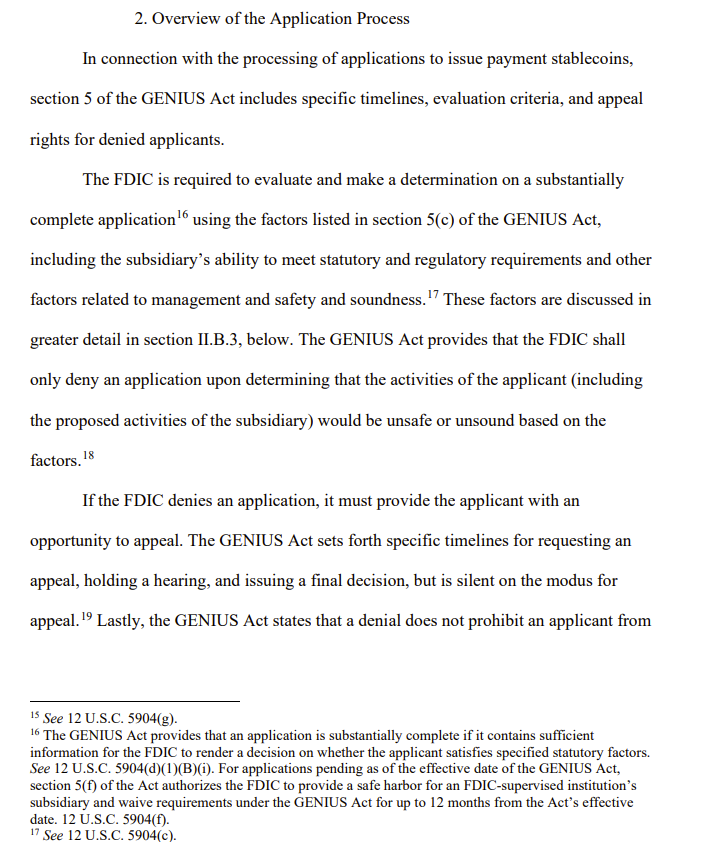
Excerpts from the FDIC’s proposed framework for bank-issued payment stablecoins. Source: FDIC

Under the proposal, banks would apply to issue payment stablecoins through a subsidiary, with the FDIC assessing both the subsidiary and its parent institution against criteria set out in the GENIUS Act. These include the ability to meet stablecoin issuance standards, the institution’s financial condition, management quality, redemption policies and other safety and soundness considerations.

Once approved, the FDIC would serve as the primary federal regulator overseeing the subsidiary’s payment stablecoin activities.

The FDIC is the US agency responsible for insuring bank deposits and supervising member institutions. In recent years, it has taken a more active role in shaping how banks engage with digital assets, including reconsidering the use of reputational risk in bank supervision. As Cointelegraph reported in October, this shift could impact how financial institutions interact with crypto-related businesses.

Related: US stablecoin rules split global liquidity with Europe, CertiK warns

Washington’s historic embrace of stablecoins

The GENIUS Act — short for Guiding and Establishing National Innovation for US Stablecoins — cleared the Senate in June and was signed into law by US President Donald Trump the following month.

The legislation establishes a comprehensive regulatory framework for payment stablecoins, including requirements that issuers maintain one-to-one reserve backing with US dollars or other approved high-quality liquid assets.
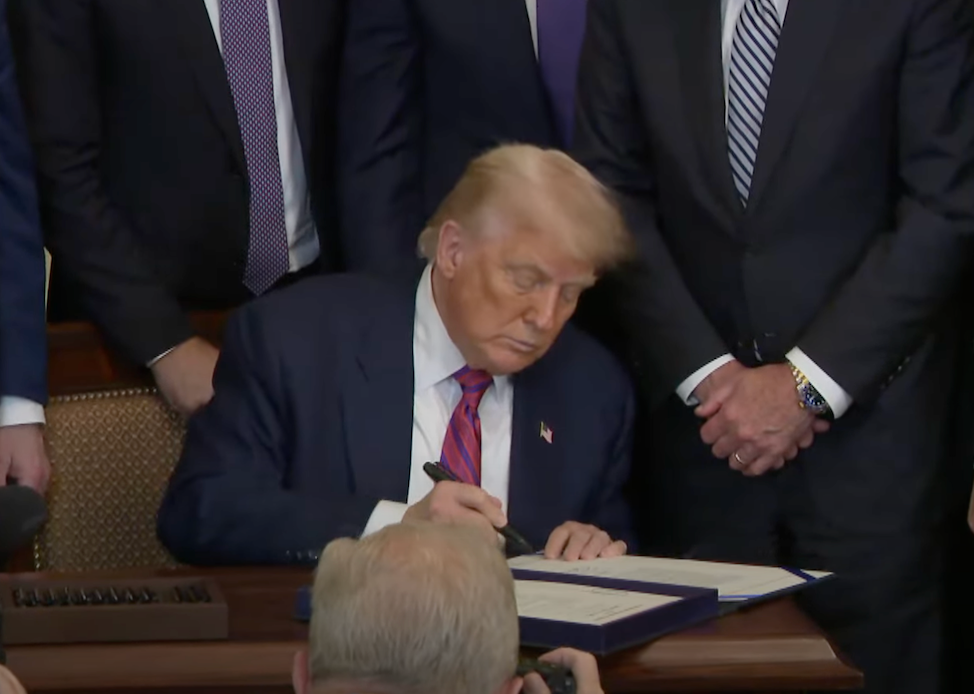
US President Donald Trump signed the GENIUS Act on July 18. Source: Associated Press

The GENIUS Act was widely welcomed by the cryptocurrency industry, with senior executives from major companies including Coinbase, Circle, Robinhood and Gemini attending President Donald Trump’s signing of the bill.

Some industry participants view the legislation as a tool to strengthen US dollar liquidity and extend the dollar’s global reach through stablecoins, a view echoed by US Treasury Secretary Scott Bessent.

The total value of stablecoins in circulation has climbed above $300 billion globally, driven almost entirely by US dollar-pegged tokens.

Related: Crypto Biz: Corporate stablecoin race heats up with Citi, Western Union at the helm

Trend Kriptolar

İlgili Okumalar

Bitcoin Withdrawals Continue: 8 Years of Storage in a Coldcard Cold Wallet Ended in Zero

Coldcard Hardware Wallet Hacked: Losses Mount Due to Vulnerable Seed Generation A critical vulnerability in Coldcard hardware wallets has led to a continued wave of fund thefts. According to Galaxy Research, the total stolen has reached 1,367.05 BTC (approx. $88.6 million) from 4,585 addresses, a significant increase from the initial 594.5 BTC reported on July 30, 2026. Most of the stolen funds remain on the attackers' addresses. The issue is not with the current firmware, which Coinkite has updated, but with seed phrases generated on vulnerable devices between March 2021 and the release of fixed firmware versions. Due to a programmer error, devices switched from using a hardware random number generator to the software-based Yasmarang generator, which was initialized with publicly accessible data like the chip's serial number. This made the seed phrases predictable through offline brute-force attacks, meaning wallets remain at risk until funds are moved to a new wallet generated with the patched firmware. Affected devices include Mk2/Mk3 with firmware 4.0.1–4.1.9 (and up to 5.0.3), Mk4/Mk5 up to version 5.6.0, and Q models up to 1.5.0Q. The only exceptions are seeds created with a high-entropy method like at least 50 independent dice rolls or a strong unique BIP-39 passphrase. All other owners must generate a new seed on the fixed firmware and transfer their assets. A case highlighting the human impact involves a 39-year-old long-term investor who lost 2 BTC (approx. $130,000) in minutes. He had accumulated the Bitcoin over eight years through physical labor, viewing it as a financial lifeline and a retirement plan in a country suffering from hyperinflation. His story underscores that even conservative "buy and hold in cold storage" strategies can be compromised by such underlying technical flaws. From a technical perspective, this incident echoes historical failures where weak random number generators undermined cryptographic security, challenging the assumption that offline storage is automatically foolproof.

cryptonews.ru4 saat önce

Bitcoin Withdrawals Continue: 8 Years of Storage in a Coldcard Cold Wallet Ended in Zero

cryptonews.ru4 saat önce

İşlemler

Spot

Popüler Makaleler

SOON Nasıl Satın Alınır

HTX.com’a hoş geldiniz! SOON (SOON) satın alma işlemlerini basit ve kullanışlı bir hâle getirdik. Adım adım açıkladığımız rehberimizi takip ederek kripto yolculuğunuza başlayın. 1. Adım: HTX Hesabınızı OluşturunHTX'te ücretsiz bir hesap açmak için e-posta adresinizi veya telefon numaranızı kullanın. Sorunsuzca kaydolun ve tüm özelliklerin kilidini açın. Hesabımı Aç2. Adım: Kripto Satın Al Bölümüne Gidin ve Ödeme Yönteminizi SeçinKredi/Banka Kartı: Visa veya Mastercard'ınızı kullanarak anında SOON (SOON) satın alın.Bakiye: Sorunsuz bir şekilde işlem yapmak için HTX hesap bakiyenizdeki fonları kullanın.Üçüncü Taraflar: Kullanımı kolaylaştırmak için Google Pay ve Apple Pay gibi popüler ödeme yöntemlerini ekledik.P2P: HTX'teki diğer kullanıcılarla doğrudan işlem yapın.Borsa Dışı (OTC): Yatırımcılar için kişiye özel hizmetler ve rekabetçi döviz kurları sunuyoruz.3. Adım: SOON (SOON) Varlıklarınızı SaklayınSOON (SOON) satın aldıktan sonra HTX hesabınızda saklayın. Alternatif olarak, blok zinciri transferi yoluyla başka bir yere gönderebilir veya diğer kripto para birimlerini takas etmek için kullanabilirsiniz.4. Adım: SOON (SOON) Varlıklarınızla İşlem YapınHTX'in spot piyasasında SOON (SOON) ile kolayca işlemler yapın.Hesabınıza erişin, işlem çiftinizi seçin, işlemlerinizi gerçekleştirin ve gerçek zamanlı olarak izleyin. Hem yeni başlayanlar hem de deneyimli yatırımcılar için kullanıcı dostu bir deneyim sunuyoruz.

262 Toplam GörüntülenmeYayınlanma 2025.05.23Güncellenme 2026.06.02

SOON Nasıl Satın Alınır

Tartışmalar

HTX Topluluğuna hoş geldiniz. Burada, en son platform gelişmeleri hakkında bilgi sahibi olabilir ve profesyonel piyasa görüşlerine erişebilirsiniz. Kullanıcıların SOON (SOON) fiyatı hakkındaki görüşleri aşağıda sunulmaktadır.

活动图片













