US Banking Lobby Urges OCC To Delay Crypto Charter Applications Approval

bitcoinist2026-02-13 tarihinde yayınlandı2026-02-13 tarihinde güncellendi

Özet

The US's largest banking lobby, the American Bankers Association (ABA), has urged the Office of the Comptroller of the Currency (OCC) to delay its approval of crypto bank charter applications. The ABA cited regulatory uncertainty, the need for greater transparency in the application process, and a lack of finalized federal oversight. This follows the OCC's conditional approval of charters for several crypto firms in December, which raised concerns about blurred regulatory lines. The ABA argues the OCC should wait until Congress finalizes new rules. Additionally, the banking industry opposes granting crypto and fintech firms direct access to the Federal Reserve's payment systems, advocating for a 12-month waiting period to ensure safety and soundness standards are met.

The US’s largest banking lobby has requested the Office of the Comptroller of the Currency (OCC) delay its approval of crypto bank charter applications, suggesting the regulator wait until regulatory uncertainty is cleared.

US Banks Call For Crypto Charter Reviews Delay

On Wednesday, the American Bankers Association (ABA) asked the OCC to pause the review of national bank charter applications for crypto firms, citing uncertainty surrounding emerging business models, the need for greater transparency in charter application and decision-making processes, and a lack of finalized federal oversight.

In a letter, the banking lobby urged the US’s top bank regulator to “ensure that robust, broadly applicable safety and soundness standards are well understood and upheld during this period of rapid innovation to provide greater transparency throughout its charter application and decisioning processes.”

As reported by Bitcoinist, the OCC approved conditional bank charters for Ripple, Circle, BitGo, Paxos, and Fidelity in December, raising concerns that the approvals could blur the lines of banking activities and lead to regulatory arbitrage.

The ABA now calls for patience as emerging crypto regulatory frameworks take shape, suggesting that the review process must be delayed until Congress finishes the rules that many recent OCC charter applicants will ultimately be subject to.

“We urge the OCC to be patient, not measure its application decisioning progress against traditional timelines, and allow each charter applicant’s regulatory responsibilities to come fully into view before moving a charter application forward,” ABA wrote.

The banking association emphasized that appropriate safety and soundness protections, including effective measures against conflicts of interest, and for compliance with other applicable consumer protection laws and regulations, must be in place from the beginning.

Notably, the Trump Family’s main crypto venture, World Liberty Financial, applied for a national trust charter in January. US Senator Elizabeth Warren sent a letter to Comptroller Jonathan Gould asking the agency to pause its review of the application until President Donald Trump divests from the crypto company, arguing that it could create a government ethics problem.

In addition, the association recommended an amendment to the OCC’s regulations to ensure new charter applicants’ names “do not misrepresent the nature of the financial services they intend to offer.”

They suggested that the agency prohibit any charter applicant that limits its activities to either fiduciary activities or trust company operations from including the word “bank” in its name.

ABA argued that “such entities would not be engaged in the business of banking and should, therefore, ‘not have a title that misrepresents the nature of the institution or the services it offers.’”

“Skinny” Accounts Clash

US banks have recently shared their opposition to granting crypto and fintech companies direct access to the Federal Reserve (Fed)’s payment systems, according to Bloomberg.

Earlier this week, the Bank Policy Institute, Clearing House Association, and Financial Services Forum sent a joint letter to the Fed, demanding a 12-month waiting period before firms are eligible to apply for payment accounts.

The banking groups argued the Fed “should block access until newly licensed stablecoin issuers prove they can operate safely.” As Bloomberg noted, crypto and fintech firms currently rely on partner banks for access and compliance infrastructure. However, the Fed’s “skinny” master accounts proposal, first introduced in October, would allow these crypto companies to bypass the intermediation.

Moreover, recent reports from Eleanor Terret claim that the tensions between the US banking sector and the crypto industry have extended from Stablecoin rewards to include the skinny master accounts proposal.

While the digital assets side was “largely positive,” Terret affirmed the banking side worried that crypto’s “less robust regulatory status could pose a problem,” with Better Markets CEO Dennis Kelleher calling the proposal “a reckless giveaway to the crypto industry that unnecessarily expands the Fed’s mandate without justification and undermines the Fed’s true mandate.”
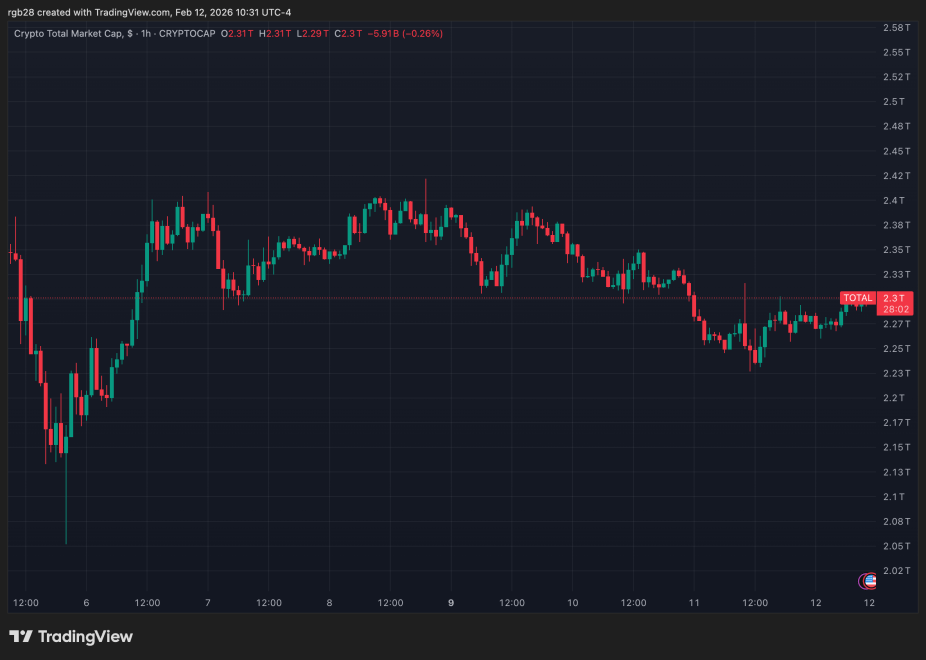
The total crypto market capitalization is at $2.3 trillion in the one-week chart. Source: TOTAL on TradingView


İlgili Sorular

QWhat is the main request made by the American Bankers Association (ABA) to the Office of the Comptroller of the Currency (OCC)?

AThe ABA requested the OCC to pause the review of national bank charter applications for crypto firms until regulatory uncertainty is cleared and Congress finishes establishing the rules.

QWhich crypto companies received conditional bank charters from the OCC in December, as mentioned in the article?

AThe OCC approved conditional bank charters for Ripple, Circle, BitGo, Paxos, and Fidelity in December.

QWhat specific recommendation did the ABA make regarding the naming of new charter applicants?

AThe ABA recommended that the OCC prohibit any charter applicant limited to fiduciary activities or trust company operations from including the word 'bank' in its name to avoid misrepresentation.

QWhy did US banking groups oppose granting crypto and fintech companies direct access to the Federal Reserve's payment systems?

ABanking groups argued that the Fed should block access until newly licensed stablecoin issuers prove they can operate safely, expressing concerns about crypto's less robust regulatory status.

QWhat was the concern raised by US Senator Elizabeth Warren regarding World Liberty Financial's charter application?

ASenator Warren asked the OCC to pause its review of the application until President Donald Trump divests from the crypto company, arguing it could create a government ethics problem.

İlgili Okumalar

Ethereum's 11th Year: Why Is This Year Particularly Crucial?

Ethereum's 11th year proved pivotal, marked by a dual evolution in its technical roadmap and organizational structure. The year saw the completion of the Fusaka upgrade, introducing PeerDAS to make data availability sampling more efficient and laying groundwork for future L2 scaling. This was followed by a significant reorganization of the Ethereum Foundation (EF). The EF downsized, redefining its core mandate around user sovereignty and CROPS principles, while spinning off key functions. Independent entities like Ethlabs (non-profit R&D), Ethereum Institutional (institutional onboarding), and EthSystems (institutional privacy solutions) now operate separately. Technologically, the community debated a bold, long-term vision outlined in Justin Drake's "Lean Ethereum" proposal and the collaborative "Strawmap." These point toward a "third major iteration" for Ethereum, targeting goals like faster finality (~1 second), gigagas-scale L1 throughput, teragas-scale L2 capacity, post-quantum cryptography, and protocol-level privacy. Data underscores Ethereum's dominant position: its L1 still holds roughly half of all stablecoin value, leads in tokenized Real-World Assets (RWA), and commands over 55% of total DeFi TVL. While L2s now handle over 10x more transactions than the mainnet, high-value assets remain concentrated on L1. The launch of Robinhood Chain, an EVM-compatible L2 for stock tokens, signals growing institutional adoption. The immediate roadmap includes the Glamsterdam upgrade (featuring ePBS for in-protocol proposer-builder separation and Block Access Lists for parallelism), potentially followed by Hegotá focusing on anti-censorship via FOCIL. In summary, Ethereum's 11th year was defined by setting ambitious technical foundations for its next decade and restructuring its core development ecosystem to be more modular and sustainable, all while maintaining its role as the leading settlement layer for decentralized finance and assets.

marsbit6 dk önce

Ethereum's 11th Year: Why Is This Year Particularly Crucial?

marsbit6 dk önce

Notable Forecast from an Analytical Company Regarding Bitcoin (BTC): After This Date, a New Bull Season Could Begin!

Bitcoin continues to trade sideways around $64,000 amid ongoing uncertainty regarding U.S. monetary policy and geopolitical risks in the Middle East. As BTC struggles for direction, an analyst predicts the next major uptrend could commence after the U.S. midterm elections. João Wedson, founder and CEO of crypto analytics firm Alphractal, revisited the connection between Bitcoin's price movements and the U.S. election calendar in his latest analysis. Wedson claims that analyzing past market cycles reveals similar patterns in Bitcoin's price behavior, particularly around U.S. midterm and presidential elections. Historically, Bitcoin has faced headwinds leading up to midterms but tends to recover once election-related uncertainty subsides. Based on historical data, Bitcoin entered bear markets roughly a year before past midterm elections, only to initiate prolonged bull markets after the elections concluded. In some cycles, price bottoms formed just days before the vote, while in others, the low occurred immediately after. The analyst also noted presidential elections have a distinct impact: Bitcoin experiences strong rallies each time a president wins re-election and approaches the peak of its main cycle shortly after the presidential inauguration. As an example, Wedson pointed to XRP, which began a sharp rise on the day Donald Trump won the 2024 election and reached a local peak on January 20, 2025, his inauguration day.

cryptonews.ru21 dk önce

Notable Forecast from an Analytical Company Regarding Bitcoin (BTC): After This Date, a New Bull Season Could Begin!

cryptonews.ru21 dk önce

Lummis: The CLARITY Act mechanism "is not working" as the Senate drags its feet

U.S. Senator Cynthia Lummis has argued that the current regulatory framework for digital assets is inadequate, harming industry, investors, and regulators alike. She is urgently pushing for the Senate to pass the Digital Asset Market Clarity Act (H.R. 3633/CLARITY Act) before the August recess, warning the current momentum for the bill is a unique opportunity this decade. The legislation aims to divide oversight between the SEC and CFTC. Time is running out, as the Senate must act before its August 8th recess. Delays would push the debate to September, further squeezing the legislative calendar before the midterm elections. Forecasting platforms now estimate only a 30% chance of the bill becoming law in 2026, a sharp drop from over 80% in February. Passage requires 60 votes, meaning at least seven Democrats must join Republicans, a task complicated by Democratic opposition. Key objections from figures like Senator Elizabeth Warren center on concerns the bill could weaken oversight of decentralized finance (DeFi) and consumer protection, potentially endangering the financial system. Over 200 crypto industry organizations, including Coinbase and Ripple, are lobbying for a vote, arguing continued uncertainty drives innovation and jobs overseas. Lummis contends the bill's custody and disclosure rules are precisely the consumer protections needed to close existing loopholes. The bill's fate now hinges on whether Senate Majority Leader John Thune schedules a vote this week or delays it until the fall session, where it would face an even more constrained political environment.

cryptonews.ru21 dk önce

Lummis: The CLARITY Act mechanism "is not working" as the Senate drags its feet

cryptonews.ru21 dk önce

İşlemler

Spot
活动图片