Unitas is Committed to Building a Global Savings Layer for Digital Assets and Compliant High-Yield Stablecoins

marsbit2026-01-12 tarihinde yayınlandı2026-01-12 tarihinde güncellendi

Özet

Unitas introduces a new market-neutral yield infrastructure standard, aiming to establish a global savings layer and compliant high-yield stablecoin ecosystem. It provides a modular yield service platform that decouples capital access, asset custody, and yield execution, serving both individual and institutional users without taking directional market risk. The core strength lies in its self-developed and self-operated yield engine, which manages the full lifecycle of signal generation, execution, and risk response. Unitas runs multiple market-neutral strategies under a unified risk framework, including delta-neutral liquidity strategies and basis arbitrage, ensuring returns come from market activity rather than price speculation. Built-in risk controls monitor exposures and hedging deviations in real-time, prioritizing stability over speed during volatility. Backed by 24/7 human oversight, the system demonstrated strong performance with a 16.7% net APY and only -0.16% max drawdown in 2025, including zero loss during extreme market conditions. Unitas emphasizes transparency through real-time disclosure of collateral and risk parameters. Future plans include expansion into TradFi, integration with RWA like tokenized stocks and commodities, and serving as a foundational yield layer connecting DeFi and traditional finance.

The digital asset infrastructure innovation team Unitas has announced the launch of a new market-neutral yield infrastructure standard. By constructing a "Yield Layer" for digital assets, Unitas is committed to providing professional market-neutral returns to global users based on full transparency and institutional-grade risk control.

Modular Architecture: Reshaping the Accessibility of Yield Services

Unitas provides a modular yield service platform designed to achieve sustainable capital growth without taking on market directional risk. Through a unified infrastructure, the platform decouples capital access, asset custody, and yield execution, serving not only individual investors but also meeting the stringent security and compliance requirements of corporate and institutional treasuries.

Proprietary Core Engine: Mastering the Full Lifecycle of Yield Execution

Different from the "strategy outsourcing" model that relies on third-party protocols, Unitas's core competitiveness lies in its self-developed, self-operated, and self-managed yield engine. Unitas controls the entire lifecycle from signal generation and trade execution to real-time monitoring and risk response.

Currently, the platform operates multiple market-neutral strategies in parallel under a unified risk framework:

  • Liquidity-Driven Delta Neutral Strategy: Captures real transaction fees and incentives in on-chain liquidity pools, supplemented by dynamic hedging, ensuring returns stem from market activity rather than price fluctuations.

  • Funding Rate and Basis Arbitrage: Captures structural price differences between spot and futures in derivative markets.

By integrating these strategies within a single system, Unitas achieves yield diversification while maintaining extremely high control over exposure, leverage, and liquidity.

System-Embedded Risk Control: Robust Performance in Extreme Market Conditions

Unitas deeply embeds risk control into the strategy execution layer. The system monitors net exposure, margin utilization, and hedge deviation in real-time, using them as hard constraints for position adjustments.

Its execution mechanism prioritizes "robustness" over mere response speed. During periods of severe market volatility, the system proactively limits adjustment frequency to avoid slippage risk and combines it with a "24/7 manual real-time supervision" model to ensure precise human-machine collaborative intervention under abnormal conditions.

Practical Data Validation: Exceptional Resilience Across Cycles

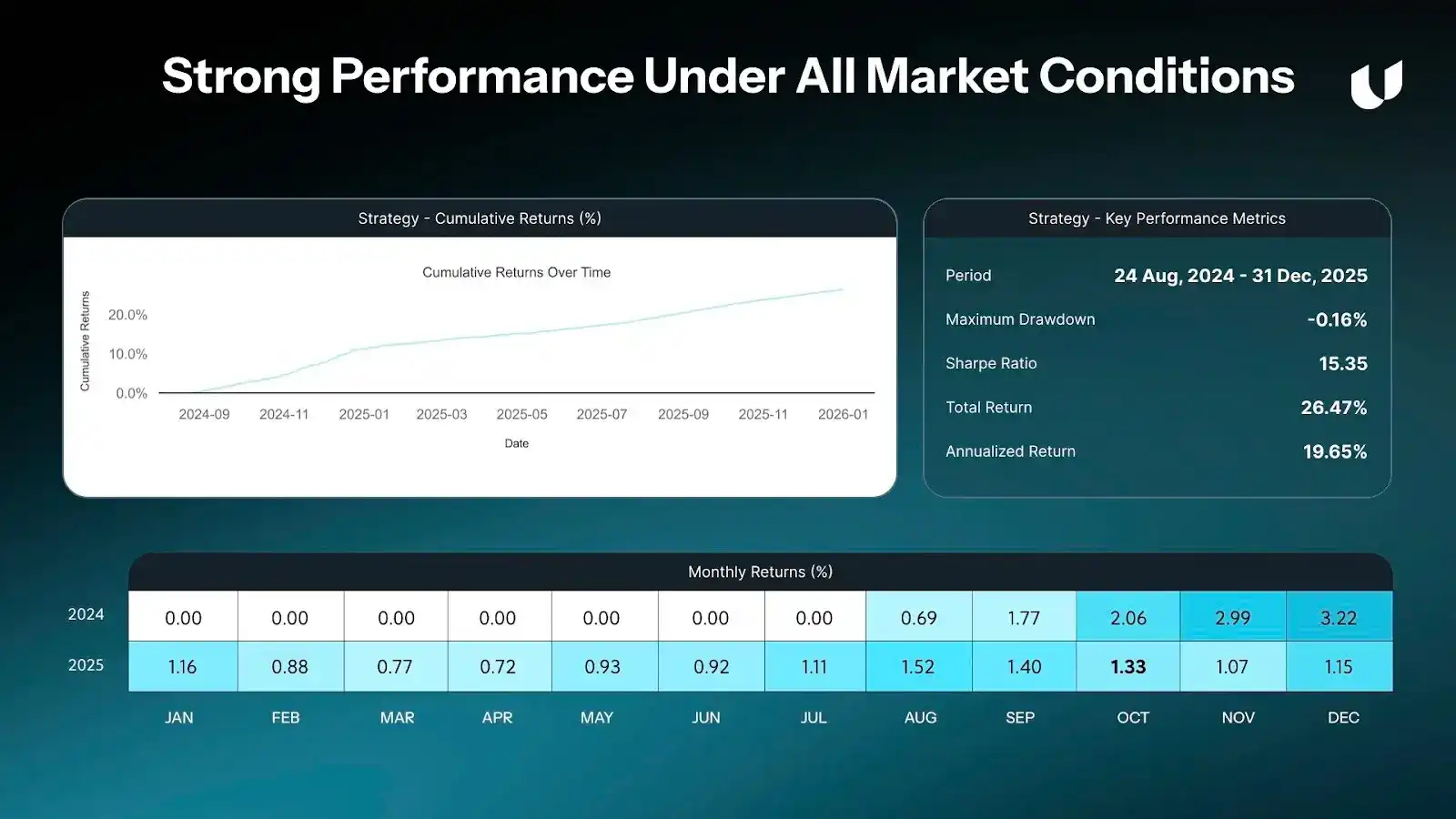
Data statistics show that throughout 2025, with a deployment scale of approximately $25 million, Unitas achieved an average net annualized yield of 16.7%, with a Maximum Drawdown of only -0.16%.
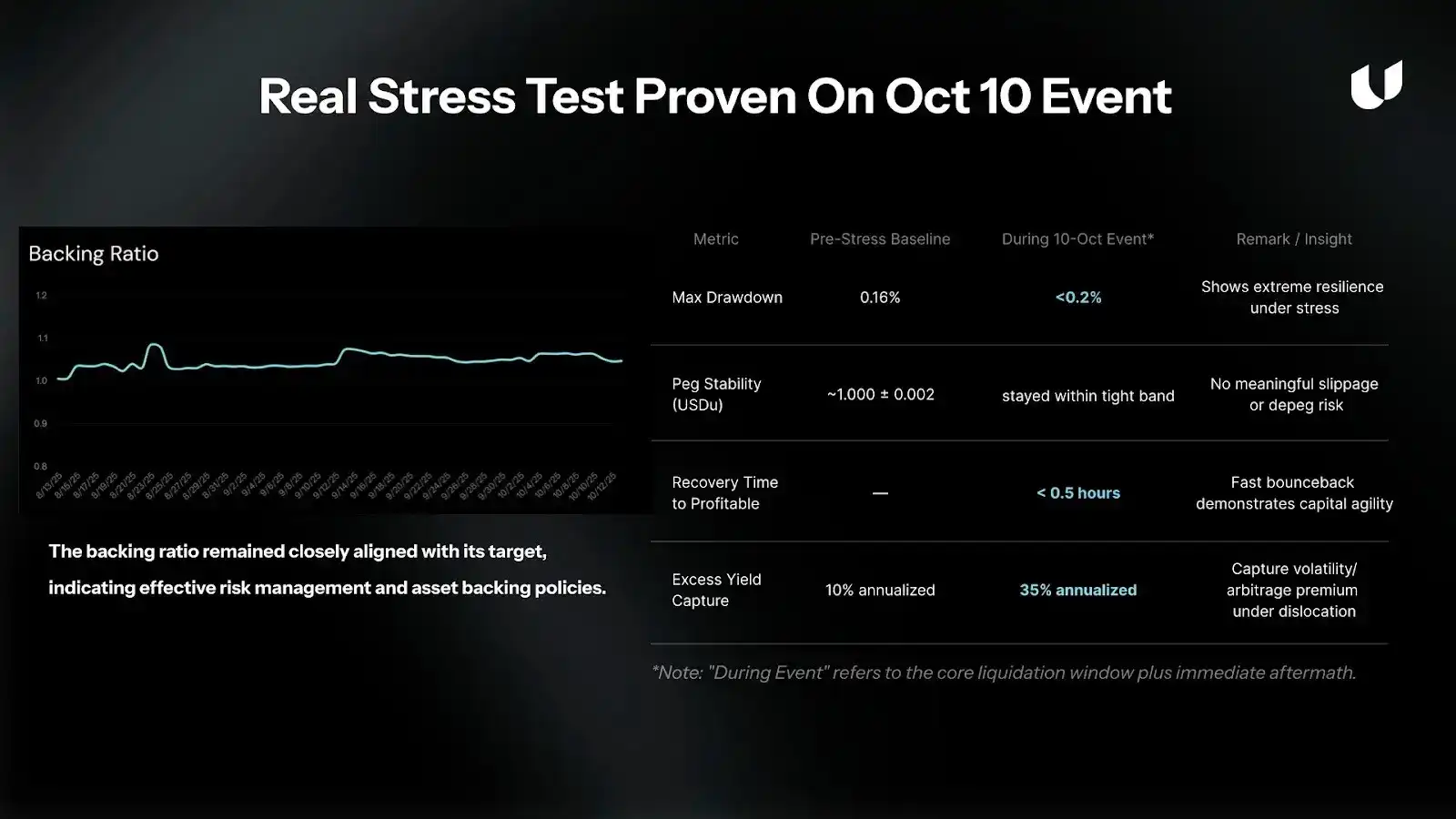
Especially during periods of extreme market volatility, such as on October 10, 2025, Unitas achieved zero actual losses through disciplined execution, with drawdowns始终控制在 0.2% 以内. This performance strongly demonstrates its实战 capability under real market depth and risk constraints, not just in experimental environments.
Transparency and Future Vision: Bridging Web3 and Traditional Finance

Unitas adheres to a high degree of audit transparency. Yield distribution is based entirely on actual performance, and collateral status and risk parameters are disclosed in real-time, eliminating "black box" concerns for users seeking long-term stable returns.

Looking ahead to 2026, Unitas's vision will extend further into the traditional finance (TradFi)领域. The platform plans deep integration with compliant institutions, treasury management platforms, and settlement systems. Its roadmap includes expanding the yield engine to real-world assets (RWA), such as tokenized stocks, commodities, and other structured notes, while maintaining consistent market-neutral logic and risk control standards.

By decoupling yield generation and distribution, Unitas aims to become the underlying cornerstone supporting savings, treasury management, and cross-border settlement, building a unified yield infrastructure spanning decentralized and traditional financial systems.


İlgili Sorular

QWhat is the core mission and vision of Unitas as described in the article?

AUnitas aims to build a global savings layer for digital assets and provide compliant, high-yield stablecoins. Its vision is to create a market-neutral yield infrastructure standard, offering professional, transparent, and institutionally risk-managed returns to users worldwide.

QHow does Unitas's modular platform differentiate itself in terms of risk and accessibility?

AUnitas provides a modular yield service that decouples capital access, asset custody, and yield execution. It operates without taking directional market risk and is designed to serve not only individual investors but also meet the stringent security and compliance needs of corporate and institutional treasuries.

QWhat is a key technological advantage of Unitas's yield engine compared to 'strategy outsourcing' models?

AA key advantage is that Unitas's core yield engine is self-developed, self-operated, and self-managed. It controls the entire lifecycle from signal generation and trade execution to real-time monitoring and risk response, unlike models that rely on third-party protocols.

QWhat were the key performance metrics achieved by Unitas in 2025, as stated in the article?

AIn 2025, with approximately $25 million in deployed capital, Unitas achieved an average net annualized yield of 16.7% while maintaining a maximum drawdown of only -0.16%.

QWhat is Unitas's future roadmap, particularly concerning integration with Traditional Finance (TradFi)?

AIn 2026, Unitas plans to deeply integrate with compliant institutions, treasury management platforms, and settlement systems. Its roadmap includes expanding its yield engine to Real World Assets (RWA) like tokenized stocks, commodities, and structured notes, all while maintaining its market-neutral logic and risk control standards.

İlgili Okumalar

Bitcoin's 'Rally Ends,' Officially Entering the Later Stage of a Bear Market?

Bitcoin prices declined 13% this week, reversing the recent rebound and signaling a likely transition into the later stages of a bear market. Key on-chain metrics deteriorated, with the short-term holder cost basis falling below the Realized Price—a pattern last seen in early 2022, characteristic of bear market maturity. The rally to ~$82k proved to be a bear market bounce, as evidenced by the 90-day realized profit/loss ratio failing to sustain above the bullish threshold of 2. Daily realized losses surged to $1.35B, including significant selling from long-term holders who accumulated near cycle tops, indicating ongoing supply redistribution. Price was rejected almost precisely at the aggregate US spot ETF cost basis of ~$83k, turning that level into resistance and leaving the average ETF investor underwater again. Spot market selling pressure intensified, with the 7-day volume delta turning significantly negative to its weakest level since February. While a major long liquidation event cleared over $400M in leverage, spot demand has not yet stepped in to absorb the resulting supply. Options markets continue pricing in higher future volatility (elevated volatility risk premium) and maintain a skew toward put options, reflecting persistent demand for downside protection, though not yet panic. Overall, market structure remains fragile. Sustained recovery likely requires a reclaim of the ETF cost basis, a shift back to positive spot demand, and a slowdown in realized loss-taking. Until then, the market risks further downside or extended consolidation within the broader bear trend.

Foresight News38 dk önce

Bitcoin's 'Rally Ends,' Officially Entering the Later Stage of a Bear Market?

Foresight News38 dk önce

How Risky is the "Death Spiral" of MSTR and STRC?

Summary: This article explores the perceived "death spiral" risk between MicroStrategy (MSTR), its Bitcoin holdings, and its perpetual preferred stock (STRC), drawing comparisons to the LUNA-UST collapse. While both systems feature price anchors, high yields for holders, and potential feedback loops, their core mechanisms differ fundamentally. The MSTR-STRC structure relies on continuous financing to sustain its high dividend payouts, primarily through stock ATM offerings. A negative feedback cycle could occur: falling MSTR stock price makes raising equity capital harder, increasing pressure to sell Bitcoin, which undermines STRC confidence and further depresses MSTR. However, unlike LUNA-UST's automated, direct linkage, the MSTR-STRC loop is weaker and has brakes: STRC dividends can be deferred or rates lowered, and STRC holders have a $100/share liquidation preference in bankruptcy, providing a price floor. The company's sustainability hinges on its ability to continue financing. Its current ~$900 million USD reserves cover only about 6.3 months of its ~$1.71 billion annual interest/dividend burden. The next six months are critical, aligning with both the potential bottom in Bitcoin's four-year cycle and the depletion timeline of its reserves. While a LUNA-style catastrophic collapse is deemed highly unlikely due to structural differences, the key question is whether MicroStrategy can navigate this period through healthy deleveraging to restart its capital engine.

Foresight News56 dk önce

How Risky is the "Death Spiral" of MSTR and STRC?

Foresight News56 dk önce

How Much Debt Does Strategy Really Have? Is There a Risk of Implosion?

MicroStrategy's Debt Risk: A Turning Point in the "Never Sell" Strategy As of June 3, 2026, MicroStrategy holds 843,706 bitcoins (valued at ~$53.1B) but faces significant financial obligations. Its capital structure includes $6.75B in convertible notes and $15.48B in perpetual preferred stock (led by the $8.5B STRC series), creating an annual payout burden of ~$1.71B. With software revenue at only ~$500M, interest and dividend obligations far exceed operating income. A critical shift occurred in late May 2026 when the company sold 32 bitcoins for ~$2.5M to cover dividends, breaking CEO Michael Saylor's long-standing "never sell" pledge. This symbolic move triggered a sharp decline in both Bitcoin's price and MSTR stock, reflecting market fears about cash flow sustainability. The core of the strain is the STRC perpetual preferred stock, designed as a "permanent loan" with no maturity date but requiring high monthly dividends (currently 11.5%). Its business model relies on a three-part cycle: issuing new STRC shares, using proceeds to buy more Bitcoin and fund a USD reserve, and using that reserve to pay dividends. This cycle depends on continuous investor demand for STRC and Bitcoin's price appreciation. Analysis shows Bitcoin needs to appreciate at least 2.3% annually to cover the $1.71B in yearly obligations at current holdings. With Bitcoin price down ~22% from March 2026 highs, this pressure has intensified. The company's $900M USD reserve can only cover about 7 months of payments if STRC issuance stalls. Key risks are not immediate bankruptcy or forced Bitcoin liquidation (as BTC is not collateral), but rather: 1) The erosion of MSTR's premium to its Bitcoin holdings (mNAV), which would cripple its ability to raise cheap capital; 2) A vicious cycle where stagnant Bitcoin prices reduce STRC demand, draining the USD reserve and forcing BTC sales, further depressing prices. The period from February 2027 to September 2028 is a crucial test, with over $5.9B in convertible notes facing put options or maturity. In essence, MicroStrategy has evolved from a simple Bitcoin holder into a complex financial entity acting like a "private Bitcoin bank," leveraging its BTC holdings to create layered financial products. Its survival depends on maintaining Bitcoin's price trend, its stock premium, and market appetite for its preferred shares. The recent token sale marks not a betrayal of its Bitcoin thesis, but an admission that the leveraged strategy must eventually be paid for.

marsbit1 saat önce

How Much Debt Does Strategy Really Have? Is There a Risk of Implosion?

marsbit1 saat önce

İşlemler

Spot
Futures

Popüler Makaleler

LAYER Nasıl Satın Alınır

HTX.com’a hoş geldiniz! Solayer (LAYER) satın alma işlemlerini basit ve kullanışlı bir hâle getirdik. Adım adım açıkladığımız rehberimizi takip ederek kripto yolculuğunuza başlayın. 1. Adım: HTX Hesabınızı OluşturunHTX'te ücretsiz bir hesap açmak için e-posta adresinizi veya telefon numaranızı kullanın. Sorunsuzca kaydolun ve tüm özelliklerin kilidini açın. Hesabımı Aç2. Adım: Kripto Satın Al Bölümüne Gidin ve Ödeme Yönteminizi SeçinKredi/Banka Kartı: Visa veya Mastercard'ınızı kullanarak anında Solayer (LAYER) satın alın.Bakiye: Sorunsuz bir şekilde işlem yapmak için HTX hesap bakiyenizdeki fonları kullanın.Üçüncü Taraflar: Kullanımı kolaylaştırmak için Google Pay ve Apple Pay gibi popüler ödeme yöntemlerini ekledik.P2P: HTX'teki diğer kullanıcılarla doğrudan işlem yapın.Borsa Dışı (OTC): Yatırımcılar için kişiye özel hizmetler ve rekabetçi döviz kurları sunuyoruz.3. Adım: Solayer (LAYER) Varlıklarınızı SaklayınSolayer (LAYER) satın aldıktan sonra HTX hesabınızda saklayın. Alternatif olarak, blok zinciri transferi yoluyla başka bir yere gönderebilir veya diğer kripto para birimlerini takas etmek için kullanabilirsiniz.4. Adım: Solayer (LAYER) Varlıklarınızla İşlem YapınHTX'in spot piyasasında Solayer (LAYER) ile kolayca işlemler yapın.Hesabınıza erişin, işlem çiftinizi seçin, işlemlerinizi gerçekleştirin ve gerçek zamanlı olarak izleyin. Hem yeni başlayanlar hem de deneyimli yatırımcılar için kullanıcı dostu bir deneyim sunuyoruz.

303 Toplam GörüntülenmeYayınlanma 2025.02.11Güncellenme 2026.06.02

LAYER Nasıl Satın Alınır

Tartışmalar

HTX Topluluğuna hoş geldiniz. Burada, en son platform gelişmeleri hakkında bilgi sahibi olabilir ve profesyonel piyasa görüşlerine erişebilirsiniz. Kullanıcıların LAYER (LAYER) fiyatı hakkındaki görüşleri aşağıda sunulmaktadır.

活动图片