Original | Odaily Planet Daily(@OdailyChina)
Author | Golem(@web3_golem)

Uniswap is about to launch a token issuance platform on Robinhood Chain.
On July 30th, Uniswap launched the Launches tab for Robinhood Chain Meme aggregation on its official website. Users can view Memes issued by different token issuance platforms like Bankr, Pons, Long, etc., on Robinhood Chain under this tab. As the trading infrastructure behind Robinhood Chain Memes, it was initially thought that Uniswap was still practicing "restraint," not competing with token issuance platforms for market share. However, the community discovered it has been quietly "recruiting."
On July 31st, according to disclosures by crypto KOL "0xSLK," Uniswap is developing a token issuance platform named Pools.trade on Robinhood Chain. The official website is already live but the product has not officially launched yet. The Pools.trade website interface only features a frog "playing" by a pond and the phrase "Coming soon."

"0xSLK" also discovered that the domain Pools.trade was registered on July 17, 2026, and the website uses the noindex tag , meaning Uniswap is deliberately hiding this matter.(Odaily Note: noindex is an instruction for search engines. When a search engine crawler sees this instruction, it can crawl the webpage but will not index it or display it in search results)
This "protesting too much" operation has piqued the community's curiosity even more. @0xSLK found that the frog video file on the website is located under a path named rh-cca/frong.mp4, and Pools.trade contains numerous internal strings prefixed with rhcca.*, strongly suggesting that "rh" refers to Robinhood. "cca" likely stands for Uniswap's Continuous Clearing Auction. Subsequently, the community even discovered the product slogan "Pools - create a token on Robinhood Chain" in the Pools.trade front-end code.
Seeing that it could no longer be hidden, on August 4th, Uniswap founder Hayden Adams directly responded to the community's question about when Pools.trade would launch with "very soon," confirming all previous community speculations.
Pools.trade Mechanism Introduction
According to disclosures by crypto KOL "0xSLK," Pools.trade is expected to have two token issuance modes after its official launch.
Crowd Launch
Crowd Launch uses a 4-hour auction mechanism with a fixed supply of 1 billion tokens. 50% is allocated for the auction, and the remaining 50%, along with the raised funds, is used to establish a Uniswap v4 liquidity pool. This portion of liquidity will be permanently locked. If the token's market capitalization reaches $50,000, it can migrate to Uniswap and open for trading; otherwise, participants can receive a full refund.
This auction employs time-weighted bidding, aiming to ensure all participants obtain the same final clearing price while reducing bottom-bunching behavior.
Instant Launch
Instant Launch is more similar to Pump.fun's Bonding Curve model, allowing users to trade immediately. 80% of the token supply is allocated for user trading, and the remaining 20% is used for liquidity building. Similarly, after reaching a market cap of $50,000, it can migrate to Uniswap v4. Unlike Crowd Launch, Instant Launch has no deadline and no refunds.
Furthermore, @0xSLK discovered more information, such as the ability to fundraise using ETH and USDG, with a protocol fee of 0.25% and a creator fee of 0.05%.
Pools-related on-chain infrastructure has been deployed to Robinhood Chain. Uniswap official documentation shows that the related contracts include CCA Factory, LiquidityLauncher, and LBPStrategy, among others. Currently, the community has found that it is possible to issue tokens by bypassing the Pools.trade front-end. Data shows that Pools.trade has already completed the creation and migration of hundreds of tokens, and several Pools-related concept Meme coins have appeared on the market, but none have been officially claimed.
Uniswap Not Content Just Behind the Scenes
Why would Uniswap want to compete with token issuance platforms on Robinhood Chain?
Uniswap does have its position within the Robinhood Chain ecosystem, firmly holding the top spot as the leading DEX. According to Dune data, over 95% of DEX transactions on Robinhood Chain occur on Uniswap. Since Robinhood Chain launched, trading volume on Uniswap protocol for Robinhood Chain has exceeded $10 billion.
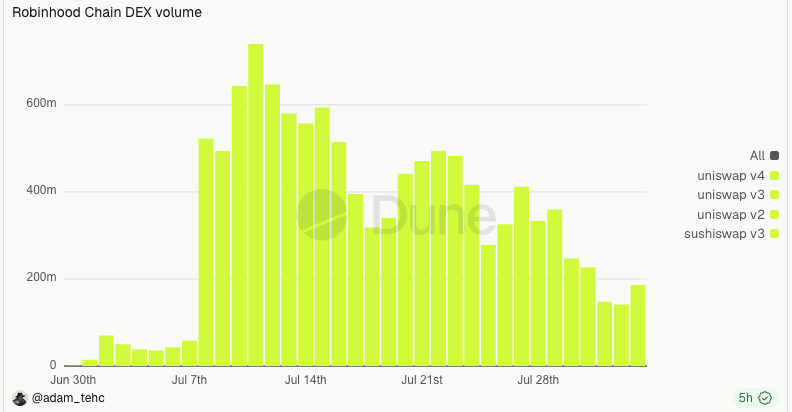
The numbers look impressive—Uniswap handles most of the trading volume on Robinhood Chain—but its revenue does not match its effort.
According to DeFiLlama data, Uniswap's total revenue over the past 30 days was $4.45 million, while Robinhood Chain token issuance platform Flap earned $4.41 million, and Pons earned $4.32 million. On the surface, Uniswap's revenue seems decent. However, it's important to note that this is Uniswap's total revenue across all EVM chains over the past 30 days. Flap and Pons primarily operate on Robinhood Chain, and the tokens they issue all migrate to Uniswap. Yet, their monthly revenues are comparable to Uniswap's.

Comparison of Uniswap, Flap, and Pons revenue over the past 30 days
Shrinking the comparison to the past 7 days, the difference in "money-printing ability" becomes even more apparent. Flap's total revenue over the past 7 days was $2.68 million, while Uniswap's was only $1.84 million. Over the past 7 days, Flap has consistently held the second position among Robinhood Chain token issuance platforms. However, on August 3rd, the number of tokens issued on the Flap platform surpassed Pons for the first time, taking the top spot in terms of token issuance volume on Robinhood Chain.

Comparison of Uniswap and Flap revenue over the past 7 days
In summary, Uniswap's decision to extend from its core DEX business into the token issuance platform domain can be analyzed from two dimensions: market returns and its own capabilities.
On one hand, the Launchpad sector has recently demonstrated significant revenue potential. In the early days of Robinhood Chain's launch, the independently developed token issuance platform NOXA, by being first to market, achieved over $13 million in revenue within 10 days. (Recommended reading: "Revenue Surpasses Pump.fun for 5 Consecutive Days, The Lone Wolf Developer Behind NOXA's Comeback"))
On the other hand, compared to Launchpads, DEXs typically require higher resource investment in technical development, operation and maintenance, and cost control. Uniswap already possesses mature infrastructure and operational experience in these areas. With its capital reserves, technical talent team, and management capabilities, Uniswap theoretically has the potential to reshape the existing market landscape.
However, the actual execution results remain to be seen. After all, Uniswap previously integrated the CCA (Continuous Clearing Auction) token issuance mechanism on Robinhood Chain on July 13th, which received a relatively muted market response. Whether this newly launched Pools.trade can achieve different results needs to be observed after its official launch.
Additionally, it is noteworthy that as a foundational liquidity protocol, if Uniswap extends its business boundaries upwards into the token issuance stage, it could potentially impact its existing cooperative relationships with upper-layer issuance platforms. If these platforms view Uniswap as a direct competitor, they might theoretically adjust their token liquidity deployment strategies, such as reducing or stopping migrating tokens to Uniswap. In that case, Uniswap could end up losing more than it gains.