Uniswap Founder Believes Tokenization Is the Next Major Challenge for AMM Market Makers

cryptonews.ru2026-08-26 tarihinde yayınlandı2026-08-26 tarihinde güncellendi

Özet

Uniswap founder Hayden Adams believes tokenization will be the next major challenge for automated market makers (AMMs), which are still in their early stages. AMMs, facilitating billions in daily trades on decentralized exchanges (DEXs), could be key for providing liquidity to tokenized real-world assets (RWAs) moving onto public blockchains. Tokenized assets, particularly U.S. Treasuries via funds like BlackRock's BUIDL, are growing rapidly, with an estimated $18 billion in risk-weighted RWA on-chain by January 2026. Regulatory clarity in the U.S. (e.g., the GENIUS Act, SEC reforms) and frameworks in Europe and Asia are supporting this growth. However, AMMs face hurdles. Liquidity on platforms like Uniswap V3 remains concentrated among a small group of sophisticated providers. Tokenization itself does not guarantee liquidity; active market-making is still required, and many tokenized products are limited to accredited investors with thin secondary markets. A major unresolved issue is regulation. Industry groups like SIFMA argue AMM functions—such as order routing, pricing, and settlement—could fall under securities laws. How regulators treat AMMs will determine whether Adams's vision for tokenized asset trading is realized on public blockchains or within regulated exchanges.

Uniswap noted that its founder, Hayden Adams, believes tokenization will change the way liquidity is provided in both cryptocurrency and traditional markets, while automated market makers (AMMs) are still in their early stages.

This is significant given that automated market makers handle billions of dollars in transactions daily and could play a crucial role in processing tokenized real-world assets transferred to public blockchains.

Automated Market Makers (AMMs) enable decentralized exchanges to provide pooled user deposits and set prices without using an order book to match buyers and sellers. According to a working paper published by the Bank for International Settlements (BIS) in November 2024, AMM-based decentralized exchanges process over $10 billion in digital assets daily.

If real-world assets (RWA) are to move on-chain, these markets will also require robust liquidity. Automated Market Makers (AMMs) are one of the few solutions capable of providing liquidity at scale.

Tokenized Assets Are Already Entering Global Markets

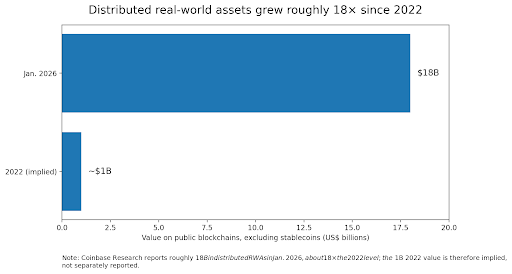
According to Coinbase Research, approximately $18 billion in "distributed" risk-weighted assets (RWA), excluding stablecoins, were on public blockchains as of January 2026—an 18-fold increase from 2022. A large portion of this amount comprises tokenized U.S. Treasury bonds. According to Coinbase data, BlackRock's BUIDL fund holds over $2 billion of such bonds, representing nearly 25% of the total tokenized Treasury bond volume.
Regulatory frameworks are also becoming much more DeFi-friendly. Coinbase points out that with the passage of the 2025 GENIUS Act and the SEC reform led by Paul Atkins, conditions for digital assets and tokenized financial assets in the U.S. have become more favorable. In Europe, MiCA exists alongside the DLT Pilot Regime, while Singapore's Project Guardian and the UAE's VARA framework are fostering tokenization hubs in Asia.

Market infrastructure is improving. On July 15, the Depository Trust & Clearing Corporation (DTCC) announced the conversion of assets held in its depository into tokens to be used in real trading operations involving over 30 traditional and digital market firms. DTCC plans to launch its tokenization service in October 2026.

Why AMMs Are Still Searching for Early-Stage Models

The "early stages" aspect of Adams's argument stems from the current functioning of AMMs.

According to the BIS study, a small group of sophisticated participants provided between 65% and 85% of the liquidity on Uniswap V3. Orders from these participants acted like typical buyers or sellers and generated significantly higher profits than retail liquidity providers.

Despite automated market makers democratizing the market-making process, liquidity has consolidated in the hands of specialists, similar to traditional financial markets.

Furthermore, tokenization itself does not guarantee liquidity. As Cryptopolitan notes in its article "Why Tokenized Assets Are Not Liquid Yet," tokenizing an asset means it is transferable, but it does not mean it is easy to trade.

On-chain markets still require market makers willing to provide two-sided quotes and hold inventory. Many tokenized funds, as well as bonds, remain available only to accredited investors and individual issuers, with secondary trading possible only on a limited volume of tokens.

The Regulatory Question Hanging Over On-Chain Trading

The question of whether automated market makers are legitimate venues for listing tokenized securities remains far from clear.

In a March 30, 2026, letter to the SEC's crypto task force, the Securities Industry and Financial Markets Association (SIFMA) argued that regulators should focus on the protocol's functions rather than the absence of decentralization, and that functions such as order routing, execution, pricing, and settlement could well fall under securities laws.

SIFMA expressed concerns about slippage, incentives for liquidity providers, pseudonymous trading, and limited oversight over potential market manipulation.

This is a critical issue because its resolution will define the future development of tokenized asset markets. The launch of DTCC's own spot trading service in October 2026 indicates that the SEC's approach to automated market makers (AMMs) will determine whether Adams's proposed market-making innovation is realized on a public blockchain or within a regulated exchange.


İlgili Sorular

QWhat is the main point of Uniswap founder Hayden Adams regarding tokenization, according to the article?

AHayden Adams believes that tokenization will change the way liquidity is provided in both cryptocurrency and traditional markets, and that Automated Market Makers (AMMs) are still at the very beginning stages of development.

QWhat role does the article suggest AMMs could play in the context of tokenized real-world assets (RWAs)?

AThe article suggests that AMMs could play a major role in providing the necessary robust liquidity at scale for markets involving tokenized real-world assets (RWAs) on public blockchains.

QAccording to the BIS working paper cited, how much in digital assets do AMM-based decentralized exchanges handle daily?

AAccording to the BIS working paper cited, AMM-based decentralized exchanges handle over $10 billion worth of digital assets daily.

QWhat is a key criticism or current limitation of AMMs mentioned in the article, as shown by research on Uniswap V3?

AA key limitation is that liquidity provision is not fully democratized; research shows that a small group of sophisticated participants provided 65% to 85% of the liquidity on Uniswap V3, earning higher profits than retail liquidity providers, mirroring concentration in traditional finance.

QWhat major regulatory concern regarding AMMs hosting tokenized securities is raised by SIFMA in the article?

ASIFMA is concerned that core functions of AMM protocols—like order routing, execution, price determination, and settlement—could fall under securities laws. They raised specific concerns about issues like slippage, liquidity provider incentives, anonymous trading, and limited controls for market manipulation.

İlgili Okumalar

Hubei State-Owned Assets Achieve the Largest Return in History

After years of anticipation, Yangtze Memory Holdings Co., Ltd. (YMTC) has filed for an IPO on Shanghai's STAR Market, seeking to raise 33 billion yuan—the largest offering in the board's history. This move follows the recent listing of its peer, ChangXin Memory Technologies (CXMT), which reached a market valuation exceeding 4 trillion yuan. Dubbed the "twin stars of domestic memory," both companies, founded in 2016 in Hefei and Wuhan respectively, symbolize China's push for semiconductor self-sufficiency. YMTC's journey began with its predecessor, Wuhan Xinxin, established in 2006. Backed by substantial state investment from Hubei and Wuhan, it evolved into a national memory base. The company achieved key technological breakthroughs, and now ranks as the world's third-largest and China's top NAND Flash manufacturer by sales. Its recent financials are strong, with Q1 2026 revenue of 47.04 billion yuan and net profit of 33.38 billion yuan. Post-IPO, its market value is widely expected to surpass 1 trillion yuan. The potential windfall highlights the success of long-term, patient capital from Hubei's state-owned entities. Key shareholders like Hubei Changsheng, Xintech, and government-backed funds have supported YMTC through years of development. Their collective stake could be worth hundreds of billions after the listing. This model mirrors other successes in Wuhan, such as Huagong Tech, where local state investment during a low point later yielded massive returns. The story reflects a broader national trend of regional transformation through strategic, high-tech investments. Hefei's bet on CXMT, now worth over 3.7 trillion yuan, propelled the city's A-share market cap to 4th nationally, showcasing how a major firm can reshape an entire local industry ecosystem. Similarly, Wuhan's photoelectronics cluster, now worth over 850 billion yuan, aims to become a world-class hub. The takeaway is clear: in the reshuffling of Chinese cities, patient, courageous state investment in core technologies—from memory chips to advanced manufacturing—is proving to be a decisive factor, turning long-term visions into economic reality.

marsbit9 dk önce

Hubei State-Owned Assets Achieve the Largest Return in History

marsbit9 dk önce

The Myth of AI Investment Collapses

"The AI Investment Myth Bursts: The Swift Collapse of a $45 Billion Fund The high-flying hedge fund Situational Awareness (SA), founded by 24-year-old former OpenAI researcher Leopold Aschenbrenner, neared total collapse in late July. Once a Wall Street darling, the fund saw its assets under management rocket from $1.5 billion to $45 billion in under a year, driven by a massively leveraged bet on the AI boom. Its core strategy was a 'Texas hedge'—simultaneously buying stocks seen as AI beneficiaries (like chipmakers) and shorting those deemed AI victims (like certain software firms). In reality, both sides of this trade were dependent on unbroken market confidence in AI. This strategy generated staggering returns, peaking at 439% year-to-date. However, it concealed extreme concentration, high leverage (reportedly 3-to-1), and liquidity risks from illiquid private holdings like Anthropic. When semiconductor stocks corrected sharply in late July, SA's long positions plummeted. Simultaneously, its short bets failed as 'AI victim' stocks rose, causing losses on both sides. The fund faced immediate, massive margin calls. With minutes to spare before a forced liquidation by its prime brokers, SA sold its entire public market portfolio at a discount to Citadel on July 30, narrowly avoiding a market-wide cascade. The fund's value crashed from $45 billion to roughly $10 billion (excluding its remaining Anthropic stake). The episode exposes the systemic risks embedded in the frenzied, highly leveraged chase for AI returns. It serves as a stark reminder of the old Wall Street adage: markets can stay irrational longer than investors can stay solvent. The crisis shifts focus from Aschenbrenner's AI predictions to whether capital markets will continue ignoring such dangerous concentration and leverage in pursuit of the next 'sure thing' narrative."

marsbit10 dk önce

The Myth of AI Investment Collapses

marsbit10 dk önce

İşlemler

Spot
活动图片