Uniswap fee switch to go live as community vote set to pass

cointelegraph2025-12-22 tarihinde yayınlandı2025-12-22 tarihinde güncellendi

Özet

The highly-anticipated Uniswap "UNIfication" governance proposal is set to pass, having received over 62 million favorable votes, far exceeding the required 40 million threshold. The proposal will activate the protocol fee switch, leading to the burning of 100 million UNI tokens from the Uniswap Foundation’s treasury. It also introduces a Protocol Fee Discount Auctions system to boost liquidity provider returns. These changes aim to improve UNI’s supply-demand dynamics and long-term value. Since voting began, UNI’s price has risen around 25%, trading at $6.08. The proposal received strong support from major crypto figures, with minimal opposition. The Uniswap Foundation assured that protocol development remains a priority and will create a Growth Budget using 20 million UNI tokens.

The highly-anticipated Uniswap protocol fee switch, dubbed “UNIfication,” is set to pass and go live later this week, having reached the 40 million vote threshold needed to trigger one of the biggest upgrades in the decentralized exchange protocol’s seven-year history.

As of early Monday, nearly 62 million votes have already been cast in favor of the UNIfication governance proposal since voting opened on Dec. 20, with voting set to close on Thursday, Christmas Day.

Uniswap Labs CEO Hayden Adams said on Thursday that a successful vote would follow a two-day timelock period in which Uniswap v2 and v3 fee switches would flip on the Unichain mainnet, triggering the burning of more Uniswap (UNI) tokens.

The proposal will see 100 million UNI tokens burned from the Uniswap Foundation’s treasury, while a Protocol Fee Discount Auctions system to increase liquidity provider returns would also be implemented.

The changes are expected to significantly improve the supply-demand dynamics of the UNI token and make it a more appealing token to hold over the long-term.

UNI has gained around 25% since the UNIfication voting opened, and is currently trading at $6.08, helping to pull it out of a month-long slump amid a broader market pullback that saw it fall to a seventh month low of $4.88.
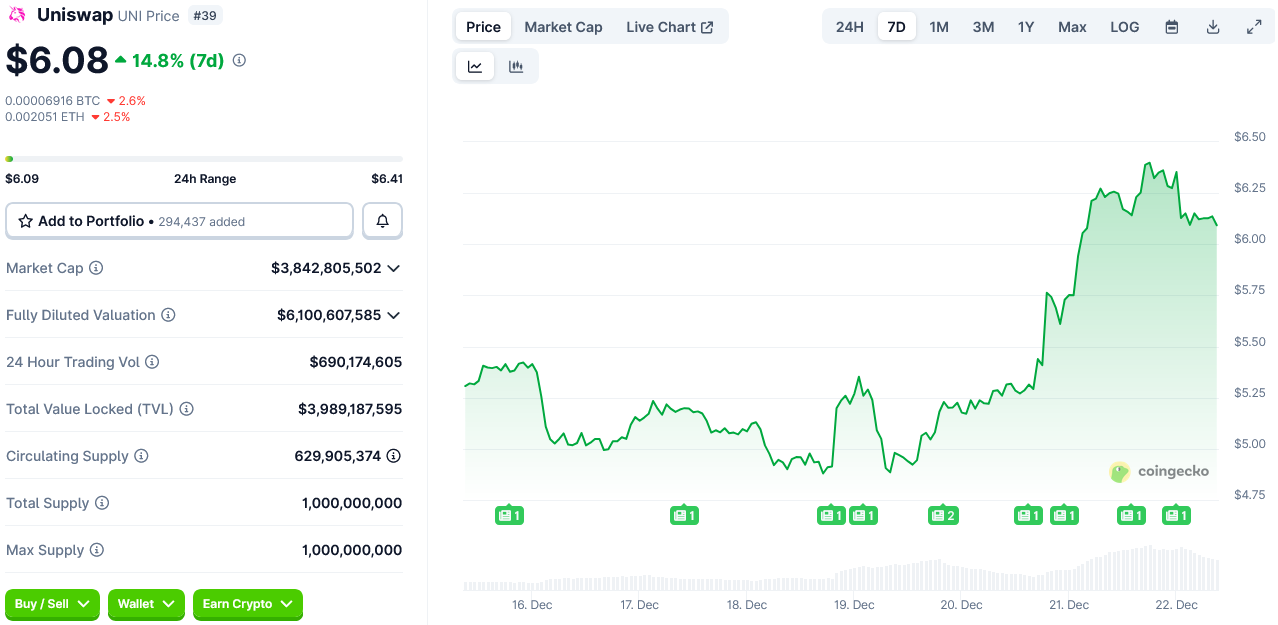
Change in UNI’s price over the last week. Source: CoinGecko

News of the UNIfication proposal in early November spurred a near 40% rally in the UNI token, taking it from about $7 to $9.70 on Nov. 11.

Uniswap is the largest decentralized exchange and has processed more than $4 trillion in trading volume since launching in November 2018. CoinGecko data shows that UNI is the 39th largest token by market cap, at $3.8 billion.

Big names back UNIfication proposal

Several crypto heavyweights with significant voting power backed the UNIfication proposal, including Jesse Waldren, founder and managing partner at crypto-focused venture capital firm Variant, Kain Warwick, the founder of decentralized finance protocols Infinex and Synthetix, and Ian Lapham, who previously worked as an engineer at Uniswap Labs.

Related: Altcoin season never ended, traders just missed the winners: Hayes

Only 741 votes, about 0.001% of those cast, have opposed the proposal so far, while a little over 1.5 million votes have abstained.
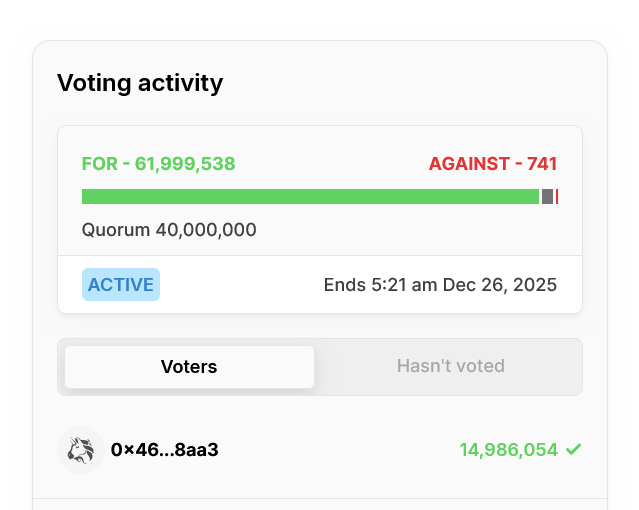
Vote distribution for the UNIfication proposal as of late Sunday. Source: Uniswap


Uniswap will still prioritize protocol development

At the time the proposal was made, the Uniswap Foundation assured builders that it wouldn’t scrap issuing grants to improve protocol development and growth, stating that supporting builders would remain a priority.

The Uniswap Foundation plans to create a Growth Budget to meet these goals, which would involve distributing 20 million UNI tokens.

Magazine: 11 critical moments in Ethereum’s history that made it the No.2 blockchain

İlgili Sorular

QWhat is the name of the Uniswap governance proposal that is set to pass, and what is its primary purpose?

AThe proposal is called 'UNIfication.' Its primary purpose is to activate the protocol fee switch, which will burn UNI tokens and implement a Protocol Fee Discount Auctions system to increase liquidity provider returns.

QHow many votes were required for the UNIfication proposal to pass, and how many have been cast in favor so far?

AThe proposal required 40 million votes to pass. As of early Monday, nearly 62 million votes have been cast in favor of it.

QWhat are the two main changes that will occur if the UNIfication proposal is successfully implemented?

AFirst, 100 million UNI tokens will be burned from the Uniswap Foundation's treasury. Second, a Protocol Fee Discount Auctions system will be implemented to increase returns for liquidity providers.

QHow has the price of the UNI token reacted to the news of the UNIfication proposal?

AThe UNI token gained around 25% since the voting opened, rising from a seven-month low of $4.88 to trade at $6.08, helping it recover from a prolonged slump.

QWhich prominent figures in the crypto industry have publicly backed the UNIfication proposal?

AProminent backers include Jesse Waldren (founder of Variant), Kain Warwick (founder of Infinex and Synthetix), and Ian Lapham (a former Uniswap Labs engineer).

İlgili Okumalar

In Jinjiang, Fujian, a Storage Super Unicorn Lies Quiet

In Fujian's Jinjiang, a city known for sportswear, lies a quiet semiconductor giant: Fujian Jinhua Integrated Circuit Co. (JHICC). Once a promising domestic DRAM manufacturer alongside Yangtze Memory and ChangXin Memory Technologies (CXMT), its journey was derailed in 2018 when the U.S. placed it on an Entity List and filed criminal charges for alleged trade secret theft. This halted production for years. A turning point came in February 2024 when a U.S. federal court found JHICC not guilty. However, it had lost crucial time. While CXMT soared to become a top-valued A-share company in 2024, JHICC, with an estimated valuation of 80 billion RMB, was just restarting. Its current output is primarily customized DDR4 chips, not the advanced DDR5/HBM demanded for AI, but it still benefits from the broader memory chip upcycle. JHICC's story is tied to Chen Zhengkun, a veteran engineer who left Micron to lead the venture. Founded in 2016 with state-backed funding, JHICC partnered with Taiwan's UMC to develop DRAM technology. Rapid progress was cut short by the U.S. actions, which Micron initiated, partly due to its heavy reliance on the Chinese market. Post-sanctions, Chen's team worked to rebuild the production line with reduced reliance on U.S. technology. According to its records, JHICC achieved small-scale production and revenue growth under immense pressure. It now focuses on the stable "niche" DRAM market (e.g., TVs, routers) with a monthly capacity of ~40,000 wafers, aiming for 60,000 by 2026. It holds over 1,000 patents but remains on the Entity List. For Jinjiang, investing in JHICC was a bold industrial leap. The local government provided unwavering financial and logistical support during the crisis, helping the company survive. JHICC has become the anchor for a growing local semiconductor cluster. Though its scale lags behind domestic peers, JHICC's persistence symbolizes a hard-won foothold in a global market long dominated by Samsung, SK Hynix, and Micron. Having missed one boom, it seeks a place in the new AI-driven memory supercycle.

marsbit1 saat önce

In Jinjiang, Fujian, a Storage Super Unicorn Lies Quiet

marsbit1 saat önce

İşlemler

Spot
活动图片





