Uniswap fee switch to go live as community vote set to pass

cointelegraph2025-12-22 tarihinde yayınlandı2025-12-22 tarihinde güncellendi

Özet

The highly-anticipated Uniswap "UNIfication" governance proposal is set to pass, having received over 62 million favorable votes, far exceeding the required 40 million threshold. The proposal will activate the protocol fee switch, leading to the burning of 100 million UNI tokens from the Uniswap Foundation’s treasury. It also introduces a Protocol Fee Discount Auctions system to boost liquidity provider returns. These changes aim to improve UNI’s supply-demand dynamics and long-term value. Since voting began, UNI’s price has risen around 25%, trading at $6.08. The proposal received strong support from major crypto figures, with minimal opposition. The Uniswap Foundation assured that protocol development remains a priority and will create a Growth Budget using 20 million UNI tokens.

The highly-anticipated Uniswap protocol fee switch, dubbed “UNIfication,” is set to pass and go live later this week, having reached the 40 million vote threshold needed to trigger one of the biggest upgrades in the decentralized exchange protocol’s seven-year history.

As of early Monday, nearly 62 million votes have already been cast in favor of the UNIfication governance proposal since voting opened on Dec. 20, with voting set to close on Thursday, Christmas Day.

Uniswap Labs CEO Hayden Adams said on Thursday that a successful vote would follow a two-day timelock period in which Uniswap v2 and v3 fee switches would flip on the Unichain mainnet, triggering the burning of more Uniswap (UNI) tokens.

The proposal will see 100 million UNI tokens burned from the Uniswap Foundation’s treasury, while a Protocol Fee Discount Auctions system to increase liquidity provider returns would also be implemented.

The changes are expected to significantly improve the supply-demand dynamics of the UNI token and make it a more appealing token to hold over the long-term.

UNI has gained around 25% since the UNIfication voting opened, and is currently trading at $6.08, helping to pull it out of a month-long slump amid a broader market pullback that saw it fall to a seventh month low of $4.88.
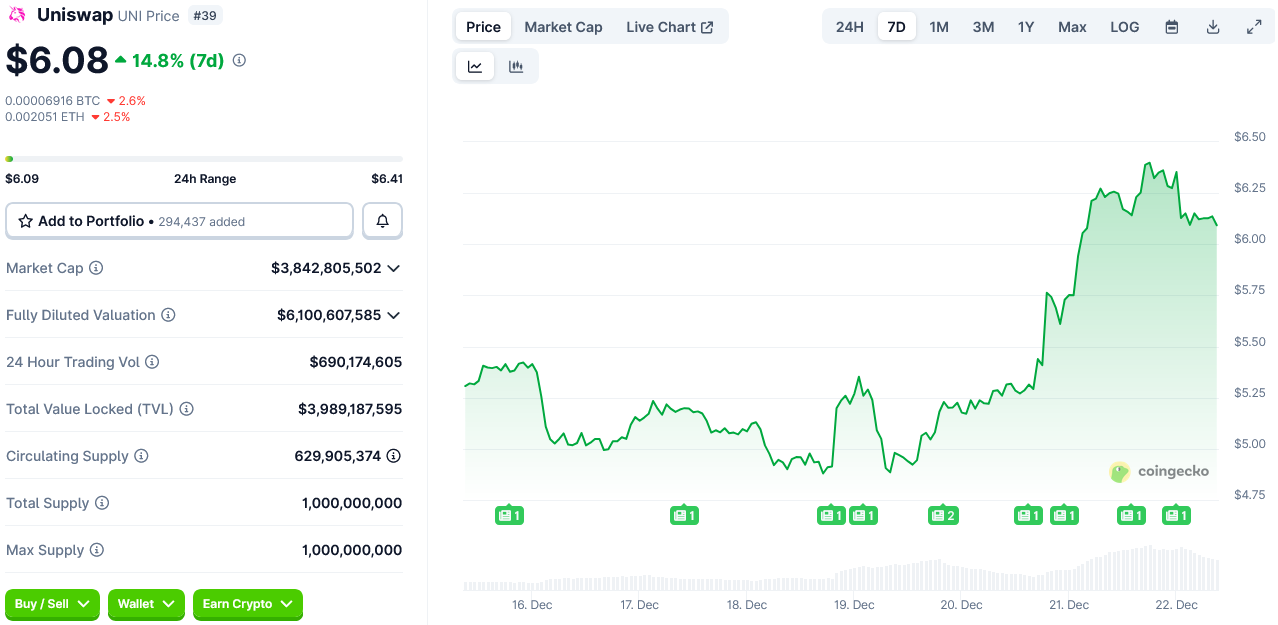
Change in UNI’s price over the last week. Source: CoinGecko

News of the UNIfication proposal in early November spurred a near 40% rally in the UNI token, taking it from about $7 to $9.70 on Nov. 11.

Uniswap is the largest decentralized exchange and has processed more than $4 trillion in trading volume since launching in November 2018. CoinGecko data shows that UNI is the 39th largest token by market cap, at $3.8 billion.

Big names back UNIfication proposal

Several crypto heavyweights with significant voting power backed the UNIfication proposal, including Jesse Waldren, founder and managing partner at crypto-focused venture capital firm Variant, Kain Warwick, the founder of decentralized finance protocols Infinex and Synthetix, and Ian Lapham, who previously worked as an engineer at Uniswap Labs.

Related: Altcoin season never ended, traders just missed the winners: Hayes

Only 741 votes, about 0.001% of those cast, have opposed the proposal so far, while a little over 1.5 million votes have abstained.
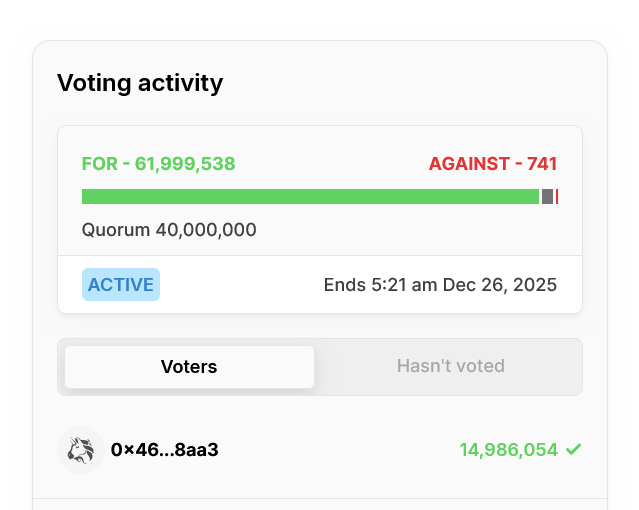
Vote distribution for the UNIfication proposal as of late Sunday. Source: Uniswap


Uniswap will still prioritize protocol development

At the time the proposal was made, the Uniswap Foundation assured builders that it wouldn’t scrap issuing grants to improve protocol development and growth, stating that supporting builders would remain a priority.

The Uniswap Foundation plans to create a Growth Budget to meet these goals, which would involve distributing 20 million UNI tokens.

Magazine: 11 critical moments in Ethereum’s history that made it the No.2 blockchain

İlgili Sorular

QWhat is the name of the Uniswap governance proposal that is set to pass, and what is its primary purpose?

AThe proposal is called 'UNIfication.' Its primary purpose is to activate the protocol fee switch, which will burn UNI tokens and implement a Protocol Fee Discount Auctions system to increase liquidity provider returns.

QHow many votes were required for the UNIfication proposal to pass, and how many have been cast in favor so far?

AThe proposal required 40 million votes to pass. As of early Monday, nearly 62 million votes have been cast in favor of it.

QWhat are the two main changes that will occur if the UNIfication proposal is successfully implemented?

AFirst, 100 million UNI tokens will be burned from the Uniswap Foundation's treasury. Second, a Protocol Fee Discount Auctions system will be implemented to increase returns for liquidity providers.

QHow has the price of the UNI token reacted to the news of the UNIfication proposal?

AThe UNI token gained around 25% since the voting opened, rising from a seven-month low of $4.88 to trade at $6.08, helping it recover from a prolonged slump.

QWhich prominent figures in the crypto industry have publicly backed the UNIfication proposal?

AProminent backers include Jesse Waldren (founder of Variant), Kain Warwick (founder of Infinex and Synthetix), and Ian Lapham (a former Uniswap Labs engineer).

İlgili Okumalar

Stablecoins Are the 'Royalists' of the Crypto World: Open USD Brings the Old Monetary System into the Fray

Title: Stablecoins Are the "Royalists" of the Crypto World: Open USD Brings the Old Monetary System into the Fray The article analyzes the launch of Open USD, a new dollar-pegged stablecoin backed by a coalition of over 140 traditional financial, payment, and tech giants like Visa, BlackRock, and Google. Author Hu Yilin argues that stablecoins like Open USD represent not a "moderate" wing of the crypto revolution, but a "royalist reform" within the old monetary system. He posits that while stablecoins adopt blockchain's efficiency, programmability, and borderless nature, they fundamentally reinforce the US dollar's centrality and the Federal Reserve's authority. They aim to replace inefficient "bureaucrats" (like traditional payment networks) rather than challenge the "monarch" (the dollar-based system). Thus, Open USD symbolizes the old system co-opting blockchain technology to upgrade dollar hegemony, potentially marginalizing native crypto projects like Circle's USDC. Hu contrasts this with more revolutionary paths, like a "Bitcoin standard," which seeks to change the monetary base itself. He warns that if the crypto ecosystem's unit of account, collateral, and value anchor remain dollar-denominated stablecoins,链上繁荣 may enrich the traditional financial system ("off-chain") rather than granting monetary premium to native crypto assets like ETH. Projects with civilizational ambitions, he argues, cannot reduce their narrative to mere "fuel" or transaction fees but must grapple with the core revolutionary idea: that a decentralized market does not require a central bank as the anchor of monetary order.

marsbit1 saat önce

Stablecoins Are the 'Royalists' of the Crypto World: Open USD Brings the Old Monetary System into the Fray

marsbit1 saat önce

Standard Chartered Takes Over USDC Onboarding; Circle Cedes Control for Scale

Standard Chartered and Circle have announced a partnership where institutional clients can now mint and redeem USDC directly through Standard Chartered's existing banking infrastructure, eliminating the need for separate accounts with Circle. Initially launching in the Dubai International Financial Centre (DIFC), this service represents the first time a Global Systemically Important Bank (G-SIB) is offering such direct, integrated access. This move effectively "translates" USDC into a standard banking option, opening the door for major institutional capital like pension funds and sovereign wealth funds that require the trust, compliance, and risk frameworks of a major bank. For Circle, this is a strategic trade: ceding some direct client relationships to leverage Standard Chartered's vast distribution network, thereby potentially massively scaling USDC's circulation and its core interest revenue model. For Standard Chartered, it's a chance to offer a new digital asset service without building the underlying stablecoin infrastructure. The partnership signals a significant shift in the stablecoin narrative. Rather than bypassing traditional finance, stablecoins are becoming integrated into it, with major banks like Standard Chartered positioning themselves at the crucial entry point. The focus is moving from legitimizing stablecoins to determining how value and pricing power will be distributed among issuers, banking channels, and regulatory frameworks in this new, converging landscape.

marsbit4 saat önce

Standard Chartered Takes Over USDC Onboarding; Circle Cedes Control for Scale

marsbit4 saat önce

İşlemler

Spot
活动图片