Understanding Crypto Payment Cards in 5 Charts: Stablecoins Move from On-Chain to Real-World Spending

marsbit2026-08-10 tarihinde yayınlandı2026-08-10 tarihinde güncellendi

Özet

5 Charts to Understand Crypto Payment Cards: Stablecoins Move from On-Chain to Real-World Spending Stablecoins are increasingly used for everyday purchases through crypto payment cards, a sector now processing over $750 million monthly. These cards allow users to spend cryptocurrencies at any merchant accepting traditional card networks, with the crypto (primarily stablecoins) instantly converted to fiat currency at checkout. Merchants receive standard payments. Users don't necessarily need a bank account. Some products require holding stablecoins with the issuer, while others work directly with self-custody wallets. These cards provide global access to USD-denominated services. Data shows monthly transaction volume reached $759 million in July 2026, a 2.5x increase from $306 million a year prior, with nearly 9 million transactions that month. The average transaction value is about $86. Initially concentrated on Gnosis Chain (home to Gnosis Pay, the first Visa card linked to a self-custody wallet), transaction volume has diversified across blockchains. As of July, Optimism leads with 29%, followed by Solana and Base at 19% each, while Gnosis Chain has fallen to 2%. Euro-pegged stablecoins, once dominant (88% in early 2024), now represent only 2% of volume. Dollar-pegged stablecoins USDC and USDT now lead, accounting for 58% and 26% of transactions respectively. While still small compared to traditional card networks, the sector is growing rapidly. It leverages existing ...

Author: Robert Hackett, Ryan Holloway, a16z

Compiler: Luffy, Foresight News

Stablecoins are increasingly being used for daily spending through card payments.

Crypto payment cards are no longer a novel niche product; the sector's monthly spending volume has now surpassed $750 million. These crypto payment cards allow users to directly spend their cryptocurrency at any offline or online merchant that accepts traditional card networks. Behind the scenes, the crypto assets (predominantly stablecoins) spent by the user are instantly converted into local fiat currency at the point of sale and settlement; for the receiving merchant, it's a standard card payment, with no awareness of the crypto assets used.

Users of crypto payment cards are not required to have a traditional bank account. Different products operate under varying models: some require users to deposit stablecoins with the card issuer; others support users holding their assets directly on-chain via self-custody wallets. Crypto payment cards essentially provide users worldwide with access to dollar-denominated account services, while also offering a practical and convenient payment solution for those holding stablecoins.
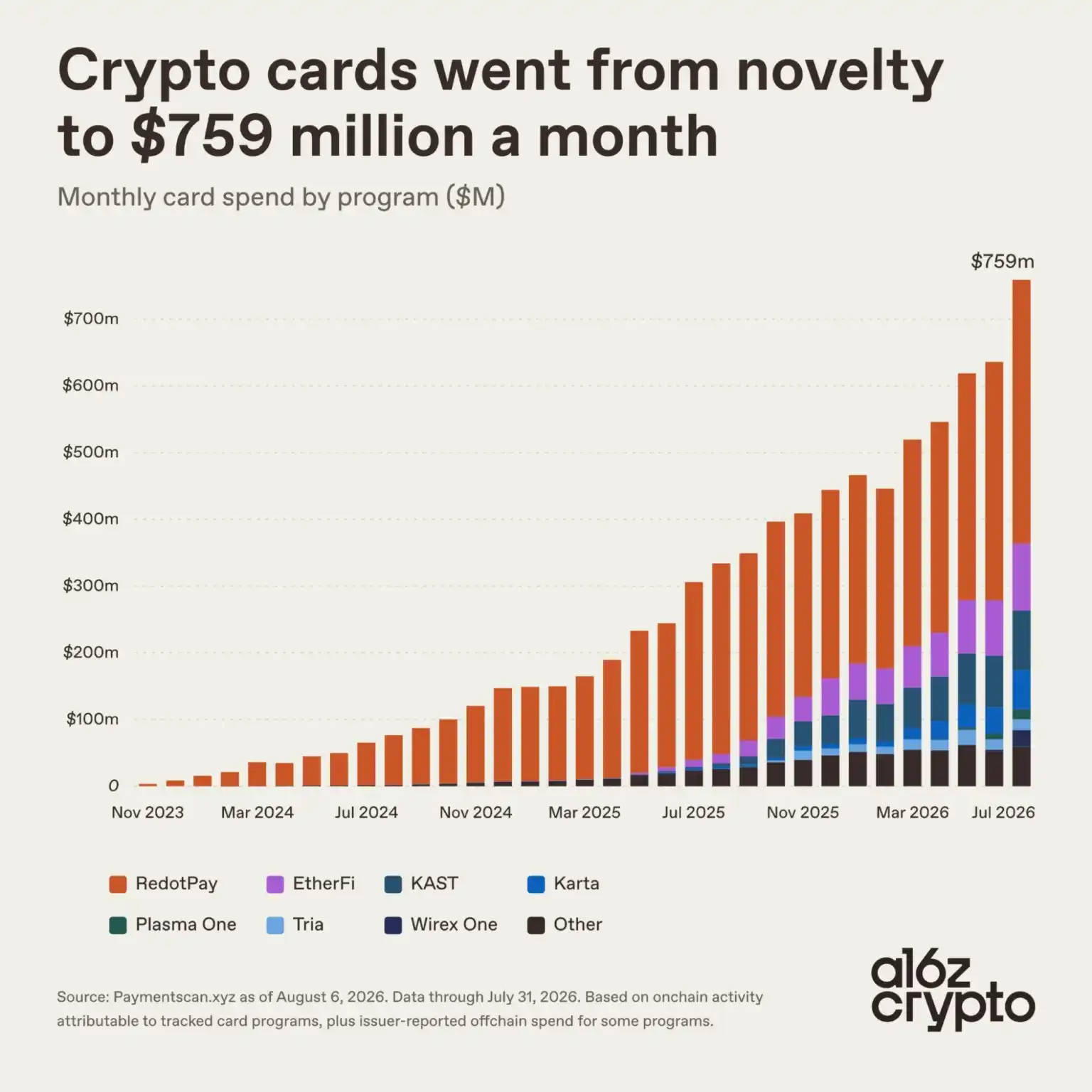
Trend of Crypto Payment Card Monthly Transaction Volume

According to Paymentscan's tracked on-chain activity data, the total monthly transaction volume for crypto payment cards reached $759 million in July 2026. This represents an increase of approximately 2.5 times compared to $306 million in the same month last year. Looking back to October 2023 when tracking began, the sector's monthly transaction volume was less than $1 million. (Note: The spending data for RedotPay, which ranks first in transaction volume, is publicly disclosed by the issuer itself and is not obtained via on-chain data scraping.)

The growth trend in the number of crypto payment card transactions largely aligns with the increase in transaction value. In July 2026, crypto payment cards processed nearly 9 million real-world transactions, compared to about 5.2 million transactions in the same month last year. This puts the average transaction value per card swipe at around $86.
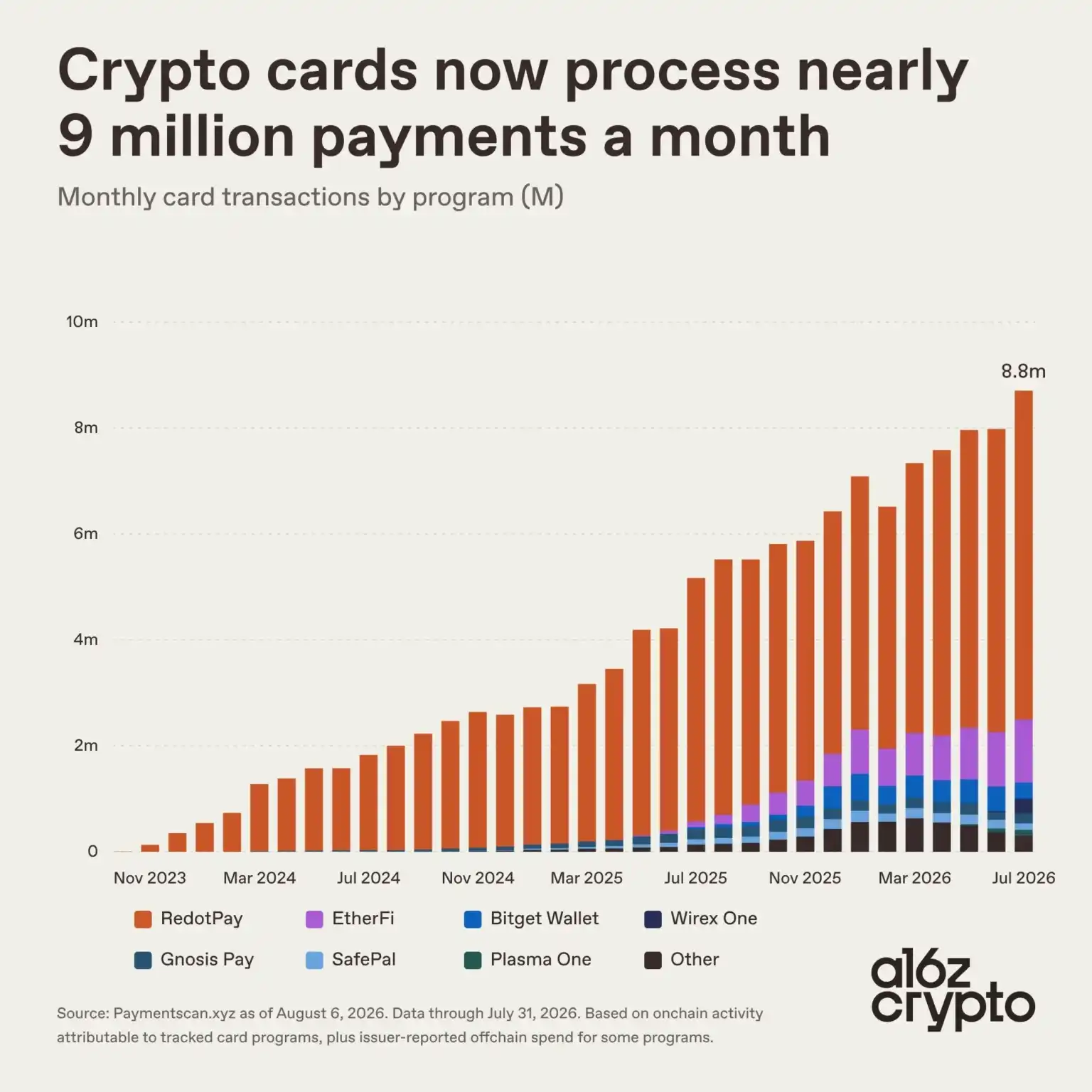
Trend of Crypto Payment Card Monthly Transaction Count

In early 2024, crypto payment card transaction volume was heavily concentrated on one blockchain: Gnosis Chain, home to the well-known product Gnosis Pay, which was the first Visa co-branded card directly connected to self-custody wallets. As more crypto payment card products have launched, the blockchains used for payment card settlement have diversified.

Paymentscan's July data shows that the Optimism chain now handles roughly 29% of crypto payment card spending volume; the Solana and Base chains each hold a 19% share; while Gnosis Chain, the former leader, has seen its share decline to just 2%.
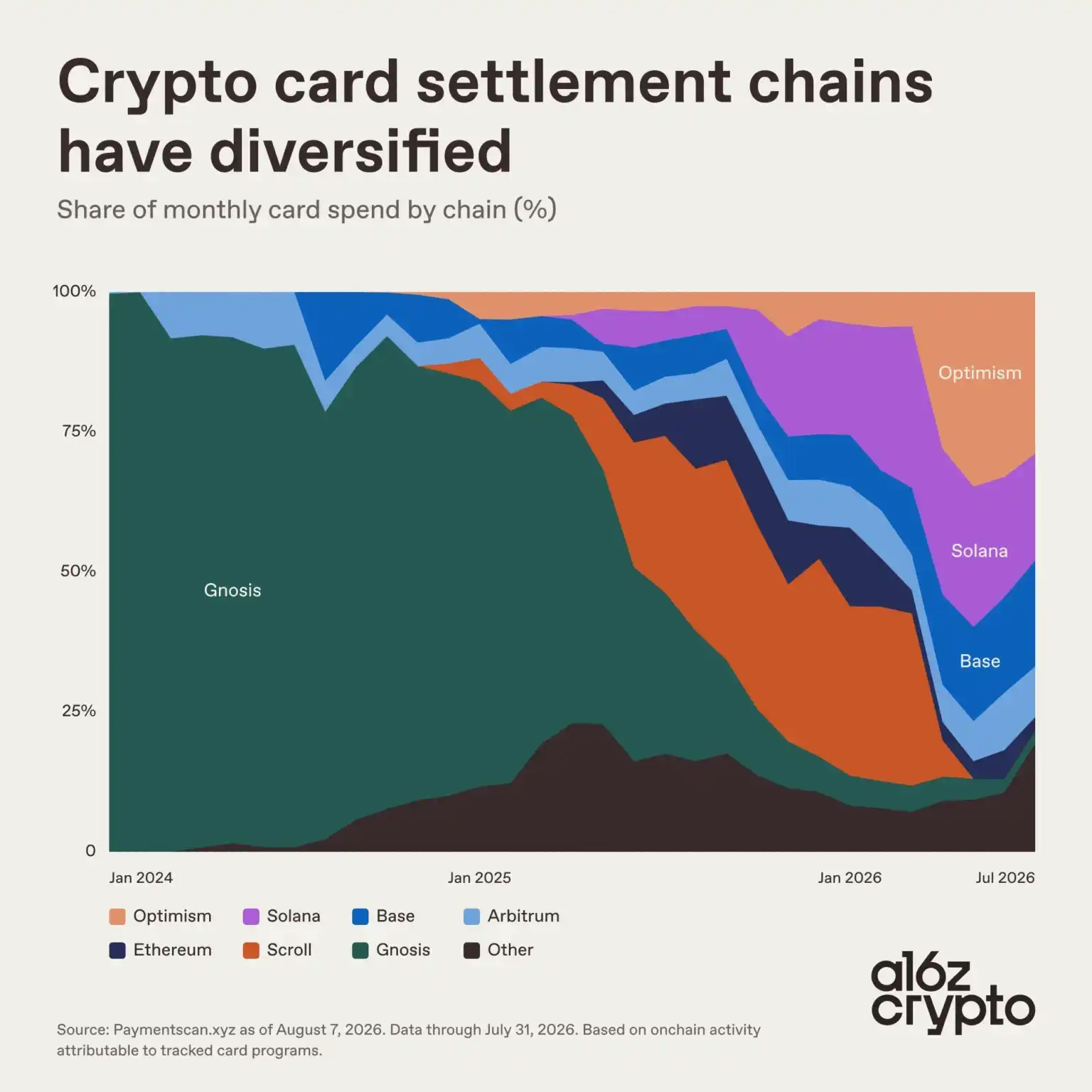
Share of Crypto Payment Card Spending Volume by Chain

The Euro-collateralized stablecoin EURe once dominated the crypto card spending market. In early 2024, it accounted for 88% of total crypto payment card transaction volume, with the vast majority of transactions occurring on the Gnosis Chain. By July of this year, however, EURe's market share had fallen to 2%.

Market dominance has now shifted to USD-denominated stablecoins. USDC facilitates 58% of crypto card spending traffic, while USDT accounts for 26%; in comparison, their shares were 48% and 7% respectively in the same period last year. Today, the vast majority of spending via crypto payment cards is conducted using dollar-pegged digital stablecoins.
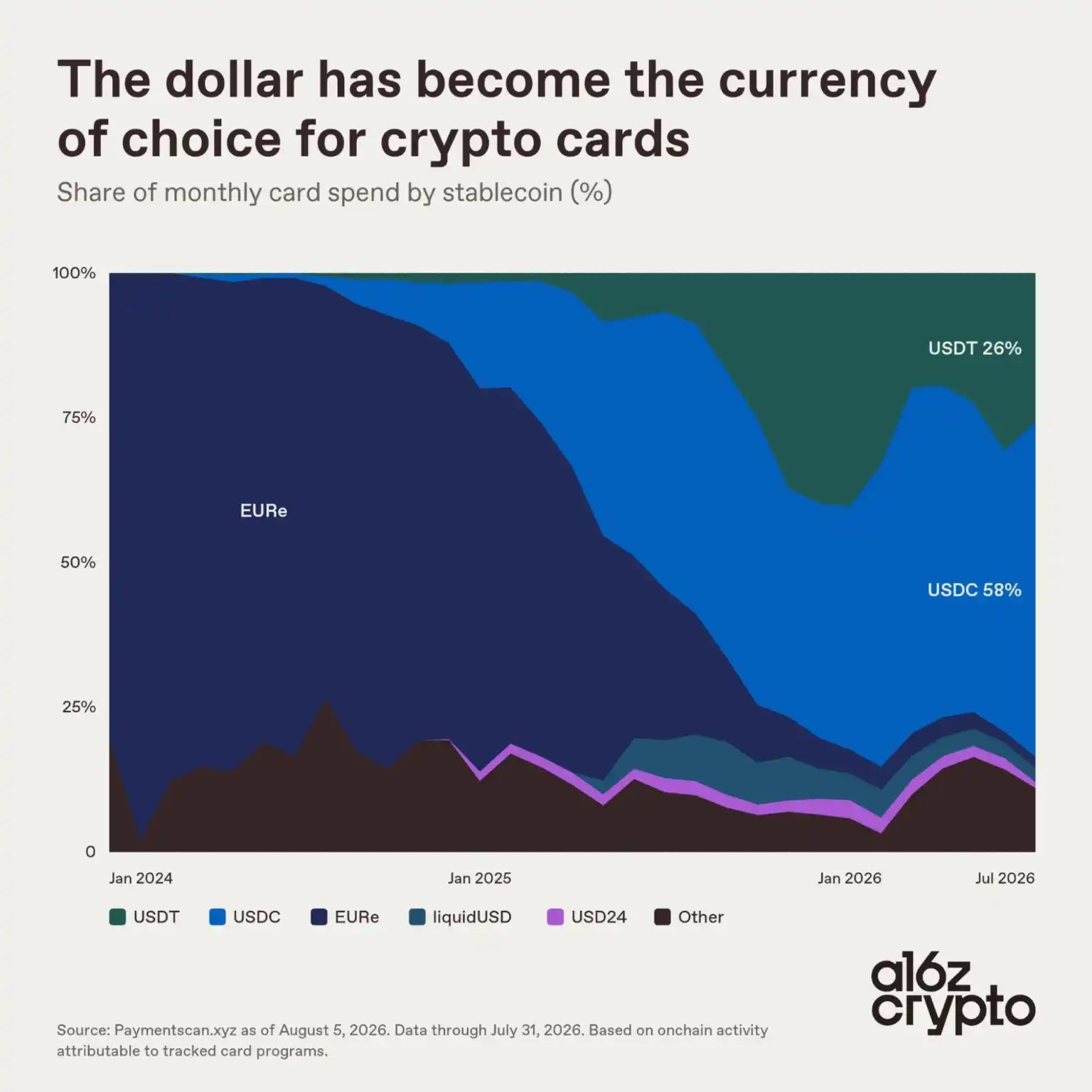
Share of Crypto Payment Card Spending Volume by Stablecoin

When compared to traditional card networks, the crypto payment card market remains very small, as traditional networks process trillions of dollars in transactions monthly.

Nevertheless, the sector is experiencing strong growth momentum. Stablecoins continue to permeate the global financial system, and crypto payment cards leverage the already mature infrastructure of mainstream card networks to achieve real-world utility. Nearly all the crypto payment card products covered in this analysis operate on the Visa network.
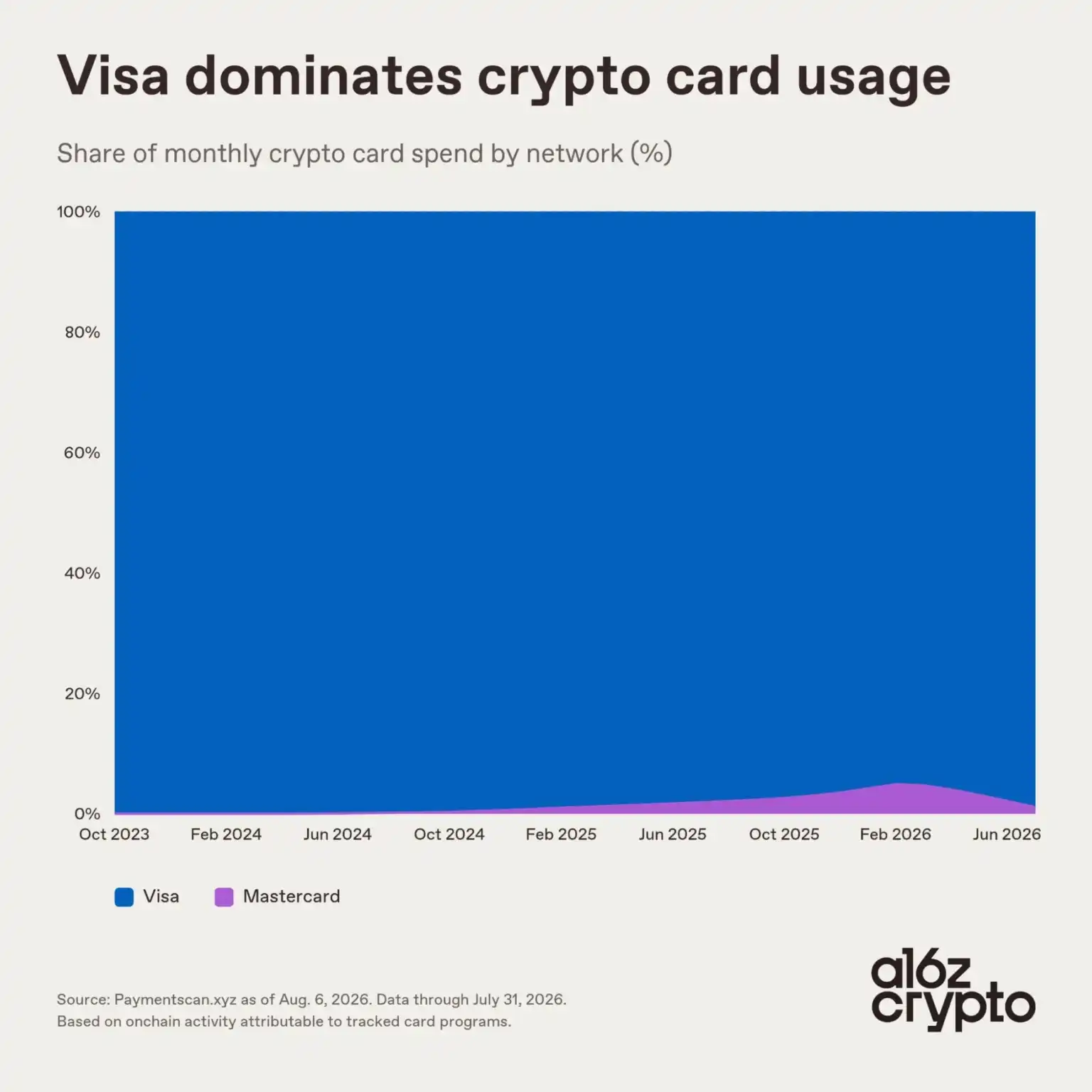
Visa Dominates Crypto Payment Card Spending

Since the GENIUS Act, the crypto industry as a whole has accelerated its development, with crypto payment cards being a key component.


İlgili Sorular

QWhat is the current monthly transaction volume of the encrypted payment card market, and how has it grown?

AAs of July 2026, the monthly transaction volume for encrypted payment cards has reached $759 million. This represents a 2.5x increase from $306 million in July 2025 and a massive jump from less than $1 million in October 2023 when tracking began.

QWhat role do stablecoins play in encrypted payment card transactions, and which stablecoins are now dominant?

AStablecoins are the primary asset used for spending on encrypted payment cards. The market has shifted from euro-denominated stablecoins (like EURe) to US dollar-denominated ones. As of July 2026, USDC accounts for 58% of the transaction volume, and USDT accounts for 26%, making dollar-based stablecoins the clear market leaders.

QHow has the blockchain ecosystem supporting encrypted payment cards changed over time?

AInitially, the Gnosis chain dominated due to Gnosis Pay. However, by July 2026, the landscape has diversified. Optimism chain handles 29% of the volume, Solana and Base each handle 19%, while Gnosis's share has declined significantly to just 2%.

QWhich traditional card network infrastructure is predominantly used by encrypted payment cards?

AVisa is the dominant traditional card network used by encrypted payment card products. Almost all the products covered in the statistics operate on the Visa network infrastructure.

QWhat is a key advantage of encrypted payment cards for users?

AA key advantage is that they provide users, including those without traditional bank accounts, access to US dollar-based financial services. They offer a convenient payment solution that allows users to spend their stablecoins at any merchant that accepts traditional card payments, with the merchant receiving fiat currency without needing to handle crypto directly.

İlgili Okumalar

New Job in the Robotics Industry: A 'Bone Doctor' Earning 6,000 Yuan Monthly, Specializing in Treating Broken Limbs

A new job has emerged in the robotics sector: the "orthopedic surgeon" for robots, earning around 6,000 RMB per month by specializing in repairing robots and robotic dogs. As the number of robots explodes, with IDC projecting 18,000 humanoid robots shipped globally in 2025 and China's MIIT predicting over 100,000 units produced domestically in 2026, demand for maintenance and repair is rising. The repair process, as demonstrated by Zhao Xin, a former service industry worker turned self-taught repairman, involves diagnosing issues like joint noises, disassembly, and part replacement. The technical barrier is relatively low, often simpler than repairing drones, with basics learnable in a month. The real challenge is obtaining proprietary parts, which are monopolized by manufacturers, lack public schematics, and are expensive. Currently, third-party repair shops, like those run by Zhao Xin or Nanjing Kaogong Yunji's Fang Jinghua, offer cheaper (10-15% of robot price, 20-50% cheaper than OEM) and faster (one week vs. over a month) service, mainly for out-of-warranty units used in entertainment performances. However, repair volume remains low—just 1-3 robots/month for some shops—making it unsustainable as a primary business. Most repair shops rely on other revenue streams like training, drone repair, or leasing. Training programs are emerging, with courses from 8 to 40 days and fees from 5,000 to 30,000 RMB. Graduates often enter sales or operations roles. For pure repair jobs, salaries range from 6,000-8,000 RMB/month for beginners to over 10,000 RMB for experienced technicians. While companies like JD.com plan large-scale technician training, the robot repair market still awaits broader industry growth to become a fully viable standalone profession.

marsbit12 dk önce

New Job in the Robotics Industry: A 'Bone Doctor' Earning 6,000 Yuan Monthly, Specializing in Treating Broken Limbs

marsbit12 dk önce

Shenzhen Is Leading the Entire Nation in 'Getting Rich'

Shenzhen, emerging as a leader in China's innovation economy, is pioneering a novel model of regional development by creating and sharing significant capital wealth with cities across the country. In 2026, Shenzhen leads major Chinese cities in new IPOs, adding 26 listed companies. Notably, a substantial portion of these successful firms, operating in strategic sectors like semiconductors (e.g., Dapu Micro, HKC), industrial AI, and new energy materials, feature state-backed investment funds from various cities in their shareholder lists. These external investors, from Nanjing, Mianyang, Changsha, Gui'an, and others, are reaping enormous financial returns from early-stage investments. This trend stems from nationwide confidence in Shenzhen's unparalleled ecosystem for nurturing high-tech firms, supported by massive government-guided funds, a complete industrial chain, and mature capital markets. For other cities, particularly smaller ones, investing in Shenzhen's proven innovators offers a strategic alternative to costly and uncertain local cultivation of industries. Beyond capital gains, these investments often secure agreements for manufacturing bases to be established in the investor cities, fostering local industrial clusters—a "double benefit" of equity appreciation and industrial upgrading. This collaborative model, where Shenzhen focuses on R&D and headquarters functions while sharing growth via equity and decentralizing production, moves beyond traditional zero-sum regional competition. It replaces subsidy-based rivalry with market-driven, mutually beneficial partnerships. This logic of open collaboration and shared prosperity aligns with the core principles of APEC, whose 33rd Leaders' Meeting will be held in Shenzhen, highlighting the city's role as a microcosm of regional cooperation and innovation-led growth.

marsbit21 dk önce

Shenzhen Is Leading the Entire Nation in 'Getting Rich'

marsbit21 dk önce

Wall Street Morning Brief: Dismal Nonfarm Sparks Rate Cut Trading, Optical Interconnects Begin to Outshine Storage, 'Short Storage, Long Optics' Becomes New Battlefield

Wall Street Morning Report: Key takeaways from market movements and upcoming events. Weak U.S. July non-farm payrolls (-23K vs. +80K expected) significantly reduced expectations for a September Fed rate hike, boosting equities. All eyes are on Wednesday's CPI data for further direction. Geopolitical tensions in the Middle East pushed oil prices higher, while gold surged over 7% weekly. A notable sector rotation emerged within AI infrastructure, with a "short memory, long optics" trade gaining traction. Optical communication stocks like Coherent and Lumentum outperformed, while memory stocks (Seagate, Western Digital, SK Hynix) faced pressure amid concerns over peak pricing and ETF outflows. Software also rallied strongly (Palantir, Atlassian). Key stock moves: SpaceX surged ~23% over two days post-lockup expiration. Palantir jumped nearly 40% weekly on strong U.S. commercial growth. Nvidia rose over 11% weekly, with a reported major investment in AI data center power. Apple is testing ChangXin Memory chips for potential use in China-sold devices. Berkshire Hathaway resumed net stock buying, with Alphabet becoming its top holding. Upcoming focus: Key earnings from Lumentum, CoreWeave, Supermicro (Aug 12), Cisco, and Coherent (Aug 13) to test AI infrastructure demand. U.S. CPI and PPI data (Aug 12 & 14) crucial for Fed policy outlook. Major events include Tencent's earnings, Google's Pixel launch, and the SEC 13F filing deadline.

marsbit36 dk önce

Wall Street Morning Brief: Dismal Nonfarm Sparks Rate Cut Trading, Optical Interconnects Begin to Outshine Storage, 'Short Storage, Long Optics' Becomes New Battlefield

marsbit36 dk önce

İşlemler

Spot
活动图片