Unable to Retain with a $100 Million Annual Salary, Yu Jiahui Departs Meta to Start His Own Venture

marsbit2026-08-14 tarihinde yayınlandı2026-08-14 tarihinde güncellendi

Özet

Despite a reported compensation package rumored to be worth up to $100 million over four years, AI researcher Jiahui Yu has announced his departure from Meta after just over a year to start his own company. Yu joined Meta in June 2025 as a founding member and multimodal lead of the TBD Lab within Meta's Superintelligence Labs (MSL). During his tenure, he was instrumental in developing and launching key products like the Muse Spark foundational model and its subsequent versions, Muse Image, Muse Video, and Voice Mode. In his departure statement, Yu expressed gratitude for his time at Meta but cited being drawn to an "important yet underexplored problem for humanity's future" as his reason for leaving. While details of his new venture remain undisclosed, his exit adds to a notable trend of high-profile AI researchers departing Meta, with one platform listing nearly 930 former Meta researchers. The move raises questions about the long-term effectiveness of Meta's high-cost talent acquisition strategy in the competitive AI landscape.

$100 million couldn't keep him!

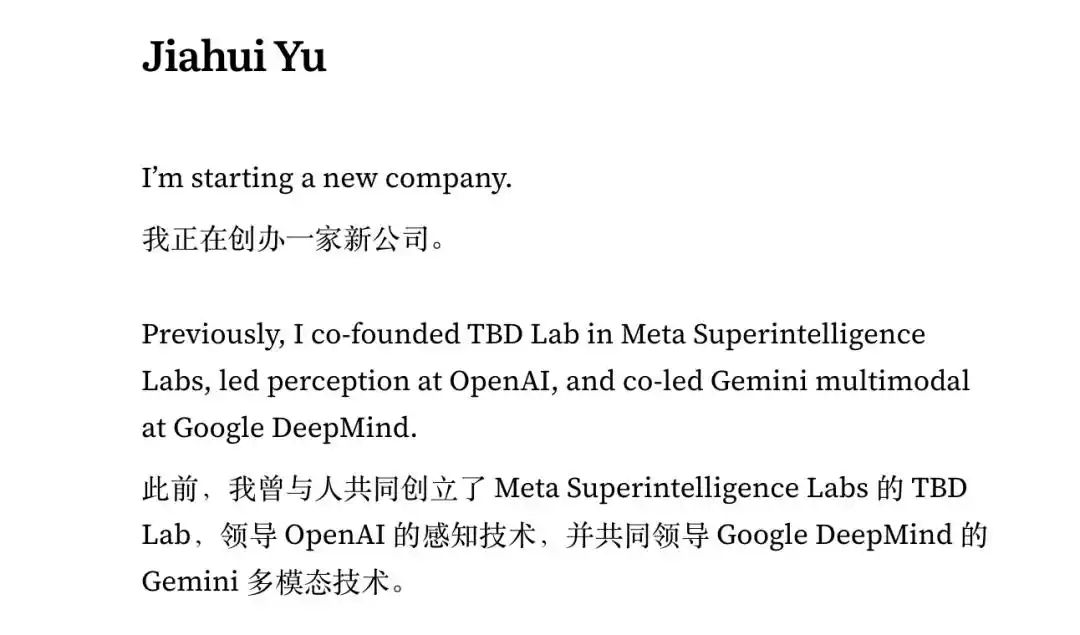
Just now, Yu Jiahui officially announced his departure from Meta to start a business.

From joining at the end of June 2025 to announcing his departure on August 14, 2026, it's exactly one year and a little over one month.
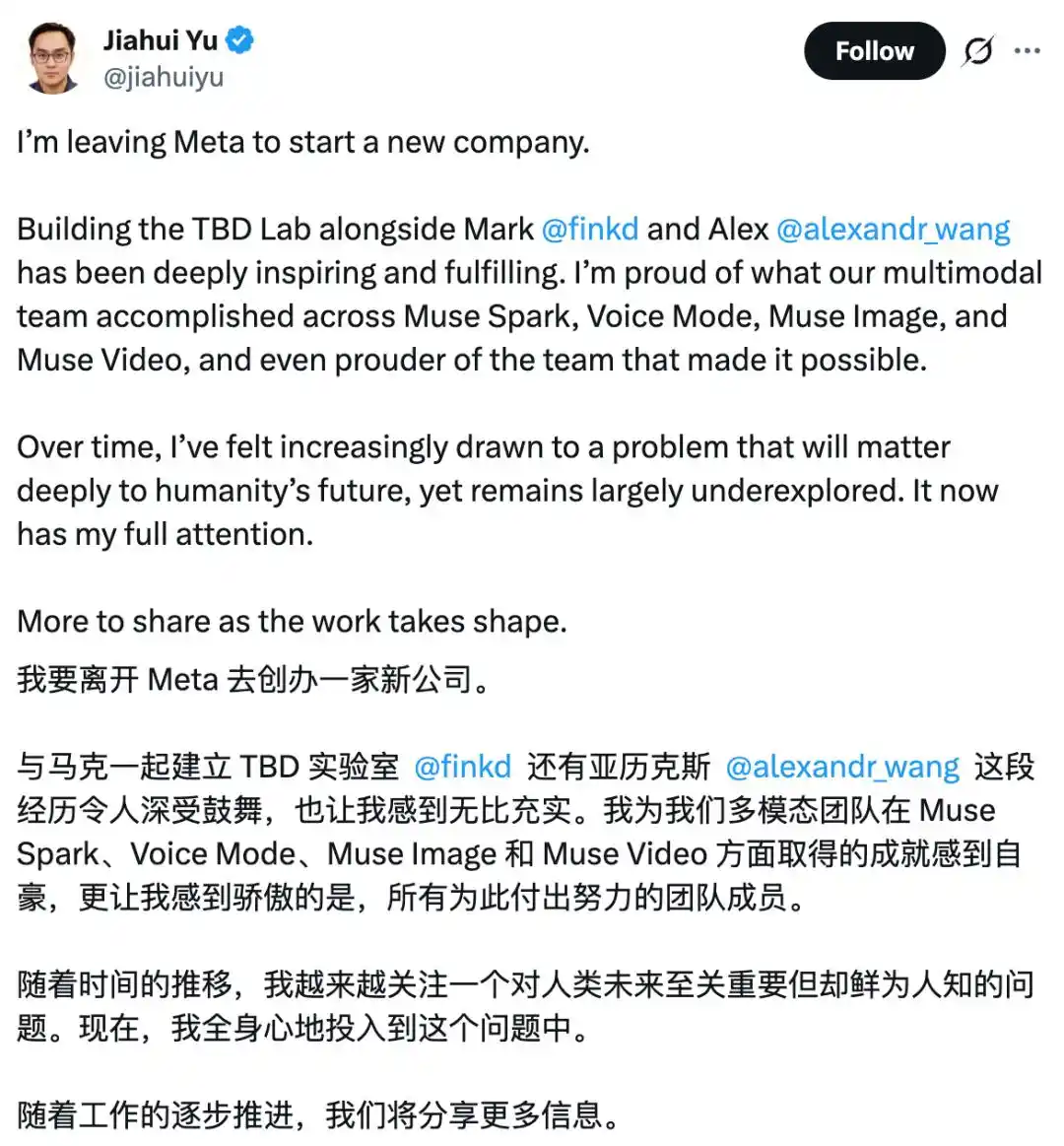
His personal website has also been updated with his resume.
Just a few days before his departure, Meta had just launched Muse Spark 1.2.

Over the past few months, Yu Jiahui's multimodal team had also successively delivered Muse Spark, Voice Mode, Muse Image, and Muse Video.

In his announcement, Yu Jiahui stated that the experience of building TBD Lab together with Zuckerberg and Meta's Chief AI Officer Alexander Wang was "extremely inspiring and fulfilling."

He specifically highlighted several achievements made by the team over the past year and mentioned that he has been increasingly drawn to a question that is "crucial for humanity's future but remains insufficiently explored."

Now, this question will receive his undivided attention.

As for the name of the new company, its specific research focus, and who the partners are, he didn't say a word:

More to share as the work takes shape.

More information will be shared as things gradually take shape.

Just Finished Delivering the Muse Suite, and the Person Is Gone

This past year, Yu Jiahui certainly didn't slack off.

At the end of June 2025, it was exposed that Yu Jiahui, along with researchers like Zhao Shengjia, Bi Shuchao, and Ren Hongyu from OpenAI, had collectively joined Meta's newly formed superintelligence team.

Zuckerberg personally stepped in to recruit him, with rumors of a "$100 million annual salary" setting a new record in the AI talent market.

Within a few days, Zuckerberg officially announced the establishment of the Meta Superintelligence Labs, or MSL.

The lab was led by Alexander Wang. For this, Meta invested $14.3 billion in Scale AI and aggressively poached talent from companies like OpenAI, Google DeepMind, and Apple.

TBD Lab was one of the core model research teams under MSL, responsible for developing Meta's next-generation frontier models. Yu Jiahui was a founding member and the head of the multimodal direction.

In April this year, this team delivered its first major report card: Muse Spark.
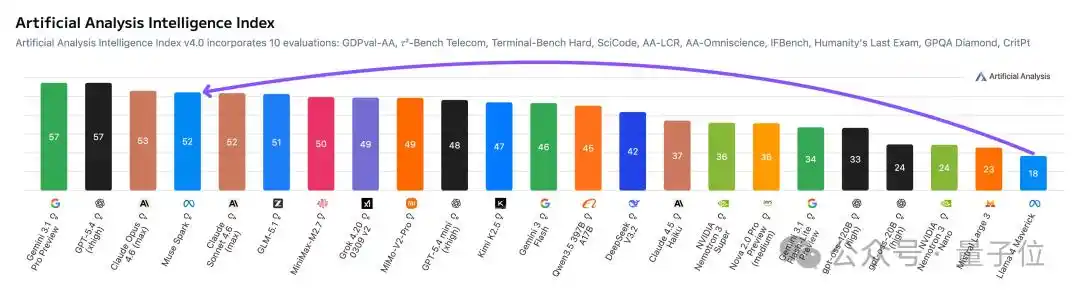
This was the first foundation model released after MSL's establishment, also marking the official shift of Meta's frontier models from the Llama series to the Muse series.

Subsequently, Yu Jiahui's team continued to release Voice Mode, Muse Image, and Muse Video, covering speech, image, and video generation.

The recent update, Muse Spark 1.2, further pushed the focus towards programming, long-horizon Agent tasks, and multimodal capabilities.
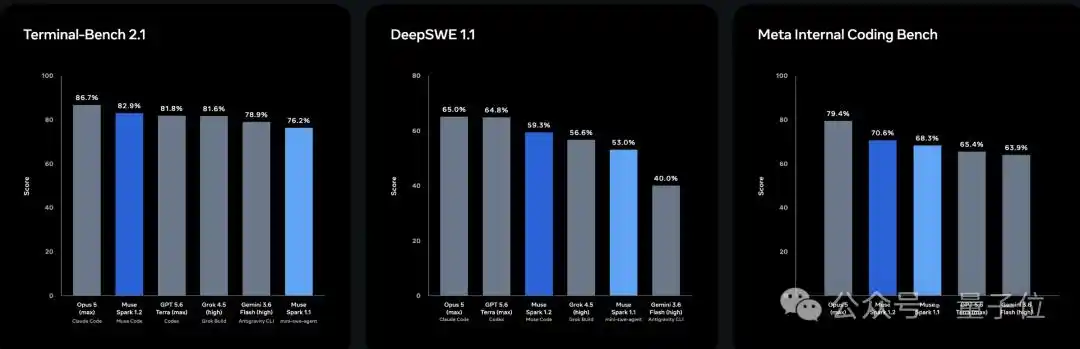
During his year at Meta, Yu Jiahui essentially built a team from scratch, re-architected the technology stack, and served up the Muse suite dish by dish.

Meta researcher Zhiqing Sun revealed that Yu Jiahui was also one of the people who recruited him into Meta.

He recalled having a meal with Yu Jiahui at a Daeho restaurant in San Francisco, where Yu persuaded him to join TBD Lab. Later, they worked together on multimodal capabilities and Computer Use.

A year later, it was the turn of someone Yu Jiahui himself recruited to see him off.

Oh Zuck, oh Zuck... was this $100 million annual salary ultimately all for naught?

Rumored $100 Million: Why Did Zuck Specifically Fight for Him?

Exactly how much money Yu Jiahui received still lacks an authoritative answer.

But in last year's Silicon Valley talent war, he was undoubtedly one of the most talked-about names.

At that time, Altman had publicly stated that Meta offered some OpenAI employees $100 million in signing bonuses and even higher annual compensation.

Subsequently, WIRED reported that Meta's offers to a few top AI talents could reach up to $300 million over four years, with total first-year compensation potentially exceeding $100 million.

However, Meta CTO Andrew Bosworth later clarified that the widely circulated $100 million figure was not for everyone, nor was it a signing bonus paid upon joining. It likely referred to a total compensation package including stock, bonuses, tenure, and performance conditions.

So, whether Yu Jiahui personally received the "$100 million annual salary" remains unknown to us.

(Shrugs)

Even so, Yu Jiahui was still placed within the story of the "hundred-million-dollar man."

His resume also seems to have hit nearly every hot keyword in the large model field over the past few years.

Yu Jiahui completed his undergraduate studies at the School of the Gifted Young, University of Science and Technology of China, before pursuing his Ph.D. at UIUC under the supervision of computer vision scholar Thomas S. Huang.

During his Ph.D., he contributed to the development of DeepFill. Simply put, it allowed AI to erase unwanted objects from photos and automatically fill in the background.

Later, after joining Google Brain, he progressed from computer vision to multimodal large models, participating in and co-leading the Gemini multimodal direction.

After moving to OpenAI at the end of 2023, he led the Perception team, contributing to GPT-4o, GPT-4.1, and a series of o-series models.
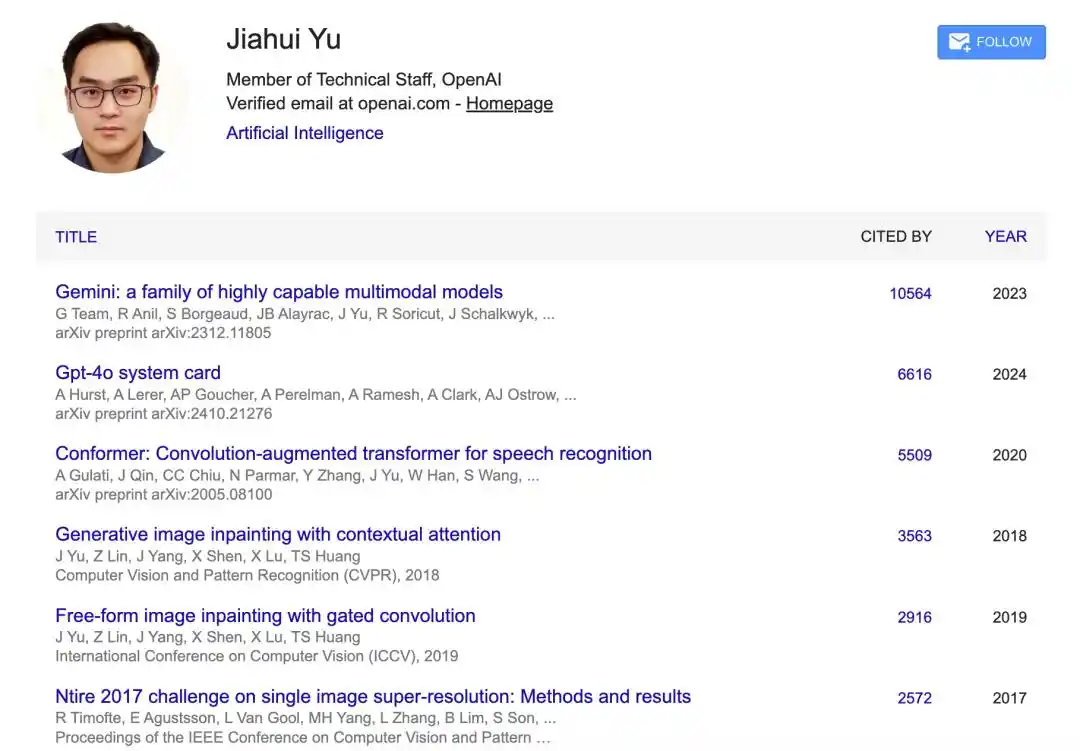
Meta was precisely in need of someone like him at that time.

With Llama 4's performance falling short of expectations, Meta urgently needed a team to rebuild its frontier model capabilities.

Compared to researchers who only made breakthroughs in a single paper, Yu Jiahui had experience in low-level vision research, had participated in large model development at both Google and OpenAI, and possessed the experience of pushing multimodal capabilities into real products.

A year ago, people might have debated:

Was Yu Jiahui really worth the rumored nine-figure compensation package?

But now, the question has become:

What exactly does someone, whom even this level of compensation, computing power, and product opportunities cannot retain, want to do by leaving?

Indeed, for researchers who have reached Yu Jiahui's level, the conditions offered by big tech companies may be nearing the ceiling for employment.

Moving further up, the remaining path seems to be becoming a founder themselves~

Meta, Just How Many People Have You Lost?!

With Yu Jiahui's departure, netizens casually started checking Meta's household register.

One look, and the numbers were startling:

929.

The research paper platform alphaXiv pulled out a list of departed Meta researchers, claiming that before Yu Jiahui, over 200 well-known researchers had already left Meta.
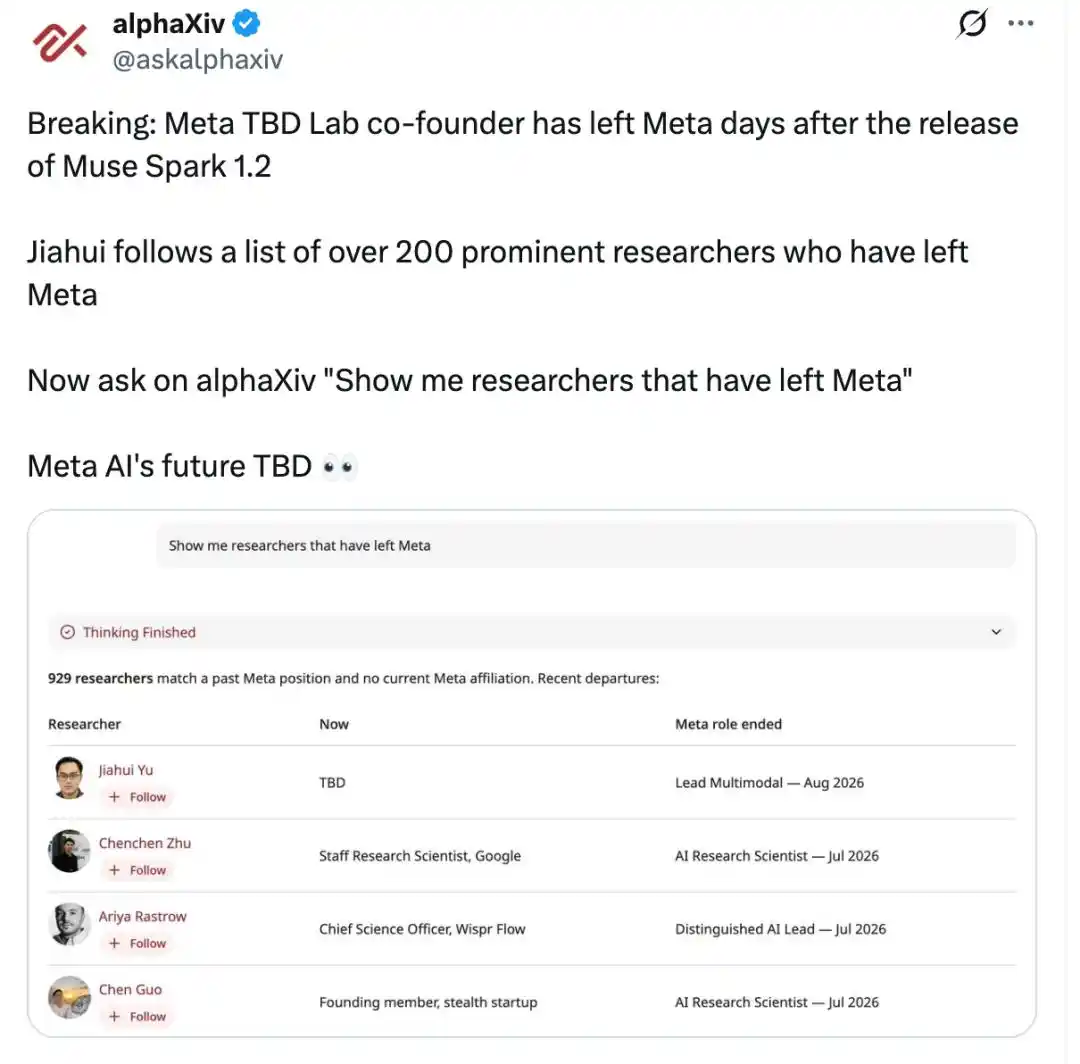
Its search page shows that a total of 929 researchers meet the criteria of "previously worked at Meta, currently not at Meta."

At the top of the list is Yu Jiahui.

Following closely are researchers who recently joined Google, became chief scientists at startups, or joined stealth startup projects.

alphaXiv didn't miss the chance to use the ready-made TBD pun, directly stating:

The future of Meta AI is also TBD (To Be Determined).

Whoa, at first glance, this Meta lab looks more like an AI talent transit hub...

Last year, when Meta was waving checks to poach talent, Altman stated:

The missionaries will ultimately defeat the mercenaries.

Now, even Yu Jiahui, whom Meta poached with heavy money, has left.

Is Zuck's talent acquisition strategy, which was mocked as employing "mercenaries," ultimately successful?

The answer is similarly TBD.

Reference Links:

[1]https://x.com/jiahuiyu/status/2087936732939616299?s=20

[2]https://x.com/askalphaxiv/status/2087973800952623416?s=20

This article is from the WeChat public account "QbitAI," author: Ting Yu

İlgili Sorular

QWho is the main subject of the article and what major career move did they announce?

AThe main subject is Jiahui Yu. He announced his departure from Meta to start his own company.

QWhat is the name of the core model research team Jiahui Yu was a part of at Meta, and what was its purpose?

AHe was a founding member of the TBD Lab, which was part of Meta Superintelligence Labs (MSL). Its purpose was to develop Meta's next-generation frontier models, with Yu leading the multimodal direction.

QAccording to the article, what significant product series did Jiahui Yu's team release at Meta, and what was the first major model called?

AHis team released the 'Muse' product series, which included Muse Spark, Voice Mode, Muse Image, and Muse Video. The first major foundational model was Muse Spark.

QWhat was the rumored compensation package offered to Jiahui Yu to join Meta, and how was it clarified by a Meta executive?

AIt was rumored to be a '1亿美元年薪' (a $100 million annual salary). Meta CTO Andrew Bosworth clarified that such figures were not a signing bonus for everyone but a total compensation package potentially including stock, bonuses, tenure, and performance conditions.

QWhat does the article suggest is a broader trend at Meta regarding AI researchers, based on data from alphaXiv?

AThe article suggests a significant trend of researchers leaving Meta. According to alphaXiv, over 200 known researchers had left before Jiahui Yu, with a total of 929 researchers meeting the criteria of having previously worked at Meta but no longer being there.

İlgili Okumalar

Selling Block Space Is No Longer Profitable, Arbitrum and MegaETH Venture into Applications

Selling block space is no longer a sustainable core business for blockchains, as it is easily commoditized and generates insufficient revenue to support their valuations, especially when compared to the high fees generated by applications built on them. This report, following up on the "Verticalization" thesis, examines how chains like Arbitrum, Polygon, MegaETH, and Sophon are adapting. It categorizes their strategies into two main paths: **Ecosystem Expansion** and **Product Expansion**. **Ecosystem Expansion** involves chains extending their reach by offering their technology stack to others. Examples include Arbitrum, which earns revenue from chains like Robinhood's L2 built on Arbitrum Stack, and Polygon, which is positioning itself as a payment chain for fintech. However, this model faces challenges, as seen with Optimism's revenue drop after Base left its Superchain, and often fails to translate chain success into sustained token value due to ongoing emissions. **Product Expansion** sees chains vertically integrating by building their own applications to capture more value internally. MegaETH shifted focus to developing first-party consumer apps and launched a native stablecoin, USDm, to capture yield. Similarly, Sophon pivoted from being an independent chain to becoming an application builder on Base. The goal is to directly own the lucrative application fee streams that typically don't flow back to the underlying chain. The conclusion is that with hundreds of chains offering similar block space, differentiation through liquidity alone is not enough. To justify high valuations and ensure sustainability, chains are moving beyond their foundational role. They are evolving into broader ecosystems or application builders themselves, actively working to internalize the value generated within their networks. This represents a pragmatic shift towards utility, where chains are becoming more than just infrastructure providers in a highly competitive landscape.

marsbit3 dk önce

Selling Block Space Is No Longer Profitable, Arbitrum and MegaETH Venture into Applications

marsbit3 dk önce

A Glimpse into Crypto Miners in Q2: Rushing into AI Data Centers – Are They Profiting?

Mining companies presented mixed Q2 results as they navigate the shift towards AI data centers alongside their core Bitcoin mining operations. While mining output increased for some, declining Bitcoin prices and rising network difficulty pressured revenues. For instance, MARA mined more Bitcoin year-over-year but saw a 27% revenue drop and a significant net loss, partly due to unrealized losses on Bitcoin holdings. The standout trend is the growing contribution of AI/high-performance computing (HPC) hosting revenue. Core Scientific now derives over 80% of its revenue from high-density hosting, while TeraWulf generates about 71% from HPC leasing. However, the transition is at varying stages. Companies like Riot Platforms and Cipher Digital are in earlier phases, with AI-related revenue still a smaller portion of their total income. The article cautions against conflating massive, long-term AI hosting contracts (often valued in billions) with current quarterly revenue, as income recognition depends on capacity delivery and lease commencement. Financially, net losses were common but driven by different factors: some by Bitcoin price revaluations or warrant fair value changes, others by operational costs exceeding revenue. The sector is diverging into three paths: pure-play miners focusing on efficiency, companies successfully transitioning to AI hosting, and those in a challenging transitional phase where legacy mining income is declining before new AI revenue scales up. The key to future performance lies in reliable power access, timely data center delivery, and converting long-term contracts into consistent quarterly income.

marsbit7 dk önce

A Glimpse into Crypto Miners in Q2: Rushing into AI Data Centers – Are They Profiting?

marsbit7 dk önce

DeepSeek's "Self-Evolution" Blueprint, Revealed

DeepSeek, in collaboration with Peking University, has unveiled a new research paper titled "A Programming Paradigm for Spatiotemporal Composability," which outlines the core architecture behind its "Harness" agent platform. The paper introduces **Cordis**, a foundational "Lego-like baseboard" that enables a highly modular and composable system where **everything is a plugin and everything can be reassembled**. The core innovation addresses two major challenges for self-evolving AI agents: **temporal composability** (the ability to dynamically load, unload, and update plugins at runtime without restarting the entire process) and **spatial composability** (managing complex, dynamic dependencies between components). Cordis solves these using two key theoretical concepts adapted for dynamic environments: **revertible effects** (which allow state changes to be cleanly rolled back) and **reactive coeffects** (which enable automatic, declarative dependency resolution). This design is not merely theoretical. It has been validated over four years in the **Koishi** chatbot framework, which is built on Cordis and hosts over 4,000 community plugins. The framework demonstrates live plugin management—enabling, disabling, or updating plugins without disrupting others—and robust handling of dependencies across a decentralized ecosystem. The paper represents DeepSeek's vision for a foundational infrastructure that supports true **self-evolution** in AI agents, allowing them to dynamically modify their own capabilities and tools at runtime. The authors are Yifan Shi (Peking University/DeepSeek, creator of Koishi), Wei Zhang (Peking University), and Tianyi Cui (DeepSeek Harness team lead).

marsbit9 dk önce

DeepSeek's "Self-Evolution" Blueprint, Revealed

marsbit9 dk önce

On-Chain Finance Finally Posts a Profitable Ledger: Figure's Quarterly Revenue Doubles, Net Profit Hits $87 Million

Blockchain finance firm Figure Technology Solutions reported a strong second-quarter earnings report, potentially serving as the first major proof of profitability for the sector. The company’s GAAP net revenue reached $226 million, up 113% year-over-year, while net profit surged 192% to $87.4 million, yielding a net profit margin of 38.8%. Its quarterly consumer loan origination volume hit $4.3 billion, marking 132% growth. Figure's business focuses on streamlining the U.S. Home Equity Line of Credit (HELOC) market by shifting the entire loan lifecycle—from origination to securitization—onto its proprietary Provenance blockchain. This backend infrastructure significantly reduces processing time and costs while remaining invisible to end borrowers, who simply benefit from faster, cheaper loans. A key growth driver is the Figure Connect platform, a blockchain-based marketplace connecting loan originators and institutional investors. It accounted for 65% ($2.8 billion) of the quarter's volume, demonstrating strong network effects with 489 partner firms. The company is building an integrated on-chain finance ecosystem that includes its SEC-approved yield-generating stablecoin, YLDS. Notably, Figure has achieved this scale and profitability without relying on token sales or speculative crypto economics, instead choosing a traditional IPO path. Its success suggests blockchain's most practical application in finance may be as an efficient, invisible infrastructure layer that solves specific real-world inefficiencies rather than attempting to overhaul the entire system.

marsbit10 dk önce

On-Chain Finance Finally Posts a Profitable Ledger: Figure's Quarterly Revenue Doubles, Net Profit Hits $87 Million

marsbit10 dk önce

İşlemler

Spot
活动图片