UK, US, Canada launch Operation Atlantic to fight crypto scams: Report

ambcrypto2026-03-18 tarihinde yayınlandı2026-03-18 tarihinde güncellendi

Özet

The US, UK, and Canada have launched Operation Atlantic, a joint initiative to combat crypto scams in real-time. Led by the US Secret Service, the UK's National Crime Agency, and Canadian authorities, the operation focuses on proactively detecting and preventing fraud, rather than just tracing stolen funds after the fact. The primary target is "approval phishing," where victims are tricked into signing malicious smart contracts that grant attackers access to their wallets. Authorities will collaborate with crypto exchanges and blockchain firms to monitor suspicious transactions and directly contact potential victims before funds are stolen. The operation also targets "pig butchering" scams, a long-term social engineering scheme. This initiative builds on previous efforts like Canada's Project Atlas. While Chainalysis reports scammers received around $14 billion in crypto in 2025, TRM Labs notes illicit activity still only represents about 1.2% of total market volume, indicating the legitimate crypto economy is growing faster. The operation highlights a shift toward cross-border, proactive law enforcement response to increasingly globalized crypto crime.

For years, crypto fraud was linked to hackers stealing funds that seemed to vanish on the blockchain. Now, that perception is changing. Three countries have joined forces to stop scams in real time.

Called Operation Atlantic, the initiative brings together the U.S. Secret Service, the UK’s National Crime Agency (NCA), and Canadian authorities.

Instead of only tracing stolen funds after a crime, the operation aims to detect and prevent scams before money is taken.

Main focus of Operation Atlantic

The main target is “approval phishing.” In this scam, victims are tricked into signing a transaction that quietly permits attackers to access their crypto wallets.

By working with private blockchain firms and analyzing real-time data, investigators are now trying to spot risky wallet activity. This marks a shift from reactive investigations to proactive prevention.

Stressing the seriousness of the situation, Brent Daniels, Deputy Assistant Director for the U.S. Secret Service’s Office of Field Operations, said,

Approval phishing and investment scams cost victims millions in financial loss each year.

In response to the rising threat of such crimes, Paul Foster, Deputy Director of Cyber at the UK’s National Crime Agency, added,

Criminals operate across borders, so our response must do the same.

What will the investigators do?

In this effort, authorities will work closely with crypto exchanges and Virtual Asset Service Providers (VASPs) to monitor suspicious transaction patterns.

When they identify a wallet at risk, investigators will contact the potential victim by phone or email before scammers complete the fraud.

Additionally, the other focus is “pig butchering” scams, a long-term social engineering scheme where criminals slowly build trust with victims.

After gaining confidence, scammers trick victims into signing transactions that grant access to their crypto wallets through malicious smart contracts.

To avoid confusion, while pig butchering refers to the broader manipulation strategy, approval phishing is the mechanism that allows scammers to actually drain funds once trust has been established.

Other such initiatives

That said, the initiative also builds on Project Atlas, a 2024 Canadian-led operation that targeted international crypto investment fraud networks.

Remarking on which, Detective Superintendent Jennifer Spurrell, Director of the Financial Crimes Services Bureau at the Ontario Provincial Police, noted,

Project Atlas demonstrated the power of coordinated disruption....As fraud becomes increasingly global, this level of collaboration is essential.

Concerning data sets on rising crypto frauds

Operation Atlantic shows that law enforcement is becoming faster and more coordinated, but crypto fraud still remains a major challenge.
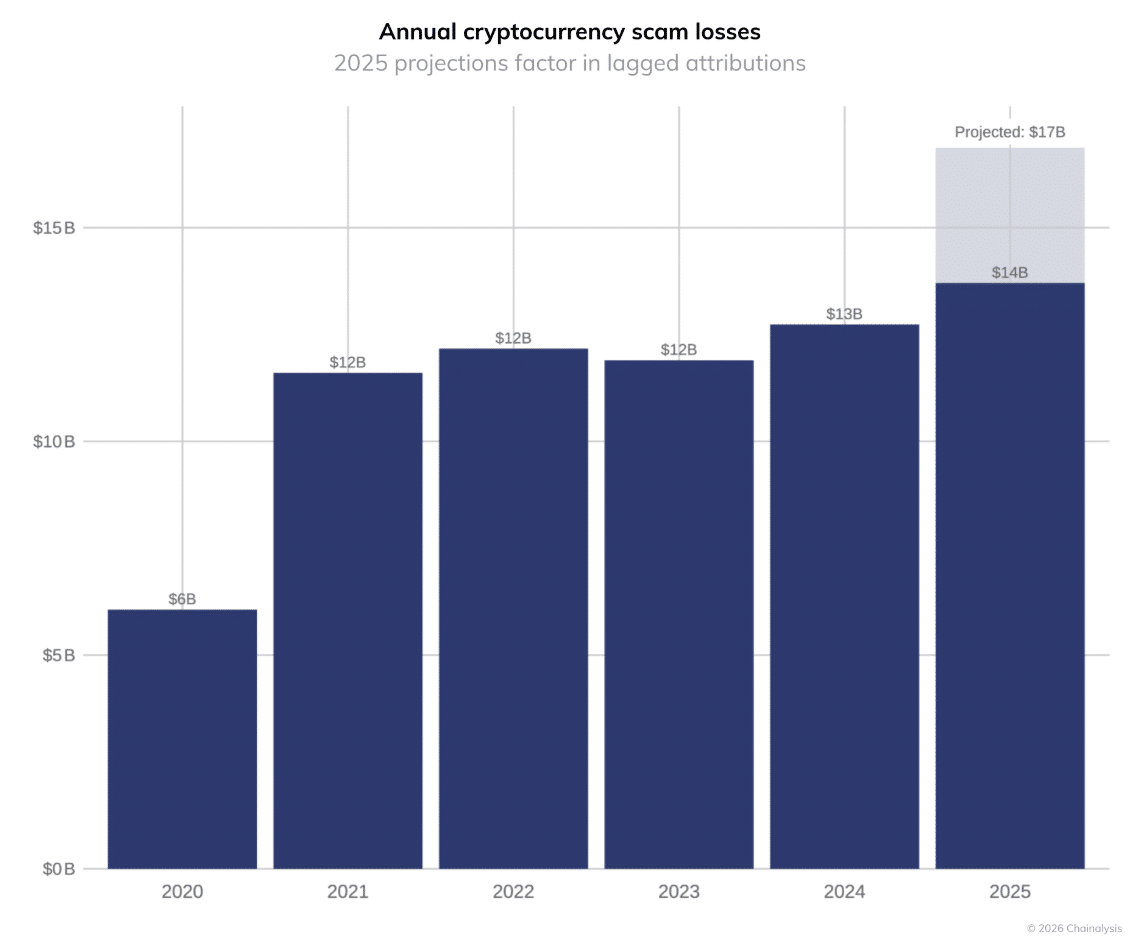
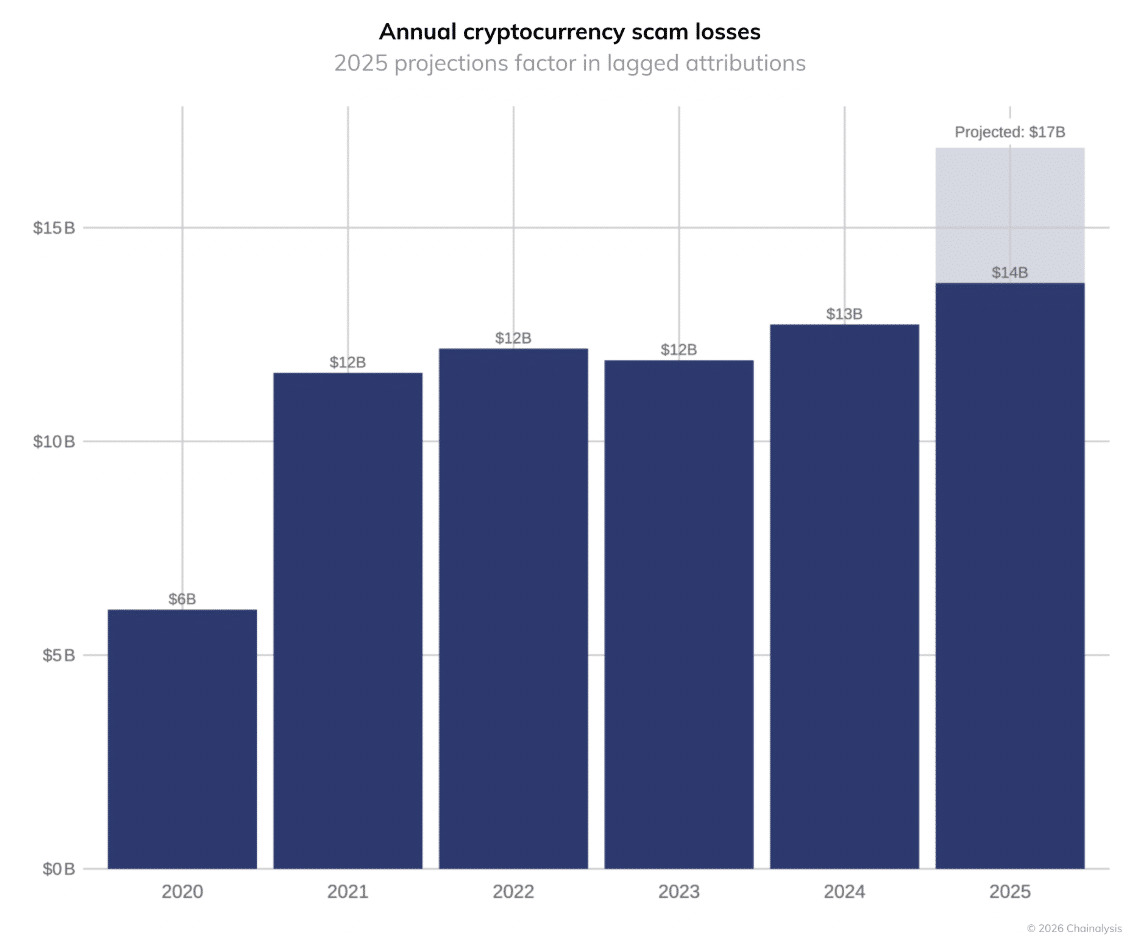
Source: Chainalysis

According to Chainalysis, scammers received around $14 billion in crypto in 2025, and investigators could identify over $17 billion as they uncover more illicit wallets.

However, TRM Labs reports a positive trend.
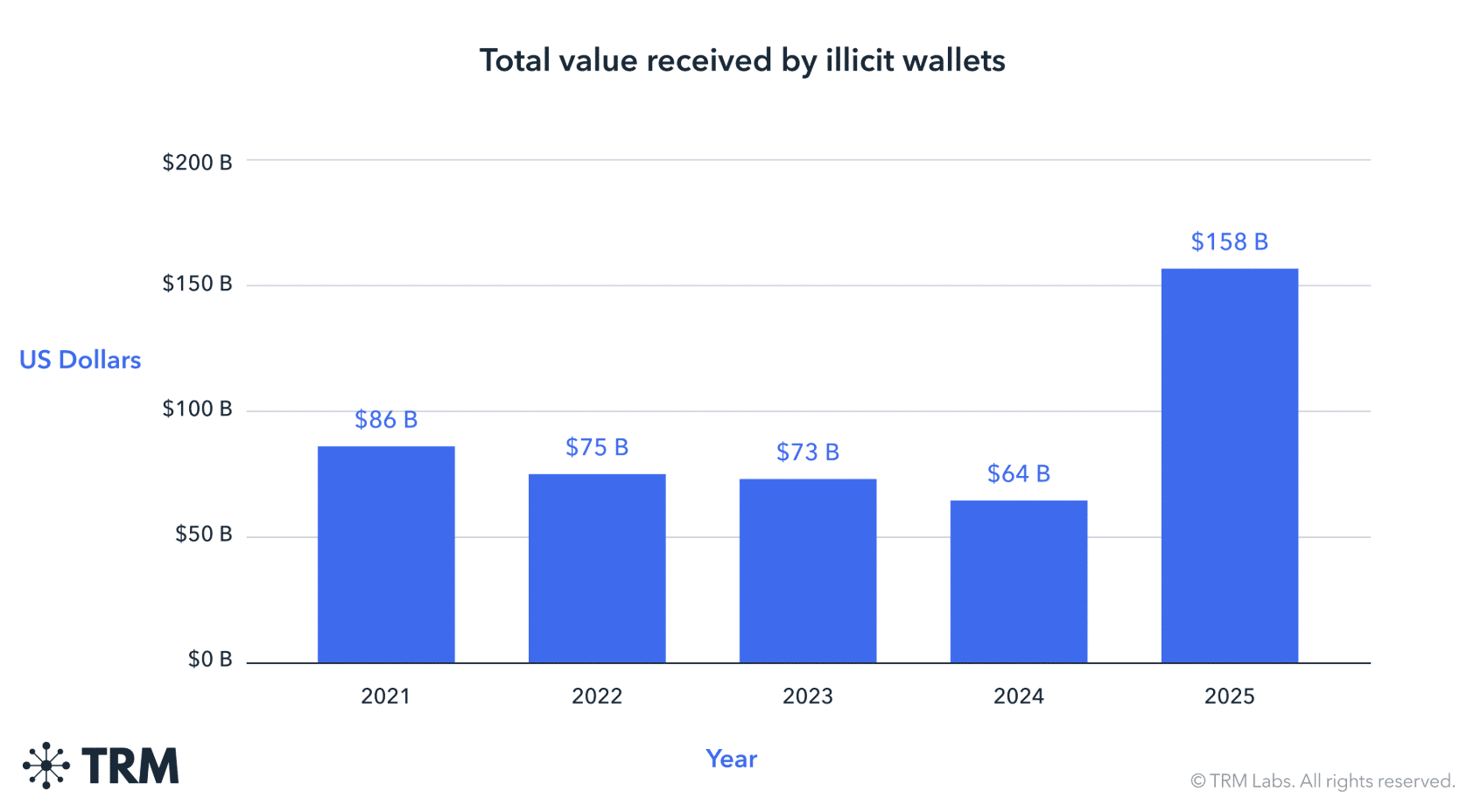
Source: TRM Labs

Illicit crypto activity reached $158 billion last year, but it accounted for only about 1.2% of total market activity. This suggests that despite rising fraud, the legitimate crypto economy is expanding at a much faster pace.


Final Summary

  • The rise of approval phishing scams exposes a key weakness in Web3 design, wherein many users do not fully understand the permissions they grant to smart contracts.
  • Billions lost to scams indicate that criminal networks are scaling just as quickly as the crypto industry itself.


İlgili Sorular

QWhat is the name of the joint operation launched by the UK, US, and Canada to combat crypto scams, and which agencies are involved?

AThe operation is called Operation Atlantic. It involves the U.S. Secret Service, the UK’s National Crime Agency (NCA), and Canadian authorities.

QWhat is the primary type of scam that Operation Atlantic is targeting, and how does it work?

AThe primary target is 'approval phishing.' In this scam, victims are tricked into signing a transaction that secretly grants attackers access to their crypto wallets, allowing the scammers to drain funds.

QHow does Operation Atlantic aim to prevent crypto fraud differently from previous methods?

AInstead of only tracing stolen funds after a crime has occurred (reactive), the operation aims to proactively detect and prevent scams by monitoring real-time data and suspicious wallet activity, then contacting potential victims before the fraud is completed.

QAccording to the report, what was the estimated value of crypto received by scammers in 2025, and what positive trend was noted by TRM Labs?

AAccording to Chainalysis, scammers received around $14 billion in crypto in 2025. TRM Labs reported that while illicit crypto activity reached $158 billion, it only accounted for about 1.2% of total market activity, indicating the legitimate crypto economy is expanding at a much faster pace.

QWhat is the name of the previous Canadian-led initiative that Operation Atlantic builds upon, and what did it target?

AOperation Atlantic builds on Project Atlas, a 2024 Canadian-led operation that targeted international crypto investment fraud networks.

İlgili Okumalar

Google and Amazon Simultaneously Invest Heavily in a Competitor: The Most Absurd Business Logic of the AI Era Is Becoming Reality

In a span of four days, Amazon announced an additional $25 billion investment, and Google pledged up to $40 billion—both direct competitors pouring over $65 billion into the same AI startup, Anthropic. Rather than a typical venture capital move, this signals the latest escalation in the cloud wars. The core of the deal is not equity but compute pre-orders: Anthropic must spend the majority of these funds on AWS and Google Cloud services and chips, effectively locking in massive future compute consumption. This reflects a shift in cloud market dynamics—enterprises now choose cloud providers based on which hosts the best AI models, not just price or stability. With OpenAI deeply tied to Microsoft, Anthropic’s Claude has become the only viable strategic asset for Google and Amazon to remain competitive. Anthropic’s annualized revenue has surged to $30 billion, and it is expanding into verticals like biotech, positioning itself as a cross-industry AI infrastructure layer. However, this funding comes with constraints: Anthropic’s independence is challenged as it balances two rival investors, its safety-first narrative faces pressure from regulatory scrutiny, and its path to IPO introduces new financial pressures. Globally, this accelerates a "tri-polar" closed-loop structure in AI infrastructure, with Microsoft-OpenAI, Google-Anthropic, and Amazon-Anthropic forming exclusive model-cloud alliances. In contrast, China’s landscape differs—investments like Alibaba and Tencent backing open-source model firm DeepSeek reflect a more decoupled approach, though closed-source models from major cloud providers still dominate. The $65 billion bet is ultimately about securing a seat at the table in an AI-defined future—where missing the model layer means losing the cloud war.

marsbit3 saat önce

Google and Amazon Simultaneously Invest Heavily in a Competitor: The Most Absurd Business Logic of the AI Era Is Becoming Reality

marsbit3 saat önce

Computing Power Constrained, Why Did DeepSeek-V4 Open Source?

DeepSeek-V4 has been released as a preview open-source model, featuring 1 million tokens of context length as a baseline capability—previously a premium feature locked behind enterprise paywalls by major overseas AI firms. The official announcement, however, openly acknowledges computational constraints, particularly limited service throughput for the high-end DeepSeek-V4-Pro version due to restricted high-end computing power. Rather than competing on pure scale, DeepSeek adopts a pragmatic approach that balances algorithmic innovation with hardware realities in China’s AI ecosystem. The V4-Pro model uses a highly sparse architecture with 1.6T total parameters but only activates 49B during inference. It performs strongly in agentic coding, knowledge-intensive tasks, and STEM reasoning, competing closely with top-tier closed models like Gemini Pro 3.1 and Claude Opus 4.6 in certain scenarios. A key strategic product is the Flash edition, with 284B total parameters but only 13B activated—making it cost-effective and accessible for mid- and low-tier hardware, including domestic AI chips from Huawei (Ascend), Cambricon, and Hygon. This design supports broader adoption across developers and SMEs while stimulating China's domestic semiconductor ecosystem. Despite facing talent outflow and intense competition in user traffic—with rivals like Doubao and Qianwen leading in monthly active users—DeepSeek has maintained technical momentum. The release also comes amid reports of a new funding round targeting a valuation exceeding $10 billion, potentially setting a new record in China’s LLM sector. Ultimately, DeepSeek-V4 represents a shift toward open yet realistic infrastructure development in the constrained compute landscape of Chinese AI, emphasizing engineering efficiency and domestic hardware compatibility over pure model scale.

marsbit3 saat önce

Computing Power Constrained, Why Did DeepSeek-V4 Open Source?

marsbit3 saat önce

İşlemler

Spot
Futures
活动图片