Turkey & Tether Freeze $544M: Why $BMIC Is The Safe Haven

bitcoinist2026-02-09 tarihinde yayınlandı2026-02-09 tarihinde güncellendi

Özet

Turkish authorities, in collaboration with Tether, froze approximately $544M in assets linked to a money laundering network. This event highlights the power centralized stablecoin issuers have to blacklist addresses, challenging crypto's censorship-resistant narrative and exposing the fragility of centralized infrastructure. This vulnerability, combined with the looming threat of quantum decryption, is shifting the value proposition toward unbreakable security. BMIC ($BMIC) is presented as a solution, offering a quantum-secure finance stack with features like 'Zero Public-Key Exposure' to protect against both regulatory overreach and future quantum attacks. Its ongoing presale, having raised over $444K, is attracting investors seeking a safe haven in defensive, next-generation infrastructure.

The clash between centralized enforcement and decentralized speculation hit a fever pitch this week. Turkish authorities, working alongside Tether, executed one of the largest asset freezes in recent memory. The operation targeted a massive money laundering network, resulting in the seizure and freezing of roughly $544M in value. Originally, the authorities did not disclose which crypto company was involved, but Tether CEO Paolo Ardoino confirmed it was Tether to Bloomberg.

It’s a stark reminder of the reach centralized stablecoin issuers actually possess. While Tether ($USDT) remains the liquidity backbone of the crypto economy, its ability to blacklist addresses at the request of law enforcement, like Turkey’s Interior Ministry, shows that the wild west era of digital finance is closing fast.

That challenges the censorship-resistance narrative many early adopters cling to. While the seizure targets illicit actors, a net positive for industry legitimacy, it also exposes the fragility of relying on centralized infrastructure.

Smart money, however, is watching this closely. The juxtaposition of a half-billion-dollar freeze and retail exuberance suggests a massive blind spot in the market. As centralized vectors like Tether become more compliant and quantum computing threats loom, the real value proposition is shifting.

It’s moving toward genuine, unbreakable security. This is where the conversation pivots from simple price speculation to infrastructure that can actually withstand both regulatory overreach and future tech assaults. Right in that gap, between the desire for safety and the reality of vulnerable legacy tech, BMIC ($BMIC) is emerging as a critical solution for the post-quantum era.

CHECK OUT BMIC ON ITS OFFICIAL PRESALE PAGE

Quantum-Proofing Finance In An Era of Centralized Vulnerability

While the Turkey-Tether collaboration highlights legal vulnerabilities in current crypto holdings, a far more dangerous technical threat is quietly developing: the quantum decryption crisis. Most current blockchain cryptography (including the keys securing those very frozen wallets) relies on math that quantum computers will eventually trivialize.

Industry veterans call this the ‘Harvest Now, Decrypt Later’ threat. Bad actors are collecting encrypted data today to unlock it once quantum processing power matures.

BMIC addresses this existential risk by introducing a Full Quantum-Secure Finance Stack. Unlike legacy wallets that leave public keys exposed on-chain, making them sitting ducks for future quantum algorithms, BMIC uses post-quantum cryptography combined with ‘Zero Public-Key Exposure.’ This approach ensures that even if the underlying network is scrutinized or attacked by advanced computational power, the user’s assets remain mathematically invisible to unauthorized decryption.
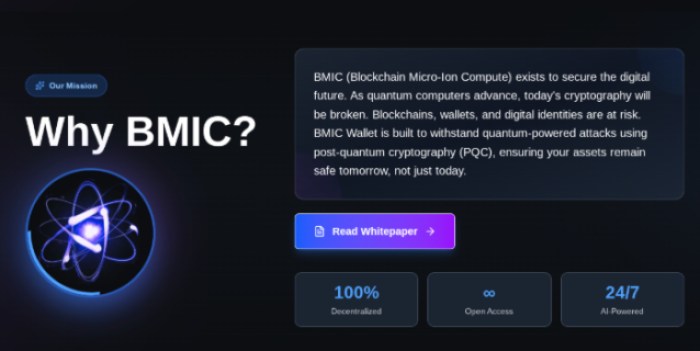
The platform integrates these defenses directly into a usable ecosystem, featuring ERC-4337 Smart Accounts and AI-Enhanced Threat Detection. This isn’t just about paranoia; it’s about future-proofing. If a centralized issuer can freeze $544M with a keystroke, and a quantum computer can eventually crack a standard private key in seconds, the only safe harbor is an architecture built explicitly to resist both.

BMIC’s ‘Burn-to-Compute’ model and Quantum Meta-Cloud extend this utility further, offering a decentralized alternative to the fragile infrastructure currently dominating the headlines.

Smart Money Pivots to BMIC as Presale Metrics Climb

The market’s appetite for defensive infrastructure is showing up in the BMIC capital raise. Sophisticated allocators are positioning themselves in protocols that solve fundamental security flaws. $BMIC has already raised over $444K, a significant figure for an early-stage infrastructure play.

With the token sitting at $0.049474, early participants are entering at a valuation that reflects the project’s development phase rather than its fully realized utility. The appeal lies in the dual-layer value proposition: $BMIC serves as both a governance token for the Quantum Meta-Cloud and the fuel for a wallet ecosystem that enterprises and privacy-conscious individuals desperately need. It’s not surprising that $BMIC made our list of best crypto to watch.

The risk here is inaction. History suggests that security solutions are often undervalued until a catastrophic event, like a major exchange hack or a cryptographic breakthrough, forces a repricing of ‘safety.’ By combining quantum-secure staking with no exposed keys, BMIC offers a yield-bearing asset that doesn’t compromise on security. As the presale continues to draw liquidity away from purely speculative assets, the window to acquire allocation at sub-five-cent levels is narrowing.

SEE HOW THE QUANTUM FUTURE IS BEING BUILT BEFORE LEGACY SYSTEMS FAIL

This article is for informational purposes only and does not constitute financial advice. Cryptocurrency investments carry high risks, including the potential loss of all invested capital. Always conduct independent research before investing.


İlgili Sorular

QWhat was the amount frozen in the joint operation between Turkish authorities and Tether, and what was the stated reason?

ATurkish authorities, working with Tether, froze approximately $544 million. The operation targeted a massive money laundering network.

QAccording to the article, what does the Tether ($USDT) asset freeze demonstrate about centralized stablecoin issuers?

AIt demonstrates that centralized stablecoin issuers possess the ability to blacklist addresses at the request of law enforcement, showing that the 'wild west era' of digital finance is ending and challenging the censorship-resistance narrative.

QWhat is the 'Harvest Now, Decrypt Later' threat mentioned in the article?

AThe 'Harvest Now, Decrypt Later' threat is a strategy where bad actors collect encrypted data today with the intention of decrypting it once quantum computing power becomes advanced enough to break current cryptographic standards.

QHow does BMIC ($BMIC) claim to protect against the quantum decryption crisis?

ABMIC uses a Full Quantum-Secure Finance Stack featuring post-quantum cryptography and 'Zero Public-Key Exposure.' This ensures a user's assets remain mathematically invisible to unauthorized decryption, even from future quantum algorithms.

QWhat is the dual-layer value proposition of the $BMIC token as described in the article?

AThe $BMIC token serves as both a governance token for the Quantum Meta-Cloud and as the fuel for a wallet ecosystem designed for enterprises and privacy-conscious individuals.

İlgili Okumalar

Uncovering the Truth About Agent Commerce, Payments, and Infrastructure

Decoding Agent Commerce, Payments, and Infrastructure: The Reality Over the past year, I've been building infrastructure for the Agent economy, engaging with major players like Stripe, Visa, Coinbase, Google, and dozens of startups. A clear conclusion emerges: true, large-scale demand does not yet exist. Startups face structural challenges. Data points illustrate this gap. Stripe's Agent commerce platform has over 1,000 merchants but only single-digit transacting agents. Visa's Agent payment token requires 9-month KYC and a $250M revenue threshold, accessible only to giants like Amazon. On-chain analysis reveals actual daily Agent transaction volume is around $17k, half of which are test transactions. The article analyzes four potential markets: **1. Agent-to-Merchant (A2M):** Current AI shopping UX is often inferior to traditional e-commerce for visual, comparison-heavy purchases (clothing, electronics). Chat interfaces are a step back. Real merchant interest is defensive "Agent Engine Optimization," fearing future obsolescence, not current demand. Potential exists in high-frequency, low-decision purchases (e.g., food delivery) or simplifying terrible UX (complex checkouts, non-native shoppers), but these require massive consumer distribution channels dominated by giants like DoorDash and Amazon. **2. Agent-to-API (A2A):** Developers already have subscriptions and billing for core APIs (compute, data). The argument for micro-payments via crypto for sub-dollar API calls is addressed by pre-paid balances today. The deeper issue is supplier resistance; major SaaS firms rely on enterprise contracts, not fractional cent pricing. Opportunity lies in the long tail of niche services, but this is a smaller market catering to developers, a historically low-paying group. **3. Agent-to-Agent (A2A):** This remains a theoretical long-term vision with near-zero current transaction volume. It involves unique challenges: discovery, trust, negotiation, dispute resolution. When it materializes, it will require a fundamentally new settlement infrastructure for high-speed, variable-value, multi-party transactions. It's a real long-term bet, but not the current market. **4. Agent-to-Finance (A2F):** This is the only category with existing, paying demand. Integrating AI into financial workflows (trading, portfolio management) is a natural evolution and enables new capabilities like autonomous rebalancing. However, competition favors incumbents with regulatory licenses, compliance infrastructure, and existing client relationships. **The Real Issue:** Why is infrastructure still being built? Incumbents can afford long-term bets, and payment companies see every problem as a nail for their payment hammer. However, payment is just one piece. The core challenge is *coordination*—orchestrating work between Agents and humans, verifying outcomes, and settling results. Payment is part of settlement, which is part of coordination. Companies that solve the coordination problem will subsume payments, not the other way around. Startups lack the infinite runway of giants and must find today's real market, which, after a year of exploration, lies outside these four categories—in an area with real, growing, and underserved activity.

marsbit43 dk önce

Uncovering the Truth About Agent Commerce, Payments, and Infrastructure

marsbit43 dk önce

Kalshi, MTS, and a16z's Ambition

The article "Kalshi, MTS, and a16z's Ambition" explores prediction markets as a focal point of excitement in 2025 for investors, crypto enthusiasts, and media. It traces their intellectual lineage from Friedrich Hayek's ideas on dispersed knowledge and market coordination to Robin Hanson's Logarithmic Market Scoring Rule (LMSR), which incentivizes truthful information sharing. The piece argues that a16z's significant investment in prediction market platform Kalshi (valued at $220B) transcends mere financial speculation. a16z frames prediction markets as a new form of "media" that provides "presence"—a way for individuals to actively engage with and influence world events through financial stakes, countering postmodern detachment. By wagering on outcomes, users become "super observers," and the market's aggregated probabilities gain authoritative power to define event truth and importance. The article uses media company MTS ("Monitoring The Situation") as a case study of a16z's "new media" strategy: rapidly producing high-intensity, multi-format content to "take over the timeline." However, prediction markets like Kalshi are presented as the ultimate piece in this media empire. Their real-money, crowd-sourced probabilities possess a unique "reality distortion field" and perceived objectivity, potentially swaying public opinion and granting a private company unprecedented interpretive power over reality. Ultimately, Kalshi's immense valuation is attributed not just to its exchange model, but to its role as a foundational component in a16z's envisioned new media landscape, where prediction markets define narrative and truth.

链捕手43 dk önce

Kalshi, MTS, and a16z's Ambition

链捕手43 dk önce

İşlemler

Spot
Futures
活动图片