Trust Wallet taps Revolut for crypto purchases in Europe

cointelegraph2025-12-11 tarihinde yayınlandı2025-12-11 tarihinde güncellendi

Özet

Trust Wallet, owned by Binance co-founder Changpeng Zhao, has partnered with Revolut to enable direct crypto purchases for users in Europe. The integration allows buying Bitcoin, Ether, and Solana with a minimum purchase of €10 and a daily cap of €23,000. While stablecoins like USDC are not yet supported, the feature supports multiple fiat currencies with zero transaction fees. However, funding a Revolut account may incur charges. The move follows Revolut’s recent regulatory approval under MiCA and its $75 billion valuation.

Trust Wallet, the self-custodial crypto wallet owned by Binance co-founder Changpeng “CZ” Zhao, has partnered with European fintech unicorn and digital banking giant Revolut to introduce a new way to purchase crypto assets on its platform.

Trust Wallet users can now buy Bitcoin (BTC), Ether (ETH) and Solana (SOL) with Revolut through a direct integration, the company announced on Thursday.

With a minimum purchase starting at 10 euros ($12) and capped at 23,000 euros ($26,950) daily and per transaction, Trust Wallet’s new buy option is expected to provide a faster and easier way to access crypto from Europe.

In October, Revolut scored regulatory approval from the Cyprus Securities and Exchange Commission to offer crypto services across 30 European Economic Area markets in compliance with the European Union’s Markets in Crypto-Assets Regulation (MiCA) framework.

Stablecoins like USDC not supported, for now

The integration will initially support only three crypto assets, but the companies said they expect to add stablecoins such as Circle’s USDC (USDC) at a later stage.

The feature enables zero-fee crypto purchases using multiple fiat currencies supported by Revolut, including the euro, the British pound, as well as the Czech koruna, Danish Krone, Polish Złoty and others.
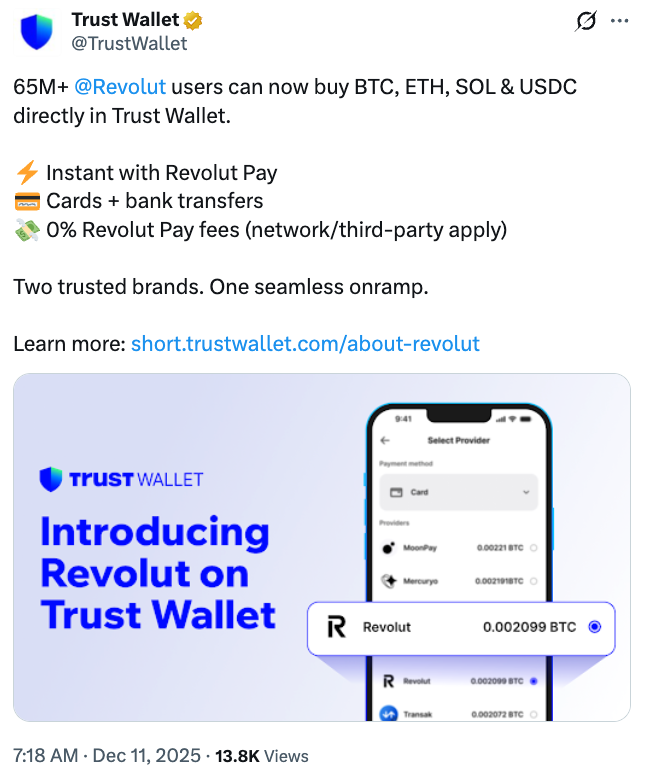
Source: Trust Wallet

While Revolut–Trust Wallet crypto purchases are offered with zero fees, adding money to a Revolut account is not free of charge in many cases, including via bank transfers, card top-ups and cash deposits. Cash deposits are subject to a 1.5% fee and are limited to $3,000 per calendar month, according to Revolut’s FAQs.

Related: Crypto self-custody is a fundamental right, says SEC’s Hester Peirce

The integration came shortly after Revolut secured a $75 billion company valuation after completing a private share sale in late November. “This makes us Europe’s most valuable private company and in the top 10 of the world’s most valuable private companies,” Revolut said in a post on X.

CZ-backed Trust Wallet has been actively tapping into trending market sectors, including prediction markets and real-world asset tokenization, expanding access to these offerings for self-custody users.

Cointelegraph contacted Revolut and Trust Wallet for comment on the integration, but had not received a response by publication.


İlgili Okumalar

Bitcoin Withdrawals Continue: 8 Years of Storage in a Coldcard Cold Wallet Ended in Zero

Coldcard Hardware Wallet Hacked: Losses Mount Due to Vulnerable Seed Generation A critical vulnerability in Coldcard hardware wallets has led to a continued wave of fund thefts. According to Galaxy Research, the total stolen has reached 1,367.05 BTC (approx. $88.6 million) from 4,585 addresses, a significant increase from the initial 594.5 BTC reported on July 30, 2026. Most of the stolen funds remain on the attackers' addresses. The issue is not with the current firmware, which Coinkite has updated, but with seed phrases generated on vulnerable devices between March 2021 and the release of fixed firmware versions. Due to a programmer error, devices switched from using a hardware random number generator to the software-based Yasmarang generator, which was initialized with publicly accessible data like the chip's serial number. This made the seed phrases predictable through offline brute-force attacks, meaning wallets remain at risk until funds are moved to a new wallet generated with the patched firmware. Affected devices include Mk2/Mk3 with firmware 4.0.1–4.1.9 (and up to 5.0.3), Mk4/Mk5 up to version 5.6.0, and Q models up to 1.5.0Q. The only exceptions are seeds created with a high-entropy method like at least 50 independent dice rolls or a strong unique BIP-39 passphrase. All other owners must generate a new seed on the fixed firmware and transfer their assets. A case highlighting the human impact involves a 39-year-old long-term investor who lost 2 BTC (approx. $130,000) in minutes. He had accumulated the Bitcoin over eight years through physical labor, viewing it as a financial lifeline and a retirement plan in a country suffering from hyperinflation. His story underscores that even conservative "buy and hold in cold storage" strategies can be compromised by such underlying technical flaws. From a technical perspective, this incident echoes historical failures where weak random number generators undermined cryptographic security, challenging the assumption that offline storage is automatically foolproof.

cryptonews.ru5 saat önce

Bitcoin Withdrawals Continue: 8 Years of Storage in a Coldcard Cold Wallet Ended in Zero

cryptonews.ru5 saat önce

İşlemler

Spot
活动图片



