Trump's Post Leaked in Advance? Polymarket Abnormal Betting Points to US-Iran Ceasefire Before Next Week

marsbit2026-03-24 tarihinde yayınlandı2026-03-24 tarihinde güncellendi

Özet

Former US President Donald Trump announced on Truth Social that "very good and productive discussions" were taking place to resolve the Middle East conflict. Prior to this public statement, several accounts on the prediction market platform Polymarket placed large bets, totaling approximately $160,000, that a ceasefire between the US would occur by March 31 or April 15. These bets, which would yield over $1 million if successful, were made by 10 newly created accounts and had already generated over $300,000 in floating profits after Trump's post. The timing and success of these wagers, particularly from an account with a history of profitable bets on geopolitical events, have raised suspicions of insider trading. In response, Polymarket announced new rules explicitly prohibiting trading on stolen confidential information, illegal insider knowledge, or by users who can influence event outcomes. Concurrently, unusual trading activity was detected in S&P 500 e-mini futures and WTI crude oil futures just minutes before Trump's post. A significant, isolated spike in volume occurred in these typically illiquid pre-market sessions. Shortly after the post, S&P futures surged over 2.5% while oil prices fell nearly 6%, suggesting that some entities may have traded on advance knowledge of the announcement. The SEC and CME Group declined to comment.

Author: Jinshi Data

On Monday morning local time, US President Trump posted on Truth Social, stating that the US and Iran had "very good and productive discussions" regarding resolving the Middle East war.

However, before Trump publicly disclosed this news, several accounts on the prediction market platform Polymarket had already placed large bets that the war would end within this week.

Ten recently opened accounts invested thousands of dollars in Polymarket's "US-Iran Ceasefire" market, betting on a ceasefire being reached by March 31 or April 15; these accounts collectively wagered approximately $160,000, and if a ceasefire is achieved before the end of the month, they stand to profit over $1 million.

These accounts were identified by X platform user Lirrato on Sunday and were subsequently shared and spread by the PolymarketHistory account. After Trump's post on Monday, the unrealized gains of these 10 accounts have already exceeded $300,000.
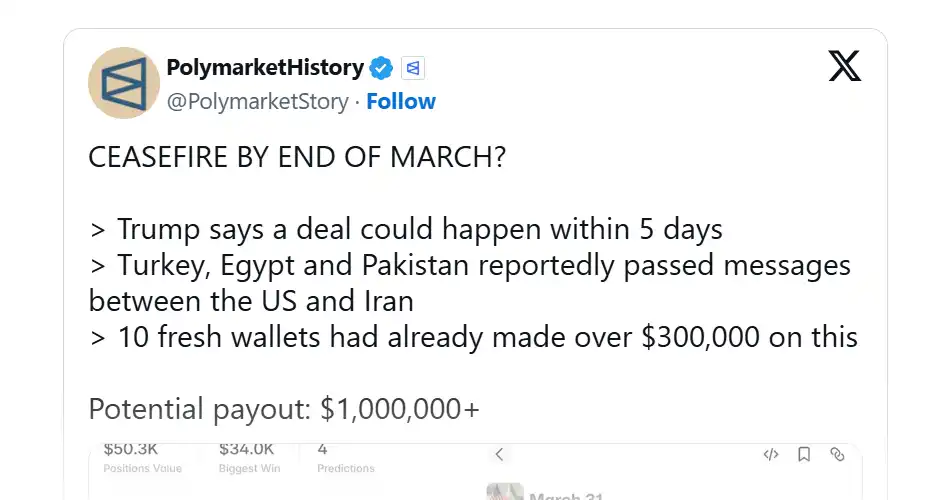
One account named "NOTHINGEVERFRICKINGHAPPENS" was particularly noteworthy. This account was registered in late February. Its first two trades were betting $7,600 on a US strike against Iran before February 28 and betting $11,283 on a strike before March 1; these two bets yielded profits totaling over $85,000. Now, the account has bet $8,005 on a US-Iran ceasefire before March 31 and another $15,614 on a ceasefire before April 15; these two bets have already generated unrealized gains of over $30,000.

The scale, timing, and past performance of these bets have led to external speculation about whether these Polymarket accounts belong to insiders—individuals connected to US or Iranian political circles who possess non-public information about diplomatic progress.

Prediction markets have previously been mired in insider trading scandals. A recent example involves a Polymarket trader who bet on the US taking military action against Venezuela, profiting over $400,000; a few days later, the US announced the capture of Venezuelan strongman Nicolás Maduro. Its competitor, Kalshi, recently also banned two users for insider trading, marking the platform's first public investigation into such activities.

On Monday, Polymarket announced an upgrade to its insider trading rules, explicitly prohibiting three types of behavior: trading using stolen confidential information, trading using illegal insider information, and trading when a user has the ability to influence the outcome of an event.

Polymarket's Chief Legal Officer, Neal Kumar, stated in a declaration: "Market prosperity relies on clear rules. The new regulations provide clarity for all participants and also demonstrate the compliance system we have built."

This rule adjustment may indicate that Polymarket will follow Kalshi's lead and initiate insider trading investigations. Although it is not yet certain whether the accounts betting on a US-Iran ceasefire are insiders, a platform investigation is expected to uncover the truth.

Abnormal Volume Spikes in S&P and Crude Futures Before Trump's Post

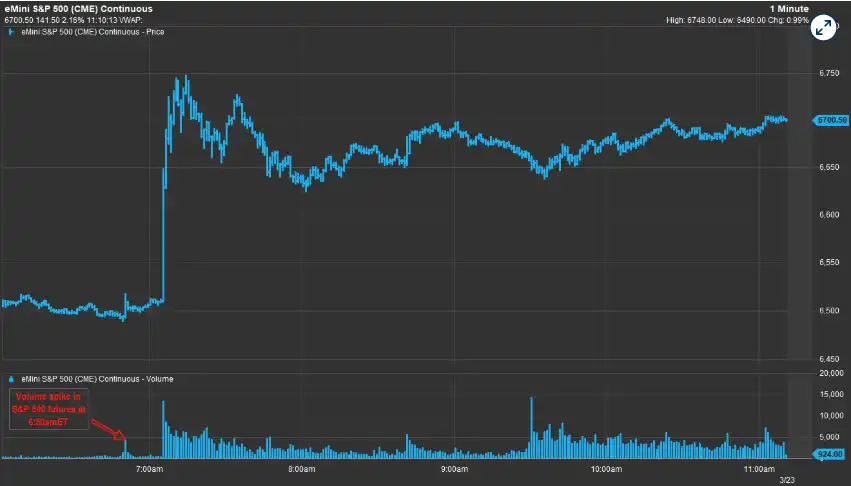
Furthermore, several minutes before Trump posted his market-moving social media update, abnormal trading volume spikes were also observed in S&P 500 futures and crude oil futures.

Around 6:50 AM New York time on Monday, the trading volume of S&P 500 e-mini futures traded on the Chicago Mercantile Exchange (CME) experienced a sharp and isolated surge, breaking the typically quiet pre-market backdrop. The early session is usually characterized by thin liquidity, making this sudden volume spike one of the largest moments of on-screen volume for that session up to that point.
A similar pattern emerged in the crude oil market. WTI crude oil futures also showed a noticeable uptick in trading activity around the same time, with a significant volume spike disrupting the previously calm market conditions.
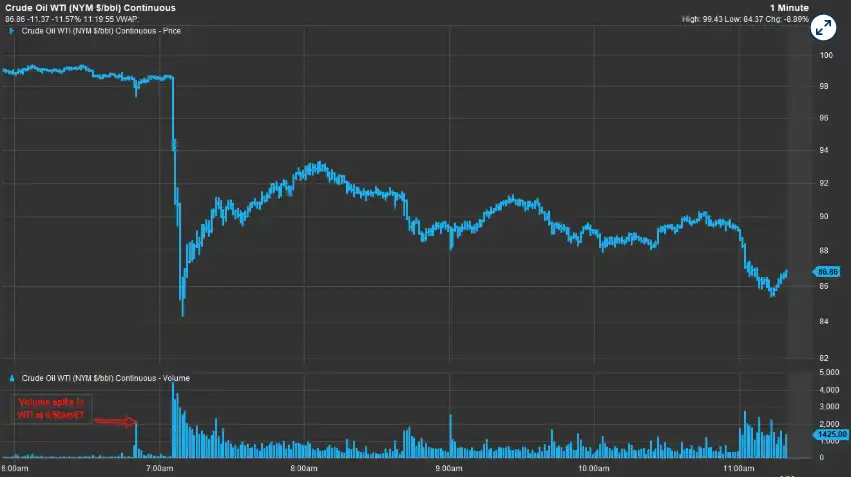
Approximately 15 minutes later, at 7:05 AM, Trump's statement about delaying strikes on Iranian power plants immediately triggered a rally in risk assets. S&P 500 futures surged over 2.5% before the open, while West Texas Intermediate (WTI) crude futures fell nearly 6% following the announcement.

The timing of the synchronized volume spikes in the stock and oil markets during the early session caught traders' attention—especially since there was no apparent catalyst driving the movement at the time of the spikes.

Pre-market futures trading typically has lower liquidity, making brief bursts of buying and selling more conspicuous than during regular trading hours. Nonetheless, these trades were still notable because anyone who bought stock futures in large quantities while simultaneously selling or shorting crude oil futures at that moment would have made huge profits just minutes later.

The US Securities and Exchange Commission (SEC) and the CME Group both declined to comment.

Algorithmic trading strategies and macro-driven strategies could also trigger rapid cross-asset capital flows during pre-market trading, even in the absence of a single identifiable catalyst.


İlgili Sorular

QWhat did President Trump post on Truth Social regarding US-Iran relations?

APresident Trump posted on Truth Social that there had been 'very good and productive conversations' regarding resolving the Middle East war.

QWhat suspicious activity was observed on the Polymarket prediction platform before Trump's announcement?

ATen recently created accounts placed large bets, totaling approximately $160,000, predicting a ceasefire between the US and Iran would be reached by March 31st or April 15th.

QWhat is the name of one notable account that made profitable bets on these events, and what were its wagers?

AOne notable account was named 'NOTHINGEVERFRICKINGHAPPENS'. It previously profited over $85,000 from bets on US strikes on Iran and had new bets on a ceasefire that were already up over $30,000 in profit.

QWhat other financial markets showed unusual activity just before Trump's post?

AS&P 500 e-mini futures and WTI crude oil futures showed isolated, sharp spikes in trading volume approximately 15 minutes before Trump's post, in an otherwise quiet pre-market session.

QHow did Polymarket respond to concerns about potential insider trading on its platform?

APolymarket announced upgraded insider trading rules, explicitly prohibiting trading on stolen confidential information, illegal insider information, and trading by users with the ability to influence event outcomes.

İlgili Okumalar

AI Agent Completely Transforms Web3 Gaming: From the Rugpull Bakery Bot Controversy to the New 2026 Agent Paradigm

This article explores how the AI Agent paradigm is fundamentally transforming Web3 gaming, moving from a disruptive force to a core, legitimized element. It begins with the controversy in the competitive baking game Rugpull Bakery, where automated scripts caused fairness issues. Instead of banning them, the developers integrated AI Agents into the official gameplay by providing technical documentation (skill.md, agent.json), marking a shift towards "Agentic Gaming." The piece outlines three primary implementation models for AI Agents in Web3 games by 2026: 1. **Autonomous Competitors & Economic Entities:** AI Agents act as independent players with unique strategies. Examples include TEN Protocol's poker agents, AI Arena's trainable NFT fighters, and Satoshi Strike Force's "Digital Athletes" trained on player data. The Somnia blockchain is highlighted as a dedicated "Agentic L1" infrastructure supporting this model at scale. 2. **Modular Infrastructure & Programmable Environments:** This model, exemplified by EVE Frontier, allows AI Agents to program game world logic itself. Using "Smart Assemblies" (e.g., Smart Turrets, Smart Gates), Agents can modify shared economic and physical rules on-chain, creating dynamic, player/AI-built worlds. The ERC-8183 standard further enables these automated entities to hire other AI services for complex tasks. 3. **Hybrid Companions & Dynamic Adaptation:** Here, AI serves as a collaborative partner. In Parallel Colony, highly autonomous AI Avatars work alongside human players who provide high-level guidance. Illuvium plans to use AI to make NPCs dynamic and responsive, creating personalized, emergent narratives for each player. The conclusion posits that Web3 gaming has reached a "post-human" inflection point. Blockchains' transparency and programmability, combined with new standards and infrastructure like Somnia, make integrating and governing AI Agents not just viable but essential. The future lies in a symbiotic digital order where players transition from manual laborers to commanders and partners of algorithmic intelligence.

marsbit24 dk önce

AI Agent Completely Transforms Web3 Gaming: From the Rugpull Bakery Bot Controversy to the New 2026 Agent Paradigm

marsbit24 dk önce

Saylor's Purchase of 1550 Bitcoin Is a Bad Trade

**Title: Saylor's Purchase of 1,550 Bitcoins Was a Bad Trade** The article critically analyzes Strategy's recent move of selling 32 bitcoins followed by a much larger purchase of 1,550 bitcoins. While appearing bullish, the author argues this trade is detrimental to MSTR shareholders. The core argument revolves around the concept of "breakeven modified Net Asset Value (mNAV)," a key metric for Strategy. To increase Bitcoin per share (BPS) for MSTR holders, Strategy must issue new shares at a premium high enough that the funds raised can buy more bitcoin than the bitcoin backing each existing share. Currently, this breakeven mNAV is estimated at 1.30. The recent trade failed on two counts: 1. The shares for the $181 million raise were issued at an mNAV *below* the 1.30 breakeven point. Selling "cheap" shares to buy bitcoin actually *reduces* BPS. 2. Only $101.3 million of the raised funds were used to buy bitcoin; the rest went to boost the company's dollar reserves. The breakeven mNAV calculation assumes *100%* of proceeds are used for bitcoin purchases. Diverting funds, even if mNAV were high, dilutes BPS. The result is an estimated 0.19% decrease in Bitcoin per share for MSTR holders. In exchange, Strategy merely extended its operational runway for its dollar reserves from ~6.3 months to 7 months. The author interprets this as Strategy prioritizing the survival and development of its STRC business over its stated core goal of increasing MSTR's BPS. This constitutes a gamble: if sacrificing MSTR value leads to improved market sentiment and a recovery in STRC's price (and thus mNAV), the whole system could work. If not, Strategy may be forced into a cycle of further diluting MSTR to stay afloat, potentially leading to deferred STRC dividends or corporate decline. The article concludes with a hope for price recovery for Bitcoin, MSTR, and STRC.

Foresight News34 dk önce

Saylor's Purchase of 1550 Bitcoin Is a Bad Trade

Foresight News34 dk önce

The AI Bear Market Lasting Two Days Is Over; Why Did Funds Buy Back Storage Stocks First?

After a severe two-day selloff in early June that erased over $1 trillion from U.S. chip stock market value, capital is flowing back first to the memory sector. The correction was not driven by a collapse in AI demand but rather a market reassessment of high expectations. Stocks like Broadcom faced selling pressure despite strong AI revenue guidance, signaling a shift in focus from who has an "AI story" to who can most rapidly translate AI demand into verifiable profits and earnings per share (EPS). Memory companies, such as Micron and SK Hynix, are leading the recovery because their EPS growth is more immediately verifiable. The AI server boom directly increases demand for high-bandwidth memory (HBM) and high-capacity server DRAM, tightening supply and driving up contract prices for conventional DRAM and NAND Flash. This price increase, coupled with a shift to higher-margin products, flows directly into near-term revenue and profitability, as evidenced in recent earnings reports. In contrast, other AI semiconductor segments like GPUs, ASICs, and optical modules, while central to the long-term AI infrastructure story, face longer and less certain paths to EPS validation. Their growth depends more on future product cycles, customer adoption timelines, and capital expenditure plans. The rebound in memory stocks highlights a market preference for assets with shorter, more transparent EPS conversion cycles following the recent de-risking phase. However, this does not negate the potential of other AI hardware segments should they provide clearer near-term order visibility. The episode has raised the validation bar for all AI-related investments.

marsbit35 dk önce

The AI Bear Market Lasting Two Days Is Over; Why Did Funds Buy Back Storage Stocks First?

marsbit35 dk önce

İşlemler

Spot
Futures
活动图片




