Trump's Midterm Election Donors Exposed: From Crypto.com to OpenAI, Crypto and AI Giants Generously Contribute

marsbit2026-02-04 tarihinde yayınlandı2026-02-04 tarihinde güncellendi

Özet

Donald Trump's midterm election fundraising has reached $429 million, with his super PAC holding $304 million—tens of millions more than Democratic opponents. Significant contributions came from the crypto and AI sectors, including $5 million from Elon Musk, $25 million from OpenAI co-founder Greg Brockman and his wife, and $16 million from SIG co-founder Jeff Yass. Crypto.com donated $30 million, while Blockchain.com and a16z founders Ben Horowitz and Marc Andreessen each contributed. Major donations also poured in from energy, healthcare, and finance industries, such as $10 million from Extremity Care, $12.5 million from energy entrepreneur Kelcy Warren, and $1 million each from figures like NFL Dallas Cowboys owner Jerry Jones and Chevron board member John Hess.

Is Trump's midterm election in jeopardy? ????

——Not sure, but he definitely has more money than his opponents! He has raised a total of $429 million, with his super PAC currently holding $304 million, tens of millions more than the Democratic camp!

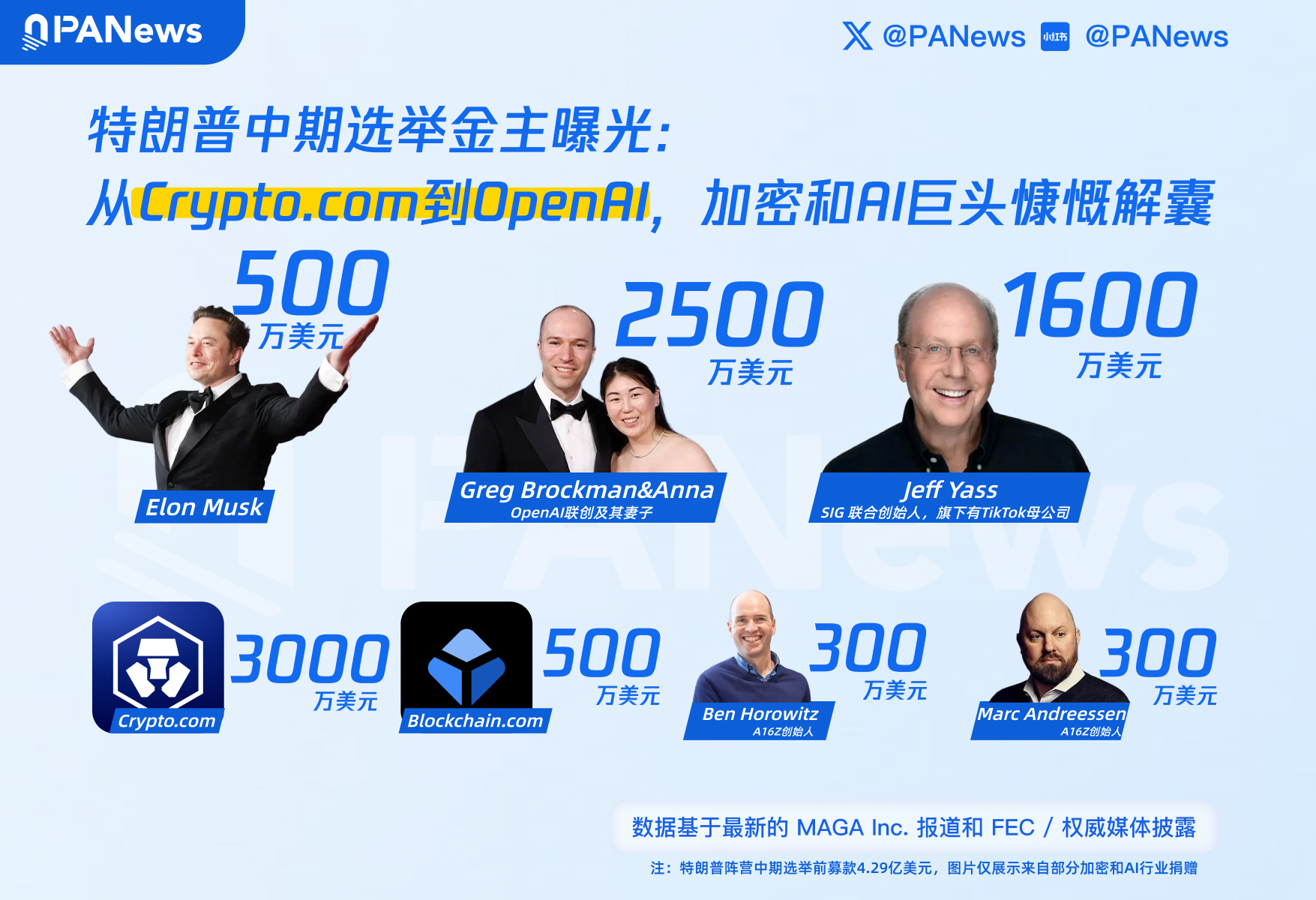
In this round of donations, the AI and crypto industries also accounted for a significant proportion:

Elon Musk: $5 million
OpenAI co-founder Greg Brockman and his wife Anna: $25 million
SIG co-founder Jeff Yass: $16 million

Crypto.com: $30 million
Blockchain.com: $5 million
A16Z founder Ben Horowitz: $3 million
A16Z founder Marc Andreessen: $3 million

Funds from the energy, healthcare, and financial industries are also heavily betting:

Extremity Care (medical company) and related parties: $10 million
RAI Services (tobacco company): $3 million

Energy entrepreneur Kelcy Warren: $12.5 million
Private equity investor Konstantin Sokolov: $11 million
Banker Julio Herrera Velutini and his daughter: $3.5 million
NYSE parent company ICE CEO Jeffrey Sprecher: $2.5 million
Food business heir Lynsi Snyder-Ellingson: $2 million
Venture capitalist William E. Ford: $1.25 million
NFL Dallas Cowboys owner Jerry Jones: $1 million
Chevron board member John Hess: $1 million
John Hess's wife Susan Hess: $1 million
Investor Warren Stephens: $1 million
Entrepreneur Jared Isaacman: $1 million
İlgili Sorular

QHow much money did Donald Trump raise for the midterm elections according to the article?

ADonald Trump raised a total of $429 million for the midterm elections.

QWhich AI and crypto industry leaders made significant donations to Trump's campaign, and how much did they contribute?

AElon Musk donated $5 million, OpenAI co-founder Greg Brockman and his wife Anna donated $25 million, and SIG co-founder Jeff Yass donated $16 million. From the crypto industry, Crypto.com donated $30 million, Blockchain.com donated $5 million, and A16Z founders Ben Horowitz and Marc Andreessen each donated $3 million.

QWhat is the amount of money currently available in Trump's super PAC, and how does it compare to the Democratic camp?

ATrump's super PAC currently has $304 million, which is tens of millions more than the Democratic camp.

QBesides AI and crypto, which other industries contributed significantly to Trump's midterm election funds?

ASignificant contributions also came from the energy, healthcare, and financial industries, including donations from Extremity Care ($10 million), RAI Services ($3 million), energy entrepreneur Kelcy Warren ($12.5 million), and others.

QWho are some of the notable individual donors from outside the AI and crypto sectors mentioned in the article?

ANotable individual donors include NYSE parent ICE CEO Jeffrey Sprecher ($2.5 million), NFL Dallas Cowboys owner Jerry Jones ($1 million), Chevron board member John Hess and his wife Susan Hess ($1 million each), and food business heiress Lynsi Snyder-Ellingson ($2 million).

İlgili Okumalar

In Jinjiang, Fujian, a Storage Super Unicorn Lies Quiet

In Fujian's Jinjiang, a city known for sportswear, lies a quiet semiconductor giant: Fujian Jinhua Integrated Circuit Co. (JHICC). Once a promising domestic DRAM manufacturer alongside Yangtze Memory and ChangXin Memory Technologies (CXMT), its journey was derailed in 2018 when the U.S. placed it on an Entity List and filed criminal charges for alleged trade secret theft. This halted production for years. A turning point came in February 2024 when a U.S. federal court found JHICC not guilty. However, it had lost crucial time. While CXMT soared to become a top-valued A-share company in 2024, JHICC, with an estimated valuation of 80 billion RMB, was just restarting. Its current output is primarily customized DDR4 chips, not the advanced DDR5/HBM demanded for AI, but it still benefits from the broader memory chip upcycle. JHICC's story is tied to Chen Zhengkun, a veteran engineer who left Micron to lead the venture. Founded in 2016 with state-backed funding, JHICC partnered with Taiwan's UMC to develop DRAM technology. Rapid progress was cut short by the U.S. actions, which Micron initiated, partly due to its heavy reliance on the Chinese market. Post-sanctions, Chen's team worked to rebuild the production line with reduced reliance on U.S. technology. According to its records, JHICC achieved small-scale production and revenue growth under immense pressure. It now focuses on the stable "niche" DRAM market (e.g., TVs, routers) with a monthly capacity of ~40,000 wafers, aiming for 60,000 by 2026. It holds over 1,000 patents but remains on the Entity List. For Jinjiang, investing in JHICC was a bold industrial leap. The local government provided unwavering financial and logistical support during the crisis, helping the company survive. JHICC has become the anchor for a growing local semiconductor cluster. Though its scale lags behind domestic peers, JHICC's persistence symbolizes a hard-won foothold in a global market long dominated by Samsung, SK Hynix, and Micron. Having missed one boom, it seeks a place in the new AI-driven memory supercycle.

marsbit33 dk önce

In Jinjiang, Fujian, a Storage Super Unicorn Lies Quiet

marsbit33 dk önce

Must-Watch Events Next Week|CLARITY Act Could Face Senate Vote; SpaceX, Circle to Report Earnings (8.3-8.9)

**Summary: Key Events and Developments to Watch (August 3-9)** The upcoming week is marked by significant financial disclosures, key legislative deadlines, and notable product updates. **Major Financial Events:** Several companies are scheduled to release their Q2 2026 earnings. American Bitcoin (ABTC) will report on August 3, followed by SpaceX and Hut 8 Mining Corp. on August 4, and Circle on August 5. Notably, a significant portion of SpaceX shares (up to 12% of total shares) will be unlocked on August 6 following their earnings release. **Key Legislative Deadline:** The U.S. Senate faces an August 7 deadline to secure 60 votes for the CLARITY Act, a bipartisan bill aiming to establish a federal regulatory framework for cryptocurrencies. The Senate may hold a full vote on the bill during the week. **Economic Data:** The U.S. July Non-Farm Payrolls report will be released on August 7, providing crucial labor market data. **Technology & Product Updates:** * **Shutdowns:** DeFi portfolio tracker Zapper and wallet app Ctrl Wallet will cease operations on August 3. * **Upgrades:** LayerZero will deprecate its v1 relayers on August 3. XRP Ledger's new version 3.3.0, featuring five new functions, is expected next week. * **AI:** Elon Musk announced that the advanced Grok 4.6 AI model is set for release around August 7. * **Bitcoin:** The BIP-110 forced signaling for a potential Bitcoin network change is scheduled to begin around August 8. **Other Notable Events:** Chinese robotics firm Unitree Tech has set its preliminary price inquiry for its IPO for August 5. South Korean exchange Upbit will delist AQT and AERGO tokens on August 3.

marsbit2 saat önce

Must-Watch Events Next Week|CLARITY Act Could Face Senate Vote; SpaceX, Circle to Report Earnings (8.3-8.9)

marsbit2 saat önce

İşlemler

Spot
活动图片





