Trump's Midterm Election Donors Exposed: From Crypto.com to OpenAI, Crypto and AI Giants Generously Contribute

marsbit2026-02-04 tarihinde yayınlandı2026-02-04 tarihinde güncellendi

Özet

Donald Trump's midterm election fundraising has reached $429 million, with his super PAC holding $304 million—tens of millions more than Democratic opponents. Significant contributions came from the crypto and AI sectors, including $5 million from Elon Musk, $25 million from OpenAI co-founder Greg Brockman and his wife, and $16 million from SIG co-founder Jeff Yass. Crypto.com donated $30 million, while Blockchain.com and a16z founders Ben Horowitz and Marc Andreessen each contributed. Major donations also poured in from energy, healthcare, and finance industries, such as $10 million from Extremity Care, $12.5 million from energy entrepreneur Kelcy Warren, and $1 million each from figures like NFL Dallas Cowboys owner Jerry Jones and Chevron board member John Hess.

Is Trump's midterm election in jeopardy? ????

——Not sure, but he definitely has more money than his opponents! He has raised a total of $429 million, with his super PAC currently holding $304 million, tens of millions more than the Democratic camp!

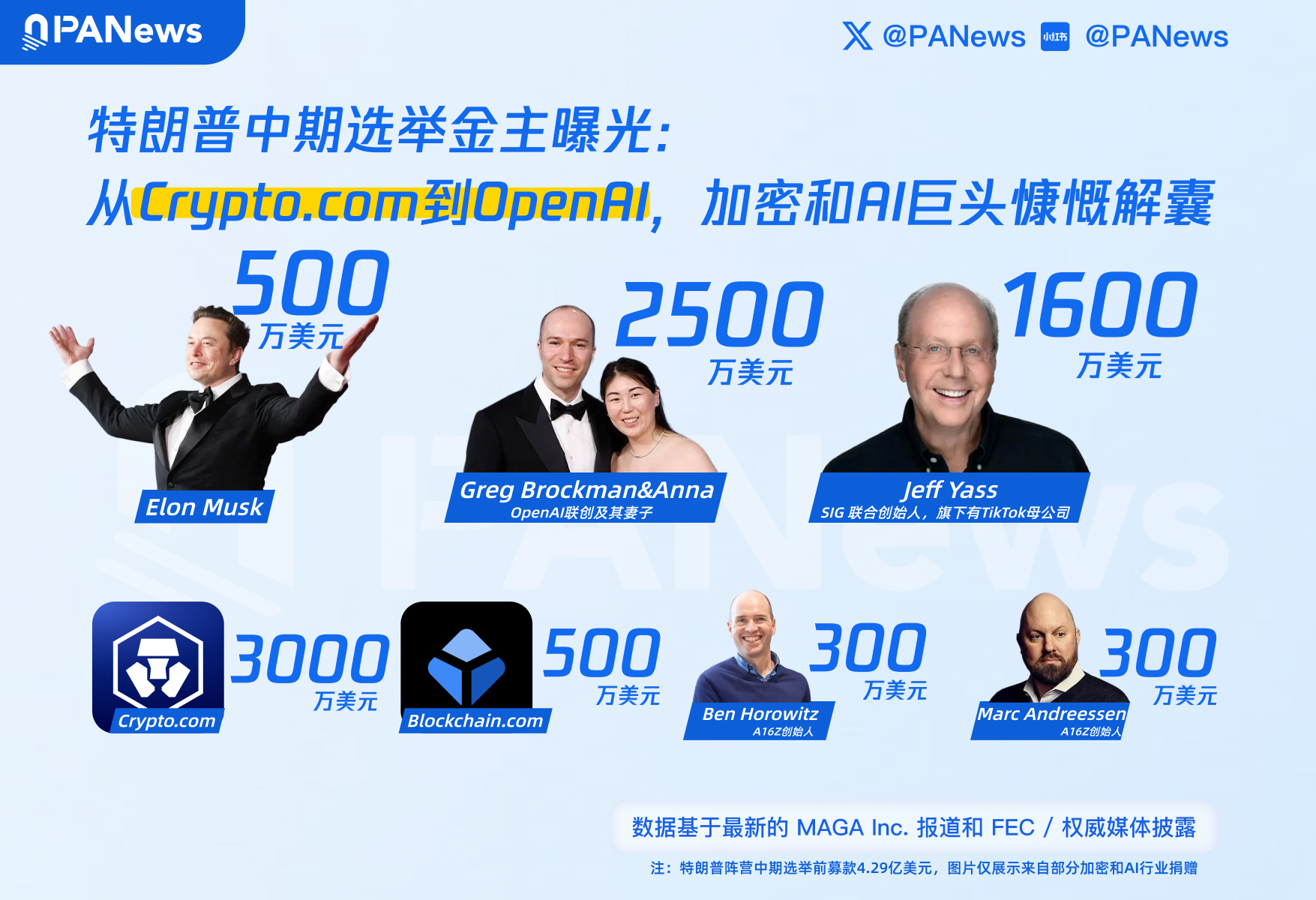
In this round of donations, the AI and crypto industries also accounted for a significant proportion:

Elon Musk: $5 million
OpenAI co-founder Greg Brockman and his wife Anna: $25 million
SIG co-founder Jeff Yass: $16 million

Crypto.com: $30 million
Blockchain.com: $5 million
A16Z founder Ben Horowitz: $3 million
A16Z founder Marc Andreessen: $3 million

Funds from the energy, healthcare, and financial industries are also heavily betting:

Extremity Care (medical company) and related parties: $10 million
RAI Services (tobacco company): $3 million

Energy entrepreneur Kelcy Warren: $12.5 million
Private equity investor Konstantin Sokolov: $11 million
Banker Julio Herrera Velutini and his daughter: $3.5 million
NYSE parent company ICE CEO Jeffrey Sprecher: $2.5 million
Food business heir Lynsi Snyder-Ellingson: $2 million
Venture capitalist William E. Ford: $1.25 million
NFL Dallas Cowboys owner Jerry Jones: $1 million
Chevron board member John Hess: $1 million
John Hess's wife Susan Hess: $1 million
Investor Warren Stephens: $1 million
Entrepreneur Jared Isaacman: $1 million
İlgili Sorular

QHow much money did Donald Trump raise for the midterm elections according to the article?

ADonald Trump raised a total of $429 million for the midterm elections.

QWhich AI and crypto industry leaders made significant donations to Trump's campaign, and how much did they contribute?

AElon Musk donated $5 million, OpenAI co-founder Greg Brockman and his wife Anna donated $25 million, and SIG co-founder Jeff Yass donated $16 million. From the crypto industry, Crypto.com donated $30 million, Blockchain.com donated $5 million, and A16Z founders Ben Horowitz and Marc Andreessen each donated $3 million.

QWhat is the amount of money currently available in Trump's super PAC, and how does it compare to the Democratic camp?

ATrump's super PAC currently has $304 million, which is tens of millions more than the Democratic camp.

QBesides AI and crypto, which other industries contributed significantly to Trump's midterm election funds?

ASignificant contributions also came from the energy, healthcare, and financial industries, including donations from Extremity Care ($10 million), RAI Services ($3 million), energy entrepreneur Kelcy Warren ($12.5 million), and others.

QWho are some of the notable individual donors from outside the AI and crypto sectors mentioned in the article?

ANotable individual donors include NYSE parent ICE CEO Jeffrey Sprecher ($2.5 million), NFL Dallas Cowboys owner Jerry Jones ($1 million), Chevron board member John Hess and his wife Susan Hess ($1 million each), and food business heiress Lynsi Snyder-Ellingson ($2 million).

İlgili Okumalar

SemiAnalysis on the Epic Plunge: It's Not Over Yet

SemiAnalysis Weekly discusses the recent sharp correction in the semiconductor market after a historic first half. Analysts Doug O'Loughlin and Dylan note that despite healthy fundamentals, markets like South Korea's KOSPI have plunged 40%, wiping out leveraged retail investors. A core debate focuses on AI demand versus supply constraints. Dylan cites SemiAnalysis's internal use of AI coding agents, leading to a 100x increase in AI spending, as evidence of powerful demand. Doug agrees demand is strong but questions its exact magnitude, calling it a "trillion-dollar question." His primary concern is physical and financial bottlenecks: a shortage of 100,000 electricians in the US, massive $450B in corporate debt issuance by hyperscalers (funded by a shrinking pension pool), and labor/scale limits in regions like Taiwan, where TSMC constitutes 20% of GDP. The conversation covers market dynamics, including the typical semiconductor cycle where over-ordering leads to crashes, China's growing memory capacity, and the potential for older chips like the H100 to lose value as models scale. Politically, AI is seen as a likely scapegoat in upcoming elections, though not a top-tier voter priority. The analysts conclude that while the long-term potential is significant, the scaling path is narrowing. The challenge is matching exponential compute demands with real-world constraints on capital, labor, and permits, risking scenarios where massive investment outpaces near-term revenue generation.

marsbit30 dk önce

SemiAnalysis on the Epic Plunge: It's Not Over Yet

marsbit30 dk önce

After Robinhood's Aggressive Entry, Why is PUMP Defying the Trend and Rising?

Amid a prolonged crypto bear market that has strained many projects, Pump.fun stands out by maintaining strong profitability. Despite a major token unlock in mid-July that was expected to cause selling pressure, its native token PUMP has risen nearly 48% over the past month. Analysis shows only a small portion of unlocked tokens were sold, with 92% of investor allocations still held. A buyback-and-burn mechanism has also supported the price, though daily回购 funds have declined by 77.5% from their peak, partly due to a change in tokenomics and lower platform revenue. Pump.fun remains a top revenue generator in crypto, with annualized revenue of around $450 million, ranking just behind giants like Tether and Circle. However, its daily revenue is down about 69% from its all-time high, reflecting dependence on meme coin market cycles. The platform also faces a class-action lawsuit alleging market manipulation and securities violations. New competition has emerged with Robinhood Chain's launchpad, which recently saw higher weekly volume and active addresses than Pump.fun. While Pump.fun's metrics haven't declined yet, it has responded with a new token launch mechanism called BOOST to improve liquidity. This has increased platform activity but raised community concerns about potential exploitation for short-term pumps. Ultimately, Pump.fun's success remains tightly linked to meme coin speculation and broader market sentiment.

marsbit30 dk önce

After Robinhood's Aggressive Entry, Why is PUMP Defying the Trend and Rising?

marsbit30 dk önce

China Business Journal Unveils Cryptocurrency Extortion Scheme

China Business Journal, a state-run Chinese newspaper, has issued a warning about scammers using its name to extort cryptocurrency from companies. According to the publication, fraudsters are sending emails impersonating its journalists. These emails threaten to publish damaging information about a company unless a Bitcoin payment is made. The scammers, using Proton Mail addresses, claim to possess compromising material from a secretive investigation. The newspaper's representatives have clarified that it has no involvement with these messages. They emphasized that the publication does not engage in such practices, never demands payment to suppress stories, and does not negotiate in this manner. The editorial team believes the criminals are exploiting the newspaper's authoritative reputation to pressure companies into making hasty decisions under threat of reputational harm. China Business Journal stated it is collecting evidence of this brand misuse, analyzing the fraudulent emails, and preparing materials for law enforcement. It reserves the right to pursue both civil and criminal liability against the scheme's organizers. Companies are urged to carefully verify any communication purportedly from the newspaper, avoid transferring cryptocurrency to unknown recipients, and report such incidents to the authorities. The newspaper confirmed it will continue its own investigation into the matter.

cryptonews.ru1 saat önce

China Business Journal Unveils Cryptocurrency Extortion Scheme

cryptonews.ru1 saat önce

İşlemler

Spot
活动图片