You never know where a butterfly flapping its wings will send the hurricane.
Nine days after the United States raided Venezuela and arrested its President Maduro, a game called RuneScape also made history once again. On that day, the number of simultaneous online players in RuneScape exceeded 258,000, the highest in the game's 25-year history.
Two seemingly unrelated events were magically connected.
While the world was watching international crude oil prices or the Venezuelan stock market due to the country's political turmoil, RuneScape players were focused on the changes in the game's gold coins, item prices, and player numbers.
If Maduro's "departure" from Venezuela marked the end of an era, then Venezuelan players "leaving" RuneScape also marked the end of an era.
The end of the old era only signifies history moving forward eternally and relentlessly; it does not equate to new hope. Venezuelans, RuneScape, and cryptocurrency—these three elements once intertwined so intensely, telling a story of survival and escape.
Survival
Thanks to oil, Venezuela was once one of the wealthiest countries in South America, but starting in 2013, its economy began to collapse.
The collapse was like a snowball rolling down a mountain, growing larger and accelerating. Between 2013 and 2021, Venezuela's GDP fell by approximately 75%–80%, the most severe economic collapse in the world in the past 45 years not caused by war, surpassing even the Great Depression in the United States and the collapse of the Soviet Union. By 2021, 95% of Venezuelans lived below the poverty line, with 77% living in extreme poverty.
In August 2018, just before the reform of Venezuela's currency, the "Bolívar," the country's annual inflation rate had already exceeded 48,000%. In just four months, the black market exchange rate for the Bolívar against the U.S. dollar fell from 1 million:1 to approximately 7 million:1, rendering the currency nearly worthless.
Amid this crumbling life, Venezuelans discovered RuneScape. At the time, the exchange rate for the game currency "gold" in Old School RuneScape (hereinafter referred to as OSRS) against the U.S. dollar was about 1–1.25 million:1, far more valuable and stable than the Bolívar.
Although OSRS launched in 2013, it was actually a fork of the August 2007 version of RuneScape. The company behind the game, Jagex, made an attempt to bring the old version into the new era to counter player attrition and negative reactions to updates.
This attempt was unexpectedly successful. OSRS continued to develop, keeping the RuneScape IP thriving. This attempt also had a sense of destiny: because it was an old version, it could be played directly through a web browser, requiring low hardware specifications, allowing a large number of Venezuelan players to flood in and "work" in this virtual game world to solve real-world survival problems.
On YouTube, there is an old video published in February 2018 showing how to play OSRS on a Canaima laptop with only 2GB of RAM. In the 2010s, the Venezuelan government distributed millions of free Canaima computers to students to aid their education.
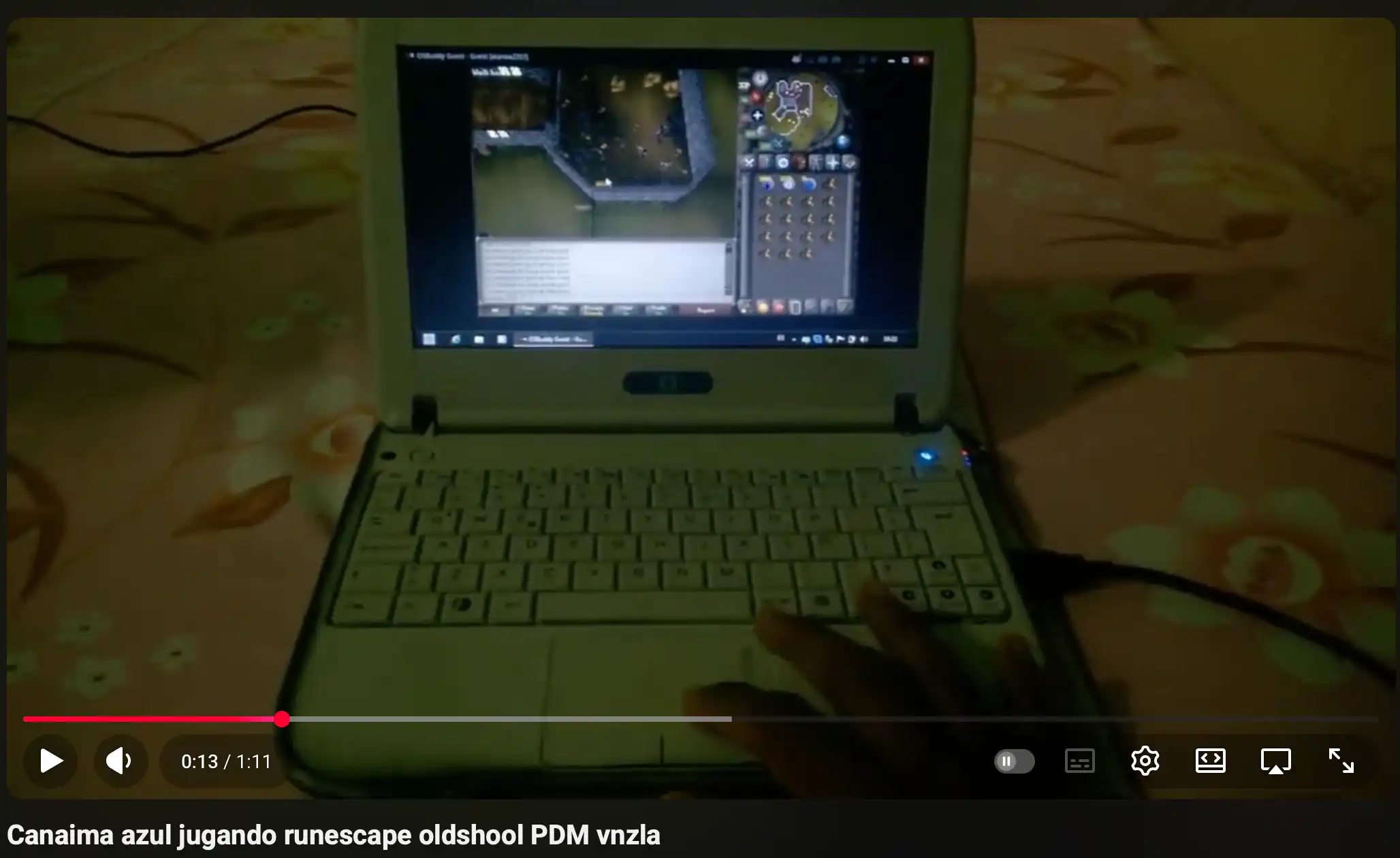
Who would have thought that knowledge would not help these children change their fate in the face of their country's decline, but this computer, with its extremely limited capabilities, would help them catch their breath in the face of survival difficulties?
Venezuelan players had been using OSRS to make a living as early as 2017 or even earlier. In September 2017, a Reddit post teaching OSRS players how to hunt Venezuelan players in the "Eastern Dragon Zone" went viral and later became an important meme in OSRS history:
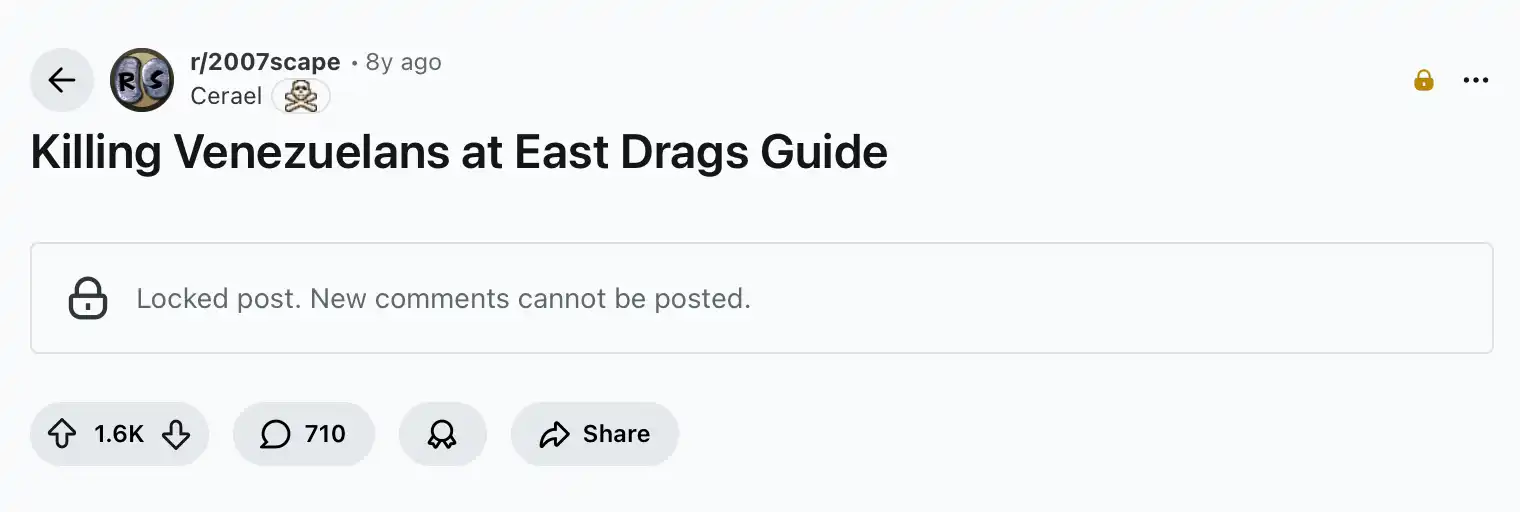
The "Eastern Dragon Zone" refers to the eastern part of the "Graveyard Hunter Area" in OSRS, where a monster called "Green Dragons" spawns. Venezuelan players crowded this area from 2017 to 2019. They frantically slaughtered dragons repeatedly, selling the dragon bones and hides dropped by the Green Dragons on the RuneScape trading market to earn gold coins, and then exchanging OSRS gold for Bitcoin or other cryptocurrencies to cash out.
According to an article published by Steemit user "fisherman" in August 2017, farming Green Dragons could earn 500,000 OSRS gold per hour, equivalent to $0.50. This method of making money was even featured in Venezuelan newspapers:
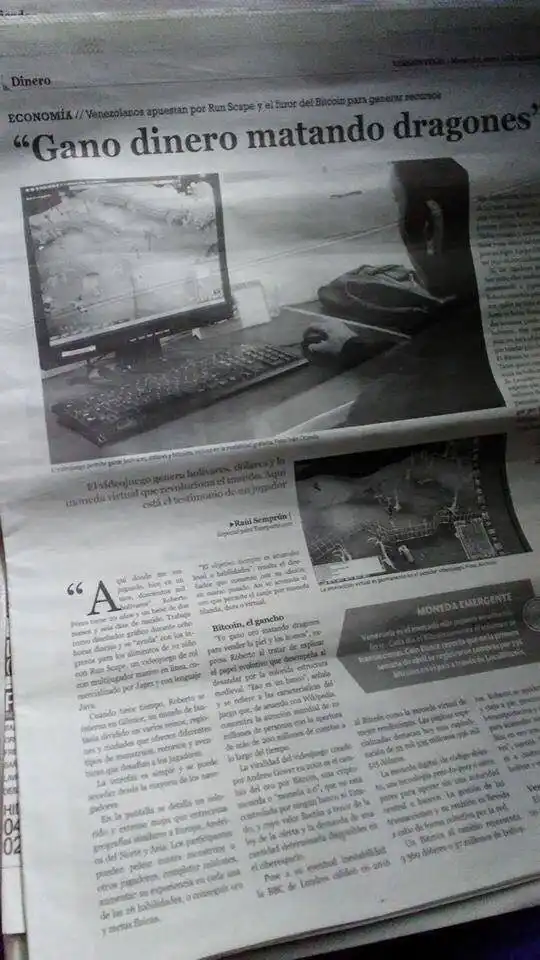
Higher-level players would farm another winged giant snake boss, "Zulrah," which could raise hourly earnings to $2–$3. Such an hourly wage was already higher than what most university graduates in Venezuela could earn.
A few years ago, when Venezuelan players were most active in farming gold in OSRS to make a living, several English media outlets interviewed them. Interviewees generally reported earning $100 or more per month from OSRS, while their parents could only earn around $10 per month. In their view, OSRS was very well-known among Venezuelans and could be considered a mainstream way to make money, enough to support their families and protect their hard work from the devaluation of the Bolívar.
Just as in Hong Kong, where many Filipino domestic helpers fill the labor needed for daily household chores, Venezuelan players in the OSRS world filled the labor for tedious, repetitive grinding/leveling up and material gathering. In addition to farming dragons, snakes, deer, and various materials, Venezuelan players also took on tasks like leveling up skills and crafting items for others. However, unlike Filipino helpers in Hong Kong, who can leisurely gather in groups on the streets for a cup of coffee, Venezuelan players could not. Due to Jagex's crackdown on real-world trading of in-game items, Venezuelan players, like cryptocurrency users using burner addresses to avoid phishing risks, maintained multiple burner accounts to avoid the risk of being banned.
In March 2019, a nationwide blackout occurred in Venezuela. During those days, the Green Dragons lost their most loyal slayers, the supply of dragon bones in the market plummeted, and prices soared.
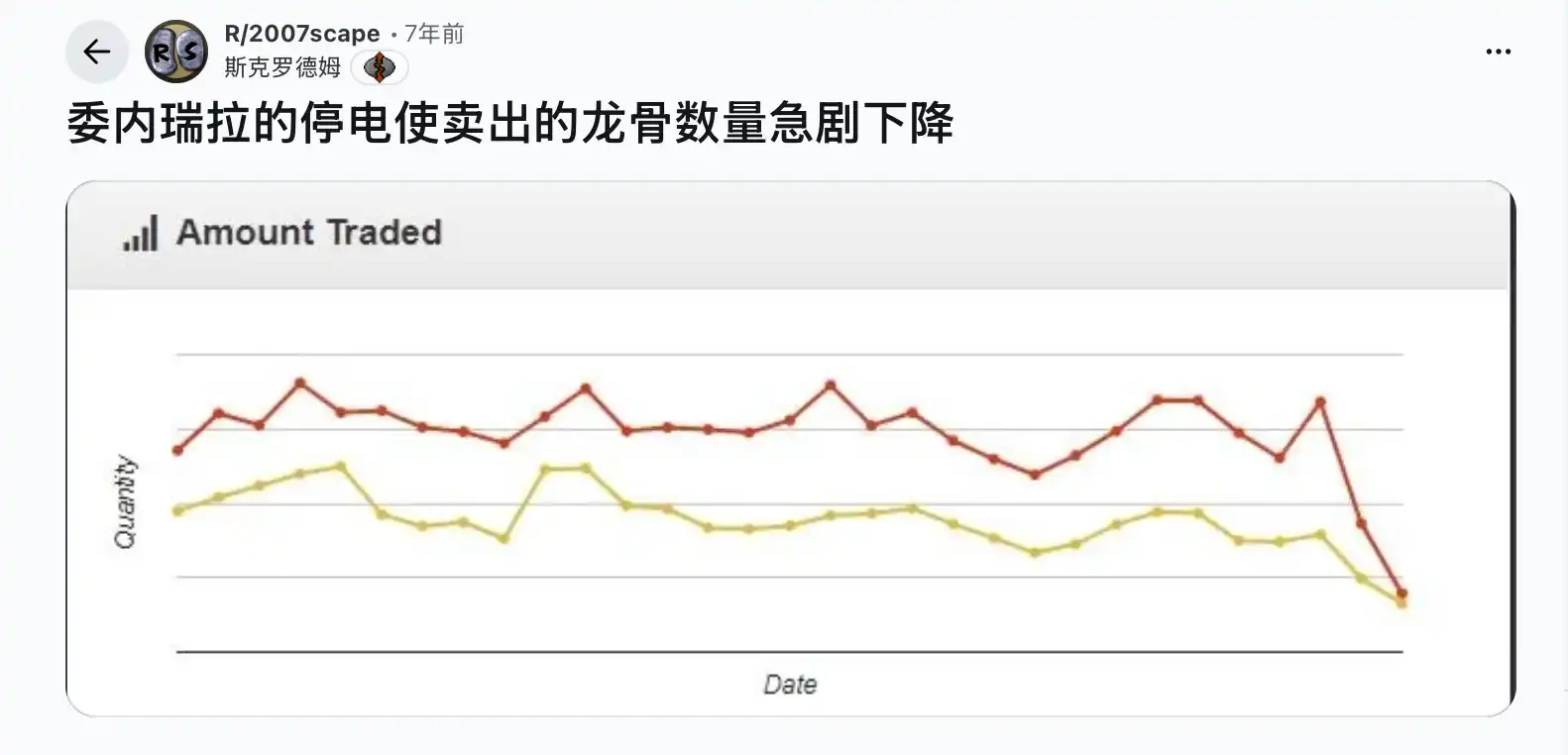
Players' attitudes toward these Venezuelan gold farmers were mixed. On one hand, Venezuelan players were generally manual farmers. Unlike players from other countries and regions who had the conditions to earn money on a larger scale through studios, they were genuinely playing the game fairly and manually like other players to earn gold, and only for survival. Sometimes, more casual players even felt that the presence of Venezuelan players actually improved their gaming experience, as they didn't need to spend much money to directly enjoy the game乐趣 they wanted.
On the other hand, such profit-seeking behavior inevitably affected normal players' gaming experience and the game's economic mechanics. The actions of Venezuelan players in the OSRS world for real-world survival, in turn, affected the survival of the OSRS world itself. Over the years, opinions about Venezuelan players on Reddit have always been contentious, filled with both anonymous malice and anonymous warmth.
Until the Venezuelan players left.
Escape
Today, in the OSRS world, only legends of Venezuela remain; the gold farmers of old are gone.
Starting in 2023, Venezuelan players began to gradually leave OSRS. While Venezuela's economy remained broken, the price of OSRS gold also plummeted. Bots that never rest and never tire began to compete with manual Venezuelan players. OSRS gold production surged, corresponding to a continuous decline in gold prices. Currently, the exchange rate for OSRS gold against the U.S. dollar is approximately 1 million gold : $0.16–$0.20.
For Venezuelan players, gold farming did not stop; they simply moved to more cost-effective places—they shifted to games like Tibia, Albion OL, World of Warcraft, etc., continuing to seek a livelihood in the real world through virtual worlds.
But some always ask, "Is this life right?" Thus, some players resolutely left these virtual game worlds, and even left their real-world country.
According to the latest data from earlier this year, about 7.9 million Venezuelans have fled the country, one of the largest refugee crises in Latin America and globally. In English media, we can find interviews with Venezuelans who used OSRS earnings to escape Venezuela.
José Ricardo, an OSRS gold middleman, made a profit by buying OSRS gold and reselling it to buyers. A few years ago, when interviewed, his monthly income was between $800 and $1,200. He invested these profits in cryptocurrency and had the money needed for vacations in Brazil, Colombia, and Trinidad and Tobago. He still lived in Venezuela, but it was just one option; he did not want his life to be forever stuck in one place, or on one thing.
Victor Alexander Rodriguez decided in early 2017, to supplement his family's income, to play OSRS for 14 hours a day with his sister to earn money. When they started gold farming, he discussed with his sister, "One day, we will leave." Together, they worked hard to raise $500 through OSRS and went to Peru in 2018. Later, he became a security guard, earning a higher salary than gold farming in OSRS. In his spare time, he occasionally returns to the OSRS world on his phone, but this time, he is truly a player enjoying the game.
But not every escape story is so beautiful. Bran Castillo once described the experience of his friend's friend—who successfully earned enough through OSRS to go to Peru, continued OSRS in Peru, but found the income level that was sufficient in Venezuela could not sustain him in Peru. On Reddit, Venezuelan players have answered questions about this; their public services, while poor in quality (the most extreme case was first logging into OSRS using mobile data because the copper wires for broadband had been stolen), basically cost little money, and the money earned was mainly for basic sustenance.
There are even darker rumors that some Venezuelan female OSRS players, after escaping the country and not knowing how to sustain themselves, turned to sex work...
OSRS players have a belief-like saying: "This game never ends; you don't quit, you just take breaks."
And the most touching blessing I've seen is: "I hope one day, none of us have to worry about anything beyond the joy of the game, just enjoying this game."
Conclusion
The connection between Venezuela and the cryptocurrency industry is so numerous and deep. Now, we津津乐道 about the potential 600,000 Bitcoin reserves of the Maduro regime, analyze in depth from various angles why the "Petro" coin issued by Venezuela failed, and examine the economic and daily life patterns after USDT became widely adopted as the de facto currency by the local people...
But this time, when we try to find the stories of "people" rather than starting from the phenomena and perspectives of the "industry macro," we see how cryptocurrency and a 25-year-old game helped Venezuelans solve their livelihood problems. Entangled in the virtual world, conveying emotions and fighting, all for survival in reality, or to escape that damned fate.
Without cryptocurrency transcending the barriers of geography, language, and culture,凝聚了 worldwide consensus on value large enough, and providing a solid foundation of world-class trust at the settlement level, the story of OSRS and Venezuela might not have happened.
And whether勉力维持崩坏的生活 in the virtual world or双重逃离虚拟和现实世界 to chase new hope, these seemingly trivial personal choices actually promoted the progress of the industry.
Their stories, gradually fading away in OSRS, and in the cryptocurrency industry,只是像局外人一样路过又悄然离开, are the real bitterness and hardship behind the industry's progress.






