Trump Steps Into Web3 Gaming – But Will It Endure? New Mine-to-Earn Project Says It Holds the Genuine Long-Term Model

bitcoinist2025-12-12 tarihinde yayınlandı2025-12-12 tarihinde güncellendi

Özet

A recently launched crypto game using Donald Trump's name has drawn attention but appears to be a traditional Web2-style game with optional Web3 elements, raising questions about its legitimacy as a true blockchain-based GameFi project. In contrast, PepeNode (PEPENODE) is introduced as a fully Web3-native "mine-to-earn" game designed for long-term sustainability. It turns crypto mining into a virtual simulation where players build and optimize server setups using PEPENODE tokens for upgrades—70% of which are permanently burned to reduce supply and increase scarcity. The project aims to avoid the pitfalls of earlier Play-to-Earn models by creating a deflationary economy tied to real gameplay consequences. The PepeNode presale is currently active for 27 days, offering tokens at $0.0011873 each, with purchases available via crypto or credit cards. The smart contract has been audited by Coinsult for security assurance.

Thursday 11 December 2025 – A recently launched crypto game using the name of U.S. President Donald Trump has drawn attention across the Web3 space, but a closer look shows an approach that feels atypical for a blockchain-based release. Players are reportedly able to bypass the crypto elements altogether, giving the impression of a traditional Web2 game wrapped in Web3 branding rather than a product built fully around blockchain technology.

PepeNode (PEPENODE) positions itself at the other end of that spectrum. The project is designed as a fully Web3-native game, with blockchain mechanics forming the core of its system rather than an optional add-on. Instead of repeating Play-to-Earn models that struggled or collapsed, such as Axie Infinity, StepN and last year’s wave of Telegram-based games, PepeNode is rolling out what it describes as crypto’s first mine-to-earn meme coin structure aimed at long-term viability.

While many GameFi projects are still testing the waters, PepeNode is taking a more committed stance, arguing that meaningful progress in GameFi requires a complete rethink rather than incremental experiments.

For investors interested in a model that claims to support a sustainable crypto gaming economy, the PepeNode presale is currently live, with PEPENODE priced at $0.0011873 per token. The opportunity is time-limited, however, as the team has announced that the presale will conclude in 27 days. After that point, PEPENODE is expected to be available only through exchanges, where prices may not revisit presale levels.

When Blockchain Is Optional, Does It Still Qualify as GameFi?

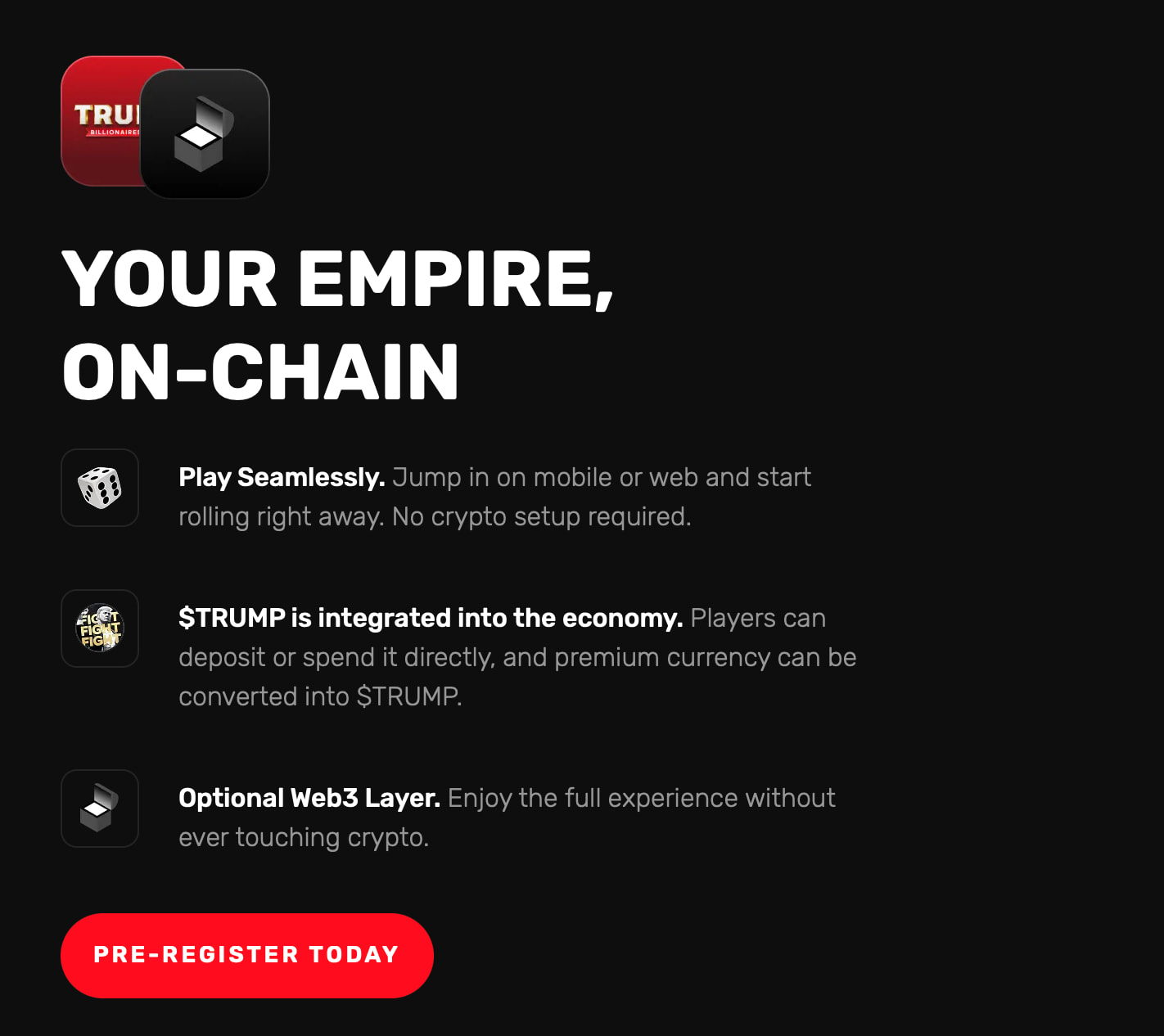
A recent post from the TrumpMeme account on X announced the opening of pre-registration for a licensed game built around the Trump brand. The project, titled Trump Billionaires Club, presents Trump in an Apprentice-style role, with gameplay centred on dice rolls, buying up properties, limited stock market activity notably without any direct crypto element and progressing through a glossy “high-roller” ranking ladder.

Players are being lured with the promise to “Live the High-Roller Lifestyle as you race to become the Ultimate TRUMP Billionaire,” with the main draw being a share of $1 million worth of Official Trump (TRUMP) tokens. Beyond that incentive, the game leans on familiar mechanics, integrating Open Loot to distribute digital collectibles an approach many long-time crypto users would recognise as Web2.5 dressed up in Web3 language.

A closer look at the website highlights a key detail: the game runs smoothly even without any blockchain involvement. Web3 features are clearly optional, and players can make purchases using traditional, non-crypto currencies. That raises an obvious question when the project promotes the idea of “Your empire, on-chain” if everything functions off-chain, where does that empire actually exist?
This suggests that while the game may appeal to casual players, it isn’t trying to address the deeper, long-standing problems GameFi has faced. Those same issues once brought millions of newcomers into crypto through gaming, only to see them leave just as quickly when fragile token economies collapsed.

For blockchain gaming to genuinely move forward, those challenges need proper solutions. And at the moment, the project positioning itself as an attempt to tackle them isn’t a familiar board-game-style remake, but the mine-to-earn ecosystem that PepeNode is building.

The First GameFi Economy Built to Grow Stronger Over Time

PepeNode keeps the concept simple on the surface: it turns crypto mining into a virtual game. But once you look a little deeper, it becomes clear the goal is to quietly strip away what never worked in earlier GameFi models. Rather than leaning on hype or shallow mechanics, the project is structured around systems that are meant to hold up over time.

Instead of pushing players into repetitive tapping, endless clicking, or mindless loops, PepeNode drops them into an empty, lifeless server room with a clear message build something that actually functions. Progress isn’t cosmetic. Every action, from buying nodes to upgrading facilities, is paid for using PEPENODE, and every decision carries real consequences.

Put the wrong components together and the system slows down, becoming inefficient and unstable. Combine the right ones and performance improves, with token output increasing like a properly tuned mining operation. The experience feels closer to solving an engineering problem than “playing” a traditional game, and that distinction is very much intentional.
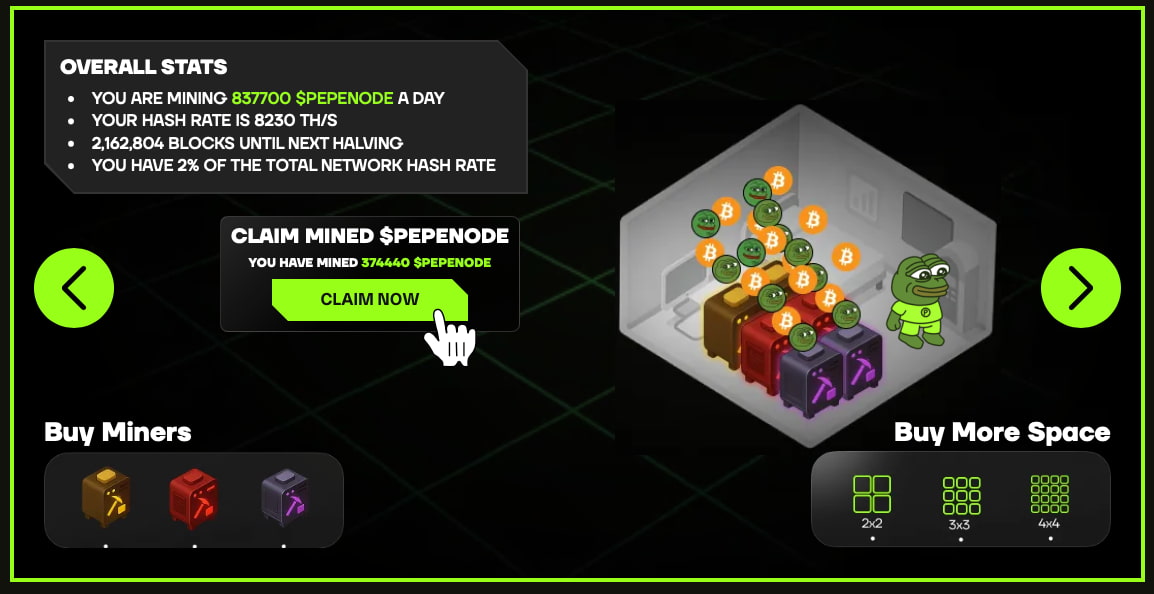
And unlike games that rely on a thin “Web3” label and a familiar brand costume, PepeNode treats simulation as more than a buzzword. When the project talks about simulation, it means it in a literal sense. The team has already hinted at systems that reflect the real-world problems miners deal with every day, from heat surges and power consumption to overall system stability the full set of operational headaches, minus the real electricity bill.

Players do earn PEPENODE from their setups, but the token isn’t just a reward. Its role runs much deeper. The more PEPENODE is spent in-game to fine-tune and optimise a rig, the greater the chance of unlocking higher-tier payouts, including major meme coin rewards such as Pepe (PEPE) and Fartcoin (FARTCOIN).

What really sets the model apart is how upgrades are handled. Every improvement consumes PEPENODE, and 70% of the tokens used are permanently removed from circulation. Progression, therefore, doesn’t expand supply it reduces it. As activity in the game increases, PEPENODE becomes increasingly scarce.

That combination of strategic building, deliberate token spending and access to desirable crypto rewards is why PepeNode is being highlighted as a serious candidate for one of the first GameFi economies designed to hold up over the long term.

Presale Nears Its End as PepeNode Enters Final 27-Day Window

With the presale window still open, early supporters have a chance to secure PEPENODE while directly backing the game’s ongoing development. Tokens are available through the official PepeNode presale site and can be purchased using ETH, BNB, USDT on both ERC-20 and BEP-20 networks, as well as standard credit or debit cards.

Buyers can connect using most major wallets, including Best Wallet, which is often cited as one of the leading crypto and Bitcoin wallets in use today. PepeNode is already listed in Best Wallet’s Upcoming Tokens discovery section, making it possible to buy, monitor, and later claim tokens directly inside the app.

To add another layer of reassurance, the project’s smart contract has undergone a full audit by Coinsult, providing early participants with added confidence in the security and structure of the code.

Those looking to stay informed can follow PepeNode on X and Telegram, or visit the PepeNode website to take part in the presale while it remains open.

Visit PepeNode to join the presale.

İlgili Okumalar

Gensyn AI: Don't Let AI Repeat the Mistakes of the Internet

In recent months, the rapid growth of the AI industry has attracted significant talent from the crypto sector. A persistent question among researchers intersecting both fields is whether blockchain can become a foundational part of AI infrastructure. While many previous AI and Crypto projects focused on application layers (like AI Agents, on-chain reasoning, data markets, and compute rentals), few achieved viable commercial models. Gensyn differentiates itself by targeting the most critical and expensive layer of AI: model training. Gensyn aims to organize globally distributed GPU resources into an open AI training network. Developers can submit training tasks, nodes provide computational power, and the network verifies results while distributing incentives. The core issue addressed is not decentralization for its own sake, but the increasing centralization of compute power among tech giants. In the era of large models, access to GPUs (like the H100) has become a decisive bottleneck, dictating the pace of AI development. Major AI companies are heavily dependent on large cloud providers for compute resources. Gensyn's approach is significant for several reasons: 1) It operates at the core infrastructure layer (model training), the most resource-intensive and technically demanding part of the AI value chain. 2) It proposes a more open, collaborative model for compute, potentially increasing resource utilization by dynamically pooling idle GPUs, similar to early cloud computing logic. 3) Its technical moat lies in solving complex challenges like verifying training results, ensuring node honesty, and maintaining reliability in a distributed environment—making it more of a deep-tech infrastructure company. 4) It targets a validated, high-growth market with genuine demand, rather than pursuing blockchain integration without purpose. Ultimately, the boundaries between Crypto and AI are blurring. AI requires global resource coordination, incentive mechanisms, and collaborative systems—areas where crypto-native solutions excel. Gensyn represents a step toward making advanced training capabilities more accessible and collaborative, moving beyond a niche controlled by a few giants. If successful, it could evolve into a fundamental piece of AI infrastructure, where the most enduring value in the AI era is often created.

marsbit11 saat önce

Gensyn AI: Don't Let AI Repeat the Mistakes of the Internet

marsbit11 saat önce

Why is China's AI Developing So Fast? The Answer Lies Inside the Labs

A US researcher's visit to China's top AI labs reveals distinct cultural and organizational factors driving China's rapid AI development. While talent, data, and compute are similar to the West, Chinese labs excel through a pragmatic, execution-focused culture: less emphasis on individual stardom and conceptual debate, and more on teamwork, engineering optimization, and mastering the full tech stack. A key advantage is the integration of young students and researchers who approach model-building with fresh perspectives and low ego, prioritizing collective progress over personal credit. This contrasts with the US culture of self-promotion and "star scientist" narratives. Chinese labs also exhibit a strong "build, don't buy" mentality, preferring to develop core capabilities—like data pipelines and environments—in-house rather than relying on external services. The ecosystem feels more collaborative than tribal, with mutual respect among labs. While government support exists, its scale is unclear, and technical decisions appear driven by labs, not state mandates. Chinese companies across sectors, from platforms to consumer tech, are building their own foundational models to control their tech destiny, reflecting a broader cultural drive for technological sovereignty. Demand for AI is emerging, with spending patterns potentially mirroring cloud infrastructure more than traditional SaaS. Despite challenges like a less mature data industry and GPU shortages, Chinese labs are propelled by vast talent, rapid iteration, and deep integration with the open-source community. The competition is evolving beyond a pure model race into a contest of organizational execution, developer ecosystems, and industrial pragmatism.

marsbit13 saat önce

Why is China's AI Developing So Fast? The Answer Lies Inside the Labs

marsbit13 saat önce

3 Years, 5 Times: The Rebirth of a Century-Old Glass Factory

Corning, a 175-year-old glass company, is experiencing a dramatic revival as a key player in AI infrastructure, driven by surging demand for high-performance optical fiber in data centers. AI data centers require vastly more fiber than traditional ones—5 to 10 times as much per rack—to handle high-speed data transmission between GPUs. This structural demand shift, coupled with supply constraints from the lengthy expansion cycle for fiber preforms, has created a significant supply-demand gap. Nvidia has invested in Corning, along with Lumentum and Coherent, in a $4.5 billion total commitment to secure the optical supply chain for AI. Corning's competitive edge lies in its expertise in producing ultra-low-loss, high-density, and bend-resistant specialty fiber, which is critical for 800G+ and future 1.6T data rates. Its deep involvement in co-packaged optics (CPO) with partners like Nvidia further solidifies its position. While not the largest fiber manufacturer globally, Corning's revenue from enterprise/data center clients now exceeds 40% of its optical communications sales, and it has secured multi-year supply agreements with major hyperscalers including Meta and Nvidia. Financially, Corning's optical communications revenue has surged, doubling from $1.3 billion in 2023 to over $3 billion in 2025. Its stock price has risen nearly 6-fold since late 2023. Key future catalysts include the rollout of Nvidia's CPO products and the scale of undisclosed customer agreements. However, risks include high current valuations and potential disruption from next-generation technologies like hollow-core fiber. The company's long-term bet on light over electricity, maintained even through the telecom bubble crash, is now being validated by the AI boom.

marsbit13 saat önce

3 Years, 5 Times: The Rebirth of a Century-Old Glass Factory

marsbit13 saat önce

İşlemler

Spot
Futures
活动图片




