Trump Rejects Iran Peace Proposal — Bitcoin Breaks $82,000

bitcoinist2026-05-12 tarihinde yayınlandı2026-05-12 tarihinde güncellendi

Özet

Bitcoin has surged nearly 30% since the US-Iran war began on February 28, outpacing gold and the S&P 500 despite ongoing market turmoil. The rally faces potential catalysts this week, including a Senate vote on the hawkish Kevin Warsh for Fed chair and markup of the significant CLARITY Act, both viewed as bullish for Bitcoin. The conflict, triggered by a US airstrike killing Iran's Supreme Leader, continues with no near-term resolution. After former President Trump rejected Iran's peace proposal demanding reparations and asset unfreezing, Bitcoin initially dipped but quickly rebounded, breaking above $82,000 and liquidating over $60 million in shorts. With Israeli PM Netanyahu insisting on dismantling Iran's uranium sites, hopes for a quick ceasefire have faded, underscoring Bitcoin's divergent performance amid deepening geopolitical strain and rising oil prices.

Bitcoin has now climbed nearly 30% since the US-Iran war began on February 28 — a run that has outpaced both gold and the S&P 500 even as the conflict continues to shake global markets.

A Week Of Potential Catalysts

Two events in the US Senate this week could add more fuel to that rally, according to 10x Research CEO Markus Thielen.

The first is a Monday vote on Kevin Warsh’s nomination as Federal Reserve chair. The second is a Thursday markup session for the CLARITY Act in the Senate Banking Committee.

Thielen described the crypto legislation as the most significant of its kind in years, one that could bring long-awaited regulatory certainty to digital assets.

As for Warsh — widely seen as more hawkish on inflation than current Fed chair Jerome Powell — Thielen said his confirmation would clear away uncertainty rather than create it. Both events, he said, lean bullish for Bitcoin.

The backdrop to all this is a conflict that shows no sign of ending soon. The US-Iran war, which started after a US airstrike killed Iranian Supreme Leader Ayatollah Ali Khamenei, has rattled financial markets for the past 10 weeks.
Source: Truth Social

One of the central flashpoints is the Strait of Hormuz, a chokepoint through which roughly one-fifth of global oil trade passes.

Oil climbed another 4.5% to $98.68 per barrel after Trump’s latest statement, adding pressure to an already strained economic picture.

Bitcoin’s Swing After Trump’s Post

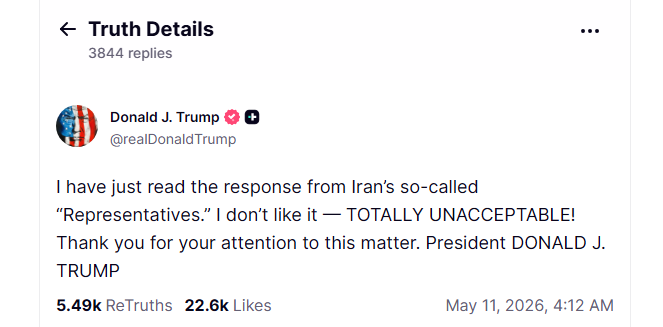
On Sunday, Trump took to Truth Social to reject Iran’s counteroffer to a peace deal. Iran had been pushing for war reparations and the unfreezing of blocked financial assets — conditions Trump flatly dismissed.

BTCUSD now trading at $81,013. Chart: TradingView

Bitcoin initially slid on the news, dropping from $81,400 to $80,500 within 45 minutes of the post. But it didn’t stay down. Within three hours, the price had swung back above $82,000, breaking $81,000 on the way up and settling near $82,350.

Data shows that move wiped out over $60 million in short positions over a four-hour window.

Israeli Prime Minister Benjamin Netanyahu added that the war won’t conclude until Iran’s uranium sites are fully dismantled, further dimming prospects of a near-term resolution.

Hopes Fade For Early End To The Conflict

Peace talks had been expected to make progress by Wednesday. Trump’s rejection of Iran’s proposal ended that possibility for now.

The conflict, which began 10 weeks ago, has shown Bitcoin behaving differently from traditional assets — rising even as geopolitical tension deepens, oil surges, and ceasefire talks collapse.

Featured image from The Leaflet, chart from TradingView

İlgili Sorular

QWhat two U.S. Senate events does Markus Thielen identify as potential catalysts for Bitcoin this week?

AThe two events are a Monday vote on Kevin Warsh's nomination as Federal Reserve chair and a Thursday markup session for the CLARITY Act in the Senate Banking Committee.

QHow did Bitcoin's price react in the immediate aftermath of Donald Trump's post rejecting Iran's peace proposal?

ABitcoin's price initially dropped from $81,400 to $80,500 within 45 minutes. However, it then recovered, swinging back above $82,000 within three hours and settling near $82,350.

QAccording to the article, what is the Strait of Hormuz and why is it significant in the current conflict?

AThe Strait of Hormuz is a geographic chokepoint through which roughly one-fifth of global oil trade passes. It is a central flashpoint in the US-Iran conflict, and disruptions there impact global oil prices and markets.

QWhat condition did Israeli Prime Minister Benjamin Netanyahu set for the conclusion of the war?

ABenjamin Netanyahu stated that the war will not conclude until Iran's uranium sites are fully dismantled.

QHow has Bitcoin's performance since the war began compared to gold and the S&P 500?

ABitcoin has climbed nearly 30% since the war began, a run that has outpaced the performance of both gold and the S&P 500 during the same period.

İlgili Okumalar

STRC Breaks Below $95: Why Does It Continue to Depeg? Is There Default Risk?

"STRC Falls Below $95: Why the Persistent Depegging and Is There Default Risk?" The article discusses the recent decline in the price of STRC, a perpetual preferred stock issued by Strategy (MSTR) designed to trade around a $100 par value. As of publication, STRC traded at $94.65, raising market concerns. STRC is described as a high-yield cash flow product, offering an 11.50% annual dividend paid monthly. Its "preferred" status grants it priority over common stock for dividends and in liquidation. Key reasons cited for the price depegging include: 1. **Bitcoin's Price Drop:** MSTR's assets are heavily tied to Bitcoin (BTC), which fell over 21% from its recent high, pressuring all Strategy-related products. 2. **Competitive Pressure:** Rival Strive Asset Management's similar product, SATA, offers daily dividends and has maintained its $100 par value with a ~13% yield. In response, Strategy has proposed changing STRC's dividend frequency from monthly to bi-weekly, pending shareholder vote. 3. **Technical Selling:** A break below $100 may have triggered algorithmic selling and stop-losses, exacerbating the decline. Regarding default risk, the analysis suggests it is currently low. Strategy founder Michael Saylor confirmed the June 2026 dividend rate remains at 11.50% with no cuts or suspensions. The company's massive reserve of 843,706 BTC provides a significant backstop for its obligations. Industry opinions are mixed. Some analysts view the BTC holdings as reliable support for dividends, while critics like Peter Schiff warn of potential dividend cuts leading to price crashes and lawsuits. Others highlight inflation risk and the company's ability to reduce dividends without a formal default. In summary, STRC's drop is attributed to BTC volatility, competition, and technical factors. While immediate default risk appears contained, the product faces challenges from market conditions and competitive dynamics.

marsbit1 saat önce

STRC Breaks Below $95: Why Does It Continue to Depeg? Is There Default Risk?

marsbit1 saat önce

AI Trading Cools, South Korean Stocks Plunge 1.8%, Spot Gold Rises 1%, Bitcoin Dives

A sell-off in AI-related stocks, triggered by Broadcom's disappointing earnings forecast, sent shockwaves through global markets. South Korea's KOSPI led Asia's decline, plunging 1.8% as the risks from concentrated chip stock gains and surging leveraged investments came to the fore. The tech-heavy Nasdaq 100 futures fell 0.5% following Broadcom's 14% after-hours plunge, which signaled a slower-than-expected transition to AI clients. This pullback extended Wall Street's weakness, halting the S&P 500's nine-day rally amid hawkish Fed signals and renewed Middle East tensions. South Korean authorities convened an emergency meeting, pledging "immediate measures" against market volatility and warning of record-high stock margin debt. The adjustment rippled across assets: Bitcoin fell to around $64,000, its lowest since February, while safe-haven gold rose 1% on bargain hunting. Oil prices dipped on Middle East ceasefire news. Market analysts noted the sell-off was driven by profit-taking after massive gains, particularly in chip stocks like Samsung and SK Hynix, which now dominate the KOSPI. Wall Street banks are divided on Korea's outlook, with Goldman Sachs raising its target while Citigroup and others warn of overvaluation and a potential bubble. Bridgewater's Ray Dalio noted that great technological shifts often create bubbles. Meanwhile, Fed officials' hints at potential future rate hikes added to the cautious mood ahead of key U.S. jobs data.

华尔街日报2 saat önce

AI Trading Cools, South Korean Stocks Plunge 1.8%, Spot Gold Rises 1%, Bitcoin Dives

华尔街日报2 saat önce

İşlemler

Spot
Futures
活动图片