Trump in Web3 Games: Temporary Hype or Trend?

bitcoinist2025-12-12 tarihinde yayınlandı2025-12-12 tarihinde güncellendi

Özet

The article "Trump in Web3 Games: Temporary Hype or Trend?" discusses the growing integration of political brands, particularly Donald Trump’s, into the crypto industry—especially within Web3 gaming. It highlights the recent launch of the 3D game *Trump Billionaires Club*, which features an in-game economy tied to the $TRUMP memecoin and user engagement mechanics. The piece argues that while political and media-driven narratives can generate initial user interest, they often fail to retain players without clear, sustainable incentives. Many gaming tokenomics rely on short-term emotional appeal rather than long-term engagement. In response, projects like PEPENODE are emerging with simplified, routine-based reward systems—such as virtual "mining" nodes—that require no technical knowledge or hardware. PEPENODE, promoted as the "first memecoin mine-to-earn" platform, allows users to buy and upgrade virtual mining nodes to earn rewards, including memecoins like PEPE and Fartcoin. Early data shows significant pre-sale interest, with $2.3 million raised and a token price of $0.001192. The project aims to combine meme-driven engagement with predictable, recurring action—a trend gaining traction as Web3 games seek broader, more consistent user bases beyond one-time hype. The article concludes that while politically themed games attract attention, their long-term success depends on transitioning from viral momentum to habitual use through clear mechanics and recurring value.

Trusted Editorial content, reviewed by leading industry experts and seasoned editors. Ad Disclosure

Political brands are increasingly penetrating the crypto industry—and today this is most noticeable in games. This week, the Spanish business publication Cinco Días described the launch of the 3D game Trump Billionaires Club, where the in-game economy is tied to the $TRUMP memecoin and user engagement mechanics.

For the market, this is a signal not so much about a specific politician, but about a direction: Web3 gaming is once again seeking a mass audience through recognizable themes and simple progression steps. When a product is understood without training, it's easier for the user to take the first step—buy a token, enter the game, complete tasks, and return tomorrow.

But this approach has a weak spot: the majority of gaming tokenomics live only on emotions and quickly burn out if the user has no clear reason to stay in the system. That is why 2025 looks like a race for mechanics that retain attention not with promises, but with regular action and predictable rewards.

Against this backdrop, memecoins are getting another chance to break out of the "buy and forget" mode into a format where the token becomes a participation tool. And here, the new project PEPENODE is trying to fill the niche: to combine meme energy with a clear gaming routine of mining, without requiring iron, electricity, or technical skills.

BUY PEPENODE

Why Gaming Memecoins Are Returning Attention to Simple Mechanics

Web3 games in 2025 need one thing: to convert the noise around a brand into a daily habit. Political and media themes provide traffic, but do not guarantee retention—users quickly leave if progress seems random or too complex.

Parallelly, the infrastructure side has become less painful for retail. According to Cointelegraph, average commissions on the Ethereum network after the Dencun update have noticeably decreased: in March 2025, the average swap was valued at approximately $0.39 versus around $86 a year earlier.

Hence the trend: projects are competing not only with memes, but also with "grounded" reward cycles—from simplified game quests to mining simulations. Against this backdrop, many investors are becoming interested in other market directions, including the list of the best altcoins for 2025.

PEPENODE currently looks like one of the variants in this logic, because it bets on regular activity and a clear interface, not on complex economics.

How PEPENODE Turns "Mining" into a Game Without Iron

The key idea of PEPENODE is positioning as the "world's first memecoin mine-to-earn": instead of classical mining with equipment, the project offers a virtual "mining" system. The entry is built around nodes and reward levels. This addresses three market pains at once: boring mining models, weak early incentives, and technical complexity for newcomers.
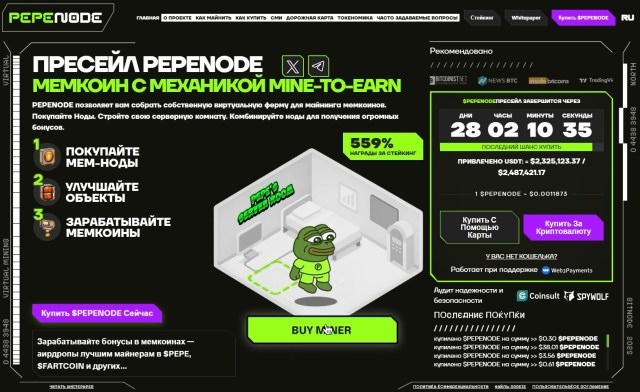
In product terms, this looks like a gamified panel. You buy and configure "node-miners," improve nodes to increase efficiency, and receive rewards, including memecoins like PEPE and Fartcoin. Importantly, the scenario of "enter — improve — collect reward" is simpler than dealing with iron and expenses.

Interest is also heating up the early demand dynamics. According to the presale team's data, PEPENODE has already attracted $2.3 million, and the token price is $0.001192. This is the level at which the base of early participants usually forms, if the product really promises activity after launch.

Large wallet tracking data indicates 2 purchases for a total of $215K; the largest deal—$51K—took place on February 8, 2025.

This bet has a clear logic: if the game finds an audience after launch, then "mining as a habit" may turn out to be stronger than the one-time hype around a loud name.

Editorial Process for bitcoinist is centered on delivering thoroughly researched, accurate, and unbiased content. We uphold strict sourcing standards, and each page undergoes diligent review by our team of top technology experts and seasoned editors. This process ensures the integrity, relevance, and value of our content for our readers.

Daria Vlasova

Follow

Crypto journalist, specializes in the digital asset market, DeFi platforms, and Web3 projects. Graduate of the Economics Faculty of Moscow State University. Since 2019, she has been writing about the crypto industry, tokenomics, and the development of new digital economy models.

Full Profile

Related Posts

Even 0.1 $BTC is financial independence for decades. But that's not enough

MEXC KYC Reward December 2025: First Trade Loss Coverage (100% Loss Coverage Up to 50 USDT)

Best crypto presale: MAXI stands out among meme-presale projects

Best crypto to buy now: MAXI attracts global attention after a surge in trading volume

Best crypto to buy now: Bitcoin Hyper (HYPER) shows the strongest growth signals

New crypto that could explode today: Pepenode (PEPENODE) predicted to surge strongly in the next few hours

İlgili Sorular

QWhat is the main focus of the article regarding Web3 gaming trends in 2025?

AThe article focuses on the trend of Web3 gaming shifting towards simple, engaging mechanics and meme-driven economies to attract and retain a mass audience, moving away from complex models that rely solely on hype.

QWhat specific project is highlighted as an example of combining meme energy with a playable mining routine?

AThe project highlighted is PEPENODE, which positions itself as the 'first meme coin mine-to-earn' project, offering a virtual mining system with nodes and reward levels instead of traditional hardware-based mining.

QAccording to the article, what is the key weakness of many gaming tokenomics models that rely on emotions and hype?

ATheir key weakness is that they quickly lose value and user interest if there is no clear reason for the user to stay in the system, as they lack predictable, regular rewards and sustainable engagement mechanics.

QWhat infrastructure development is mentioned as making the market less painful for retail participants?

AThe article mentions that average commissions on the Ethereum network have noticeably decreased after the Dencun update, with the average swap fee estimated at around $0.39 in March 2025 compared to about $86 a year earlier.

QWhat early traction data is provided for the PEPENODE project in its pre-sale phase?

AThe pre-sale for PEPENODE had attracted $2.3 million, with a token price of $0.001192. Data also indicated two large purchases totaling $215K, with the largest single transaction being $51K on February 8, 2025.

İlgili Okumalar

North Korean Hackers Loot $500 Million in a Single Month, Becoming the Top Threat to Crypto Security

North Korean hackers, particularly the notorious Lazarus Group and its subgroup TraderTraitor, have stolen over $500 million from cryptocurrency DeFi platforms in less than three weeks, bringing their total theft for the year to over $700 million. Recent major attacks on Drift Protocol and KelpDAO, resulting in losses of approximately $286 million and $290 million respectively, highlight a strategic shift: instead of targeting core smart contracts, attackers are now exploiting vulnerabilities in peripheral infrastructure. For instance, the KelpDAO attack involved compromising downstream RPC infrastructure used by LayerZero's decentralized validation network (DVN), allowing manipulation without breaching core cryptography. This sophisticated approach mirrors advanced corporate cyber-espionage. Additionally, North Korea has systematically infiltrated the global crypto workforce, with an estimated 100 operatives using fake identities to gain employment at blockchain companies, enabling long-term access to sensitive systems and facilitating large-scale thefts. According to Chainalysis, North Korean-linked hackers stole a record $2 billion in 2025, accounting for 60% of all global crypto theft that year. Their total historical crypto theft has reached $6.75 billion. Post-theft, they employ specialized money laundering methods, heavily relying on Chinese OTC brokers and cross-chain mixing services rather than standard decentralized exchanges. Security experts, while acknowledging the increased sophistication, emphasize that many attacks still exploit fundamental weaknesses like poor access controls and centralized operational risks. Strengthening private key management, limiting privileged access, and enhancing coordination among exchanges, analysts, and law enforcement immediately after an attack are critical to improving defense and fund recovery chances. The industry's challenge now extends beyond secure smart contracts to safeguarding operational security at the infrastructure level.

marsbit14 dk önce

North Korean Hackers Loot $500 Million in a Single Month, Becoming the Top Threat to Crypto Security

marsbit14 dk önce

Circle CEO's Seoul Visit: No Korean Won Stablecoin Issuance, But Met All Major Korean Banks

Circle CEO Jeremy Allaire's recent activities in Seoul indicate a strategic shift for the company, moving away from issuing a Korean won-backed stablecoin and instead focusing on embedding itself as a key infrastructure provider within Korea’s financial and crypto ecosystem. Despite Korea accounting for nearly 30% of global crypto trading volume—with a market characterized by high retail participation and altcoin dominance—Circle has chosen not to compete for the role of stablecoin issuer. Instead, Allaire met with major Korean banks (including Shinhan, KB, and Woori), financial groups, leading exchanges (Upbit, Bithumb, Coinone), and tech firms like Kakao. This approach reflects a broader industry transition: the core of stablecoin competition is shifting from issuance rights to systemic positioning. With Korean regulators still debating whether banks or tech companies should issue stablecoins, Circle is avoiding regulatory uncertainty by strengthening its role as a service and technology partner. The company is deepening integration with trading platforms, building connections, and promoting stablecoin infrastructure. This positions Circle to benefit regardless of which entity eventually issues a won stablecoin. Allaire also noted the potential for a Chinese yuan stablecoin in the next 3–5 years, underscoring a regional trend of stablecoins becoming more regulated and integrated with traditional finance. Ultimately, Circle’s strategy highlights that future influence in the stablecoin market will belong not necessarily to the issuers, but to the foundational infrastructure layers that enable cross-system transactions.

marsbit42 dk önce

Circle CEO's Seoul Visit: No Korean Won Stablecoin Issuance, But Met All Major Korean Banks

marsbit42 dk önce

SpaceX Ties Up with Cursor: A High-Stakes AI Gambit of 'Lock First, Acquire Later'

SpaceX has secured an option to acquire AI programming company Cursor for $60 billion, with an alternative clause requiring a $10 billion collaboration fee if the acquisition does not proceed. This structure is not merely a potential acquisition but a strategic move to control core access points in the AI era. The deal is designed as a flexible, dual-path arrangement, allowing SpaceX to either fully acquire Cursor or maintain a binding partnership through high-cost collaboration. This "option-style" approach minimizes immediate regulatory and integration risks while ensuring long-term alignment between the two companies. At its core, the transaction exchanges critical AI-era resources: SpaceX provides its Colossus supercomputing cluster—one of the world’s most powerful AI training infrastructures—while Cursor contributes its AI-native developer environment and strong product adoption. This synergy connects compute power, models, and application layers, forming a closed-loop AI capability stack. Cursor, founded in 2022, has achieved rapid growth with over $1 billion in annual revenue and widespread enterprise adoption. Its value lies in transforming software development through AI agents capable of coding, debugging, and system design—positioning it as a gateway to future software production. For SpaceX, this move is part of a broader strategy to evolve from a aerospace company into an AI infrastructure empire, integrating xAI, supercomputing, and chip manufacturing. Controlling Cursor fills a gap in its developer tooling layer, strengthening its AI narrative ahead of a potential IPO. The deal reflects a shift in AI competition from model superiority to ecosystem and entry-point control. With programming tools as a key battleground, securing developer loyalty becomes crucial for dominating the software production landscape. Risks include questions around Cursor’s valuation, technical integration challenges, and potential regulatory scrutiny. Nevertheless, the deal underscores a strategic bet: controlling both compute and software development access may redefine power dynamics in the AI-driven future.

marsbit1 saat önce

SpaceX Ties Up with Cursor: A High-Stakes AI Gambit of 'Lock First, Acquire Later'

marsbit1 saat önce

İşlemler

Spot
Futures
活动图片