Trump "Gets Serious": Powell Faces Investigation, Interest Rate Dispute Escalates

marsbit2026-01-12 tarihinde yayınlandı2026-01-12 tarihinde güncellendi

Özet

US Federal Reserve Chair Jerome Powell has publicly accused the US Department of Justice (DOJ) of threatening criminal charges to pressure the Fed into aligning interest rate policy with former President Donald Trump's demands. In a rare video statement, Powell condemned the action as an unprecedented attack on the central bank’s independence. The investigation, initiated by the Washington DC US Attorney’s office, focuses on allegations that Powell misled Congress regarding a $250 million renovation project at the Fed’s headquarters. The conflict stems from Trump's longstanding criticism of Powell for being too slow to cut interest rates. Since returning to office, Trump has intensified pressure on the Fed to lower rates to stimulate economic growth. Market reactions were immediate, with US stock index futures falling, gold and silver prices rising, and Bitcoin holding near $91,000. Powell reaffirmed the Fed’s commitment to data-driven policy, emphasizing its mandate to ensure price stability and maximize employment, not to yield to political influence. Legal experts suggest the evidence against Powell is weak, but if charges proceed, he could face resignation or even imprisonment. Meanwhile, speculation about his potential replacements includes Kevin Warsh and Kevin Hassett, both seen as favorable to Trump’s economic agenda. The situation has raised concerns about institutional independence and potential constitutional crisis.

On January 11, Federal Reserve Chairman Jerome Powell issued a rare video statement, publicly accusing the U.S. Department of Justice (DOJ) of threatening criminal charges in an attempt to force the Fed to comply with Trump's interest rate policy demands. This incident quickly became a focal point in global financial markets, sparking widespread concerns about the Fed's independence.
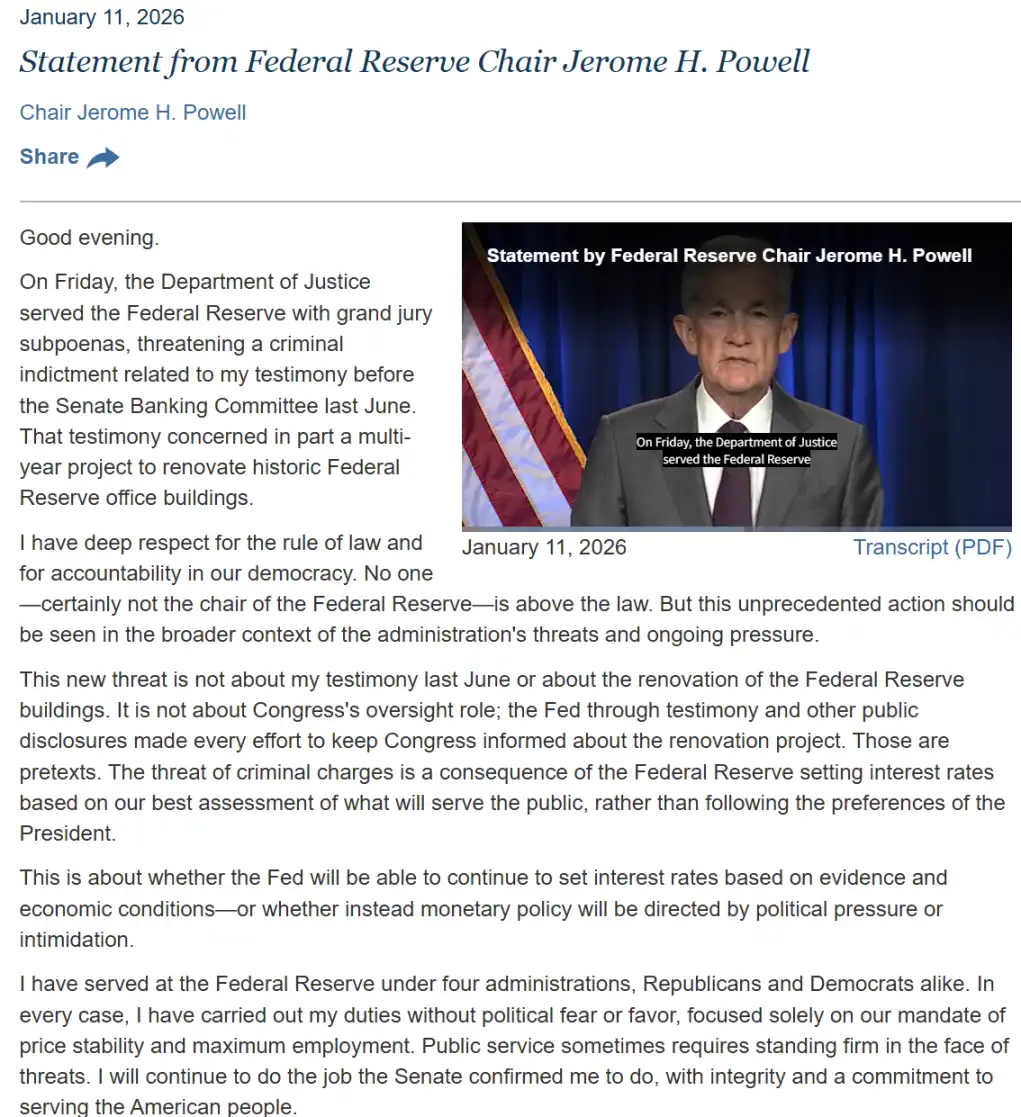
In his statement, Powell emphasized that such threats are a "consequence" of the Fed setting interest rates based on public interest rather than presidential preferences, calling it a blatant attack on central bank autonomy. This event is not isolated but the latest manifestation of the intertwining of politics and economics during Trump's second term.

Following the incident, U.S. stock index futures fell rapidly, with S&P 500 futures dropping over 0.5% and Dow futures declining by 150 points during Asian trading hours. Spot gold rose by 1.88%, spot silver surged by about 4%, and the cryptocurrency market saw BTC hovering around $91,000.

Trump Repeatedly Dissatisfied with Powell's "Slow Rate Cuts"

Powell was appointed as Fed Chair by then-President Trump in 2018 and was reappointed in 2022, with his term originally set to end in May 2026. As the head of the Fed, Powell has led the central bank through the challenges of the COVID-19 pandemic, economic recovery, and high inflation, with policies characterized by data-driven and gradual adjustments.

However, after Trump won the 2024 presidential election and returned to the White House, he quickly turned his focus to the Fed. Trump has long criticized Powell for being "slow to act," particularly on interest rate policy. He has repeatedly publicly demanded that the Fed cut rates significantly to stimulate economic growth and stock market performance, even promising during his campaign to "take control" of the Fed to advance his "America First" economic agenda.

The incident was sparked by a $250 million renovation project at the Fed's Washington headquarters. The project, launched several years ago to update aging facilities, has faced controversy due to cost overruns and transparency issues.
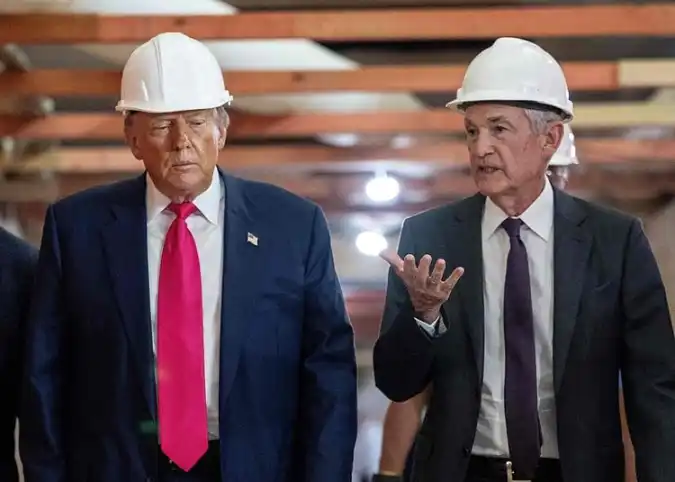
In July 2025, Republican Representative Anna Paulina Luna accused Powell of providing false testimony about the project during a congressional hearing and called for a criminal investigation. This accusation did not immediately escalate at the time, but after Trump took office, the DOJ quickly intervened. On January 11, 2026, multiple media outlets reported that the U.S. Attorney's Office for the District of Columbia had formally opened a criminal investigation into Powell, focusing on whether he misled Congress and whether the project's funds were used improperly. A grand jury has issued subpoenas demanding relevant records from the Fed.

On January 12, NBC reported that Trump, in a phone interview, claimed to know nothing about the investigation and again criticized Powell. "I know nothing about it, but he's obviously not doing a good job at the Fed, and he's not doing a good job with the building either." When asked to respond to Powell's claim that the subpoena was a government attempt to pressure the Fed into cutting rates, Trump said, "No, I wouldn't even consider doing it that way. The real pressure on him should be the reality of interest rates being too high. That's the only pressure he's facing."

In his video statement, Powell directly linked the investigation to interest rate policy. He noted that the DOJ's actions were "unprecedented" and aimed at forcing the Fed to lower interest rates through criminal threats to cater to Trump's demands. In the statement, Powell reiterated the Fed's statutory mission to maintain price stability and maximize employment, not to bow to political pressure. He described the incident as a "blatant violation of the Fed's independence" and suggested it was a continuation of the Trump administration's pressure on the central bank.

During Trump's first term, Powell had already clashed with the White House over his refusal to cut rates sharply, leading Trump to publicly call him an "enemy." The timing of this investigation is particularly sensitive: the Fed's most recent meeting kept the benchmark interest rate in the 4.25%-4.5% range, far higher than Trump's desired level.

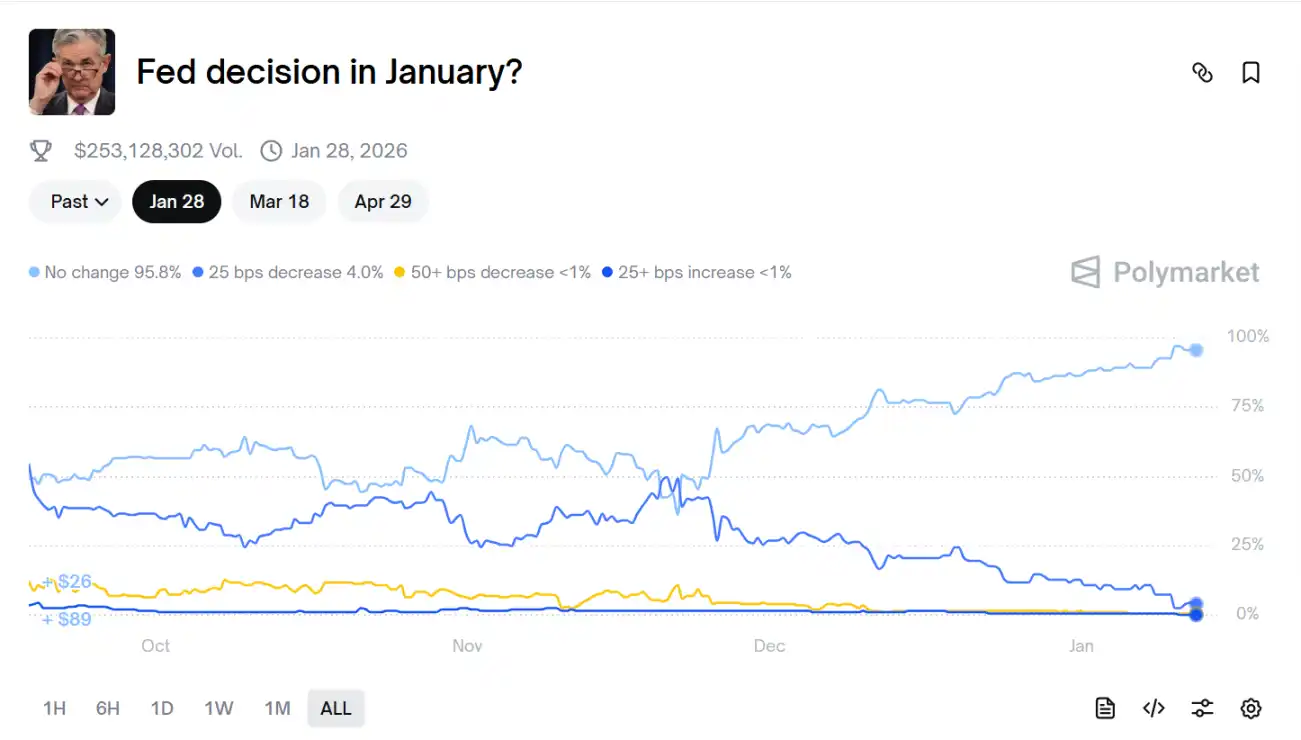
Latest data from Polymarket shows that market bets on the Fed holding rates steady in January have risen to 96%.
On X, supporters see Powell as a hero defending independence, while opponents accuse the Fed of "sabotaging the economy." Some users called for "abolishing the Fed," while others warned that this could trigger a constitutional crisis.
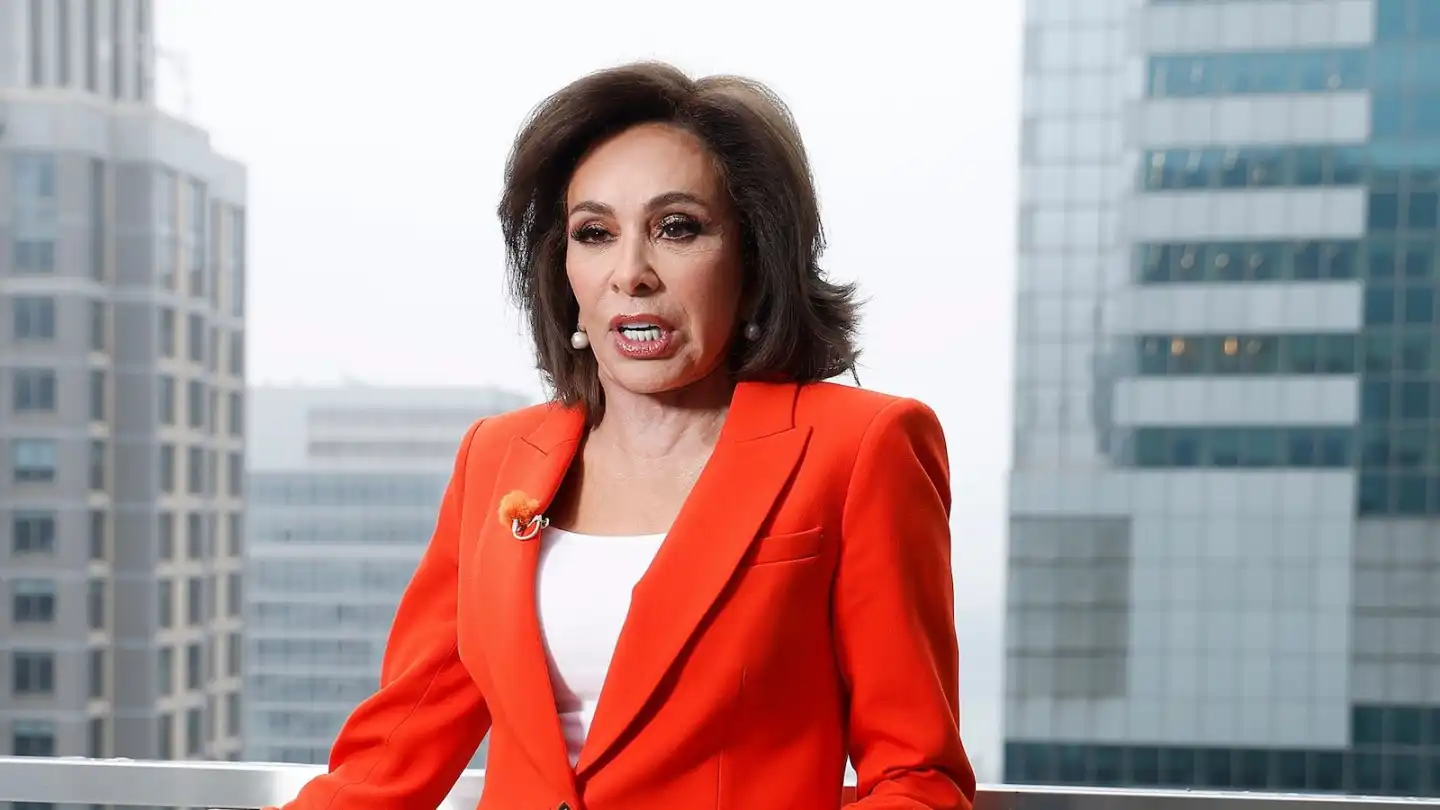
The investigation was authorized by newly appointed U.S. Attorney Jeanine Pirro, a staunch Trump ally, further deepening suspicions of political interference.

Powell responded that he would fully cooperate with the investigation but would not let it influence monetary policy decisions. The roots of this incident trace back to the Fed's institutional design. Established in 1913, the Fed was intended to be independent of politics, but there have been numerous precedents of presidential interference, such as during the Nixon era's Watergate scandal. This event marks an extension of Trump's "deregulation" agenda, as he has already promised to restructure federal agencies, including weakening the Fed's power, since taking office.

As of January 12, the investigation is still in its preliminary stages, with prosecutors repeatedly requesting documents. The White House has not commented. Analysts predict that if the investigation escalates, the Fed may be forced to accelerate rate cuts to alleviate pressure, but this could trigger a rebound in inflation, affecting U.S. economic growth.

Powell himself may face personal risks: if the allegations are substantiated, he could be forced to resign or even face imprisonment, although legal experts consider the evidence weak.

Powell has already responded proactively through his public statement. Moving forward, aside from hiring lawyers to challenge the subpoena's legality, he could also appeal to the courts or seek assistance from bipartisan lawmakers, particularly those concerned about the Fed's independence.

Hassett and Warsh Emerge as Top Contenders for Fed Successor

The criminal investigation into Powell has increased market uncertainty. After the news broke, investors worried that damage to the Fed's independence could lead to policy disorder. Powell's statement emphasized that threatening criminal charges would "undermine" the central bank's credibility, potentially raising risk premiums.

Secondly, this event is seen as a signal of Trump consolidating power, triggering strong backlash from Democrats and social groups. Democratic lawmakers called it a "constitutional crisis," expressing concerns that the DOJ is being weaponized for political retaliation.

Latest speculation about Fed leadership suggests that while Powell's term lasts until May 2026, the criminal investigation has accelerated discussions about his successor. Trump has stated he will announce his nominee by the end of the month.
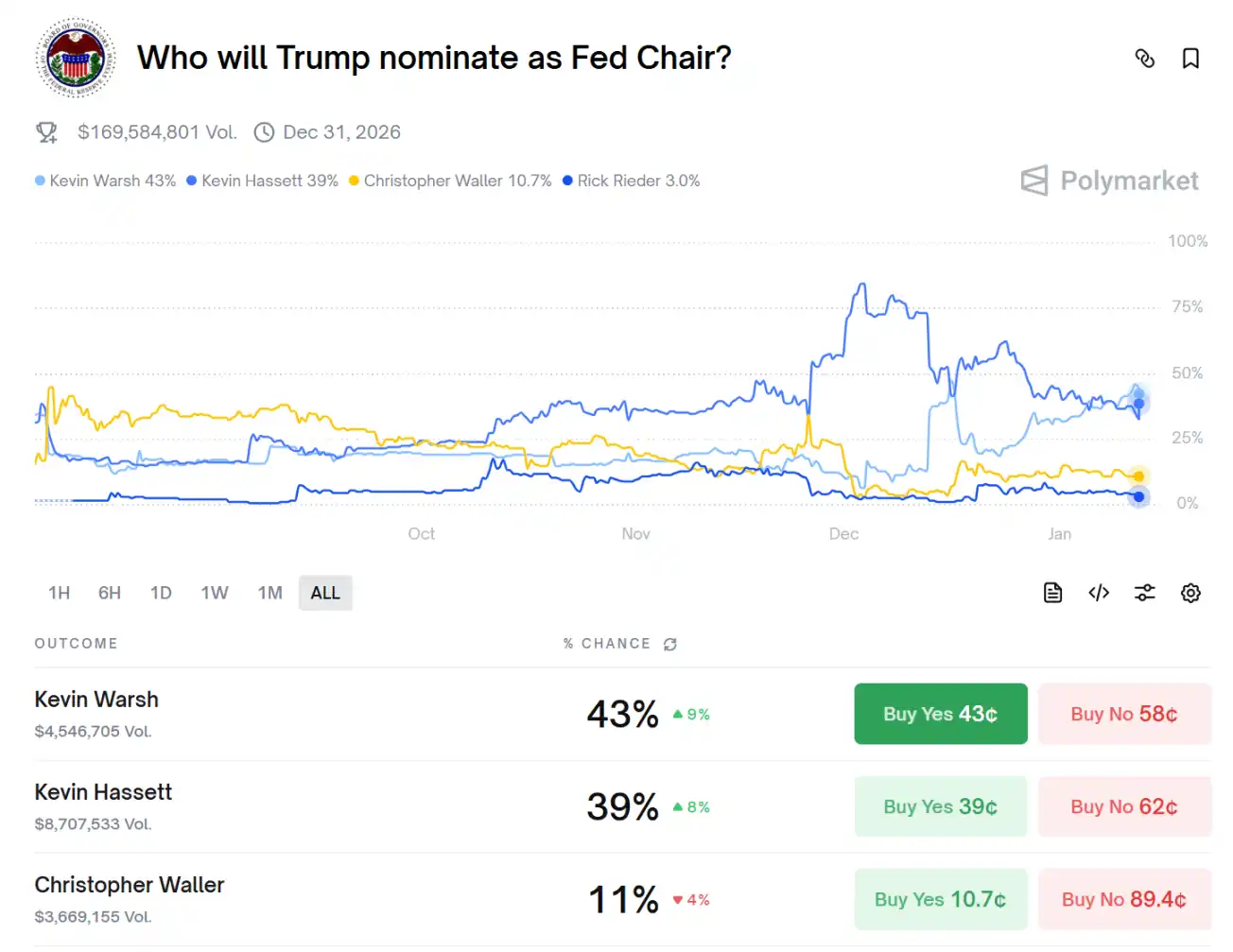
Latest data from Polymarket shows that market bets are highest on Kevin Warsh and Kevin Hassett, at 43% and 39%, respectively. Warsh was nominated as a Fed governor by President Bush in 2006, becoming the youngest Fed governor at the time. He is known for his hawkish stance but is market-friendly. In 2017, Trump considered Warsh for Fed Chair but ultimately chose Powell.

Hassett is a well-known conservative economist in the U.S., currently serving as Director of the White House National Economic Council and previously as Chair of the White House Council of Economic Advisers. He supports low interest rates and Trump's economic agenda. In November 2025, he was seen by Trump and his advisory allies as the top candidate for the next Fed Chair.

İlgili Sorular

QWhat is the main reason behind the criminal investigation against Jerome Powell according to the article?

AThe criminal investigation against Jerome Powell is widely perceived as an attempt by the Trump administration to pressure the Federal Reserve into lowering interest rates, as Powell himself stated it is an 'unprecedented' action aimed at forcing the Fed to capitulate to Trump's policy demands.

QHow did financial markets react immediately after the news of the investigation broke?

AFollowing the news, U.S. stock index futures fell rapidly, with S&P 500 futures down over 0.5% and Dow futures dropping 150 points in Asian trading hours. Spot gold rose 1.88%, spot silver surged about 4%, while BTC remained volatile around $91,000.

QWhat was the specific project that served as the pretext for the criminal investigation into Powell?

AThe investigation was formally launched over a $250 million renovation project at the Federal Reserve's Washington headquarters, with prosecutors examining whether Powell misled Congress and if there were irregularities in the project's fund usage.

QWho are the two leading candidates to replace Jerome Powell as Fed Chair according to market speculation on Polymarket?

AAccording to Polymarket data, the two leading candidates to replace Powell are Kevin Warsh, with a 43% probability, and Kevin Hassett, with a 39% probability.

QWhat did Powell emphasize was the Fed's statutory mission in his video statement, in contrast to yielding to political pressure?

AIn his video statement, Powell emphasized that the Federal Reserve's statutory mission is to maintain price stability and maximize employment, not to submit to political pressure, calling the investigation a 'blatant assault on the Fed's independence'.

İlgili Okumalar

Will the Next Crypto Bull Run Start with On-Chain Trading of SpaceX?

This article presents a scenario-based forecast for the crypto industry from 2026 to 2029, arguing that the next major cycle will be driven not by technological narratives but by legal access to real-world assets. The author predicts that by mid-2026, pre-IPO perpetual contracts for top private companies like SpaceX, OpenAI, and Anthropic on platforms like Hyperliquid will become the primary gateway for accessing quality assets, as most crypto-native tokens fail to capture real value. The much-hyped AI x Crypto intersection largely fails except for prediction markets, which thrive on betting on AI model supremacy. By 2027, public blockchain foundations are forced to choose between catering to retail speculation or building compliant infrastructure for institutions, with many opting for the latter. Growth in stablecoins and tokenized private credit/equity hits a "triple ceiling" due to regulatory and political uncertainty rather than market demand. The pivotal shift is forecast for 2028. A major liquidation event in pre-IPO perpetuals exposes the structural flaw of synthetic markets lacking a real underlying asset anchor. In response, regulatory changes finally allow the public solicitation of private securities resales to verified accredited investors. This creates a legitimate secondary market for real company equity, which then becomes the core asset class of the new bull market, relegating synthetic perps to a niche role. By 2029, the industry becomes "boring" but foundational. Tokens without claims on real cash flows or assets cease trading. Stablecoin growth is steady but politically capped. Crypto infrastructure fades from view as it gets absorbed into traditional finance backends. The article's central thesis is that the key bottleneck for crypto's next phase is legal and regulatory channels for real asset ownership, not technology.

marsbit36 dk önce

Will the Next Crypto Bull Run Start with On-Chain Trading of SpaceX?

marsbit36 dk önce

The Value Distribution of Stablecoins

**Summary: The Value Distribution of Stablecoins** The article argues that stablecoins are evolving from mere trading tools into broader channels for dollar access. It divides the stablecoin ecosystem into four layers to analyze how value is distributed: 1. **Issuance Layer:** Mints stablecoins, holds reserve assets, and captures the spread between reserve yield and user costs (e.g., Tether, Circle). This layer currently earns the largest profit margin. 2. **Infrastructure Layer:** Connects stablecoins to the traditional financial system, handling fiat on/off-ramps, banking integration, compliance (KYC/AML), and asset management (e.g., Bridge, BVNK). This is the "unglamorous" but critical work, building the essential bridges between crypto and real-world finance. 3. **Acquiring/Distribution Layer:** Integrates stablecoins into merchant systems, manages payment flows, and provides enterprise financial software (e.g., Stripe, Coinbase). They act as the access point for businesses. 4. **Application Layer:** The end-users and businesses that ultimately use stablecoins for payments, settlements, or as a store of value. They benefit from convenience but have little pricing power. The core thesis is that while the issuance layer currently dominates profits, the often-overlooked **infrastructure layer holds significant long-term potential**. The real challenge and barrier to mass adoption is not the on-chain transfer of stablecoins (which is simple), but the complex "last mile" integration into existing business workflows, banking systems, and regulatory frameworks across different countries. Companies in this layer are currently in a "land grab" phase, investing heavily to build networks, secure bank partnerships, and establish compliance pathways. While their position is currently pressured by the profitable issuers above and distribution platforms below, the article suggests that if stablecoins become a default financial rail for businesses, the infrastructure providers who have done the hard work of integration will ultimately gain strong pricing power and become entrenched, essential players.

marsbit7 saat önce

The Value Distribution of Stablecoins

marsbit7 saat önce

The Value Distribution of Stablecoins

The Value Distribution of Stablecoins The article argues that stablecoins are evolving from a mere trading tool into a broad "dollar channel." It analyzes the industry's value chain through four layers: 1. **Issuance Layer (e.g., Tether, Circle):** The top layer that mints stablecoins, holds reserve assets, and captures the thickest interest rate spread. 2. **Infrastructure Layer (e.g., Bridge, BVNK):** Connects stablecoins to the traditional financial system, handling critical but complex "dirty work" like fiat on/off-ramps, banking integration, compliance (KYC/AML), and cross-border settlement. 3. **Acquiring/Distribution Layer (e.g., Stripe, Coinbase):** Embeds stablecoins into merchant systems, manages payment flows, and integrates with enterprise software. 4. **Application Layer:** End-users and businesses that ultimately use stablecoins for payments, settlement, or storing value. The author posits that while the issuance layer currently captures the most profit, the most overlooked and potentially critical layer is infrastructure. The core challenge for stablecoin adoption isn't the on-chain transfer (which is simple), but bridging the gap between blockchain and the real-world financial system. This involves solving practical problems for businesses: fiat conversion, reconciliation, tax handling, and user onboarding. Infrastructure companies are currently in a difficult "land-grab" phase—building networks, securing banking relationships, and achieving compliance country-by-country. They face pressure from both the profitable issuance layer above and distribution platforms below. However, the author suggests this layer is building a crucial moat. Once stablecoins become a default business rail, the infrastructure players who have done the hard work of integration may gain significant, durable value and pricing power.

链捕手7 saat önce

The Value Distribution of Stablecoins

链捕手7 saat önce

İşlemler

Spot
Futures
活动图片