Trump Crypto Deal Triggers JPMorgan Risk Debate After $500M Abu Dhabi Stake Revelation

bitcoinist2026-02-04 tarihinde yayınlandı2026-02-04 tarihinde güncellendi

Özet

A $500 million investment by Abu Dhabi's Sheikh Tahnoon bin Zayed Al Nahyan into Trump-linked crypto platform World Liberty Financial (WLFI) has sparked a debate on political influence and regulatory risk. The deal, signed days before Trump's inauguration, has drawn scrutiny from US lawmakers, including Senator Elizabeth Warren. Trump has denied involvement. The revelation coincides with a lawsuit from Trump against JPMorgan Chase over alleged politically motivated account closures, and public clashes between CEO Jamie Dimon and crypto firms. The deal's scale, foreign involvement, and timing, coupled with Sheikh Tahnoon's role in a US-approved AI firm, have amplified concerns about transparency and influence, putting a spotlight on how major banks navigate crypto-related risks.

A reported $500 million investment by an Abu Dhabi royal into a Trump-linked crypto venture is reverberating well beyond the digital asset space, feeding into a broader debate about political influence, regulatory oversight, and how major financial institutions such as JPMorgan Chase navigate crypto-related risk.

The timing of the deal, just days before Donald Trump’s inauguration, has sharpened scrutiny at a moment when the bank is already facing a high-profile lawsuit from the US president and renewed tension with crypto firms.
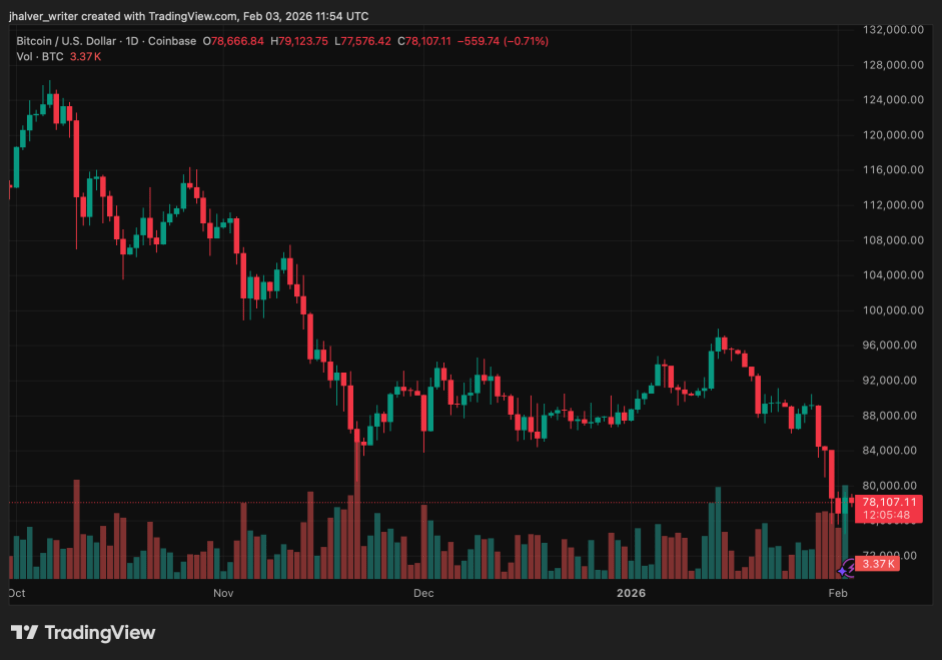
BTC's price trends to the downside on the daily chart. Source: BTCUSD on Tradingview

$500M World Liberty Financial Deal Draws Political Scrutiny

According to reporting by The Wall Street Journal, entities linked to Sheikh Tahnoon bin Zayed Al Nahyan acquired a 49% stake in World Liberty Financial (WLFI), a cryptocurrency platform tied to the Trump family, for $500 million.

The agreement was reportedly signed by Eric Trump four days before Trump returned to office. Trump has denied any knowledge of the transaction, stating that his sons manage the business independently.

The investment was structured in phases, beginning with an initial $250 million payment. Of that amount, about $187 million reportedly went to Trump-family-linked entities, with additional allocations to other WLFI founders. If completed in full, the deal would make the Tahnoon-backed vehicle WLFI’s largest shareholder.

The scale, foreign involvement, and timing of the investment have raised questions among US lawmakers, including calls from Senator Elizabeth Warren to pause regulatory reviews involving WFLI. No investigation has been announced, and WLFI has said the transaction was conducted independently of President Trump.

JPMorgan Lawsuit and Crypto Tensions Collide

The revelation comes as JPMorgan Chase faces a lawsuit from Trump alleging politically motivated account closures. The bank has said its decisions comply with legal and regulatory requirements.

Separately, JPMorgan CEO Jamie Dimon has clashed publicly with Coinbase leadership over crypto regulation, highlighting ongoing friction between traditional banks and digital asset firms.

For investors, these overlapping headlines bring renewed attention to how JPMorgan manages reputational and regulatory risk.

The bank’s stock has delivered strong multi-year returns, but analysts note that political controversy, legal costs, and shifting crypto policy could weigh on sentiment, particularly as regulators focus more closely on “debanking” practices and banks’ exposure to digital assets.

Why the Deal Resonates Beyond Crypto

The Abu Dhabi stake has drawn added attention because Sheikh Tahnoon also chairs G42, an AI firm that recently received US approval to purchase advanced chips from American suppliers.

While no wrongdoing has been alleged, the overlap between foreign capital, sensitive technology approvals, and a Trump-linked crypto venture has amplified concerns about transparency and influence.

Cover image from ChatGPT, BTCUSD chart on Tradingview

İlgili Sorular

QWhat is the significance of the $500 million investment by an Abu Dhabi royal into a Trump-linked crypto venture?

AThe $500 million investment is significant because it has sparked a broader debate about political influence, regulatory oversight, and how major financial institutions like JPMorgan navigate crypto-related risks. Its timing just before Trump's inauguration and the involvement of a foreign entity have drawn intense political scrutiny.

QWhich company received the investment and who is its largest shareholder as a result of the deal?

AThe investment was made into World Liberty Financial (WLFI), a cryptocurrency platform tied to the Trump family. If completed in full, the deal would make the Tahnoon-backed vehicle WLFI's largest shareholder with a 49% stake.

QHow has US Senator Elizabeth Warren reacted to the World Liberty Financial deal?

ASenator Elizabeth Warren has called for a pause on regulatory reviews involving World Liberty Financial (WLFI) in response to the deal.

QWhat two major issues is JPMorgan Chase currently facing that are mentioned in the article?

AJPMorgan Chase is currently facing a lawsuit from former President Trump alleging politically motivated account closures, and its CEO, Jamie Dimon, is engaged in public clashes with crypto firms like Coinbase over regulation.

QWhy does the article state the deal 'resonates beyond crypto,' citing Sheikh Tahnoon's other role?

AThe deal resonates beyond crypto because Sheikh Tahnoon also chairs G42, an AI firm that recently received US approval to purchase advanced chips from American suppliers. This overlap between foreign capital, sensitive technology approvals, and a Trump-linked venture amplifies concerns about transparency and influence.

İlgili Okumalar

Agents Take Over Traffic Distribution Power: What Are Tencent, ByteDance, and Alibaba Competing For?

In the race to dominate the AI era's entry point, China's tech giants—Tencent, ByteDance, and Alibaba—are aggressively deploying AI Agents to control the future of traffic distribution. Alibaba is pursuing a dual-track "closed loop + openness" strategy. Its Qianwen app is evolving into a super-Agent integrated across its ecosystem (Taobao, Alipay, etc.) to handle complex tasks like travel planning. Concurrently, it is opening its platform to external brands (Luckin Coffee, KFC) and has launched a B2B Agent platform, "Wukong," targeting enterprise automation. Its other flagship, Quark, aims to be an "AI super search box" for information and tasks. ByteDance is executing an omnipresent "sprawl strategy." Its Doubao app boasts over 300 million monthly active users and is evolving into a default AI entry point for daily life, with plans for paid versions and e-commerce integration. Its core weapon is the Kouzi platform, a visual "AI assembly factory" for developers to build custom Agents. ByteDance is also pushing hardware integration, collaborating on AI phones and developing smart glasses to embed Doubao everywhere. Tencent is playing its long-held "ultimate card" by quietly embedding an AI Agent directly into WeChat. This Agent, accessible via a swipe, can understand user commands and automatically execute tasks by calling upon WeChat's millions of mini-programs (e.g., finding and ordering coffee). This leverages WeChat's unparalleled 1.4-billion-user ecosystem to position the app as an AI-powered "service operating system," a move that could dramatically reshape the competitive landscape. The core battleground is shifting from competing for "user screen time" to competing to be the "default execution layer" for user intent. The business model is evolving from an "attention economy" to an "intent economy," where the Agent that can most efficiently fulfill a user's need gains control over service access and token flow. This represents a fundamental change in how users connect with digital services, making the fight for the Agent入口 (entry point) a pivotal moment for redefining industry leadership in the AI age.

marsbit28 dk önce

Agents Take Over Traffic Distribution Power: What Are Tencent, ByteDance, and Alibaba Competing For?

marsbit28 dk önce

From Banning Doubao to Embracing Honor: Why Did WeChat Suddenly 'Change Its Face'?

The article explores the sudden shift in WeChat's strategy towards AI assistants from mobile phone manufacturers, transitioning from strict opposition to active collaboration. For over a year, WeChat fiercely resisted attempts by phone AI assistants (like ByteDance's Doubao in late 2025) to control its features via GUI automation ("simulated clicking"), citing security and data control concerns. This stance created a significant barrier for system-level AI integration. Now, Tencent has initiated A2A (Agent-to-Agent) partnerships with major phone brands like Honor, Xiaomi, OPPO, and vivo. This model allows a phone's system AI (e.g., Honor's YOYO) to parse a user's voice command and send a structured request directly to WeChat's own internal AI agent via secure APIs. WeChat then executes the action (e.g., sending a message) and returns the result. The article attributes Tencent's "change of face" to strategic pressure. While leading in social app usage, Tencent trails rivals like ByteDance and Alibaba in standalone AI app popularity. WeChat, with its vast mini-program ecosystem, is Tencent's key asset for an AI comeback. The upcoming WeChat AI agent aims to handle tasks like booking and payments within the app. However, phone system assistants remain the primary AI entry point for most users. The A2A collaboration allows Tencent to extend WeChat's AI reach to this crucial system layer while maintaining control over its core functions and data. For phone manufacturers, embracing A2A is a pragmatic move. The GUI route proved unviable due to WeChat's blocks. A2A offers a compliant path to integrate a vital service, enhancing their AI assistants' usefulness. It allows them to focus on developing their own AI ecosystems for other services while cooperating on WeChat access. The collaboration is framed as a mutual, strategic necessity: Tencent gains a distribution channel, and manufacturers gain a key functionality. The partnership relies on a "dual authorization" mechanism for security, requiring both user and app consent for each action. While questions about long-term data privacy practices remain, experts note A2A is more secure and compliant than GUI automation. Ultimately, this cooperation is seen as a tentative, calculated truce. Tencent's long-term goal is to make WeChat an AI-powered "service OS." Phone manufacturers aim to make their system AI the central user interface. Their paths may converge or clash in the future, but for now, the A2A deal represents the opening chapter in the battle for the AI-era user入口, driven by necessity and strategic calculus on both sides.

marsbit2 saat önce

From Banning Doubao to Embracing Honor: Why Did WeChat Suddenly 'Change Its Face'?

marsbit2 saat önce

İşlemler

Spot
Futures
活动图片