Trillion-Dollar Euphoria for Memory Sellers, Halved Profits for Memory Buyers

链捕手2026-05-27 tarihinde yayınlandı2026-05-27 tarihinde güncellendi

Özet

Title: The Trillion-Dollar Memory Seller's Carnival vs. The Buyer's Halved Profits On May 26, a stark contrast unfolded. While memory chipmaker Micron's market cap surged past $1 trillion, smartphone maker Xiaomi reported plummeting profits. Xiaomi's Q1 2026 profits fell 43% year-on-year. Executive Lu Weibing cited memory prices quadrupling from last year, adding roughly $210 to a phone's cost. To survive, Xiaomi is cutting entry-level models, sacrificing volume. Micron's stock, however, skyrocketed over 19% in a day, capping an 8x gain in a year. Major banks like UBS and JPMorgan issued bullish reports, raising price targets drastically. Their core thesis: Long-Term Agreements (LTAs) with AI cloud giants (Microsoft, Google, etc.) are eliminating the memory industry's notorious boom-bust cycle. By locking in fixed-price, multi-year contracts for AI-grade memory (HBM, server DDR5), these deals promise stable, utility-like earnings, justifying a higher valuation (20-30x P/E vs. the historical 8-15x). The article reveals a three-tiered memory market in 2026: 1) **AI Storage (HBM/DDR5/Enterprise SSD)**: Extreme shortage, soaring prices, LTAs. This is Micron's story. 2) **Mobile/Embedded Memory**: Also facing sharp price hikes as AI production crowds out capacity, severely pressuring phone makers like Xiaomi. 3) **PC Retail**: Some spot prices are falling due to channel inventory liquidation, creating a divergence from contract markets. The author questions if LTAs truly end ...

Author: Xiao Jing, Tencent Technology

Editor: Xu Qingyang

Two things happened simultaneously on the evening of May 26th.

Xiaomi released its Q1 2026 financial report. Total revenue was 99.1 billion yuan, down 10.9% year-over-year; adjusted net profit was 6.07 billion yuan, plummeting 43.1% year-over-year. Smartphone business revenue was 44.3 billion yuan, down 12.5% year-over-year, with gross margin dropping to 10.1%, a decrease of 2.3 percentage points compared to the same period last year.

On the earnings call, Lu Weibing, President of Xiaomi Group, mentioned a number: the price of memory with the same specs has skyrocketed nearly 4 times compared to last year. For a phone with 12GB LPDDR5 + 512GB UFS configuration, memory costs alone have increased by about 1,500 yuan. He said Xiaomi "will not pass on the increased memory costs to consumers," but also predicted the price hike cycle would continue into 2027 or even 2028. To survive, Xiaomi proactively cut entry-level models, leading to quarterly shipments dropping to 33.8 million units.

The second thing, Micron Technology surged over 19% in a single day, with its market cap surpassing $1 trillion. UBS raised its price target for Micron from $535 directly to $1,625, an increase of about 204% at once, becoming the highest target among the 46 brokerages currently covering Micron.

A few days earlier, Citigroup had just raised Micron's target from $425 to $840, and HSBC raised it from $750 to $1,100. Wall Street hasn't been this unanimous on a cyclical stock in a long time. Twelve months ago, Micron's stock price was below $110. It has multiplied eightfold in a year.

On the same day, trillion-dollar euphoria for memory sellers, halved profits for memory buyers.

Goldman Sachs played a noteworthy role in this frenzy. In December 2025, Goldman gave Micron a Neutral rating with a $205 target. In Q1 2026, Goldman reduced its Micron position by nearly 20%.

On March 19th, the day Micron reported earnings, Goldman raised its target from $360 to $400, but maintained Neutral—at a time when the stock price had already far exceeded $400. Then Micron soared 40% in a week, and Goldman perfectly missed the rally.

On May 17th, Goldman issued a storage industry report concluding "the most severe supply shortage in 15 years," upgrading the overall storage sector rating. But for Micron, it was still Neutral, with the target price still at $400. As an outlier, Goldman is either the last sane person in this euphoria, or the one who missed out the worst.

But such intense divergence is also worth serious thought.

01 Why the Frenzy? A New Story Called LTA?

The core thesis of UBS analyst Timothy Arcuri's report on May 26th is that Long-Term Agreements (LTA) are fundamentally eliminating the cyclicality of the memory industry.

Memory chips are the product in the semiconductor industry most akin to a commodity. DRAM and NAND prices have followed a brutal forty-year law: up for two years, down for two years; price collapses have never been absent. The profits of Micron, Samsung, and SK Hynix resemble EKG readings, and the market has never dared to value these companies based on "steady-state earnings." For forty years, the valuation fluctuation range for cyclical stocks has roughly been 8 to 15 times P/E.
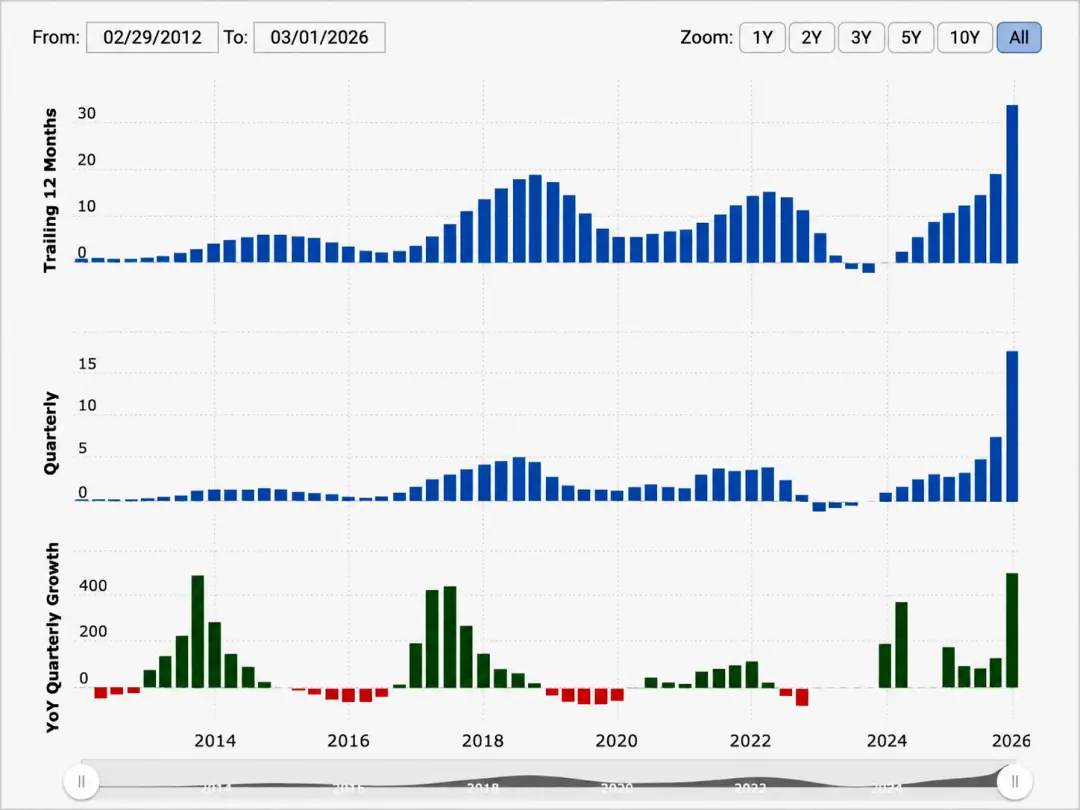
Figure: Micron's EKG-like Financial Data Fluctuations

UBS's story is that the "cycle curse" of these companies will be broken, and the protagonist behind it is "AI."

Cloud vendors like Microsoft, Google, Amazon, and Meta, to secure HBM and DDR5 supply in the AI arms race, are proactively signing 3 to 5-year fixed-price long-term contracts with memory manufacturers, even with prepayments. These contracts are not the traditional "intent-based" agreements in the semiconductor industry but binding purchase commitments, locking in volume, price, and even wafer capacity.
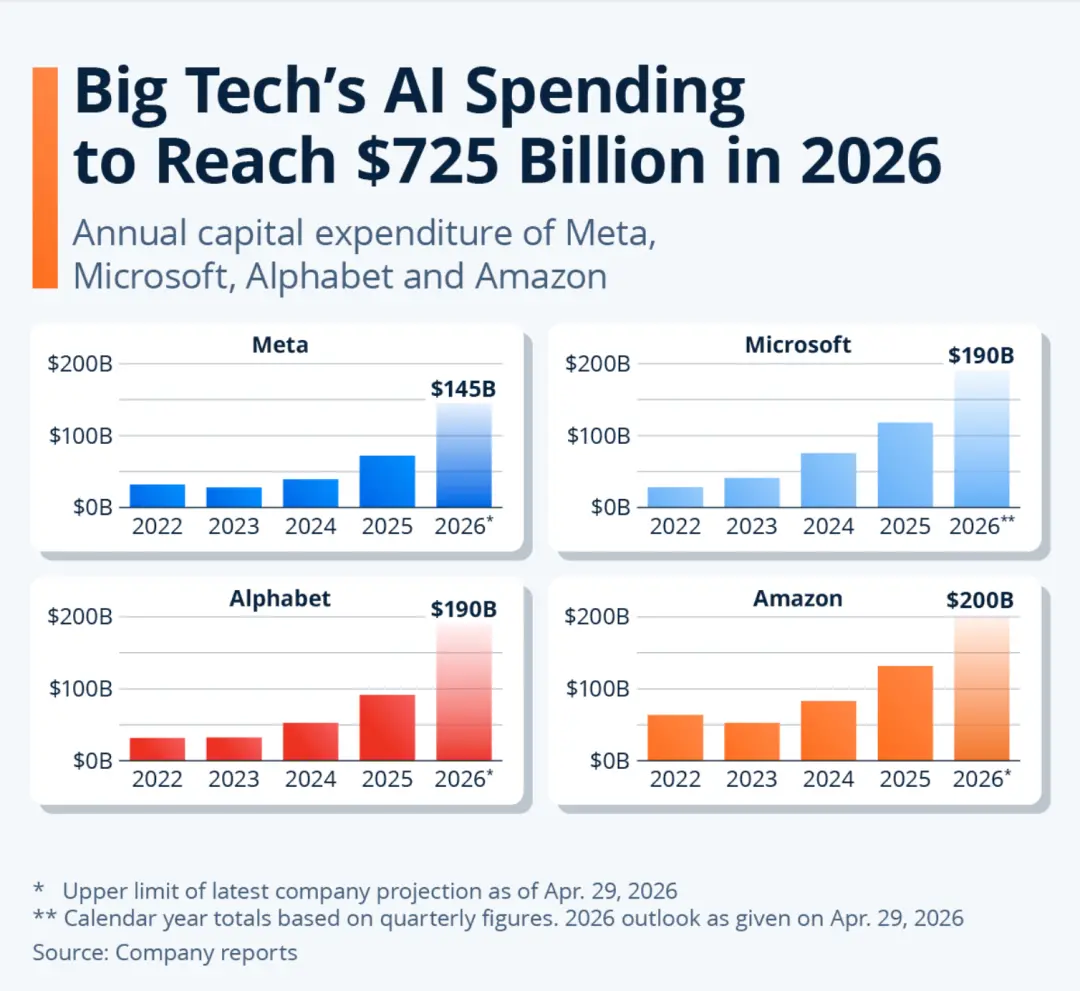
Figure: AI Capital Expenditure of Major Tech Companies (2022—2026E): The four combined are expected to reach $725 billion in 2026. Individually: Amazon $200B, Microsoft $190B, Alphabet $190B, Meta $145B. 2026 data based on each company's latest guidance upper limit as of April 29; Microsoft figures are calendar year aggregates based on quarterly data.

Microsoft and Google were reported in April to be negotiating three-year DRAM LTAs with SK Hynix, structures including prepayment deposits. Previously, manufacturers begged customers for orders; now, customers pay deposits to lock capacity. The power dynamics of the supply chain have reversed.

UBS's model calculations show that after incorporating LTAs into Micron's earnings forecasts, even if DRAM spot prices crash 50% in FY 2029, Micron's annual EPS could still maintain over $100. LTAs can narrow the fluctuation amplitude of DDR prices from cycle peak to trough by about 50%. By 2027, 20% to 30% of the industry's total DDR bit shipments will be locked by fixed-price LTAs. For top hyperscalers' DDR5 procurement, 60% to 70% may already be under fixed contracts.

From a valuation perspective, if cyclicality disappears, memory stocks should no longer be valued as cyclical stocks but as infrastructure utilities, jumping from 8-15x P/E to 20-30x P/E.

JP Morgan also published a report with similar conclusions in mid-May, titled directly "LTAs Are Eliminating Memory Industry Cyclicality." Citigroup's logic is that HBM production will squeeze out ordinary DRAM wafer capacity, leading to long-term tightness in general-purpose memory.

Micron's stock surge welcomes the Davis Double Click of profit and valuation system switching.

02 This Memory Is Not That Memory

Wall Street uses "Memory Supercycle" to tell a unified bull narrative. But "memory" and "memory" are completely different.

The 2026 memory market shows a three-tier differentiation.

The first tier is AI memory: HBM, server DDR5, enterprise SSD. Here, price hikes, shortages, and LTAs locking capacity occur simultaneously. TrendForce expects, Q2 2026 DRAM contract prices to rise 58%-63% QoQ, NAND Flash contract prices to rise 70%-75% QoQ; Kioxia also publicly stated its 2026 capacity is basically sold out. This tier is the story behind Micron's trillion-dollar market cap.

The second tier is mobile and embedded memory: mobile DRAM and smartphone NAND. Price hikes are also severe here. Counterpoint data shows Q1 2026 DRAM prices rose over 50% QoQ, NAND Flash prices rose over 90% QoQ. Related TrendForce reports show memory typically accounted for about 10%-15% of smartphone BOM, now risen to 30%-40%, with low-end models under more pressure.
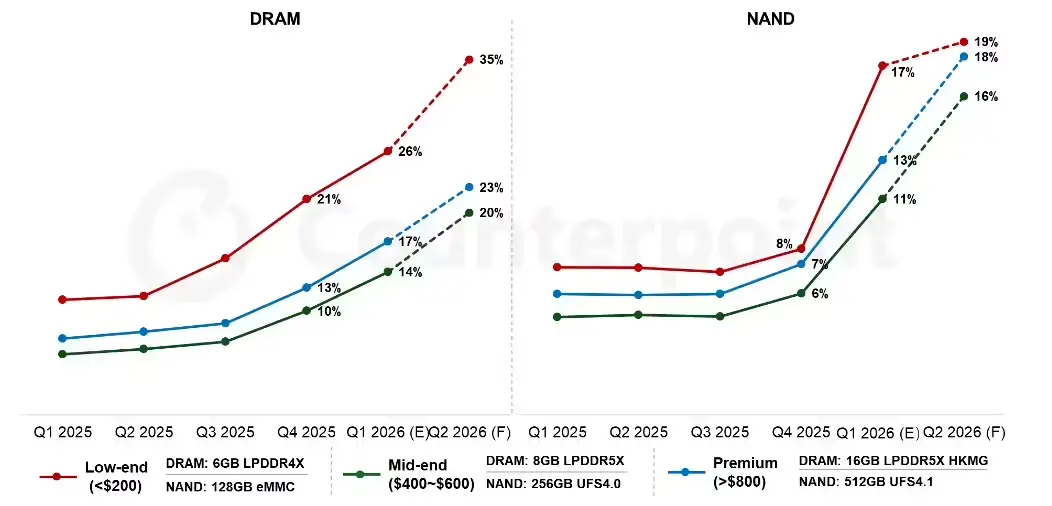
Left chart DRAM (Memory) Trend: Low-end phone increase most aggressive, rising from initial low levels to a forecast of 35% by Q2 2026; high-end to 23%; mid-range to 20%. Dashed portion (after Q1 2026) is forecast.

Right chart NAND (Flash) Trend: All price points remained basically flat through Q3 2025, but began surging sharply from Q4 2025.

Xiaomi sits in this tier. Its pain is "AI is taking away capacity, leaving less for phones, and phone makers must pay higher prices for the remaining capacity."

OEMs prioritize capacity for AI customers, leaving phone makers with few choices in contract procurement. If you want to ship, you have to buy at new contract prices; if you don't, production lines and new product schedules will be affected.

The third tier is PC retail spot: DDR5 modules, consumer SSDs. Reverse movement has appeared here. TrendForce reports show that by late March, 32GB DDR5 modules in Chinese channels dropped 500-1050 yuan from near 3000 yuan, with some clearance prices as low as 1950 yuan; Tom's Hardware also wrote that some DDR5 products in Chinese and overseas retail markets have retreated 25%-30% from highs.

But this is mainly a split between retail spot and contract procurement. PC channels have inventory and can sell off; phone makers buy via contracts and have no sell-off option.

The same "memory" industry, three tiers, three directions. The essence of this differentiation is that the three memory giants are shifting wafer capacity from consumer-grade to AI. HBM production squeezes out ordinary DRAM wafers, enterprise SSDs squeeze out consumer NAND supply, leaving less capacity for phones and PCs. Phone makers, forced to ship, have to accept price hikes; PC channels, with ample inventory, can slash prices and sell off.
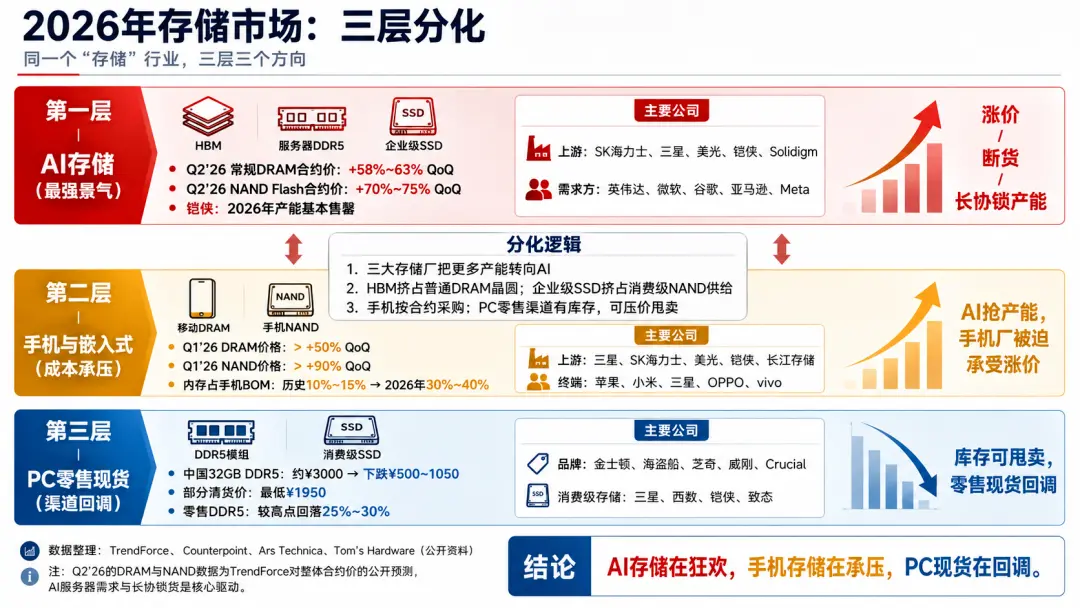
Image generated with AI assistance

Micron and others have actively chosen to allocate capacity to AI customers willing to pay more. In the short term, this is a beautiful product mix upgrade. But it also means Micron is blocking its own retreat; once AI demand slows, capacity may not switch back smoothly.

Micron's earnings report shows that sequentially, DRAM bit shipments only grew mid-single digits, NAND bit shipments only grew low-single digits; growth mainly came from ASP increases. Micron's story today rests solely on the "extreme tightness of the AI memory branch."

Micron is betting everything on this branch.

03 Can LTAs Really Eliminate the Cycle?

The logic of LTAs seems solid. Under AI spending cadence, memory chip supply elasticity is extremely low; HBM capacity takes 18 to 24 months from planning to production, and producing HBM squeezes out general-purpose DRAM wafers. Cloud vendors sign LTAs because they fear "AI project delays."

But LTAs eliminating cyclicality has one prerequisite: the demand side doesn't collapse.

Different institutions have different statistical calibers for AI CapEx, but the direction is consistent: AI infrastructure investment is moving from hundreds of billions of dollars towards nearly a trillion dollars. According to some market models, this is a capital expenditure curve with an annualized growth near 40%-50%.

However, nothing in the physical world grows at over 40% forever. No AI bubble burst is needed; just a slowdown from 45% to 20% could reverse the memory chip supply-demand balance within 18 months. All three memory makers are now expanding capacity like crazy; Micron's FY2026 CapEx is $25 billion, with an additional $10 billion in FY2027.

And there's something that must be faced: when a company's revenue growth relies entirely on price elasticity rather than volume elasticity, the story is fragile. Micron's shipment volume only grew 4%-6%; the 196% revenue growth mainly came from price increases. Prices can rise but also fall, and they fall much faster than they rise. This is the nature of cyclicality.

Let's do a simple math problem.

Micron's current market cap is $1 trillion. Micron has already raised FY2026 CapEx to over $25 billion, and expects capital expenditure to increase significantly in FY2027, with some market reports mentioning the increment could exceed $10 billion.

Micron's Q2 FY2026 non-GAAP net profit was about $14 billion, annualized simply to about $56 billion, corresponding to about 18x P/E. If future price hikes and LTAs are extrapolated further, P/E can still be calculated down to around 15x.

It might seem "cheap." But the denominator of this P/E is a super-cycle peak profit where DDR4 contract prices rose 10x in 15 months, HBM is sold out for the year, and gross margin jumped from 36% to 75%.

Multiplying a cycle-peak profit by a seemingly "reasonable" multiple to get a seemingly "not expensive" valuation is precisely the classic valuation trap when cyclical stocks peak.

In 2000, Cisco's P/E was also "only" in the 60s, based on 15 consecutive quarters of 50%+ revenue growth. When growth slowed from 50% to 20% to 0%, EPS didn't need to fall much for the stock to drop 80%, because both the multiple and earnings contracted simultaneously.

From Davis Double Click to Double Kill.

History tells us one thing: in commodity markets, LTAs are never a one-sided "floor." They protect buyers in up cycles and sellers in down cycles, but only if both sides have the ability and willingness to perform. The moment LTAs are most needed is precisely when they are most likely to fail.

This is not to say Micron is necessarily a bubble. AI demand for compute and memory may indeed be structural, LTAs may indeed rewrite industry rules, and a trillion-dollar market cap may be just the starting point.

But when all of Wall Street shouts "this time is different" simultaneously, it's at least worth stopping to ask: the last time everyone was this certain, what happened afterwards?

In a sense, only by enjoying the euphoria of the bubble can one make money.

But, it took Cisco about 25 years, into today's AI era, to finally surpass its closing high from the internet bubble period—and the internet did indeed change everything.


İlgili Sorular

QAccording to the article, what are the two main events that happened on the evening of May 26th, and what do they illustrate?

ATwo main events happened: 1) Xiaomi released its Q1 2026 financial report, showing a significant drop in profit and revenue, with its president attributing part of the pressure to memory chip costs rising nearly 4 times year-over-year. 2) Micron Technology's stock surged over 19%, pushing its market cap above $1 trillion. These events illustrate the stark contrast between memory sellers (like Micron) experiencing a 'trillion-dollar狂欢' (carnival) and memory buyers (like Xiaomi) facing '利润腰斩' (profit halving).

QWhat is the new narrative that Wall Street, specifically UBS and J.P. Morgan, is using to justify Micron's high valuation and argue against the traditional cyclical nature of the memory industry?

AThe new narrative centers on Long-Term Agreements (LTAs). Analysts argue that AI-driven hyperscalers (like Microsoft, Google, Amazon, Meta) are signing 3-5 year binding contracts with memory makers to lock in supply (especially for HBM and DDR5) at fixed prices, often with prepayments. This supposedly fundamentally eliminates the industry's traditional boom-bust cycle by guaranteeing stable demand and pricing. If the cycle is broken, memory stocks should be valued like infrastructure/utility companies (20-30x P/E) rather than cyclical stocks (8-15x P/E).

QHow does the article describe the three-tiered divergence within the broader 'storage' market in 2026?

AThe article describes a three-tiered divergence: 1) **AI Storage (HBM, server DDR5, enterprise SSD)**: Extreme shortages, soaring prices, sold-out capacity. This is the core of Micron's growth story. 2) **Mobile & Embedded Storage**: Also facing severe price hikes. Phone makers like Xiaomi are squeezed as they must purchase at high contract prices to maintain production, with memory now taking 30-40% of BOM costs. 3) **PC Retail Spot Market**: Shows the opposite trend, with prices for DDR5 modules and consumer SSD dropping 25-30% from peaks due to channel inventory sell-offs, creating a split with the contract market.

QWhat critical assumption must hold true for the Long-Term Agreement (LTA) narrative to successfully 'eliminate the cycle'? What potential risk does the article highlight regarding this assumption?

AThe critical assumption is that AI demand does not collapse or significantly slow down. The article highlights the risk that even a slowdown in AI capital expenditure growth (e.g., from 40-50% to 20%) could reverse the supply-demand balance within 18 months. As memory makers like Micron ramp up massive capital expenditure (CapEx) based on peak-cycle demand, a slowdown could lead to overcapacity. Furthermore, LTA contracts are most likely to be challenged or renegotiated precisely when they are most needed—during a downturn.

QWhat historical analogy does the article draw to caution against potential valuation risks for Micron at its current peak?

AThe article draws an analogy to Cisco during the dot-com bubble of 2000. At its peak, Cisco's P/E ratio 'was only in the 60s,' based on 15 consecutive quarters of 50%+ revenue growth. When growth slowed dramatically, Cisco's stock fell about 80% due to a simultaneous contraction in both its earnings multiple (P/E) and its earnings (EPS)—a phenomenon known as a '戴维斯双杀' (Davis Double Kill), the opposite of the戴维斯双击 (Davis Double Play) it is currently experiencing. The warning is that using peak-cycle earnings multiplied by a 'reasonable' multiple can be a classic valuation trap for cyclical stocks.

İlgili Okumalar

SpaceX, OpenAI, Anthropic: The Three AI Giants Racing for IPO, Which One Is Worth Betting On?

SpaceX, OpenAI, and Anthropic are poised for historic IPOs within weeks, potentially raising a combined $180 billion—a sum exceeding the entire internet bubble's fundraising. The hosts of the Limitless Podcast argue this isn't just individual company financing but an unprecedented capital concentration for AI infrastructure, driven by an insatiable need for compute, data centers, power, and chips. SpaceX's IPO is notable for reportedly changing market index rules to allow faster inclusion, potentially funneling trillions in passive retirement funds into its stock, despite its unproven space-based data center business model. In contrast, Anthropic demonstrates explosive growth, with ARR reportedly hitting $45 billion and approaching profitability, fueled by strong enterprise adoption of products like Claude Code. Google's separate $80 billion raise highlights the immense capital pressure, even for giants. The discussion acknowledges bubble risks but leans optimistic. The hosts contend the massive spending is building essential physical infrastructure for the next technological era. A key bottleneck isn't capital but the real-world limits of chip manufacturing and construction speed. As long as demand for AI compute outstrips supply, this investment cycle represents a foundational build-out rather than a purely financial bubble. All three companies are seen as foundational bets on the future, with Anthropic often cited as the most immediately compelling due to its proven revenue trajectory.

marsbit35 dk önce

SpaceX, OpenAI, Anthropic: The Three AI Giants Racing for IPO, Which One Is Worth Betting On?

marsbit35 dk önce

From 'Old Guys' to 'New Favorites': How AI Is Revaluing Old Infrastructure from Dell to Nokia?

From "Vintage Tech" to "New AI Darlings": How AI Revalues Old Infrastructure One year ago, tech giants like Dell, Nokia, Cisco, and Western Data were seen as slow-growth, low-valuation stories, far from the AI spotlight dominated by players like Nvidia. Now, these legacy tech stocks are gaining market attention, sparking debate on whether this is genuine industry revaluation or a temporary narrative. As AI moves from model parameters to real-world data centers, the market is recognizing companies with proven delivery and infrastructure capabilities. This shift marks a change in the AI investment thesis: from pure model and GPU focus to the complex systems engineering required for deployment. Companies like Dell, HPE, and Corning are being revalued not for being "sexy" AI innovators, but for their decades of accumulated expertise in supply chains, enterprise delivery, and infrastructure—assets that have become critical in the AI buildout phase. The revaluation is unfolding across three key infrastructure lines: 1. **Servers & System Integration:** Dell and HPE are emerging as crucial system integrators or "general contractors" for AI data centers, translating GPU orders into complete, deployable server racks integrated with power, cooling, and networking. 2. **Networking & Connectivity:** AI's scale demands robust high-speed connections. Corning (fiber optics), Nokia (AI-RAN, 6G), and Cisco (data center switches) are gaining importance for enabling efficient data transfer within and between AI clusters. 3. **Storage:** Beyond high-speed memory (HBM/DRAM), the AI data explosion is driving demand for high-capacity hard drives (HDDs) from companies like Western Digital and Seagate to handle training data, logs, and cold storage cost-effectively. For this revaluation to be substantive and not just a narrative, three criteria are key: 1) Concrete AI-related order and revenue growth (e.g., Dell's AI server sales), 2) Upward revisions to company financial guidance, and 3) Sustainable improvements in profit quality, not just top-line revenue spikes. In essence, AI's transition to a real construction phase is re-pricing "old assets" against "new demand." The opportunity, however, is selective. Only those legacy firms that are demonstrably integrated into the capital expenditure chains of data center and enterprise AI deployment are likely to experience a true "logic re-rating" rather than just a temporary valuation bounce.

marsbit41 dk önce

From 'Old Guys' to 'New Favorites': How AI Is Revaluing Old Infrastructure from Dell to Nokia?

marsbit41 dk önce

The Merger of Codex and ChatGPT Marks the Beginning of a Major Reshuffle in Programming Tools

OpenAI is shifting its strategic focus from ChatGPT to Codex, merging them along with the browser tool Atlas into a unified desktop super-app. This move signals an internal belief that Codex, originally a programming tool, represents the next evolution of AI more than conversational models like ChatGPT. Over the past year, Codex's weekly active users have surged past 5 million. The key distinction is that while ChatGPT answers questions, Codex executes tasks. Enterprises increasingly value this ability to get work done over simply receiving advice. Consequently, Codex is attracting professionals beyond developers, including analysts, bankers, marketers, and product managers. OpenAI's reorganization and increased investment in Codex stem from recognizing that the future of AI competition lies in execution capabilities, not just conversation. The company is launching role-specific plugins (e.g., for data analysis, sales, design) to transform Codex into a broad knowledge work platform that automates and redefines white-collar workflows. Beyond being a tool, Codex reflects OpenAI's ambition to redefine software. New features like "Sites"—which generates interactive websites from documents—and collaborative "Annotations" aim to create a paradigm where the AI understands the goal and handles the tools and steps, functioning more like a digital colleague than traditional software. The ultimate goal is a unified experience where the user cares only about the completed task.

marsbit50 dk önce

The Merger of Codex and ChatGPT Marks the Beginning of a Major Reshuffle in Programming Tools

marsbit50 dk önce

Interpreting Investment Opportunities in the Age of Great Navigation, Invesco Great Wall Fund Releases '2026 Report on Chinese Enterprises Going Global'

Invesco Great Wall Fund has released its "2026 China Corporate Globalization Report," titled "The 'Great Navigation Era' of Chinese Enterprises." The report analyzes the new trends and investment opportunities as Chinese companies expand globally, moving from simple product exports to comprehensive overseas operations involving services, branding, and local production. Driven by factors like trade friction, the pursuit of higher profit margins abroad, and policy support, globalization is becoming essential for Chinese companies. The report outlines an evolution: from early product export ("Globalization 1.0") to the current "Globalization 2.0," characterized by overseas capacity, capital goods investment, consumer brand expansion, and service exports. Chinese firms' competitive advantages are highlighted, including a vast engineer talent pool, low-cost and robust infrastructure, and complete industrial clusters. Specific sectors with significant出海 potential are identified: * **Capital Goods** (e.g., engineering machinery, power equipment): Benefiting from global demand, especially in Belt & Road markets and the AI-driven power grid upgrade cycle. * **Consumer Brands**: Transitioning from cost to brand advantage, leveraging供应链 efficiency. * **Technology & Innovation**: Including AI applications, optical modules within global tech supply chains, and new energy vehicles focusing on local production. * **Pharmaceuticals**: Chinese biotech firms are becoming preferred partners for global pharma, with potential for breakthrough drugs in areas like oncology and weight loss. The report concludes that corporate globalization represents a sustained, core theme for China's capital markets, though companies must navigate challenges like geopolitics and localization.

marsbit1 saat önce

Interpreting Investment Opportunities in the Age of Great Navigation, Invesco Great Wall Fund Releases '2026 Report on Chinese Enterprises Going Global'

marsbit1 saat önce

İşlemler

Spot
Futures
活动图片