Treasury’s GENIUS Act Report Backs Mixers, But Wants a New ‘Hold Law’ For Crypto

bitcoinist2026-03-09 tarihinde yayınlandı2026-03-09 tarihinde güncellendi

Özet

The U.S. Treasury's GENIUS Act report acknowledges the legitimate privacy benefits of cryptocurrency mixers for lawful users, such as protecting personal or business transactions. However, it highlights the misuse of these tools by illicit actors like North Korean cyber units and ransomware groups to launder funds. To address this, the report proposes a new "digital-asset-specific hold law" that would allow regulated platforms to temporarily freeze suspicious transactions, giving law enforcement time to act without disrupting legitimate privacy-focused usage. The report is part of a broader effort to balance financial innovation and security under the GENIUS Act framework.

Treasury sent Congress its GENIUS‐Act‐mandated report on “innovative tools” to fight crypto‐enabled illicit finance.

A Crypto’s “Hold Law” And A Privacy Paradox

In a 32-page report submitted to the US Congress this March, the U.S. Treasury Department has endorsed lawful uses of crypto mixers (a service that takes in cryptocurrency from many different users, mixes all those coins together, and then sends each user back an equivalent amount from the pool, but from different addresses than the ones they used to deposit) in favor of privacy.

However, it has also urged lawmakers to create a new “digital‐asset‐specific hold law” so platforms can freeze suspicious funds.

Mixers, Privacy And DPRK

The report notes favorably that mixing and similar tools “can be used by lawful users seeking to enhance financial privacy on public blockchains,” including for “protecting sensitive information about personal wealth, business transactions, or charitable donations from public view. It adds that Treasury “recognizes that privacy‐enhancing technologies, including mixers and other obfuscation tools, may serve legitimate purposes when used by compliant actors in line with applicable AML/CFT requirements.”

On the other side, the same report also stresses that North Korea’s cyber units and major ransomware crews rely on mixers, cross‐chain bridges, and rapid swaps as core infrastructure to launder massive hauls from hacks and fraud. The report cites billions of dollars in stolen digital assets tied to DPRK actors and details how those funds are pushed through mixers and into stablecoins before being bridged and cashed out, using the same tools that ordinary users might pick for privacy.

What The “Hold Law” Would Do

Therefore, to tackle this paradox, the report proposes a “hold law” that would ensure that legitimate, clean, users keep their privacy while unlawful or suspicious activity can be addressed. Under the proposal, crypto exchanges and other regulated platforms would gain a clear and legal “pause button” for suspicious funds. The report recommends that “Congress establish a digital‐asset‐specific statutory ‘hold’ authority” that would allow platforms “to temporarily retain or delay the movement of digital assets associated with suspected illicit activity while appropriate legal process is pursued.” Firms could temporarily hold or delay those assets when strong red flags appear, with statutory cover for doing so.

The idea would be to give law enforcement time to act against ransomware crews, large fraud schemes, or state‐sponsored hackers, while limiting the tool to narrowly defined, high‐risk cases so routine customer flows are not frozen by default.

TradFi and Legacy media have often linked mixers to money laundering, with Tornado Cash as the obvious cautionary tale. Ethereum co‐founder Vitalik Buterin has repeatedly argued that mixers are neutral tools, even saying he used Tornado Cash to make a private donation to Ukraine, and is now backing ‘compliant’ designs like Privacy Pools that aim to protect on‐chain privacy without commingling with known dirty funds.

Another Piece On The GENIUS Act Puzzle

The report is part of the broader GENIUS Act framework, the law Trump signed to create a federal regime for payment stablecoins and push “innovative” tools against illicit finance. It fulfills a mandate for Treasury to spell out how AI, digital identity, and blockchain analytics should be used under a risk‐based AML approach.

The report also proposes a preferred tech stack (AI, digital ID, blockchain analytics, APIs) that regulated platforms should deploy under a risk‐based AML approach.
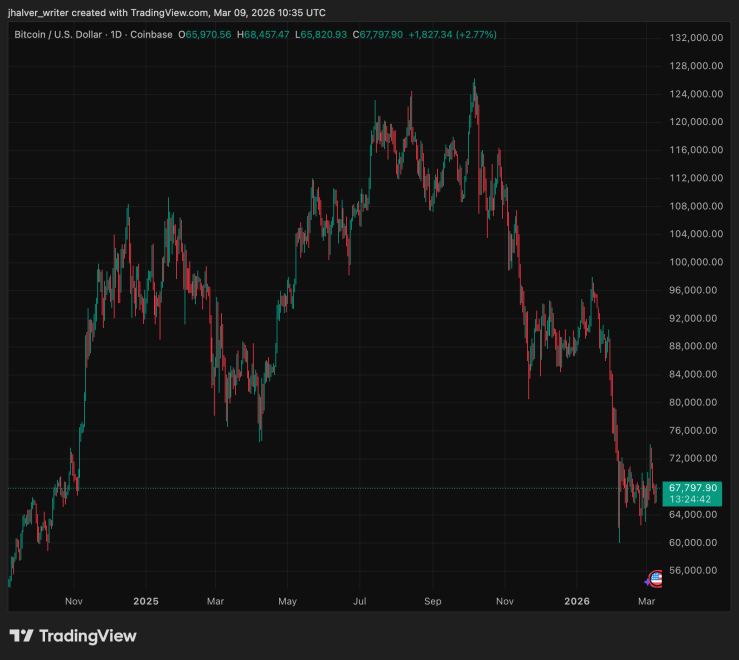
BTC's price trends to the downside on the daily chart. Source: BTCUSD on Tradingview

Cover image from ChatGPT, BTCUSD chart from Tradingview

İlgili Sorular

QWhat is the main purpose of the GENIUS Act report submitted by the U.S. Treasury Department?

AThe GENIUS Act report outlines 'innovative tools' to fight crypto-enabled illicit finance, endorsing lawful uses of crypto mixers for privacy while proposing a new 'hold law' to freeze suspicious funds.

QHow does the report view the use of crypto mixers by lawful users?

AThe report recognizes that mixers and other privacy-enhancing technologies can serve legitimate purposes for lawful users seeking financial privacy, such as protecting sensitive information about personal wealth or business transactions, when used in compliance with AML/CFT requirements.

QWhat specific legislative measure does the Treasury Department recommend to address suspicious crypto transactions?

AThe Treasury Department recommends that Congress establish a digital-asset-specific statutory 'hold' authority, allowing platforms to temporarily retain or delay the movement of digital assets associated with suspected illicit activity while legal process is pursued.

QAccording to the report, how do malicious actors like North Korea's cyber units utilize crypto mixers?

ANorth Korea's cyber units and ransomware crews use mixers, cross-chain bridges, and rapid swaps as core infrastructure to launder massive amounts of stolen digital assets, often pushing funds through mixers into stablecoins before cashing out.

QWhat broader framework is this report a part of, and what additional tools does it propose for regulated platforms?

AThe report is part of the GENIUS Act framework, which aims to create a federal regime for payment stablecoins and combat illicit finance. It proposes a tech stack including AI, digital identity, blockchain analytics, and APIs for regulated platforms under a risk-based AML approach.

İlgili Okumalar

In Jinjiang, Fujian, a Storage Super Unicorn Lies Quiet

In Fujian's Jinjiang, a city known for sportswear, lies a quiet semiconductor giant: Fujian Jinhua Integrated Circuit Co. (JHICC). Once a promising domestic DRAM manufacturer alongside Yangtze Memory and ChangXin Memory Technologies (CXMT), its journey was derailed in 2018 when the U.S. placed it on an Entity List and filed criminal charges for alleged trade secret theft. This halted production for years. A turning point came in February 2024 when a U.S. federal court found JHICC not guilty. However, it had lost crucial time. While CXMT soared to become a top-valued A-share company in 2024, JHICC, with an estimated valuation of 80 billion RMB, was just restarting. Its current output is primarily customized DDR4 chips, not the advanced DDR5/HBM demanded for AI, but it still benefits from the broader memory chip upcycle. JHICC's story is tied to Chen Zhengkun, a veteran engineer who left Micron to lead the venture. Founded in 2016 with state-backed funding, JHICC partnered with Taiwan's UMC to develop DRAM technology. Rapid progress was cut short by the U.S. actions, which Micron initiated, partly due to its heavy reliance on the Chinese market. Post-sanctions, Chen's team worked to rebuild the production line with reduced reliance on U.S. technology. According to its records, JHICC achieved small-scale production and revenue growth under immense pressure. It now focuses on the stable "niche" DRAM market (e.g., TVs, routers) with a monthly capacity of ~40,000 wafers, aiming for 60,000 by 2026. It holds over 1,000 patents but remains on the Entity List. For Jinjiang, investing in JHICC was a bold industrial leap. The local government provided unwavering financial and logistical support during the crisis, helping the company survive. JHICC has become the anchor for a growing local semiconductor cluster. Though its scale lags behind domestic peers, JHICC's persistence symbolizes a hard-won foothold in a global market long dominated by Samsung, SK Hynix, and Micron. Having missed one boom, it seeks a place in the new AI-driven memory supercycle.

marsbit1 saat önce

In Jinjiang, Fujian, a Storage Super Unicorn Lies Quiet

marsbit1 saat önce

İşlemler

Spot
活动图片





