Transformer's Ancestral Design Under Fire: Three Papers at COLM Conference Strike a Blow

marsbit2026-08-17 tarihinde yayınlandı2026-08-17 tarihinde güncellendi

Özet

This article discusses three studies presented at COLM 2026 that challenge fundamental, widely-adopted design choices in Transformer-based language models. The first paper, "Cracks in the Foundation," investigates standard components like QK normalization, GQA, and sliding window attention. Using a controlled set of 26 models (OlmPool), it finds that combinations of these "default" choices can severely degrade long-context performance by up to 47% on the HELMET benchmark. Notably, QK normalization, intended to stabilize training, was found to hurt performance in certain models, and "attention head concentration" (focus on initial tokens) correlated positively with better long-context capabilities. The second paper, "Lost in Backpropagation," analyzes the output projection layer. It reveals a major "gradient bottleneck": because the vocabulary size is much larger than the hidden state dimension, 95-99% of the gradient signal is lost during backpropagation, and the remaining signal is poorly aligned with the true gradient direction, potentially hindering training efficiency. The third paper, "When Fewer Layers Break More Chains," examines layer pruning. While pruning has minimal impact on standard knowledge benchmarks, it catastrophically damages models' ability for complex, multi-step reasoning (test-time scaling). Pruned models fail to improve with more thinking tokens or sampling passes. Fine-tuning struggles to recover this lost reasoning capability. Collectively, these...

Many key techniques in Transformer architecture collectively crumbled at a conference?!

At COLM 2026, multiple papers simultaneously targeted the same issue—

Those unquestioned design choices in Transformers that nobody doubts anymore, actually don't hold up.

Transformer is almost the default architecture for all mainstream models, and its settings are largely regarded as sacred, with few looking back to verify.

As a result, these papers recalculated the costs of these default choices from different angles.

And the conclusions reached by different researchers were strikingly consistent: every standard design choice in Transformer has paid a real cost in some dimension not measured by existing evaluation systems.

Cracks in Long Context

The first paper, titled 'Cracks in the Foundation', from institutions including Ai2, targeted the architectural choices often treated as 'standard'—QK normalization, GQA, sliding window attention, and pretraining context length.

The researchers selected the values used in real models like Llama 2, Llama 3, Qwen 3, and Olmo 3, created permutations and combinations, and trained 26 models for comparison.

These models had parameters ranging from 7B to 8B, with data, tokenizer, and context extension schemes kept identical—only the architecture differed.

The team called these models 'OlmPool', pretrained them all on 140B tokens, then performed long-context finetuning with an additional 10B tokens, burning over 170,000 GPU hours in total.

The result: on the HELMET 32K evaluation, the 26 models scored a high of 56.4 and a low of 29.9—a difference of 26.5 points, translating to a relative gap of 47%.

With the same data and largely similar architecture, just flipping four different switches could cause such a wide score gap.
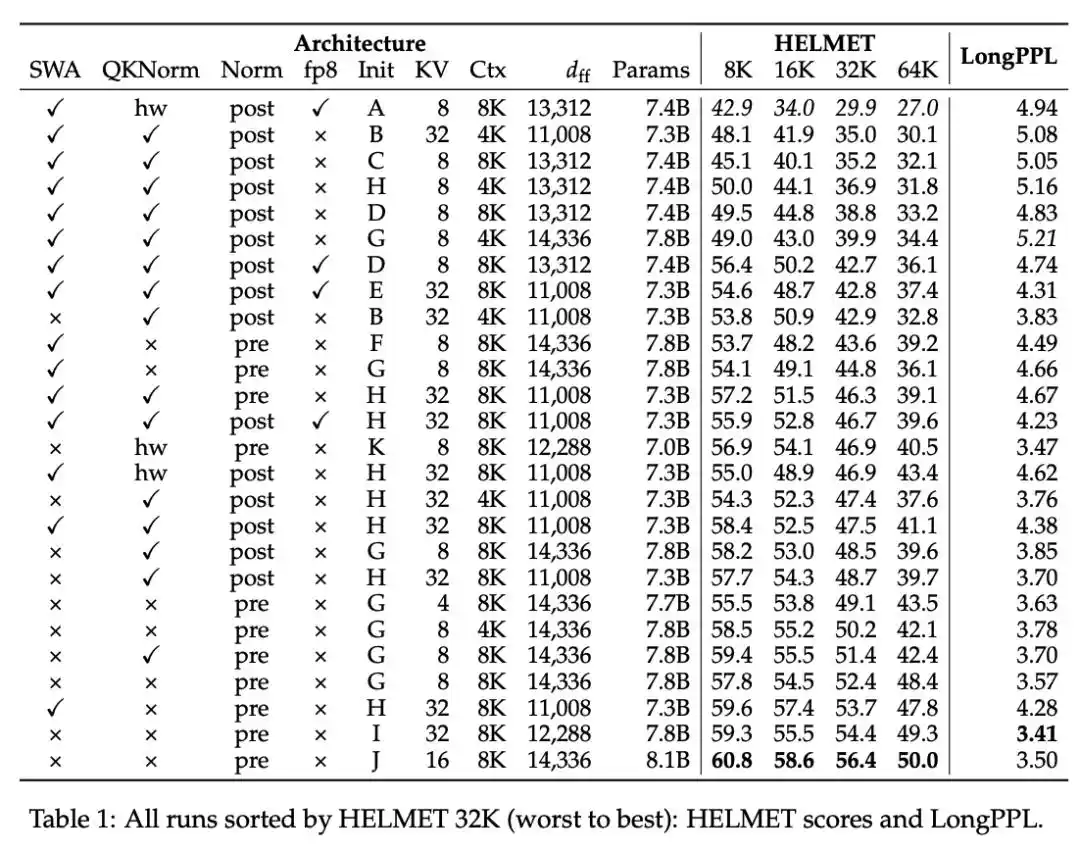
Flipping a single switch had little impact. Using a context length of 4096 vs 8192 during pretraining, or adding sliding window attention, only dropped the score by one or two points on average.

The real trouble came when several choices were combined. Once SWA and GQA were placed in the same model, the average score dropped by 9 points—far more than the sum of their individual effects.

The worst combination identified by the team was using GQA, sliding window attention, and per-head QK normalization together, with a drop in performance also significantly greater than the sum of individual effects.

They later found that simply counting how many 'harmful design' items a model had could accurately predict its long-context performance, even more reliably than analyzing the architecture item by item.

QK normalization was the most counterintuitive. It was originally added to models for training stability and is largely considered a good thing in the industry.

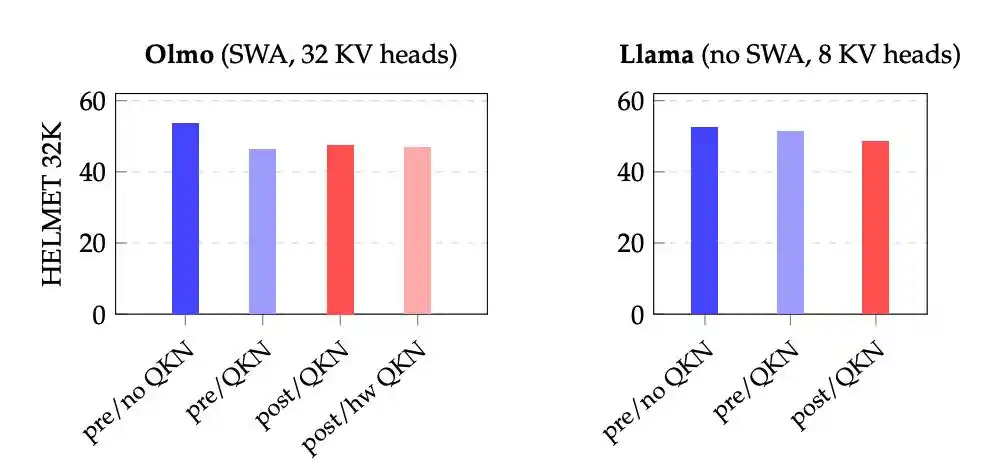
But the paper found that removing Olmo 3's original QK normalization and post-norm, and replacing them with pre-norm, actually increased the HELMET score by 6 points.

Applying the same change to Llama 3, however, had the opposite effect, dropping the score by 3.8 points.

The same 'standard' choice can yield completely opposite results when applied to a different base model.
This section also revealed a phenomenon contrary to many people's intuition—'attention concentration', referring to the model allocating a large portion of its attention to the first few tokens of the context.

This phenomenon has long been considered a bad habit that wastes compute, and many new methods specifically aim to eliminate it. However, in the OlmPool models, the more pronounced the attention concentration phenomenon, the better the long-context performance.

QK normalization happens to weaken this concentration, which might be the reason it hampers long-context ability.

Lost Gradients

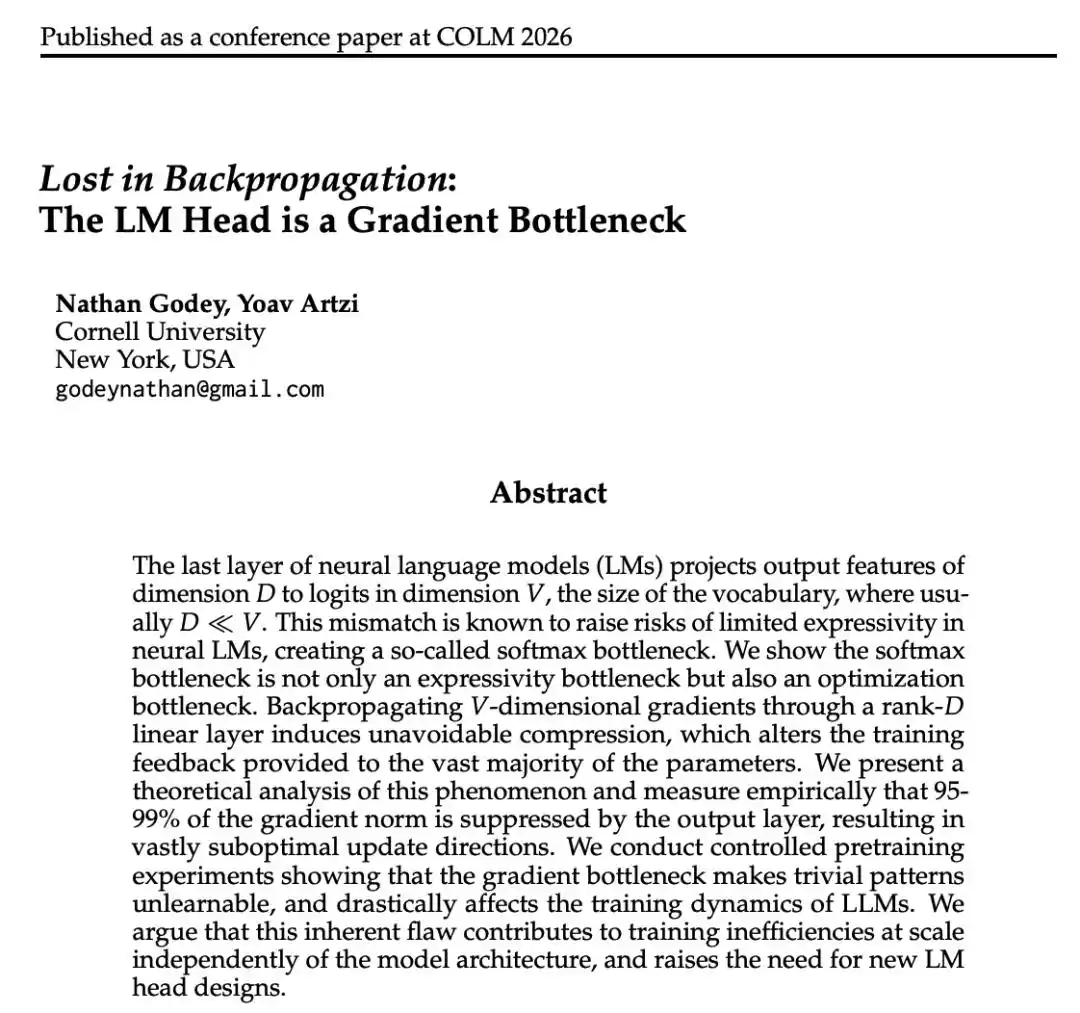
The second paper, titled 'Lost in Backpropagation', from Cornell University, targeted the last layer used by almost all language models—the output projection layer.
At each processing step, a language model calculates a series of numbers representing its understanding of the current context; this series is called the hidden state D.

To predict the next word, the model must convert the hidden state into scores for each candidate word in the vocabulary, outputting as many scores as there are words in the vocabulary.

These scores are called logits; the higher the score, the more likely the model considers that word to be the next one.

The component performing this conversion is the output layer, essentially a matrix operation.

The size of the vocabulary is typically much larger than the length of the hidden state—one is tens of thousands, the other may only be a few thousand.

This size disparity was previously only viewed as one problem, called the 'softmax bottleneck', meaning a vocabulary too large compared to the hidden state limits the variety of next-word distributions the model can express.

This paper argues that the same disparity has another effect.

During backpropagation, the error signal must pass through the output layer to guide the model's parameter adjustments; this stage is also affected by the disparity.
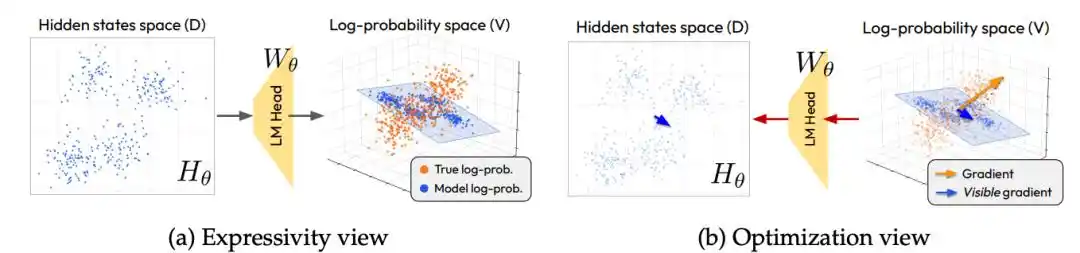
Theoretically, the error signal contains as much information as the vocabulary before it is passed back.

However, the amount of information the output layer can transmit back is limited by its own structure, with an upper bound roughly the size of the hidden state, which is much smaller than the vocabulary.

The paper measured this information loss step on already-trained models like GPT-2, Pythia, Llama 3, OLMo 2, and Qwen 3, by projecting the error signal into the null space of the output layer weights and observing what remained.

The result: on models like GPT-2, Pythia, Llama 3, OLMo 2, and Qwen 3, 95% to 99% of the gradient norm was clipped at this step.

The remaining signal had a cosine similarity with the original gradient of only 0.1 to 0.2.
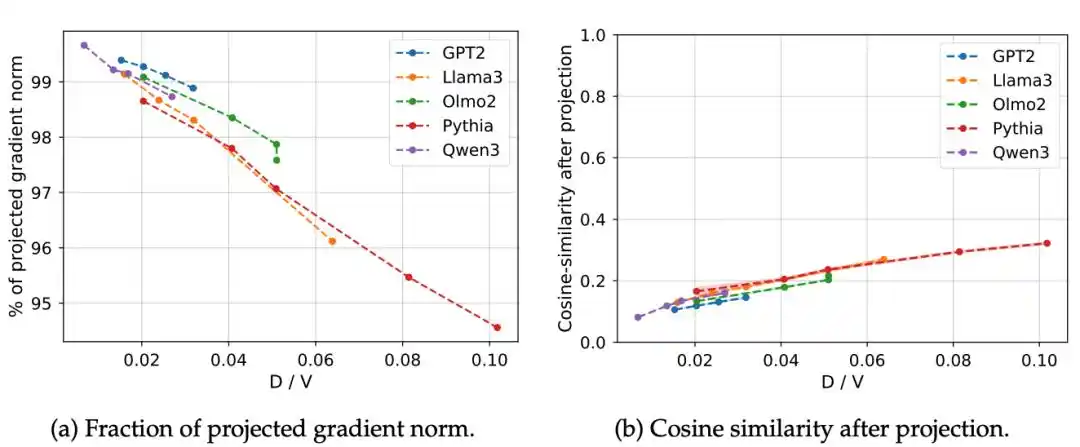
Over 90% of the signal meant to be passed back was 'eaten' at this step, and the remaining bit pointed in a direction misaligned with the intended one.

This output layer is a necessary passage almost every language model must traverse, never viewed as something needing scrutiny. Yet, during every backpropagation, it quietly erases most of the training signal that should have been transmitted back.

Cutting a Layer Breaks the Reasoning Chain

Another paper, titled 'When Fewer Layers Break More Chains', from the University of Tübingen, discusses a widely used model compression technique—layer pruning, which involves directly deleting certain layers from the Transformer to save compute by reducing model depth.

Layer pruning is viable because prior research found that some layers contribute little to overall performance; deleting them results in minimal score drops on conventional knowledge-based evaluations.

Pruning a quarter of the layers can retain over 80% of the original accuracy. Results like these have made layer pruning a generally accepted efficiency method.

But these evaluations test knowledge-based tasks with short answers, which can be answered correctly based on what the model has memorized.

This paper tests another capability—long-chain reasoning. The method used is 'test-time scaling', essentially letting the model think longer—giving it more tokens for reasoning, or having it generate answers multiple times and pick the correct one. Normally, the longer it thinks or the more attempts it makes, the higher the accuracy should be.
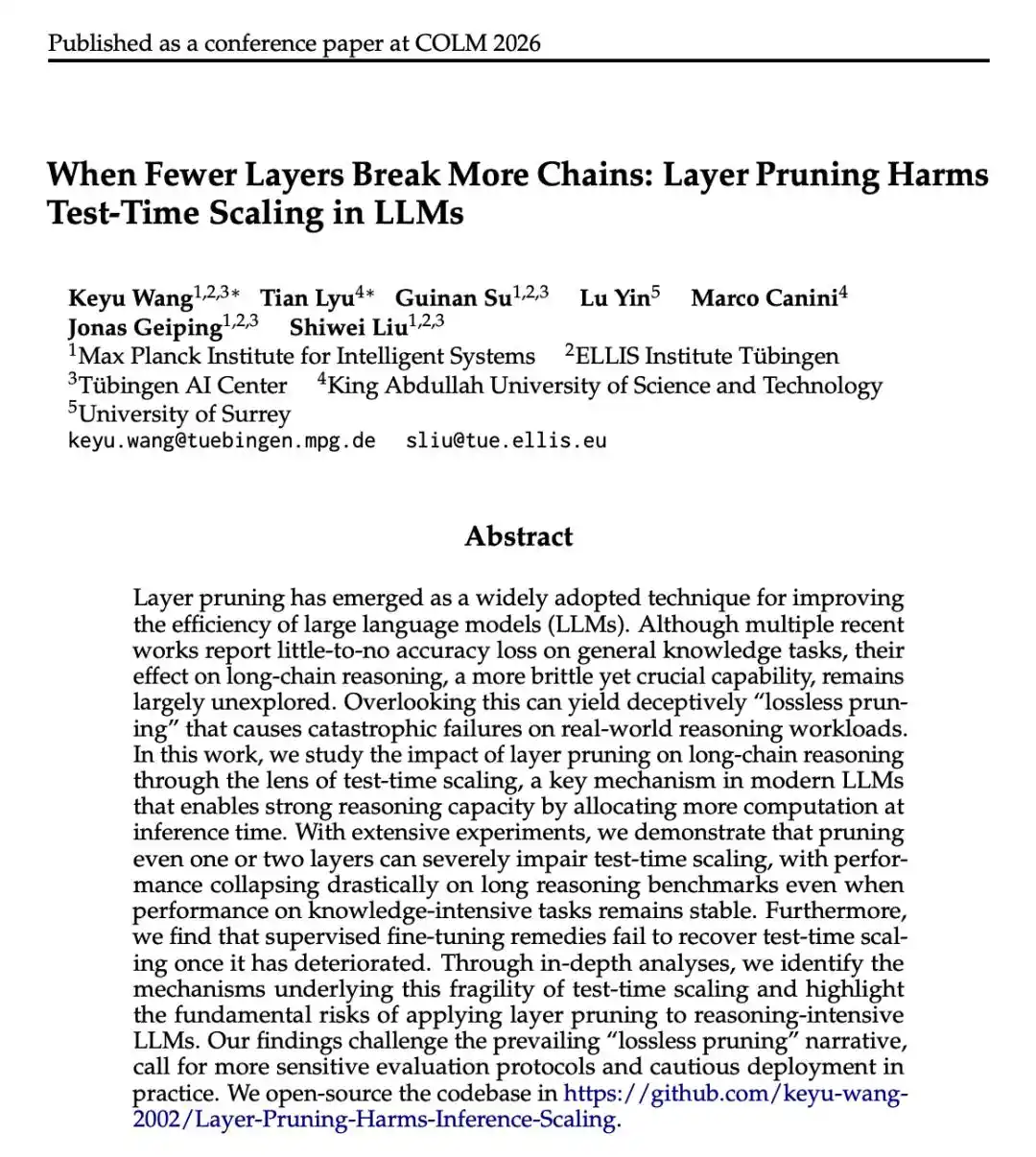
The paper selected two models inherently capable of this, s1.1-7B and Qwen3-8B, pruned one or two layers using three mainstream layer pruning methods, and observed whether these scaling methods still worked.

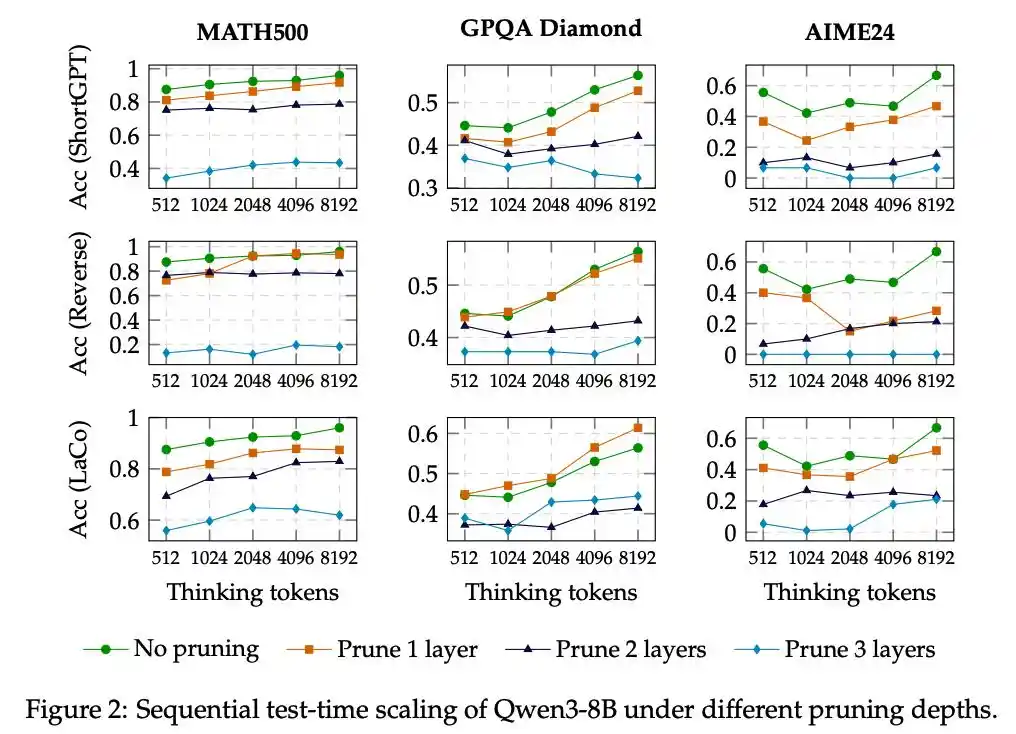
On knowledge-based evaluations, scores indeed dropped gradually. But on AIME24, with math competition difficulty, for s1.1-7B, pruning just one layer caused a significant drop in accuracy; pruning two layers dropped it close to zero.

Giving the model more thinking tokens should help it reason better. Instead, the pruned models showed no improvement with longer thinking time; test-time scaling essentially failed.
The authors then tested if finetuning could recover performance, using both LoRA finetuning and full-parameter finetuning on the pruned models.

For models pruned by one layer, finetuning had almost no effect. For models pruned by two layers, finetuning recovered some scores but remained far from pre-pruning levels.

In short, this paper aims to warn that layer pruning is not as safe as it appears.

The three papers study completely different subjects: one looks at long context, one at training gradients, and one at reasoning chains.

But viewed together, a common pattern emerges—all three papers focus on conventional designs already widely adopted by mainstream models, with few looking back to question them.

Now, these 'conventional' practices are also being re-examined.

This article is from the WeChat public account 'QbitAI', author: Follow Frontier Technology

İlgili Sorular

QWhat major finding did the paper 'Cracks in the Foundation' present regarding Transformer architecture choices?

AThe paper found that common Transformer design defaults like QK normalization, GQA, sliding window attention, and pretraining context length, when combined, significantly harm long-context performance. The worst combination (GQA + SWA + per-head QK normalization) caused performance drops greater than the sum of individual effects.

QAccording to the paper 'Lost in Backpropagation', what is a significant but overlooked problem with the standard output projection layer in language models?

AThe paper identifies that the output layer, due to the large size difference between the vocabulary and the hidden state dimension, causes severe gradient information loss during backpropagation. In models like GPT-2 and Llama 3, 95% to 99% of the gradient's magnitude is discarded, and the remaining signal's direction is poorly aligned with the true gradient.

QWhat key weakness of layer pruning for model compression was highlighted in the paper 'When Fewer Layers Break More Chains'?

AThe paper reveals that while layer pruning minimally impacts performance on knowledge-based tasks, it severely damages a model's ability for long-chain reasoning and 'test-time compute' scaling. On complex tasks like AIME24, pruning even one layer caused a dramatic accuracy drop, and the benefit of giving the model more thinking tokens was essentially nullified.

QWhat counterintuitive correlation did the 'Cracks in the Foundation' study find related to 'attention concentration'?

AThe study found that models with more pronounced 'attention concentration'—where a large portion of attention is focused on the initial tokens of the context—actually performed better on long-context tasks. This challenges the common view that this phenomenon is a computational flaw. QK normalization, which weakens this concentration, was linked to worse long-context performance.

QWhat common theme connects the three papers discussed in the article regarding their targets of investigation?

AAll three papers target and critically re-examine foundational, widely-adopted, and rarely-questioned 'default' design choices in modern Transformer-based language models (e.g., specific normalization schemes, the output layer structure, and layer pruning). They collectively show these standard components can have significant hidden costs in areas like long-context understanding, training efficiency, and complex reasoning capability.

İlgili Okumalar

Report on the State of the Crypto Industry by 2026, Featuring Sumsub Vice President for North America, Danielle LaBarbera

The cryptocurrency industry is entering an era of regulated maturity, driven by frameworks like the CLARITY Act and the $GENIUS Act in the US. These provide clearer rules but also raise operational standards, requiring platforms to effectively demonstrate compliance. Simultaneously, fraud is evolving into sophisticated, AI-powered, lifecycle-based attacks, moving beyond simple onboarding scams. According to Daniel LaBarbera, VP of Sumsub for North America, companies must shift from one-time KYC checks to continuous, risk-based verification. This involves integrating identity, behavioral, device, and transaction data into a unified risk view. The 2026 State of Crypto Industry report highlights that while 55% of crypto firms faced fraud last year, effective strategies now combine AI-driven detection, continuous monitoring, and behavioral analytics. Key compliance challenges persist, particularly with the Travel Rule. Only 23% of companies are fully compliant, with high implementation costs, data security concerns, and regulatory fragmentation being major hurdles. Meanwhile, stablecoins are gaining traction, accounting for 36% of all crypto transactions in 2025, and evolving from trading tools into financial infrastructure for payments and settlements. The path forward lies in risk-based approaches that balance security, speed, and user experience. This includes adopting documentless verification, reusable KYC, and breaking down silos between compliance functions to create a holistic, lifecycle view of customer risk and trust.

cryptonews.ru11 dk önce

Report on the State of the Crypto Industry by 2026, Featuring Sumsub Vice President for North America, Danielle LaBarbera

cryptonews.ru11 dk önce

U.S. National Debt Approaches $40 Trillion in 5 Months, Bitcoin Debate Gains Momentum

The US national debt has surged to nearly $40 trillion in just five months, the fastest trillion-dollar increase on record. The debt's growth has accelerated dramatically over time, from taking 192 years to reach the first $1 trillion in 1981 to adding the latest $1 trillion in only five months. The federal budget deficit for the fiscal year is already over $1.8 trillion, exceeding last year's total, and net interest payments on the debt have surpassed $1 trillion, now exceeding defense or Medicare spending. This rapid debt accumulation is fueling arguments within the cryptocurrency industry that Bitcoin serves as a hedge against government-backed currencies and fiscal irresponsibility. Proponents, including some lawmakers and industry leaders, argue Bitcoin could act as a "hard currency" fiscal control mechanism. Legislation has even been proposed for the Treasury to acquire Bitcoin to help reduce the national debt. The International Monetary Fund has warned that global public debt could hit 100% of world GDP by 2029 if current trends continue, with the US and China as primary drivers. Some analyses suggest a sovereign debt crisis could drive capital into alternative assets like Bitcoin, similar to past regional banking crises. However, skeptics point out that both Bitcoin and gold have fallen in price at times during 2026 despite record debt, indicating the depreciation hedge theory may operate over a much longer timeframe than short-term price action.

cryptonews.ru21 dk önce

U.S. National Debt Approaches $40 Trillion in 5 Months, Bitcoin Debate Gains Momentum

cryptonews.ru21 dk önce

Technological Self-Reliance in China: A War from Lithography Machines to ABF Films

"China's Tech Independence: A Battle from Lithography Machines to ABF Film" In August 2026, Japan's Ajinomoto announced a 30% supply cut of ABF film to Chinese mainland clients, causing industry-wide shock and fears of price hikes and shortages in the semiconductor supply chain. That same year, Chinese company Lotus Holdings, known for its MSG business, acquired a small domestic ABF film startup for 103 million yuan, aiming to change this passive situation. ABF film is a core insulating material for advanced CPU, GPU, and AI chip packages. Ajinomoto, originally a food flavoring company, has monopolized over 95% of the global ABF film market for nearly 30 years, deriving its technology from byproducts of monosodium glutamate production. With AI chips consuming 5-10 times more ABF film than traditional chips, the supply-demand gap is widening. Ajinomoto's supply cut to China, where domestic ABF film production accounts for less than 5%, directly threatens the production of domestic high-end AI chips and their substrates. This incident highlights a crucial but often overlooked truth: the vulnerabilities in China's quest for technological self-reliance extend beyond headline areas like lithography machines to critical but seemingly minor components—insulating films, photoresists, electronic specialty gases, etc. The article frames China's tech independence as a multi-front war. While major breakthroughs have been achieved in chip design (e.g., Huawei's HiSilicon), foundry (e.g., SMIC), and memory chips (e.g., YMTC), countless smaller "Ajinomoto-style" chokepoints remain. Lotus Holdings' acquisition represents a significant shift: the battle is no longer fought only by tech giants but has become a collective, industry-wide effort involving companies from diverse backgrounds. Historically, external blockades have often spurred China's technological breakthroughs, as seen with Huawei's Kirin chips and YMTC's 3D NAND flash memory. Ajinomoto's supply cut, while a short-term challenge, may similarly catalyze domestic innovation in ABF film and other critical materials. The path to technological sovereignty is long and arduous, requiring sustained patience and investment to fill every gap in the complex supply chain. Lotus's move is not an immediate solution but a step towards that future, symbolizing a broader, relentless march toward independence.

marsbit40 dk önce

Technological Self-Reliance in China: A War from Lithography Machines to ABF Films

marsbit40 dk önce

İşlemler

Spot
活动图片