Trading Volume of Crypto Company Preferred Shares Soars to $13 Billion, with Strategy and Alphabet Leading the Breakout of a 'New Financing Tool'

marsbit2026-07-15 tarihinde yayınlandı2026-07-15 tarihinde güncellendi

Özet

In June 2026, trading activity in crypto company preferred shares surged dramatically, with monthly volume reaching approximately $13 billion when standardized to par value. This acceleration, primarily driven by STRK and a growing number of new preferred share listings, has transformed a niche, custom financing tool once dominated by financial institutions into a broader, more liquid, and increasingly evergreen asset class. Key indicators point to the market's maturation, with improved efficiency in pricing, secondary market depth, and persistent investor demand. Notably, this evolution is extending beyond crypto. In the same month, Alphabet launched its first convertible preferred share offering as part of a funding round exceeding $80 billion for AI infrastructure. Similarly, Super Micro Computer announced a $3.75 billion convertible preferred share issuance within a $7 billion capital raise for AI expansion, highlighting the growing role of preferred shares as a scalable financing tool across industries.

Author: Jeff Park

Compiled by: Shenchao TechFlow

Shenchao Introduction: Preferred shares were once exclusive financing tools for banks and insurance companies. Today, crypto companies like Strategy have transformed them into a highly liquid and sustainably tradable asset class. More critically, this path has evolved from crypto to traditional tech—Alphabet and Super Micro Computer are using it to finance AI infrastructure, with individual deal sizes reaching $80 billion. This is no longer a niche game.

In 2026, trading activity for crypto company preferred shares accelerated sharply, with monthly trading volume standardized at par value reaching approximately $13 billion in June. This surge was primarily driven by STRC and the increasing number of new preferred share listings, transforming a once-customized financing niche dominated by financial institutions (banks and insurance companies) into a broader, more liquid, and increasingly evergreen asset class.

Beyond higher trading volume, a key signal is the maturity of the preferred share market itself. As liquidity deepens, these instruments have become more efficient not only in terms of coupon rates and issuer quality but also in secondary market depth, relative value, and the persistence of investor demand. This evolution is beginning to extend beyond crypto: in June, Alphabet launched its inaugural convertible preferred share issuance as part of an equity financing exceeding $80 billion to fund AI infrastructure; meanwhile, Super Micro Computer announced the issuance of $3.75 billion in convertible preferred shares within a $7 billion capital raise for AI expansion, highlighting the increasingly vital role of preferred shares as a scalable financing tool across industries.
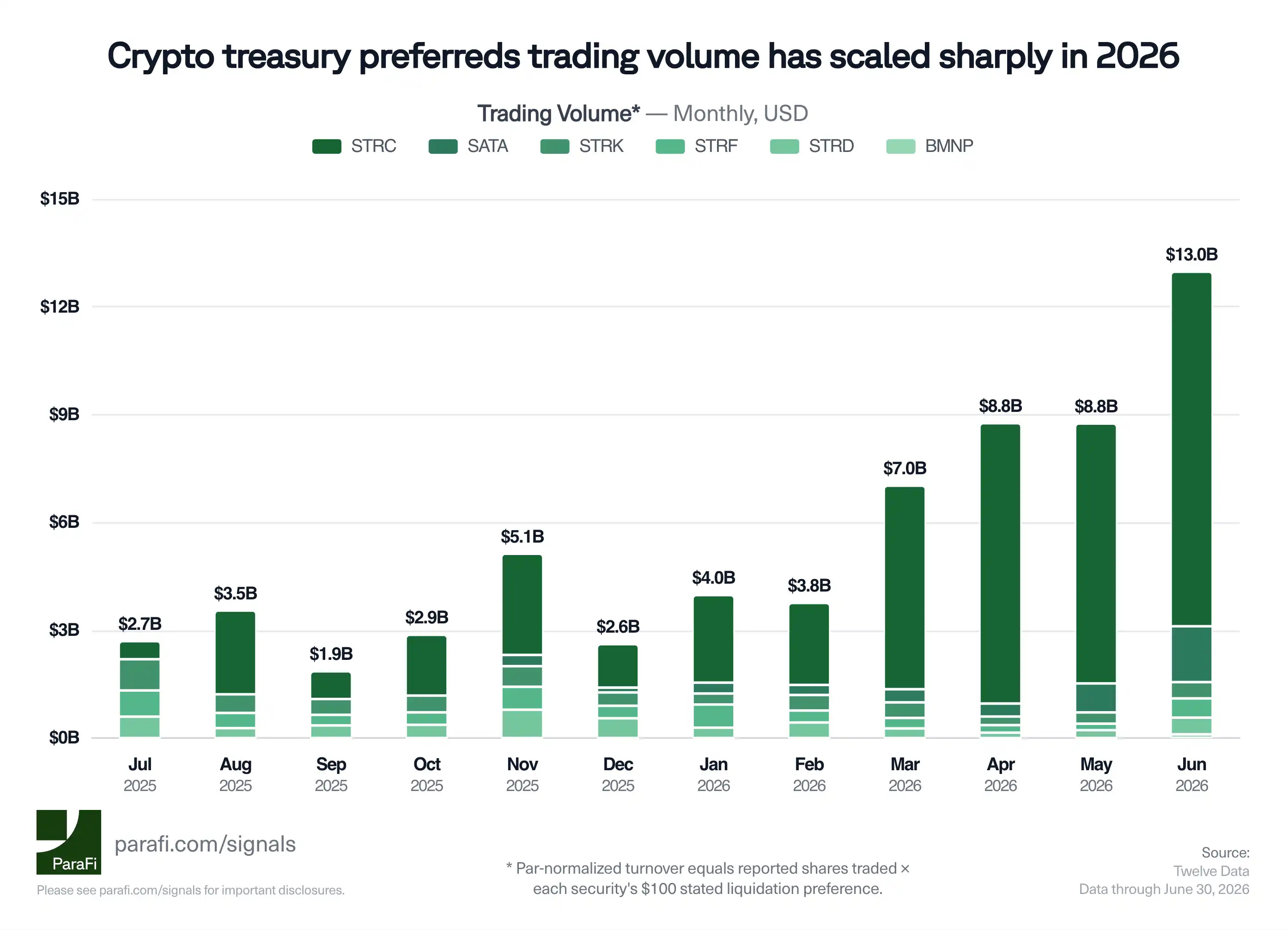
Note: The selected scope includes trading volume for STRK, STRF, STRD, STRC, SATA, and BMNP standardized on a par value basis. Par-value standardized turnover is calculated as reported traded share count multiplied by the $100 per share stated liquidation preference for each security. It does not represent actual dollar trading volume and, viewed alone, cannot establish market liquidity. Source: Twelve Data. Data as of June 30, 2026.

Important Disclosure: ParaFi Signals are for informational purposes only and should not be considered or construed as financial, legal, tax, or investment advice. The information above should not be regarded as a recommendation to buy or sell any particular security.

İlgili Sorular

QAccording to the article, what was the approximate monthly trading volume of crypto enterprise preferred shares (normalized by par value) in June 2026?

AAccording to the article, the monthly trading volume of crypto enterprise preferred shares normalized by par value reached approximately $13 billion in June 2026.

QWhich two companies are highlighted in the article as using preferred shares for AI infrastructure funding?

AThe article highlights Alphabet and Super Micro Computer (SMCI) as using preferred shares for AI infrastructure funding.

QWhat is the primary historical user group of preferred shares as mentioned in the article?

AThe article states that preferred shares were historically a customized financing niche dominated by financial institutions, specifically banks and insurance companies.

QBesides higher trading volume, what key signal indicates the maturity of the preferred share market as described in the article?

AThe key signal of the market's maturity is that these instruments are becoming more efficient not only in terms of coupon rates and issuer quality, but also in secondary market depth, relative value, and the durability of investor demand.

QWhat should the 'Par Value Normalized Turnover' metric mentioned in the note NOT be interpreted as on its own?

AThe 'Par Value Normalized Turnover' metric alone should not be interpreted as establishing market liquidity, as it represents reported traded share numbers multiplied by a $100 liquidation preference per security and does not represent actual dollar trading volume.

İlgili Okumalar

Hyperliquid Pre-IPO Contract Priced CXMT at $7.2, Foreign Capital Engaging with China's Storage Narrative via DeFi

Hyperliquid, a blockchain-based perpetual contracts platform, has launched a pre-IPO contract for Chinese memory chipmaker Changxin Technology (CXMT) ahead of its STAR Market debut. Priced at 7.2 USDC (approx. $7.2) per share, the contract implies a market cap of about $500 billion, exceeding the official IPO valuation of roughly $80 billion and sitting at the upper end of analyst estimates. This marks the first time such a crypto derivative has targeted a STAR Market listing. It provides global investors, particularly those unable to meet China's 500,000 yuan ($69,000) investment threshold for the STAR Market, a direct avenue to gain exposure to the "China storage substitution" narrative. The 24/7 tradable, leveraged contract also fills a gap for those seeking to hedge or speculate around the A-share listing, which operates under T+1 settlement and restricts short-selling. Changxin Technology, the world's fourth-largest DRAM supplier, is raising nearly $8 billion in one of Asia's largest IPOs this year, buoyed by a DRAM super-cycle and strategic shifts by major competitors. While the Hyperliquid contract offers a novel parallel pricing mechanism, the lack of direct arbitrage with the underlying A-shares may lead to persistent price divergence. Nevertheless, its emergence underscores significant international interest in China's key semiconductor players.

marsbit16 dk önce

Hyperliquid Pre-IPO Contract Priced CXMT at $7.2, Foreign Capital Engaging with China's Storage Narrative via DeFi

marsbit16 dk önce

The 'Great Divergence' of the Crypto Market in 2026: BTC Bear Market, but BlackRock, Franklin Templeton, and JPMorgan Are Simultaneously Doing One Thing

"2026 Crypto Market 'Great Divergence': BTC Bearish, But BlackRock, Franklin, JPMorgan Are Simultaneously Building Infrastructure." In July 2026, amidst BTC struggling at $62K, seven key events signal a profound shift: the 'Great Divergence' between price action and underlying infrastructure development. Franklin Templeton's CIO notes a "big disconnect" between price and fundamentals. Meanwhile, major institutions are advancing real-world blockchain adoption: BlackRock, Goldman Sachs, and JPMorgan join a UK government-backed tokenization taskforce targeting repo and gilts; Hyundai pilotes USDT for cross-border trade settlement; Bolivia considers integrating USDT into its national payment system; and Robinhood's new blockchain sees rapid adoption. This activity represents a quiet infrastructure bull market, driven by institutional strategy and long-term regulatory roadmaps, not short-term crypto price cycles. The core narrative is shifting from speculative price action to foundational utility. Infrastructure development—focused on upgrading traditional finance, enabling real-world payments, and tokenizing assets—is now decoupled from BTC's volatility. Historical parallels (e.g., dot-com bust/AWS birth, 2018 crypto winter/DeFi Summer) show that infrastructure built during downturns often becomes the next cycle's "toll booth." The critical question is no longer "Will BTC drop further?" but "Who will own the tolls when this new infrastructure is complete?" While BTC remains a key liquidity anchor, the valuation logic for crypto's real-world utility is increasingly separate from its most traded asset's price.

marsbit34 dk önce

The 'Great Divergence' of the Crypto Market in 2026: BTC Bear Market, but BlackRock, Franklin Templeton, and JPMorgan Are Simultaneously Doing One Thing

marsbit34 dk önce

Scaling Law a One-Size-Fits-All Solution? First Crystal Structure Manipulation Benchmark Shows Top Large Models Falling Short

Scaling Law Hits a Wall: New Benchmark Reveals AI's Struggles with Atomic-Level Material Manipulation A new benchmark called AtomWorld, developed by researchers, reveals a significant limitation in current large language models (LLMs). While powerful at understanding textual scientific knowledge, they perform poorly when tasked with physically manipulating atomic structures based on natural language instructions. The benchmark tests core atomic operations like replacing atoms, rotating structures, and expanding supercells. Results show that simply scaling up model size (Scaling Law) yields only modest and unstable improvements, particularly for tasks requiring strong 3D spatial reasoning and geometric planning. For instance, complex tasks like "rotating around a specific atom" see very low success rates even in top models like Claude Opus. This highlights a critical gap: textual knowledge does not automatically translate to reliable action in a physically constrained 3D space. The study argues that for AI in Science to progress, the focus must shift from just scaling language data (Language Scaling) to also scaling actionable capabilities (Action Scaling). This involves building training loops around "action-feedback-correction" cycles within simulated or real scientific environments. Ultimately, AtomWorld underscores that to become true lab assistants, AI models need to evolve beyond explaining knowledge to reliably executing precise, verifiable scientific actions.

marsbit46 dk önce

Scaling Law a One-Size-Fits-All Solution? First Crystal Structure Manipulation Benchmark Shows Top Large Models Falling Short

marsbit46 dk önce

İşlemler

Spot
活动图片