Author: Zen, PANews
As the South Korean stock market cools, the competition for new coin listings between the two major crypto exchanges, Upbit and Bithumb, is heating up.
Over the past month, the pace of new coin listings on Upbit and Bithumb has noticeably accelerated, with each exchange adding 17 new Korean Won trading pairs. This is significantly higher than the regular pace of 6 to 10 new listings per month observed in the first half of the year. Against the backdrop of overall subdued trading volumes, a listing war to capture existing funds and retail investor attention has reignited.
The Best Summer for Korean Stocks, Crypto Trading Suffers a Major Cool-Down
In the first half of the year, the South Korean stock and cryptocurrency markets charted two completely opposite curves.
According to data from the Korea Exchange (KRX), the average daily trading volume for the KOSPI in January was 27.06 trillion Won, rising to 32.23 trillion Won in February, setting a record high at the time. Entering May, the market went wild, with the KOSPI's average daily trading volume reaching 50.22 trillion Won. It remained at a high level of 50.35 trillion Won in June, nearly doubling from the beginning of the year.
This trading frenzy was largely concentrated in major semiconductor companies like Samsung Electronics and SK Hynix, collectively creating a pronounced uptrend and wealth effect. Against the backdrop of the KOSPI's rapid rise, retail funds flowed into the stock market. Consequently, the already lackluster South Korean domestic crypto trading scene further shrank, continuing to cool during "Korea's most beautiful summer."
According to CoinGecko data, the total trading volume of the five major Korean Won exchanges—Upbit, Bithumb, Coinone, Korbit, and Gopax—in the second quarter of this year was approximately $146.43 billion, a 49.5% decrease from the same period in 2025 ($289.69 billion). Among them, Upbit's trading volume fell 54% year-over-year, while Bithumb's dropped 41.7%.
For South Korean investors in the first half of this year, the market with the most current heat and momentum was clearly stocks, not cryptocurrencies. For exchanges, even listing a few more altcoins or launching several campaigns during this phase couldn't compete with the stock market generating a strong wealth effect.
During this period, Upbit and Bithumb's listing pace remained normal or even slowed, generally maintaining 6~10 new listings per month. In the second quarter, when the Korean stock market was most frenzied, Bithumb seemed to be avoiding the stock market's momentum, adding only 22 new tokens, significantly lower than the 33 added in the same period of 2025.
The "Turning Point" Has Arrived, Two Major Exchanges Launch a Listing War
Entering the third quarter, things began to change.
After the peak in May and June, the KOSPI's average daily trading volume fell to 36.88 trillion Won in July, a decrease of about 26.8% month-over-month. By August, as of statistics from August 9th by the Korea Exchange, the average daily trading volume further declined to 26.28 trillion Won, already lower than the level at the beginning of the year.
Furthermore, data from the Korea Exchange shows that the proportion of individual investors in KOSPI trading volume decreased from 48.19% in January to 31.23% in July. The investor deposit balance, considered "standby funds" for the securities market, also dropped from a high of 139.69 trillion Won on June 4th to 104.14 trillion Won by the end of July, a decrease of approximately 25.5% over two months.
From wealth surges to "those who didn't buy stocks are the real winners," after the frenzy of the first half, both the retail trading share in the stock market and the off-market standby funds began to cool from their highs.
It was precisely during this period that Upbit and Bithumb's listing pace began to accelerate noticeably.
From early July to August 11th, Upbit added a total of 17 new Korean Won trading pairs in just over a month, along with 8 new coins only open for BTC and USDT trading. Compared to the roughly 6 to 10 new listings per month in the first half of the year, this is equivalent to at least two months of normal volume. Bithumb also maintained a high-frequency listing pace, similarly adding 17 new Korean Won trading pairs.
PANews has learned that compared to the previously rumored high listing fees, some projects involved in the recent intensive listings stated they were informed afterwards and did not pay any listing fee.
Whether the management of the two exchanges decided on the number of listings based on changes in KOSPI trading volume is unknown to us. However, from the perspective of user competition, this time window is clearly more favorable than the first half of the year.
When the stock market had numerous rising targets and high volatility daily, competing for retail attention with new coins was like a drop in the bucket. But when the stock market's profitability weakens, the marginal effect of exchanges attracting risk-tolerant investors with new assets, short-term price fluctuations, and reward campaigns may be enhanced.
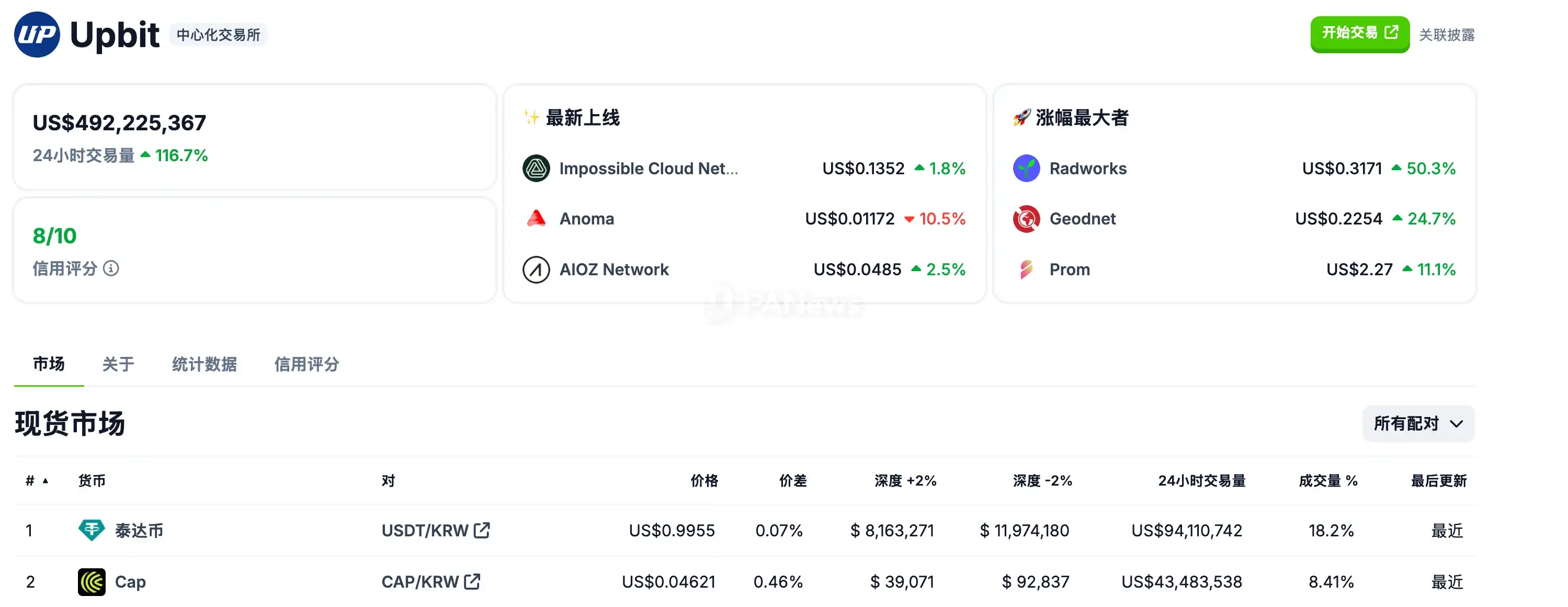
According to CoinGecko data, as of August 11th, Upbit's total trading volume was approximately $492 million, a 116.7% increase in the past 24 hours. Among them, CAP, GRVT, HOME, GEOD, and other assets newly added for Korean Won trading since July have already entered the top ranks of trading volume. Just 9 recently added assets contributed nearly 20% of the platform's 24-hour trading volume.
Amid Competition for Existing Market Share, Listings Are Becoming Increasingly Similar
However, frequently listing new coins can create new trading hotspots, but it's still insufficient to reverse the overall shrinking trend of the Korean crypto market.
From July 1st to 27th, the cumulative trading volume of the top five domestic Korean exchanges also decreased by 16.9% compared to the same period last month. During the same period, Upbit's trading volume fell 10.0% to approximately 11.6943 trillion Won, but its market share increased from 62.3% to 67.4%.
This means that the trading demand generated by new coins, at least at this stage, is more a redistribution within the existing market share rather than a large-scale return of incremental funds to the overall market.
For Korean exchanges, this competition for existing market share is particularly important. Upbit and Bithumb's revenue relies almost entirely on trading fees, which makes them more dependent on the level of trading volume compared to large global exchanges.
Thus, in the competition for the existing market, the assets chosen by Upbit and Bithumb are becoming increasingly similar.
According to statistics from DAXA and exchange announcements, in the second quarter of this year, Upbit and Bithumb listed assets on the same day for 9 instances; if counting projects that were listed by both exchanges within a few days of each other, the number reaches 14. During the same period, the combined trading volume of the two accounted for about 96% of the total volume of the top five Korean Won exchanges.
Therefore, this listing war actually involves competition on two levels.
On one hand, Upbit and Bithumb need to quickly cover popular market assets to avoid new trading demand being monopolized by the other. On the other hand, after the overall contraction of the Korean crypto market, what the two exchanges truly need to compete for is essentially the limited risk capital and attention of Korean retail investors.
While these measures cannot revive the entire crypto market to prosperity, by continuously creating new trading targets and short-term opportunities to keep the limited funds on their own platforms as much as possible, it might already be the best outcome exchanges can strive for under the current circumstances.