Trading Moment: Gold and Silver Hit New Highs, BTC Finds Strong Support Between 88K and 90K, Has the Chinese Meme Trend Concluded?

marsbit2026-01-12 tarihinde yayınlandı2026-01-12 tarihinde güncellendi

Özet

Recent geopolitical tensions in Venezuela, Greenland, and Iran have driven a global asset repricing, with spot gold surpassing $4,600 and silver hitting a record high above $84/oz. Bitcoin hovers near $92,000, facing resistance at $95,000. Analysts are divided: some predict a surge to $103,000–$105,000 or even $135,000, citing strong support at $88,000–$90,000, while others warn of a potential drop to $70,000 or lower. Ethereum shows signs reminiscent of its last major rally, trading around $3,158, with technical patterns suggesting a possible breakout if it holds $3,000 support. Solana gains attention as X (formerly Twitter) plans to integrate "Smart Cashtags" for token data display. South Korea lifted a nine-year ban, allowing listed companies to invest in cryptocurrencies. Meme coins, especially Chinese-themed ones like "币安人生" (Binance Life), surged but corrected over 20% after Justin Sun hinted Huobi might follow the trend, signaling a possible local top. Key events ahead include U.S. CPI data and Fed speeches.

Daily key market data review and trend analysis, produced by PANews.

1. Market Observation

Amid escalating geopolitical conflicts in Venezuela, Greenland, and Iran, global assets are undergoing a new round of revaluation. Spot gold has broken through the $4,600 mark, accumulating a gain of $280 in the first month of the new year, while spot silver surged to a historic high above $84/oz, with intraday gains approaching 5%. Despite potential short-term selling pressure of approximately $5 billion from the annual rebalancing of indices like the Bloomberg Commodity Index (BCOM), analysts generally believe that the long-term fundamentals for gold—as the ultimate geopolitical safe haven—and silver—with its tightening supply due to industrial and investment demand—remain solid. Market expectations even include gold hitting $5,000 and silver breaking $100.

Against this turbulent backdrop, the Federal Reserve's moves are in focus. The Fed's balance sheet recently expanded by $105 billion, the largest increase since 2022, and Chairman Powell is facing a criminal investigation by the U.S. Attorney's Office regarding renovation funds. Despite the complex macro environment, Goldman Sachs chief U.S. economist David Mericle remains optimistic in the 2026 outlook report, forecasting U.S. GDP growth of 2.8% (above the consensus of 2%) and expecting inflation to moderate to 2.1%, with the Fed likely to cut rates by 25 basis points each in June and September. He believes growth will be driven more by productivity gains from advancements like AI. Simultaneously, the Trump administration's geopolitical moves, including a hardline stance on Iran and judicial rulings on tariff policies, are adding further uncertainty to the market.

Bitcoin is currently oscillating near $92,000, still unable to break the $95,000 resistance level. On the bullish side, BitBull notes the weekly RSI broke the downtrend line, predicting prices could reach $103,000 to $105,000 in the next 3-4 weeks; traders James Easton and Skew also observe bullish divergence and buyer strength, considering the $90,000 support solid; MartyParty analysis suggests Bitfinex whales are closing long positions, often a sign of a Wyckoff "spring" bottom, potentially indicating a major rally similar to the 50% surge in early 2025, targeting $135,000; CryptoQuant data also shows retail accumulation suggests market cycle maturity.

However, bearish risks persist. Doctor Profit points out the market has simultaneously formed three major bearish structures, believing $70,000 is an inevitable target and noting insiders have been selling since August; Fidelity's Jurrien Timmer, through power law analysis, indicates that if 2026 sees consolidation, $65,000 would be the "make-or-break" line, potentially even testing the $45,000 trendline; Murphy, via options Gamma data analysis, notes strong support zones at $90,000 and $88,000, but significant Short Gamma exists at $92,000, making a failed breakout prone to being pulled back below.

Ethereum's market sentiment and technicals are showing characteristics similar to those before the last major rally. Santiment analyst Brian Quinlivan points out that although ETH is down about 36% from its all-time high, trading near $3,089, the subdued social media sentiment resembles the pre-surge period last year, and its "second-largest market cap" status has been reconfirmed by the market; analyst Michaël van de Poppe believes the ETH/BTC ratio bottomed in April last year, with momentum supported by a doubling in stablecoin market cap and developer activity, mirroring the 2019 cycle. Technically, Dami-Defi notes a symmetrical triangle is forming on the daily chart, with a breakout imminent; Ted is optimistic about holding the $3,000 support and moving towards $3,500-$3,600; but Lennaert Snyder remains cautious, believing failure to break the $3,308 high could lead to a retest of the monthly open at $2,970. The overall market remains in the "fear" zone, and ETH's subsequent trend will highly depend on whether it can effectively break through the current technical resistance.

In altcoins and market dynamics, the Solana ecosystem is seen by the community as receiving significant positive news. After prominent trader Eugene called for SOL to rise to $160, X platform product lead and Solana advisor Nikita Bier revealed that X will launch the "Smart Cashtags" feature next month, allowing users to specify particular assets or smart contracts when posting ticker symbols. Solana official also stated "X's new feature will allow users to directly view Solana token charts and news", although SOL price touched $144, its weekly active wallets have dropped from 30.2 million to 7.3 million.

Additionally, policy easing news came from the South Korean market, where the Financial Services Commission ended a nine-year ban, allowing listed companies to invest in cryptocurrencies. Both pieces of news are considered major supportive catalysts for crypto assets.

The Meme coin sector experienced rapid rotation from English to Japanese, to Chinese, and even to Sichuan dialect. Over the weekend, the BNB Chain Foundation spent $200,000 purchasing Chinese Meme coins like "Binance Life", "Hakimi", "I'm F*cking Coming", and "Laozi". Although "Binance Life"'s market cap once surged to $188 million, perhaps after Justin Sun indicated that Huobi would follow the Chinese Meme trend, market speculation suggests this might signal a阶段性见顶 (phase peak) for the sector. "I'm F*cking Coming", "Laozi", and other Chinese Meme coins fell over 20% in the past 24 hours. For now, the Chinese Meme trend still primarily revolves around He Yi, CZ, and BNB Chain. (*Note: Content is for reference only, not investment advice, please do your own research)

2. Key Data (As of January 12, 13:00 HKT)

(Data source: CoinAnk, Upbit, SoSoValue, CoinMarketCap)

  • Bitcoin: $92,022 (Year-to-date +4.8%), daily spot trading volume $29.78 billion

  • Ethereum: $3,158 (Year-to-date +6.1%), daily spot trading volume $15.02 billion

  • Fear & Greed Index: 27 (Fear)

  • Average GAS: BTC: 1.75 sat/vB, ETH: 0.02 Gwei

  • Market Dominance: BTC 58.7%, ETH 12.1%

  • Upbit 24h Trading Volume Ranking: XRP, BTC, IP, ETH, SOL

  • 24h BTC Long/Short Ratio: 9.25% / 50.75%

  • Sector Performance: Partial gains in crypto market sectors, AI sector up 2.12%

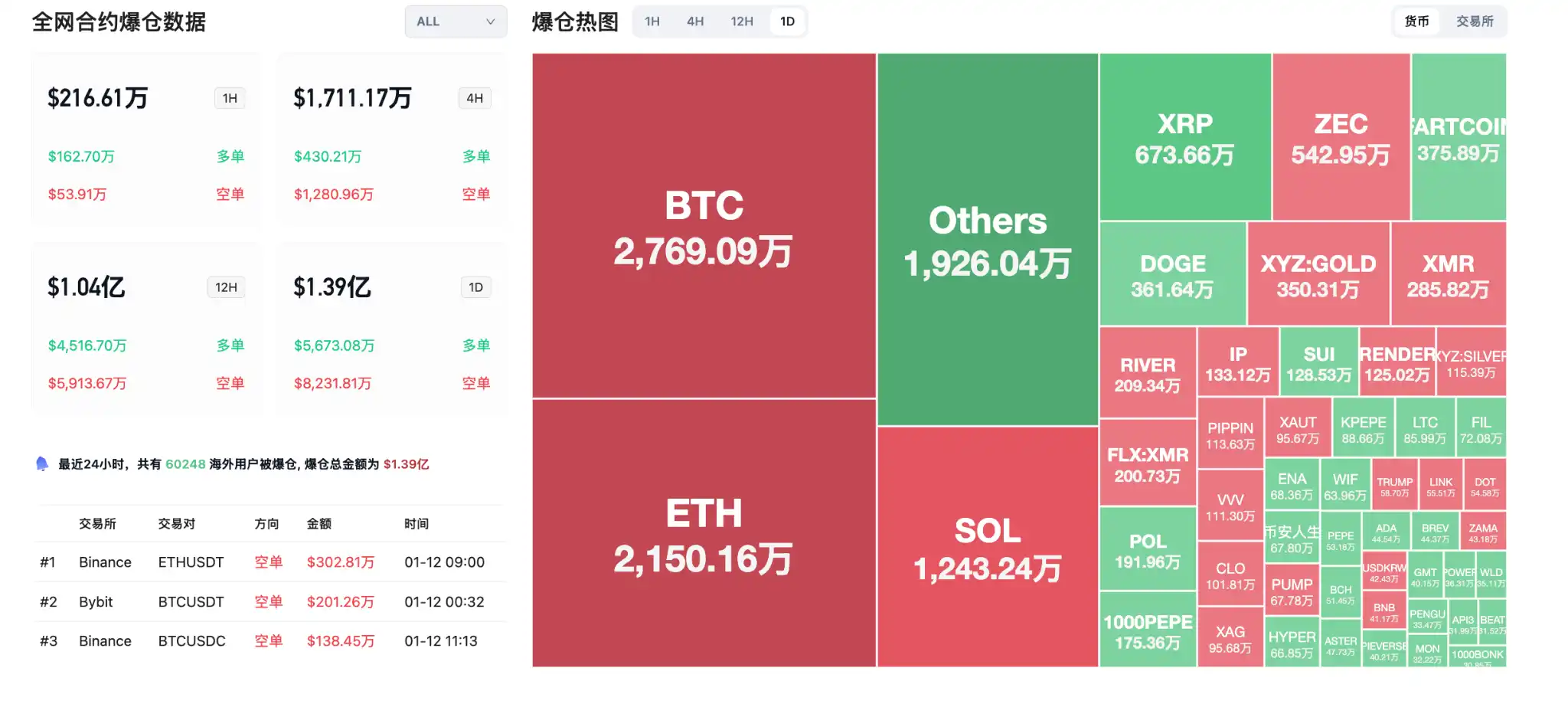
  • 24h Liquidation Data: 60,248 people liquidated globally, total liquidation amount $139 million, including BTC $27.69 million, ETH $21.50 million, SOL $12.34 million
3. ETF Flows (As of January 9)

  • Bitcoin ETF: Net outflow of $681 million last week

  • Ethereum ETF: Net outflow of $68.57 million last week

  • XRP ETF: Net inflow of $38.07 million last week

  • SOL ETF: Net inflow of $41.08 million last week

4. Today's Outlook

  • Binance Alpha will list CharacterX (CAI) on January 12

  • Zama: Public auction for 10% of ZAMA tokens starts January 12, 2026

  • Semler Scientific Founder: Special shareholder meeting to approve proposed merger with Strive will be held on January 13

  • Binance supports FXS mainnet switch and rebranding to FRAX, related adjustments to trading will begin gradually from January 13

  • Binance Wallet launches exclusive Unitas (UP) Booster event and Token Generation Event (TGE)

  • Fogo announces 38.98% of tokens will unlock at network launch on January 13

  • Cheelee (CHEEL) will unlock approximately 20.81 million tokens on January 13 at 08:00 UTC, representing 2.78% of circulating supply, valued at ~$11.6 million;

  • JPMorgan Chase kicks off U.S. major bank quarterly earnings season (January 13)

  • Multiple Fed officials, including Williams, to speak intensively before the month-end FOMC meeting (January 13, 07:00 UTC)

  • US December CPI YoY: Expected 2.7%, Previous 2.7% (January 13, 21:30 UTC)

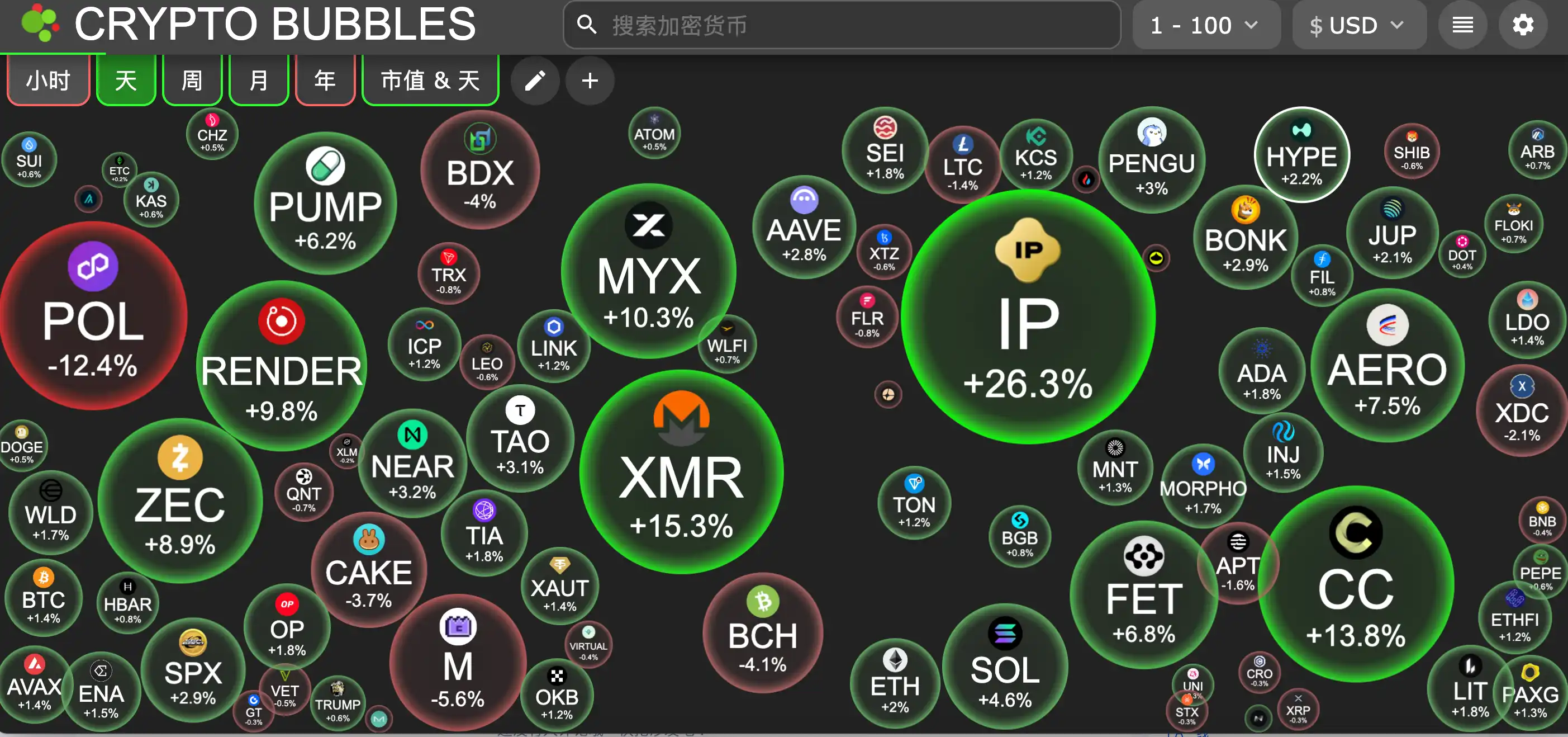
Today's top gainers among top 100 coins by market cap: Story +26.3%, Monero +15.3%, Canton Network +13.8%, MYX Finance +10.3%, Render +9.8%.
5. Hot News

  • Data: TRUMP, CONX, ARB, and other tokens face large unlocks, with TRUMP unlock valued at ~$271 million

  • Week Ahead | US Senate Banking Committee to review crypto market structure bill; TRUMP to unlock tokens worth over $270 million

  • "Strategy Counterparty" opens new long positions on FARTCOI and XPL, and fully closes kPEPE long positions

  • LISA flash crashed 76% in 24 hours, driven by selling from three Alpha users causing a rapid price drop

  • YouTube viewership for cryptocurrency-related content drops to lowest since January 2021

  • Jeff Huang's (MachiBigBrother) HYPE long positions fully closed, overall position profited ~$686,000 in nearly 1 day

  • South Korea lifts nine-year corporate crypto ban, allows listed companies to invest in cryptocurrencies

  • RTFKT's Clone X NFT series floor price surges ~340% in 7 days, market speculates LVMH and Pudgy Penguins as potential acquirers

  • Pump.fun launches creator fee sharing feature

  • Spot gold breaks above $4,600 for the first time

  • Michael Saylor: The best-performing assets over the past decade are NVDA, MSTR, and BTC

  • BNB Chain Foundation bought $币安人生 (Binance Life), $哈基米 (Hakimi), $我踏马来了 (I'm F*cking Coming), and $老子 (Laozi) within two days

  • Bitmine stakes another 86,400 ETH, cumulative staking reaches 1.052 million ETH

İlgili Sorular

QAccording to the article, what are the key support levels for Bitcoin mentioned by analysts?

AAnalysts identified $88,000 and $90,000 as strong support zones for Bitcoin.

QWhat is the primary reason cited for the surge in gold and silver prices?

AThe surge is attributed to escalating geopolitical conflicts in Venezuela, Greenland, and Iran, leading to a global asset re-evaluation with gold acting as the ultimate safe haven.

QWhat event is suggested to potentially signal a top for the Chinese Meme coin trend?

AThe market speculation that the Chinese Meme coin trend may be reaching a阶段性见顶 (stage top) was triggered after Sun Yuchen (Justin Sun) announced that Huobi would follow the trend.

QWhat major policy change regarding cryptocurrency was announced in South Korea?

ASouth Korea's Financial Services Commission ended a nine-year ban, now allowing publicly listed companies to invest in cryptocurrencies.

QWhat is the overall market sentiment (Fear & Greed Index) according to the data provided?

AThe overall market sentiment is in the 'Fear' zone, with a reading of 27.

İlgili Okumalar

7 Months After the Collapse of Huiwang, Southeast Asia's Escrow Platforms Undergo a Major Reshuffle

Following the collapse of Huione Pay—dubbed the "Alipay of Southeast Asia"—seven months ago, the region's underground financial guarantee platform sector is undergoing a significant reshuffle. This power vacuum has been swiftly filled by emerging platforms such as XinBi, Tiger/Navigator, JinBei (renamed JinBo), Dali/Tiancheng, and FullyLight. These platforms, operating largely via Telegram and offering services like escrow for illicit transactions, have absorbed the vast user base and markets left behind by Huione. While positioning themselves as "trust intermediaries," their primary clientele consists of networks involved in online scams, money laundering, illegal gambling, and even human trafficking. For instance, the Tiger/Navigator platform explicitly provides "escrow" services for kidnapping-for-ransom operations ("强押车交易"). Data underscores the immense scale: Huione alone processed over $103 billion in cryptocurrency payments and facilitated over $31 billion through its escrow market before its downfall, linking it to Cambodia's notorious Prince Group. Since its collapse, competitors have seen explosive growth. For example, the XinBi platform has accumulated over $1.6 billion in total USDT revenue, while platforms like NewPay, OkPay (under Dali), and FullyLight Wallet collectively processed over $4.8 billion in USDT in a single year. This ecosystem thrives in regions like Cambodia and Myanmar, where regulatory gaps allow these platforms to act as critical financial infrastructure for sprawling cybercrime industries, from scam compounds to online casinos. The article concludes that the moniker "Southeast Asian Alipay" is a misnomer, obscuring the platforms' fundamental role in enabling serious criminal enterprises rather than representing legitimate financial innovation.

Odaily星球日报19 dk önce

7 Months After the Collapse of Huiwang, Southeast Asia's Escrow Platforms Undergo a Major Reshuffle

Odaily星球日报19 dk önce

The Changing Landscape: What Are Crypto VCs Experiencing?

Title: The Shifting Landscape of Crypto Venture Capital The era of dedicated crypto venture capital funds is undergoing a significant transformation. Once essential for navigating the sector's complexity and high risk, these specialized funds are now facing an identity crisis as the market matures. This shift mirrors historical patterns in other specialized investment classes like cleantech and SPACs, where initial information advantages dissipate as technologies become mainstream and integrated into existing industry frameworks. The article argues that crypto is reaching a critical inflection point, transitioning from a "building phase" to an "integration phase." Major players like Stripe, BlackRock, and Visa now engage with crypto not for its novel mechanics but as a foundational financial infrastructure. Their needs—regulatory compliance, banking partnerships, distribution channels—align with traditional fintech, a domain easily understood by large, generalist funds like Sequoia and Founders Fund. This evolution creates a "barbell effect" within the VC landscape. On one end are massive, diversified platforms that can incorporate crypto as one vertical among many. On the other are small, nimble funds focused on niche, experimental projects. The middle ground—medium-sized dedicated crypto funds—is being squeezed out. Their typical fund size makes it impossible to generate sufficient returns solely from early-stage crypto bets, yet they cannot compete with giants for later-stage deals. Consequently, leading crypto-native firms like Paradigm and Framework Ventures are expanding into AI, robotics, and other sectors, driven partly by LP pressure for better returns amid a broader VC DPI crisis. Others, like Dragonfly and a16z, have narrowed their crypto focus predominantly to financial infrastructure like stablecoins, reframing the sector's core narrative. For crypto entrepreneurs, this consolidation presents challenges. While generalist funds offer larger checks and broader resources, crypto projects now compete fiercely with AI for attention and capital within these firms. Furthermore, the long-term, non-commercial foundational work that built the ecosystem—funded by dedicated crypto VCs—is less likely to attract generalist capital focused on direct returns. The conclusion is that "crypto investor" as a standalone category is becoming obsolete, akin to "internet investor." Crypto is becoming a baseline infrastructure layer. The future will see a barbell structure: large-scale growth financing handled by generalist funds, while pioneering, speculative projects are funded by small, specialized vehicles. The dedicated crypto funds of the 2017-2021 boom, which incubated core infrastructure, are giving way to this new, bifurcated reality.

Foresight News36 dk önce

The Changing Landscape: What Are Crypto VCs Experiencing?

Foresight News36 dk önce

As Consensus Accelerates, What Are Young Investors Betting On?

Title: As Consensus Forms Faster, What Are Young Investors Betting On? In the rapid evolution of tech investment, a new generation of young investors is navigating a landscape where AI, robotics, commercial aerospace, and quantum computing are advancing simultaneously. Traditional investment logic based on financial models is giving way to a need for deep technical understanding and the ability to act before industry consensus forms. An analysis of trends from the "WAIC FUTURE TECH" list of young investment leaders reveals key shifts in focus. The first major trend is the movement of AI from the digital screen into the physical world. Investment is shifting from large language models and chatbots towards embodied AI, robotics, AI hardware, and edge computing. While demonstrations generate excitement, the real challenge lies in achieving scalable, reliable, and cost-effective delivery in complex real-world environments like factories and logistics. Success depends not just on algorithms but on the integration of sensors, actuators, and control systems. Second, the competitive focus for large models is moving beyond raw capability toward building an "intelligence flywheel." The goal is to create self-reinforcing systems where user interaction generates data, improving the model, which in turn enhances the user experience and attracts more engagement. Companies that successfully embed AI into workflows to create these closed-loop systems can build lasting value that isn't easily erased by the next model upgrade. Third, facing a potential bottleneck in high-quality human-generated data, investors are looking at new underlying technologies. Reinforcement learning and self-play, as demonstrated by AlphaGo Zero, offer paths for AI to generate its own experience. Scientific foundation models, which aim to build general AI capabilities for fields like life sciences and materials discovery, represent a non-consensus direction that could unlock new frontiers of knowledge and data. Finally, in deep-tech areas like quantum computing, commercial aerospace, and space-based infrastructure, patient capital is essential. These fields have long, uncertain development and validation cycles involving complex engineering, supply chains, and regulations. Investment here requires a long-term view, focusing on foundational team capabilities and the eventual emergence of market demand, even if commercial returns are distant. Collectively, these trends illustrate how young investors are adapting to a new era. They are learning to make earlier, technically-informed judgments, balance hype with real-world viability, and provide the patient capital needed to build the deep-tech foundations of the future.

marsbit1 saat önce

As Consensus Accelerates, What Are Young Investors Betting On?

marsbit1 saat önce

İşlemler

Spot
活动图片





