
Trading Moment: Can BTC Break Through $100K Again Amid Geopolitical Shocks? Can Copper and Aluminum Take Over from Gold and Silver?

marsbit2026-01-05 tarihinde yayınlandı2026-01-05 tarihinde güncellendi

Özet

Amid significant geopolitical shocks in early 2026, including the U.S. military action in Venezuela and the arrest of President Maduro, Bitcoin demonstrates resilience, holding above $90,000 with a 5.5% year-to-date increase. Analysts suggest a high probability of BTC surpassing $100,000 in Q1, supported by strong ETF inflows. Ethereum remains stable around $3,150, with key resistance at $3,300. Precious metals like gold and silver see gains, while copper and aluminum are projected to outperform in 2026. Meme coins and AI-related tokens also rally, with PEPE surging over 70%. Regulatory attention arises due to insider trading suspicions in prediction markets linked to Venezuela event. Key upcoming events include Trump’s policy meeting and NVIDIA’s CES keynote.

Daily key market review and trend analysis, produced by PANews.

1. Market Overview

As the second quarter (Q2) of the 21st century's third decade begins, the macro landscape faced a major geopolitical shock early in 2026. The U.S. launched a military operation codenamed "Absolute Resolve" against Venezuela and arrested President Maduro, rapidly escalating geopolitical risks. Although markets feared supply disruptions, oil prices reacted relatively mildly given global oversupply and Venezuela's output accounting for only about 1% of global production. Gold returned to $4,400, while silver, platinum, and other precious metals rose over 3%.

Additionally, CITIC Securities released its 2026 outlook report, stating that 2026 is a year to "consolidate foundations and launch strategic counteroffenses" in the "15th Five-Year Plan." Driven by fiscal and monetary "dual easing" and efforts to boost domestic demand, GDP growth is expected to be around 5%. For capital markets, the A-share bull market is likely to continue but with slower gains. Commodities (copper, aluminum), under the resonance of "anti-fragility" and major trends, are expected to take over from 2025's standout performers, gold and silver, becoming the most eye-catching assets in global pricing for 2026. However, caution is advised regarding potential阶段性 corrections in the tech sector, with a focus on new energy, defense, and non-ferrous metals. For Hong Kong stocks, market activity is expected to further ignite under the impetus of "new four bulls" and the Fed's rate-cut cycle. Globally, although U.S. Treasury yields and inflation are expected to remain high, the Sino-U.S. rivalry is shifting from tariff confrontations to tech security contests, making the AI industry chain worth long-term tracking.

Bitcoin showed strong resilience at the start of 2026, rising for five consecutive days despite geopolitical turmoil, stabilizing above $90,000. ETFs recorded a net inflow of $471.3 million on the first trading day. On-chain analyst Murphy noted that the concentration of BTC筹码 within 5% of the spot price dropped from 14.9% to 14.5% with a slow price increase. URPD data showed effective support formed by 822,000 BTC at $87,000, with an expected reasonable fluctuation range between $92,000 and $104,000. Technically, Ted pointed out that the SMA200 is at $106,751, making a breakthrough above $100,000 in Q1 2026 highly probable, and there is a gap at $88,200 on CME. Crypto Auris warned that a drop below $87,000 could lead to a retreat to the $84,000 range. Although CryptoQuant's head of research, Julio Moreno, warned that based on moving averages, it might have entered a bear market with a bottom between $56,000 and $60,000, institutional sentiment is generally optimistic. Charles Schwab is bullish on 2026 performance, Ark Invest's Zach Pandl predicts new all-time highs in the first half, and a Forbes article indicated that 2026 price predictions are concentrated between $120,000 and $170,000. Traders Phyrex and Lennaert Snyder believe that as institutions return post-holiday, market liquidity will recover.

For Ethereum, ETFs recorded a net inflow of $174.5 million on the first day, with prices hovering around $3,150. Analyst Killa noted that ETH is in a stable zone, tending to consolidate or close higher in January and February. Daan Crypto Trades identified $3,300 as a key resistance level for a bullish reversal, with major support below at $2,600. Man of Bitcoin analyzed that ETH faces resistance in the $3,094 to $3,291 range and will follow Bitcoin's "orange route." Despite recovery expectations, some early optimistic predictions failed. Synthetix founder Kain Warwick lost a $50,000 bet because ETH did not reach $25,000 in 2025 and has lowered his 2026 target to $10,000. Previous $10,000 predictions by Tom Lee and Arthur Hayes were also not realized.

In the crypto market, the Venezuela situation caused剧烈 fluctuations and regulatory attention in the prediction market Polymarket. According to Lookonchain tracking, three mysterious wallets heavily bet on Maduro's ouster hours before his arrest, profiting over $630,000. One address invested only $34,000 and made nearly $410,000, raising insider trading concerns. In response, U.S. Representative Ritchie Torres plans to propose the "2026 Financial Prediction Market Public Integrity Act" to prohibit officials from using non-public information in such trades. Meanwhile, Bitcoin Treasuries data shows Venezuela has held Bitcoin since December 31, 2022, with a current balance of 240 BTC worth approximately $22.33 million. However, other analysts estimate it has about $60 billion in Bitcoin and USDT "shadow reserves." With the regime change, key figure Alex Saab, who holds the private keys, has become a focus.

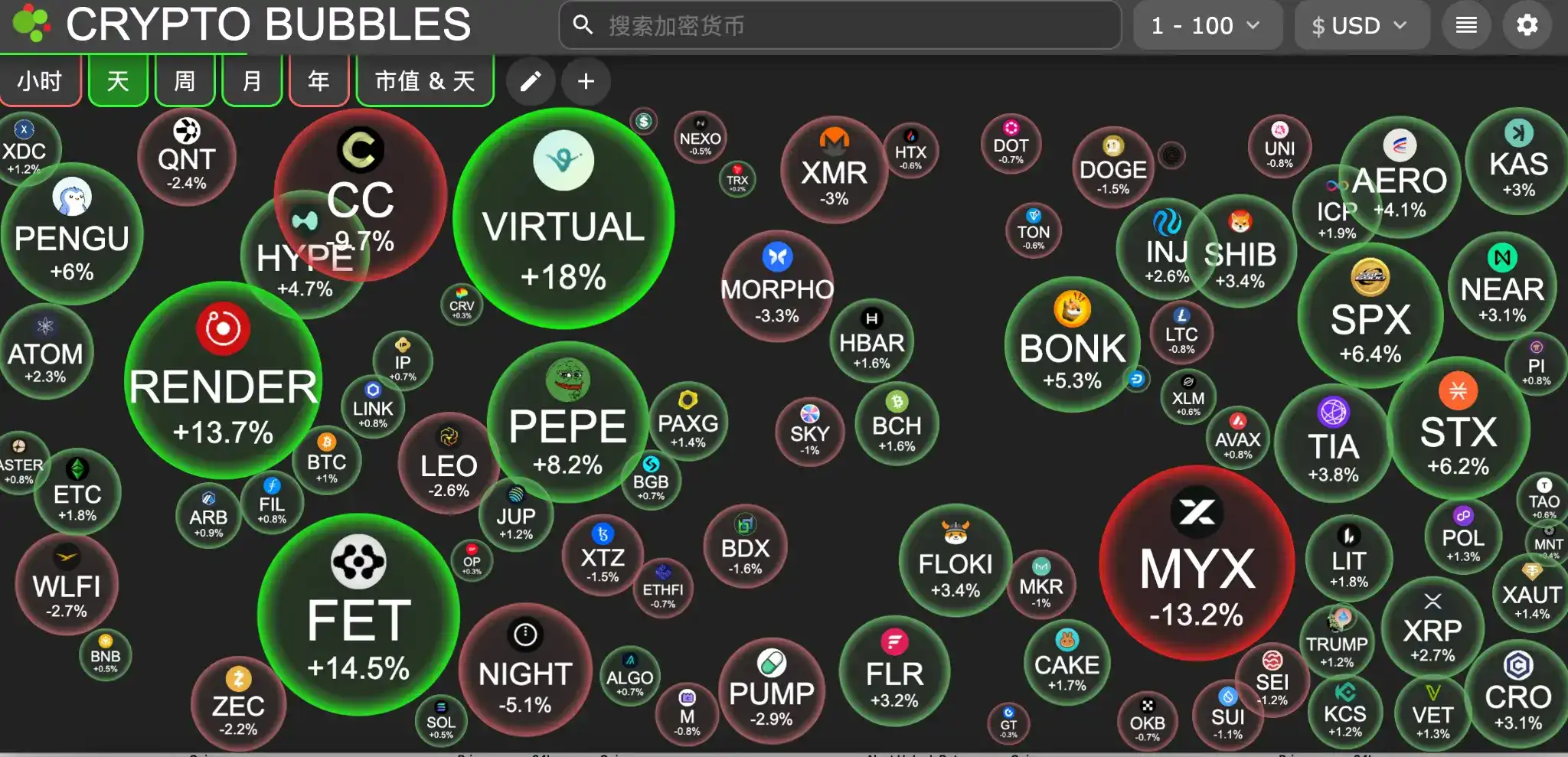
The altcoin market is also active, with most altcoins rising alongside Bitcoin. PEPE has surged over 70% year-to-date, prompting whale James Wynn to recently open a 10x leveraged long position. Additionally, old Meme coins like BONK, BOME, FLOKI, WIF, and NEIRO followed suit, with Ponke and CZ's Dog rising over 70% in the past 24 hours.

Perhaps due to the annual "tech春晚" CES and speeches by tech leaders like Nvidia CEO Jensen Huang and AMD's Lisa Su, AI-related tokens also普遍上涨, with VIRTUAL, FET, and RENDER up over 10%.

2. Key Data (As of January 5, 13:00 HKT)

(Data sources: CoinAnk, Upbit, SoSoValue, CoinMarketCap)

  • Bitcoin: $92,454 (year-to-date +5.5%), daily spot trading volume $38.79 billion
  • Ethereum: $3,152 (year-to-date +6.2%), daily spot trading volume $17.45 billion
  • Fear & Greed Index: 26 (Fear)
  • Average GAS: BTC: 1.75 sat/vB, ETH: 0.02 Gwei
  • Market Dominance: BTC 58.7%, ETH 12.1%
  • Upbit 24-hour trading volume ranking: XRP, BTC, ETH, SOL, BONK
  • 24-hour BTC Long/Short Ratio: 50.66% / 49.34%
  • Sector Performance: Most crypto sectors rose, Meme sector up 6.2%, AI sector up 5.7%
  • 24-hour Liquidation Data: 76,848 people liquidated globally, total liquidation amount $210 million, including BTC $65.91 million, ETH $40.45 million, SOL $9.70 million
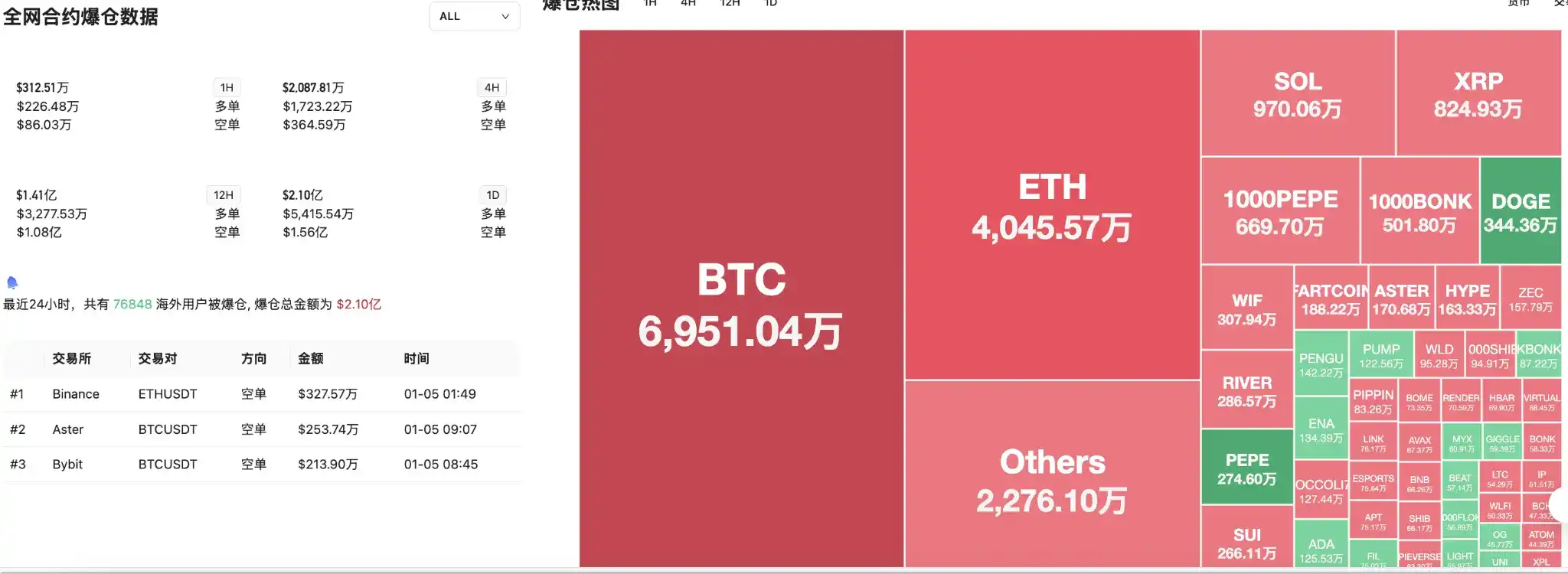
3. ETF Flows (As of January 2)

  • Bitcoin ETF: +$471 million, BlackRock's IBIT led with net inflow of $287 million
  • Ethereum ETF: +$174 million, Grayscale's ETHE led with net inflow of $53.6861 million
  • XRP ETF: +$13.59 million

4. Today's Outlook

  • Zama OG NFT claim portal opens on January 5
  • Trump to attend policy meeting on January 6 at 4:30 AM
  • Binance Alpha to list Brevis (BREV)
  • Hyperliquid co-founder: 1.2 million HYPE tokens to be allocated to team members after unlock on January 6
  • South Korean President Lee Jae-myung to visit China from January 4 to 7
  • U.S. court confirms Maduro to appear in New York court on January 6 at 1:00 Beijing time
  • CES media day, Nvidia CEO speech (January 6, 5:00)
  • Ethena (ENA) to unlock approximately 171 million tokens at 15:00 Beijing time on January 5, representing 2.37% of circulating supply, worth about $42 million
  • Hyperliquid (HYPE) to unlock approximately 12.46 million tokens at 08:00 Beijing time on January 6, representing 3.61% of circulating supply, worth about $313 million

Top 100 coins by market cap today, biggest gainers: Virtuals Protocol up 18%, ASI Alliance up 14.5%, Render up 13.7%, Pepe up 8.2%, SPX6900 up 6.4%.
5. Hot News

  • Data: HYPE, ENA, APT, and other tokens to see large unlocks, with HYPE unlock worth about $313 million
  • Weekly Preview | Solana生态 crypto derivatives exchange Ranger public sale; U.S. BLS to release December employment data
  • Venezuela holds 240 BTC, analysts estimate Bitcoin "shadow reserves" may exceed 600,000
  • Memecoin sector market cap up 23% weekly, trading volume surged 300%
  • Spot gold back above $4,400, silver breaks $76/oz
  • Infinex public sale only raised $491,000 so far, 90.17% remaining
  • U.S. lawmakers propose bill to ban officials from "insider trading" in prediction markets
  • Six contracts betting on "Maduro's ouster" in prediction market total $56.6 million
  • SpaceX, OpenAI, and Anthropic plan IPOs in 2026, potentially one of history's most significant listing waves
  • Bitmine新增 stakes over 49,000 ETH, total stakes exceed 590,000 ETH
  • Digital RMB tops Baidu热搜: interest on活期 balances, fundamentally different from WeChat/Alipay wallets
  • James Wynn opens 10x leveraged PEPE long position
  • Ethereum treasury company Quantum Solutions discloses ETH holdings increased to ~5,418
  • Helium founder: to stop HNT token buybacks due to冷淡 market response
  • Whale holding ETH for four years swaps 14,145 ETH for 492 WBTC
  • Grayscale research head: four reasons may drive Bitcoin to new highs in H1 2026
  • Binance to add observation tags for ACA, D, DATA, and FLOW
  • Data: Gold rose ~65% in 2025 with over 50 new highs, silver rose ~150%

İlgili Sorular

QWhat is the main geopolitical event mentioned at the beginning of 2026 that impacted global markets?

AThe United States launched a military operation called 'Absolute Determination' against Venezuela and arrested President Maduro, pushing geopolitical risks to a climax.

QAccording to CITIC Securities' 2026 outlook, which assets are expected to outperform after gold and silver?

AResources such as copper and aluminum are expected to take over from the strong performance of gold and silver in 2025 and become the most eye-catching globally priced assets in 2026.

QWhat is the key support level for Bitcoin mentioned by on-chain analyst Murphy?

AURPD data shows that 820,000 BTC at $87,000 form an effective support level for Bitcoin.

QWhich meme coin has seen a surge of over 70% since the beginning of the year, attracting a whale to open a 10x leveraged long position?

APEPE has risen over 70% since the beginning of the year, attracting whale James Wynn to open a 10x leveraged long position.

QWhat major legislation is U.S. Representative Ritchie Torres planning to propose in response to the Polymarket activity surrounding the Venezuela event?

AU.S. Representative Ritchie Torres plans to propose the '2026 Financial Prediction Market Public Integrity Act' to prohibit officials from using non-public information to participate in such trading.

İlgili Okumalar

7 Months After the Collapse of Huiwang, Southeast Asia's Escrow Platforms Undergo a Major Reshuffle

Following the collapse of Huione Pay—dubbed the "Alipay of Southeast Asia"—seven months ago, the region's underground financial guarantee platform sector is undergoing a significant reshuffle. This power vacuum has been swiftly filled by emerging platforms such as XinBi, Tiger/Navigator, JinBei (renamed JinBo), Dali/Tiancheng, and FullyLight. These platforms, operating largely via Telegram and offering services like escrow for illicit transactions, have absorbed the vast user base and markets left behind by Huione. While positioning themselves as "trust intermediaries," their primary clientele consists of networks involved in online scams, money laundering, illegal gambling, and even human trafficking. For instance, the Tiger/Navigator platform explicitly provides "escrow" services for kidnapping-for-ransom operations ("强押车交易"). Data underscores the immense scale: Huione alone processed over $103 billion in cryptocurrency payments and facilitated over $31 billion through its escrow market before its downfall, linking it to Cambodia's notorious Prince Group. Since its collapse, competitors have seen explosive growth. For example, the XinBi platform has accumulated over $1.6 billion in total USDT revenue, while platforms like NewPay, OkPay (under Dali), and FullyLight Wallet collectively processed over $4.8 billion in USDT in a single year. This ecosystem thrives in regions like Cambodia and Myanmar, where regulatory gaps allow these platforms to act as critical financial infrastructure for sprawling cybercrime industries, from scam compounds to online casinos. The article concludes that the moniker "Southeast Asian Alipay" is a misnomer, obscuring the platforms' fundamental role in enabling serious criminal enterprises rather than representing legitimate financial innovation.

Odaily星球日报41 dk önce

7 Months After the Collapse of Huiwang, Southeast Asia's Escrow Platforms Undergo a Major Reshuffle

Odaily星球日报41 dk önce

The Changing Landscape: What Are Crypto VCs Experiencing?

Title: The Shifting Landscape of Crypto Venture Capital The era of dedicated crypto venture capital funds is undergoing a significant transformation. Once essential for navigating the sector's complexity and high risk, these specialized funds are now facing an identity crisis as the market matures. This shift mirrors historical patterns in other specialized investment classes like cleantech and SPACs, where initial information advantages dissipate as technologies become mainstream and integrated into existing industry frameworks. The article argues that crypto is reaching a critical inflection point, transitioning from a "building phase" to an "integration phase." Major players like Stripe, BlackRock, and Visa now engage with crypto not for its novel mechanics but as a foundational financial infrastructure. Their needs—regulatory compliance, banking partnerships, distribution channels—align with traditional fintech, a domain easily understood by large, generalist funds like Sequoia and Founders Fund. This evolution creates a "barbell effect" within the VC landscape. On one end are massive, diversified platforms that can incorporate crypto as one vertical among many. On the other are small, nimble funds focused on niche, experimental projects. The middle ground—medium-sized dedicated crypto funds—is being squeezed out. Their typical fund size makes it impossible to generate sufficient returns solely from early-stage crypto bets, yet they cannot compete with giants for later-stage deals. Consequently, leading crypto-native firms like Paradigm and Framework Ventures are expanding into AI, robotics, and other sectors, driven partly by LP pressure for better returns amid a broader VC DPI crisis. Others, like Dragonfly and a16z, have narrowed their crypto focus predominantly to financial infrastructure like stablecoins, reframing the sector's core narrative. For crypto entrepreneurs, this consolidation presents challenges. While generalist funds offer larger checks and broader resources, crypto projects now compete fiercely with AI for attention and capital within these firms. Furthermore, the long-term, non-commercial foundational work that built the ecosystem—funded by dedicated crypto VCs—is less likely to attract generalist capital focused on direct returns. The conclusion is that "crypto investor" as a standalone category is becoming obsolete, akin to "internet investor." Crypto is becoming a baseline infrastructure layer. The future will see a barbell structure: large-scale growth financing handled by generalist funds, while pioneering, speculative projects are funded by small, specialized vehicles. The dedicated crypto funds of the 2017-2021 boom, which incubated core infrastructure, are giving way to this new, bifurcated reality.

Foresight News58 dk önce

The Changing Landscape: What Are Crypto VCs Experiencing?

Foresight News58 dk önce

As Consensus Accelerates, What Are Young Investors Betting On?

Title: As Consensus Forms Faster, What Are Young Investors Betting On? In the rapid evolution of tech investment, a new generation of young investors is navigating a landscape where AI, robotics, commercial aerospace, and quantum computing are advancing simultaneously. Traditional investment logic based on financial models is giving way to a need for deep technical understanding and the ability to act before industry consensus forms. An analysis of trends from the "WAIC FUTURE TECH" list of young investment leaders reveals key shifts in focus. The first major trend is the movement of AI from the digital screen into the physical world. Investment is shifting from large language models and chatbots towards embodied AI, robotics, AI hardware, and edge computing. While demonstrations generate excitement, the real challenge lies in achieving scalable, reliable, and cost-effective delivery in complex real-world environments like factories and logistics. Success depends not just on algorithms but on the integration of sensors, actuators, and control systems. Second, the competitive focus for large models is moving beyond raw capability toward building an "intelligence flywheel." The goal is to create self-reinforcing systems where user interaction generates data, improving the model, which in turn enhances the user experience and attracts more engagement. Companies that successfully embed AI into workflows to create these closed-loop systems can build lasting value that isn't easily erased by the next model upgrade. Third, facing a potential bottleneck in high-quality human-generated data, investors are looking at new underlying technologies. Reinforcement learning and self-play, as demonstrated by AlphaGo Zero, offer paths for AI to generate its own experience. Scientific foundation models, which aim to build general AI capabilities for fields like life sciences and materials discovery, represent a non-consensus direction that could unlock new frontiers of knowledge and data. Finally, in deep-tech areas like quantum computing, commercial aerospace, and space-based infrastructure, patient capital is essential. These fields have long, uncertain development and validation cycles involving complex engineering, supply chains, and regulations. Investment here requires a long-term view, focusing on foundational team capabilities and the eventual emergence of market demand, even if commercial returns are distant. Collectively, these trends illustrate how young investors are adapting to a new era. They are learning to make earlier, technically-informed judgments, balance hype with real-world viability, and provide the patient capital needed to build the deep-tech foundations of the future.

marsbit1 saat önce

As Consensus Accelerates, What Are Young Investors Betting On?

marsbit1 saat önce

İşlemler

Spot
活动图片





