Tracking Digital Asset Markets Beyond Crypto-Native Venues

insights.glassnode2026-06-03 tarihinde yayınlandı2026-06-03 tarihinde güncellendi

Özet

Glassnode has expanded its platform with new metrics for tracking digital asset markets beyond crypto-native venues, focusing on US spot ETFs and US Digital Asset Treasury (DAT) companies. These additions allow users to access daily price and trading volume data for relevant ETFs and publicly listed treasury firms tied to specific crypto assets. The DAT metrics enable comparisons between equity behavior and underlying crypto assets, helping identify stocks that act as strong proxies versus those with more idiosyncratic profiles. ETF volume data offers insights into liquidity, participation, and institutional flows, revealing how much trading activity occurs through traditional finance channels compared to crypto-native markets. These tools provide a unified view of digital asset exposure across spot markets, ETFs, and listed vehicles, enhancing analysis for institutional and traditional finance integration.

Glassnode has continued to expand its Traditional Finance coverage in Studio, helping users connect crypto-native market activity with the growing universe of listed instruments tied to digital assets.

This expansion reflects the growing role of ETFs, treasury companies, and other listed vehicles in digital asset market analysis, as institutional exposure increasingly moves beyond spot markets.

Two new metric families are now live:

  • US Spot ETF Price & Volume
  • US Digital Asset Treasury Company Price & Volume.

For each selected crypto asset, users can now retrieve daily price and traded volume across the relevant US spot ETFs and publicly listed treasury companies, with one time series per ticker. This gives investors a more complete view of how crypto exposure is being expressed through traditional equity markets.

DATs: Analyzing Equity Behavior Relative to Crypto

For US Digital Asset Treasury (DAT) companies, the data makes it easier to compare how listed equities behave relative to the underlying crypto asset and assess which names exhibit stronger or weaker equity beta to crypto market movements.

For example, users can compare BTC performance against companies holding BTC on their balance sheet to identify which stocks behave more like direct crypto proxies, and which names trade with a more idiosyncratic equity profile.
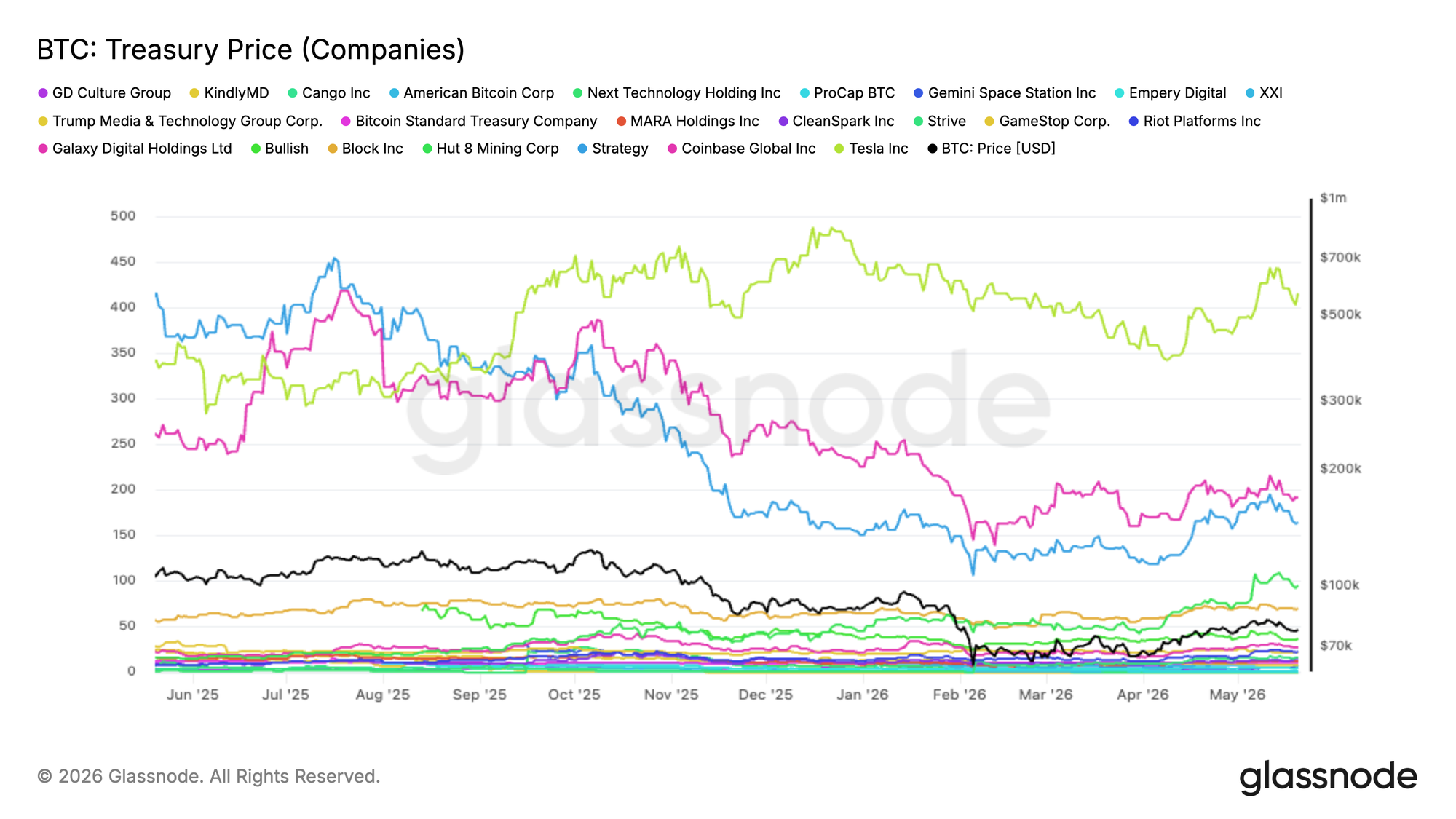
View live chart

US Spot ETF Volume: Assessing Participation and Liquidity Conditions

The addition of trading volume is particularly useful for US spot ETFs. Trading volume provides insight into liquidity, participation, and conviction.

For example, a sharp spike in ETF trading volume around a major price move or macro event can signal heavy institutional repositioning — and comparing ETF volume against the underlying spot market shows how much real flow is moving through TradFi venues versus crypto-native ones. Sustained volume can confirm genuine demand behind a price trend, while thin volume on a move may warrant more caution.
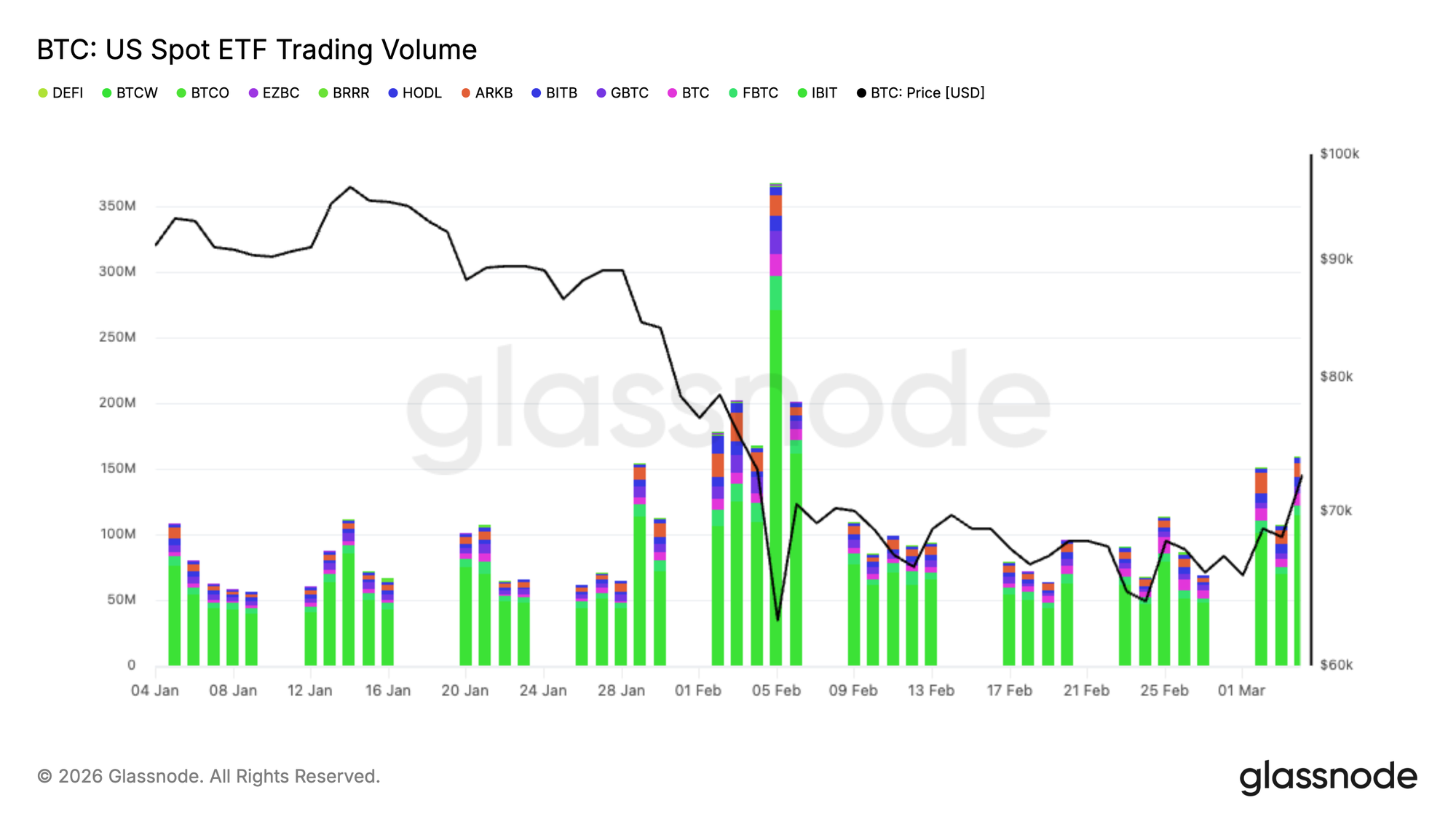
View live chart

Together, these new metrics strengthen Glassnode’s ability to bridge crypto-native data with traditional market instruments, giving users a unified view of spot assets, ETFs, and listed treasury vehicles directly in Studio.

Explore the new metrics in Studio

  • DAT Price Companies
  • DAT Trading Volume Companies
  • US Spot ETF Price
  • US Spot ETF Trading Volume

  • Follow us on X for timely market updates and analysis
  • Join our Telegram channel for regular market insights
  • For on-chain metrics, dashboards, and alerts, visit Glassnode Studio

Disclaimer: This report is for informational and educational purposes only. The analysis represents a limited case study with significant constraints and should not be interpreted as investment advice or definitive trading signals. Past performance patterns do not guarantee future results. Always conduct thorough due diligence and consider multiple factors before making investment decisions.


İlgili Sorular

QWhat two new metric families has Glassnode added to its Studio platform to track digital asset markets beyond crypto-native venues?

AThe two new metric families are US Spot ETF Price & Volume and US Digital Asset Treasury Company Price & Volume.

QAccording to the article, what advantage does tracking US Spot ETF trading volume provide for market analysis?

ATracking US Spot ETF trading volume provides insight into liquidity, participation, and conviction. It can signal institutional repositioning and help determine how much real flow is moving through traditional finance venues compared to crypto-native ones.

QHow can the data on US Digital Asset Treasury (DAT) companies help investors?

AThe data makes it easier to compare how listed equities of DAT companies behave relative to the underlying crypto asset, helping to assess which stocks have a stronger or weaker equity beta to crypto market movements and identify which act more like direct crypto proxies.

QWhat is the overall purpose of Glassnode's expansion with these new metrics, as described in the article?

AThe overall purpose is to bridge crypto-native data with traditional market instruments, giving users a unified view of how crypto exposure is expressed through spot assets, ETFs, and listed treasury vehicles in traditional equity markets.

QWhere can users access these new metrics and find additional market insights from Glassnode, based on the article's final sections?

AUsers can access the new metrics in Glassnode Studio. For timely updates, they can follow Glassnode on X, join their Telegram channel for market insights, and visit Glassnode Studio for on-chain metrics, dashboards, and alerts.

İlgili Okumalar

Misjudged A-Shares: Resilience, Expectations, and Confidence

China's A-share market recently faced selling pressure, especially in tech sectors, initially triggered by a global tech sell-off that began in South Korea. However, the article argues this is a case of "mistaken injury" and highlights the market's underlying resilience. This resilience stems from three main pillars: **1) Tech Sector Fundamentals:** Unlike Korea's market dominated by a few memory chip stocks, China's tech sector is diversified across computing, communications, electronics, and semiconductors, supported by dual narratives of global AI supply chains and domestic substitution. Core areas like optical modules and fiber optics continue to show strong earnings growth. **2) "National Team" Support:** State-backed institutions and large corporations have made significant market purchases and announced buybacks, providing liquidity and signaling confidence. This is seen as a stabilizing policy signal, often associated with market bottoms. **3) Broader Market Pillars:** Other major sectors are showing endogenous recovery momentum. Consumer stocks benefit from stabilizing CPI and signs of sector recovery (e.g., liquor price hikes). Cyclical sectors like aluminum have high earnings, potential price increases due to tight supply, and low valuations. The financial sector offers stable dividends and low valuations. The conclusion is that the sell-off was driven by external contagion, not a collapse in fundamentals. With strong policy support and recovering momentum across key sectors, the A-share market possesses the toughness to regain stability.

marsbit21 dk önce

Misjudged A-Shares: Resilience, Expectations, and Confidence

marsbit21 dk önce

The Clarity Act's Journey Through Congress: The Thorny Path of Bipartisan Compromise in the U.S.

The U.S. Congress is struggling to advance the crypto market structure bill known as the Clarity Act, with bipartisan compromise proving difficult. Key hurdles include unresolved disputes over "yield" products and, more critically, the inclusion of strong ethics provisions for elected officials—a non-negotiable demand for many Democrats. While a compromise on yield was reached in May, securing only limited Democratic support in committee, the separate Senate Agriculture Committee version later passed with no Democratic votes due to the ethics impasse. As Republicans push for a full Senate vote in July, demands for ethics rules have expanded, and other contentious issues like developer protections and concerns from law enforcement and large banks further complicate negotiations. Despite consensus on the need for legislation, the path forward is unclear. Recent discussions between senators and White House officials aim to find acceptable ethics language. Some lawmakers question whether a compromise text can garner enough bipartisan support, with one Democrat stating the current proposal lacks the strong ethics provisions required for their vote. Potential short-term goals for the crypto community include symbolic Senate action before the August recess, a longer-term aim for passage by 2026, or establishing a detailed framework that addresses ethics and other compromises. The process remains arduous, relying on the traditional, vote-by-vote effort to build bipartisan support.

marsbit40 dk önce

The Clarity Act's Journey Through Congress: The Thorny Path of Bipartisan Compromise in the U.S.

marsbit40 dk önce

Are Kalshi and Polymarket Founders at Odds? This Business Rivalry Is More Brutal Than You Think

"The Rivalry Between Kalshi and Polymarket Founders Turns Bitter and Litigious" The intense feud between Tarek Mansour, CEO of Kalshi, and Shayne Coplan, founder of Polymarket, has escalated far beyond typical business competition into personal animosity and regulatory battles. Both lead billion-dollar prediction market platforms, but their approaches differ sharply. Kalshi positions itself as the compliant operator, securing U.S. regulatory approval before launching. In contrast, Polymarket initially operated offshore, allowing U.S. users to access its platform via VPN, which drew regulatory scrutiny. The conflict reached a peak in November 2024 when FBI agents raided Coplan's New York apartment. While Coplan publicly blamed political motives, his team privately suspected Kalshi was involved. According to sources, Kalshi's lawyers had previously reported Polymarket's operations to federal prosecutors, highlighting its accessibility to U.S. users despite a ban. This incident fueled mutual accusations and underhanded tactics, including social media smear campaigns and attempts to sabotage each other's major business deals. Their rivalry also played out in Washington, influencing regulatory debates. Kalshi actively lobbied against Polymarket's practices, framing them as illegal and unethical. Polymarket, after facing a CFTC fine and investigation, later acquired a licensed U.S. firm to launch a domestic app, regaining a foothold. Despite the hostility, both companies have seen massive growth, with combined trading volumes soaring. However, increased regulatory scrutiny, particularly around insider trading on Polymarket's platform, continues to pose challenges. The founders' deep-seated mutual disdain ensures their battle for market dominance remains as much a personal vendetta as a commercial one.

marsbit49 dk önce

Are Kalshi and Polymarket Founders at Odds? This Business Rivalry Is More Brutal Than You Think

marsbit49 dk önce

İşlemler

Spot
活动图片




