Tracking Digital Asset Markets Beyond Crypto-Native Venues

insights.glassnode2026-05-21 tarihinde yayınlandı2026-05-21 tarihinde güncellendi

Özet

Glassnode has expanded its analytics platform to track digital asset markets beyond crypto-native venues. New data includes daily price and volume for U.S. spot ETFs and publicly-listed digital asset treasury (DAT) companies. This allows users to compare the behavior of these listed equities against underlying crypto assets, assessing which stocks act as strong proxies. ETF trading volume data provides insights into institutional participation and liquidity, helping to distinguish genuine market trends from thin, speculative moves. These new metrics offer a unified view of crypto exposure through traditional finance instruments, bridging the gap between on-chain and traditional market data.

Glassnode has continued to expand its Traditional Finance coverage in Studio, helping users connect crypto-native market activity with the growing universe of listed instruments tied to digital assets.

This expansion reflects the growing role of ETFs, treasury companies, and other listed vehicles in digital asset market analysis, as institutional exposure increasingly moves beyond spot markets.

Two new metric families are now live:

  • US Spot ETF Price & Volume
  • US Digital Asset Treasury Company Price & Volume.

For each selected crypto asset, users can now retrieve daily price and traded volume across the relevant US spot ETFs and publicly listed treasury companies, with one time series per ticker. This gives investors a more complete view of how crypto exposure is being expressed through traditional equity markets.

DATs: Analyzing Equity Behavior Relative to Crypto

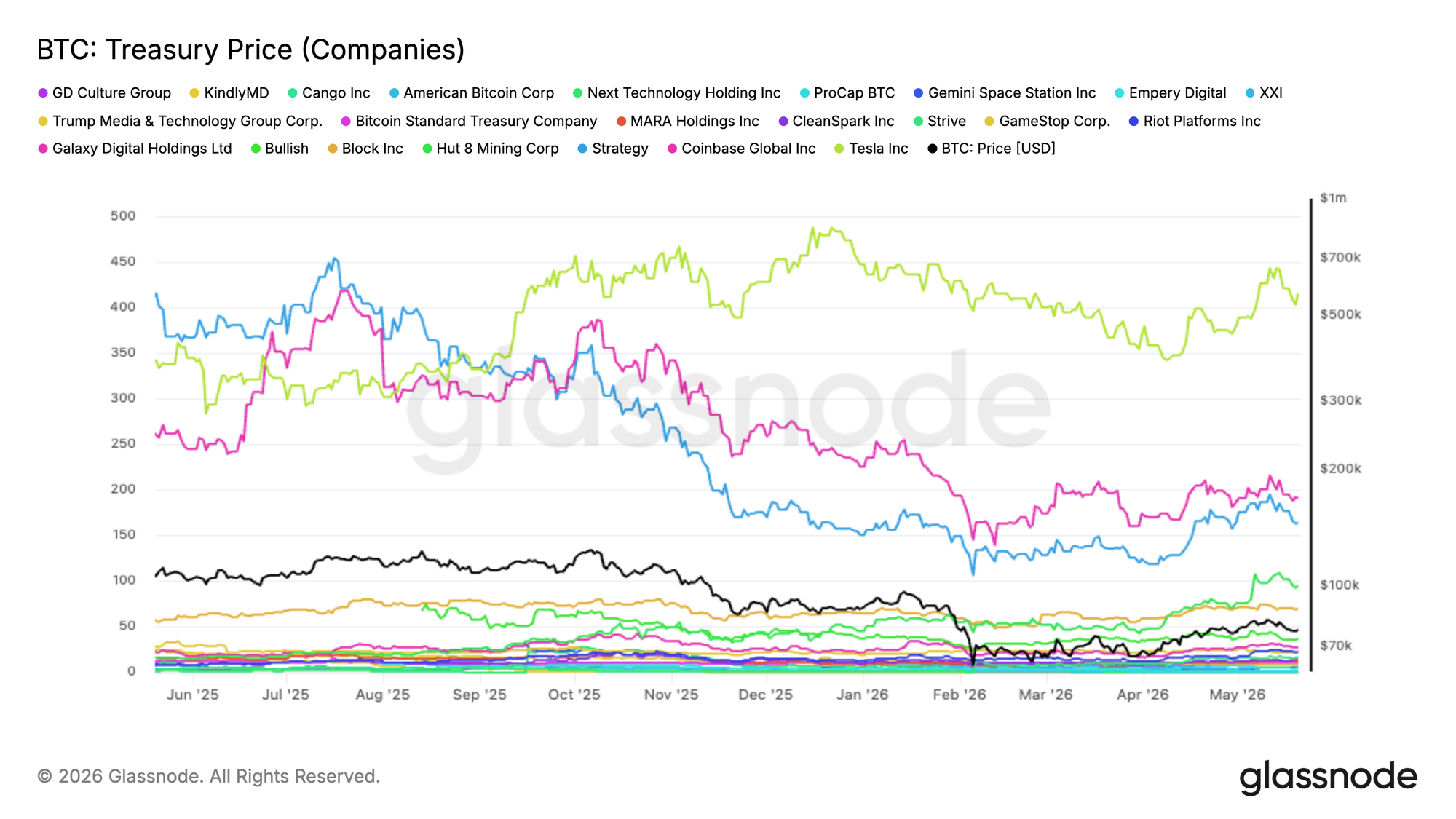
For US Digital Asset Treasury (DAT) companies, the data makes it easier to compare how listed equities behave relative to the underlying crypto asset and assess which names exhibit stronger or weaker equity beta to crypto market movements.

For example, users can compare BTC performance against companies holding BTC on their balance sheet to identify which stocks behave more like direct crypto proxies, and which names trade with a more idiosyncratic equity profile.
View live chart

US Spot ETF Volume: Assessing Participation and Liquidity Conditions

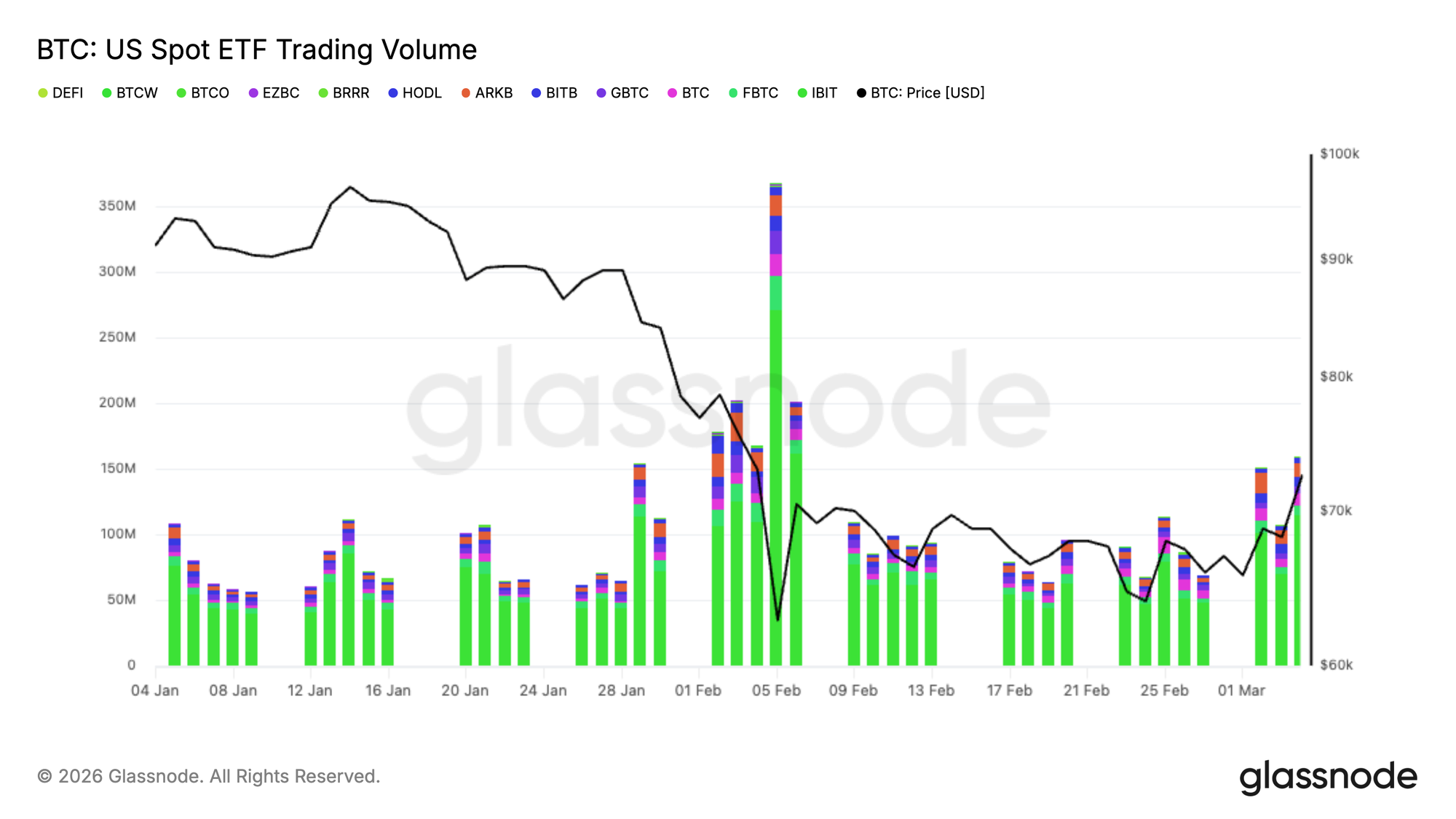
The addition of trading volume is particularly useful for US spot ETFs. Trading volume provides insight into liquidity, participation, and conviction.

For example, a sharp spike in ETF trading volume around a major price move or macro event can signal heavy institutional repositioning — and comparing ETF volume against the underlying spot market shows how much real flow is moving through TradFi venues versus crypto-native ones. Sustained volume can confirm genuine demand behind a price trend, while thin volume on a move may warrant more caution.
View live chart

Together, these new metrics strengthen Glassnode’s ability to bridge crypto-native data with traditional market instruments, giving users a unified view of spot assets, ETFs, and listed treasury vehicles directly in Studio.

Explore the new metrics in Studio

  • DAT Price Companies
  • DAT Trading Volume Companies
  • US Spot ETF Price
  • US Spot ETF Trading Volume

  • Follow us on X for timely market updates and analysis
  • Join our Telegram channel for regular market insights
  • For on-chain metrics, dashboards, and alerts, visit Glassnode Studio

Disclaimer: This report is for informational and educational purposes only. The analysis represents a limited case study with significant constraints and should not be interpreted as investment advice or definitive trading signals. Past performance patterns do not guarantee future results. Always conduct thorough due diligence and consider multiple factors before making investment decisions.


İlgili Sorular

QWhat new metric families has Glassnode introduced in Studio?

AGlassnode has introduced two new metric families: US Spot ETF Price & Volume and US Digital Asset Treasury Company Price & Volume.

QWhat is the primary purpose of adding the US Spot ETF trading volume data?

AThe primary purpose of adding US Spot ETF trading volume data is to provide insight into liquidity, participation, and conviction, helping users assess the significance of price trends and the flow of capital between traditional and crypto-native venues.

QHow can the data for US Digital Asset Treasury (DAT) companies be used?

AThe data for US Digital Asset Treasury (DAT) companies can be used to compare how listed equities behave relative to the underlying crypto asset and to assess which stocks exhibit a stronger or weaker equity beta to crypto market movements, identifying which ones act more as direct crypto proxies.

QWhat overall capability do these new metrics strengthen for Glassnode?

AThese new metrics strengthen Glassnode's ability to bridge crypto-native data with traditional market instruments, giving users a unified view of spot assets, ETFs, and listed treasury vehicles directly within its Studio platform.

QWhat disclaimer does the article provide regarding its content?

AThe article provides a disclaimer stating that the report is for informational and educational purposes only, the analysis is a limited case study, it should not be interpreted as investment advice or definitive trading signals, and users should always conduct thorough due diligence before making investment decisions.

İlgili Okumalar

Anthropic's IPO Launch: Commercial Miracle or Valuation Bubble?

Anthropic has confidentially filed for an IPO, led by Morgan Stanley and Goldman Sachs, potentially going public by October. Following its latest $650 billion funding round, its pre-IPO valuation stands at $965 billion, with projections reaching up to $2 trillion at listing, which would make it the highest-valued private company ever. The article, written by Fu Sheng, addresses skepticism that this represents an AI bubble akin to the 2000 dot-com crash. It argues the current situation differs fundamentally. Unlike the internet bubble era, which relied on speculative narratives with little revenue, Anthropic's valuation is backed by unprecedented, measurable financial performance. Key data points include: * **Revenue Growth:** ARR skyrocketed from $10 billion in early 2025 to $470 billion by May 2026, targeting $100 billion by year-end—a growth curve unmatched in business history. * **Profitability:** It achieved operating profitability in Q2 2026 with an estimated $5.6 billion profit. * **Efficiency:** With ~3,000 employees and ~$470 billion ARR, its revenue per employee exceeds $10 million. Products like Claude Code, launched less than a year ago, already generate $25 billion in annualized revenue. * **Enterprise Adoption:** It boasts a strong enterprise client base, with 8 of the Fortune 10 and over 1,000 large firms spending over $1 million annually on Claude. The valuation is framed using a traditional SaaS model (e.g., a 10x Price-to-Sales multiple on $100 billion revenue). The author contends the core question for analysts has shifted from "How big could this be?" to "How much is it earning and will earn next quarter?" The discussion extends beyond Anthropic to a broader paradigm shift: the transition from a "carbon-based" to a "silicon-based" economy. Companies are increasingly prioritizing investment in compute and AI capabilities over human resources, as these directly scale productivity and competitive advantage. Anthropic's IPO is thus positioned not just as a corporate milestone, but as a price anchor for this new economic era.

链捕手2 saat önce

Anthropic's IPO Launch: Commercial Miracle or Valuation Bubble?

链捕手2 saat önce

Near Returns to the AI Stage: Transformation into a Public Chain Due to 'Payroll Difficulties,' Agent and Privacy Emerge as New Growth Narratives

NEAR Returns to AI Origins: From Payroll Struggles to Blockchain, Now Focusing on AI Agents and Privacy NEAR Protocol's journey began not with grand blockchain ambitions, but from a practical hurdle: its AI startup founders, including Transformer paper co-author Illia Polosukhin, couldn't efficiently pay international developers in 2017. This led them to pivot and build a high-performance, scalable blockchain. After years navigating various crypto narratives like sharding and cross-chain interoperability, NEAR is now leveraging its AI roots to re-enter the AI arena. A key driver is its "NEAR Intents" layer, which abstracts complex cross-chain transactions. Users simply state their goal (e.g., swap BTC for ETH), and a solver network finds the optimal route. This system has processed over $20B in cross-chain volume, generating significant fee revenue. A major growth area is private transactions via "Confidential Intents/Swaps," which hide trade details until settlement to protect against MEV and front-running. Remarkably, private swaps recently accounted for over 40% of NEAR's transaction volume, highlighting strong demand but also potential regulatory scrutiny. With its AI-founder pedigree, NEAR is positioning itself at the intersection of blockchain, AI agents, and privacy, aiming to become infrastructure for the emerging agent economy while navigating the challenges of its rapid adoption.

marsbit4 saat önce

Near Returns to the AI Stage: Transformation into a Public Chain Due to 'Payroll Difficulties,' Agent and Privacy Emerge as New Growth Narratives

marsbit4 saat önce

İşlemler

Spot
Futures
活动图片



