TPS is Just the Entry Ticket, Ordering Decides Success or Failure: On-Chain Transactions Enter a New Era of 'Application-Awareness'

marsbit2025-12-29 tarihinde yayınlandı2025-12-29 tarihinde güncellendi

Özet

The competition between blockchains has shifted from TPS (transactions per second) to transaction ordering, which critically impacts market maker behavior, liquidity depth, and pricing. Transaction ordering refers to how transactions in the mempool are sequenced and included in blocks. This process affects transaction cost, MEV (Maximal Extractable Value), success rate, and fairness. For market makers, the ability to cancel orders quickly during volatility is essential—failure leads to risks like sniping, where high-Gas transactions exploit pending orders, forcing wider spreads and reduced liquidity. Innovations are moving from generic, Gas-based ordering to "application-aware sequencing," where transaction intent and fairness rules take priority. Examples include: - Hyperliquid, which prioritizes cancellations and post-only orders at the consensus layer. - Solana’s Application Controlled Execution (ACE) and BAM nodes, allowing DEXs to set custom ordering rules (e.g., market-maker priority). - Chainlink’s SVR, which uses MEV auctions to redistribute value from liquidations triggered by oracle updates. These developments suggest that tailored transaction sequencing is becoming essential—not just an improvement—for on-chain trading, potentially enabling DEXs to surpass CEXs in efficiency and fairness.

Competition between chains has escalated to the level of "transaction ordering," which directly impacts market makers' bid-ask spreads and depth🧐🧐

The demand for "general-purpose chains" has been disproven. Current chain-to-chain competition focuses on two levels:

1) Building "application chains" on the foundation of existing mature businesses, allowing blockchain to supplement existing operations in areas like settlement;

2) Competition at the level of "transaction ordering."

This article focuses on the second level.

Ordering directly influences the behavior of market makers. This is the core issue.

What is Transaction Ordering?

On-chain, user transactions are not immediately written to a block; they first enter a "waiting area" (Mempool). There may be thousands of transactions simultaneously, and it must be decided by a sequencer, validator, or miner:

1) Which transactions are included in the next block?

2) In what order are these transactions arranged?

The process of "deciding the order" is transaction ordering, which directly affects the transaction costs for on-chain users, MEV conditions, transaction success rate, and fairness.

For example, during network congestion, ordering determines whether a transaction can be quickly added to the chain or waits indefinitely in the mempool.

For high-frequency traders like market makers, whether a cancellation order takes effect is more critical than a placement order succeeding. The priority given to processing cancellation orders directly impacts whether market makers dare to offer deep liquidity.

In the last cycle, everyone pursued TPS, believing that speed alone could improve on-chain transaction settlement. But it has been proven that, besides speed, the risk pricing of market makers is equally important.

On centralized exchanges, trade matching strictly follows the "price-time priority" principle. In this highly deterministic environment, market makers can provide deep order book liquidity with extremely narrow spreads.

On-chain, after transactions enter the Mempool waiting area, nodes select transactions based on Gas fees, which creates room for sniping existing orders by offering higher Gas.

Suppose TRUMP is priced at $4.5, and a market maker places a buy order at $4.4 and a sell order at $4.6 to provide depth. But the exchange price of TRUMP suddenly crashes to $4.

At this point, the on-chain market maker wants to cancel the $4.4 buy order but gets sniped by a high-frequency trader offering higher Gas—buying at $4 and selling to the market maker at $4.4.

Therefore, market makers can only widen their spreads to reduce risk.

The purpose of the new generation of ordering innovations is to transition from "general ordering" to "Application-Aware Sequencing."

The ordering layer can understand transaction intent and order based on preset fairness rules, not just based on Gas fees.

1) Define the ordering method at the consensus layer

A typical case is Hyperliquid. It stipulates at the consensus layer that cancellation and Post-Only transactions take priority, breaking the Gas priority rule.

For market makers, being able to exit is paramount. During sharp price fluctuations, cancellation requests are always executed before others' takers.

Market makers fear being sniped the most. Hyperliquid precisely guarantees that cancellations are always prioritized—when the price drops, market makers cancel their orders, and the system forcibly prioritizes processing the cancellations, allowing market makers to successfully hedge risks.

On the day of the 10.11 crash, Hyperliquid market makers stayed online continuously, with spreads of 0.01–0.05%. The reason is that market makers knew they could get out.

2) Add new ordering methods at the sequencing layer

For example, Solana's Application Controlled Execution (ACE). Jito Labs developed BAM (Block Assembly Marketplace), introducing specialized BAM nodes responsible for transaction collection, filtering, and ordering.

Nodes run in a Trusted Execution Environment (TEE), ensuring the privacy of transaction data and the fairness of ordering.

Through ACE, DEXs on Solana (like Jupiter, Drift, Phoenix) can register custom ordering rules with BAM nodes. For example, market maker priority (similar to Hyperliquid), conditional liquidity, etc.

Additionally, proprietary AMM market makers like HumidiFi represent innovation at the ordering level, using Nozomi to connect directly with major validators to reduce latency and complete transactions.

During specific transactions, HumidiFi's off-chain servers monitor prices across platforms. The oracle communicates with the on-chain contract to inform it of the situation. Nozomi acts like a VIP channel, allowing effective order cancellation before execution.

3) Utilizing MEV facilities and private channels

Chainlink SVR (Smart Value Recapture) focuses on the归属 (belonging) of the value generated by ordering (MEV).

By deeply integrating with oracle data, it redefines the ordering rights and value distribution of liquidation transactions. After generating a price update, Chainlink nodes send it through two channels:

1) Public channel: Sent to the standard on-chain aggregator (serving as a backup, but in SVR mode, there is a slight delay to leave an auction window).

2) Private channel (Flashbots MEV-Share): Sent to an auction market supporting MEV-Share.

This way, the auction proceeds from liquidations triggered by oracle price changes in lending protocols (i.e., the amount searchers are willing to pay) are no longer solely captured by miners; most are captured by the SVR protocol.
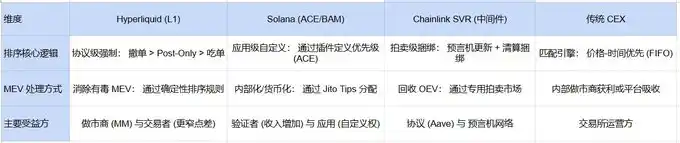
Summary

If TPS is the entry ticket, then having only TPS is completely insufficient now. Custom ordering logic might not just be an innovation but a necessary path for putting transactions on-chain.

It might also be the beginning of DEXs surpassing CEXs.

İlgili Sorular

QWhat is the core argument of the article regarding the evolution of blockchain competition beyond TPS?

AThe article argues that competition between blockchains has moved beyond just transaction speed (TPS) and is now focused on the critical layer of 'transaction ordering' (sequencing). Effective and fair transaction ordering directly impacts market maker behavior, liquidity depth, and the overall user experience, making it a decisive factor for success.

QHow does transaction ordering on a blockchain negatively impact market makers, according to the article?

AIn a default 'gas-first' ordering system, market makers are vulnerable to being sniped. When an asset's price moves, a high-frequency trader can pay a higher gas fee to have their 'take order' (e.g., buying the asset at a low price) processed before the market maker's 'cancel order' (e.g., trying to withdraw their offer). This forces the market maker to buy the asset back at their own, now outdated, higher price, leading to losses and causing them to widen their spreads to mitigate risk.

QWhat is 'Application-Aware Sequencing' and can you name a project that implements it at the consensus layer?

A'Application-Aware Sequencing' is an innovative approach where the sequencing logic understands the intent of transactions (e.g., a cancelation vs. a trade) and orders them based on predefined fairness rules, not just gas fees. Hyperliquid is a prime example that implements this at the consensus layer by mandating that cancel and post-only orders are always prioritized over others, ensuring market makers can escape unfavorable positions.

QBesides consensus-layer changes, what other method does the article mention for improving transaction ordering on Solana?

AThe article mentions Solana's Application Controlled Execution (ACE) and the Block Assembly Marketplace (BAM) developed by Jito Labs. This allows decentralized exchanges (DEXs) like Jupiter and Drift to register custom ordering rules (e.g., market maker priority) with specialized BAM nodes, which operate in a Trusted Execution Environment (TEE) for privacy and fairness.

QHow does Chainlink's Smart Value Recapture (SVR) model change who benefits from MEV generated by oracle price updates?

AChainlink's SVR model changes MEV distribution by creating a two-path system for oracle price updates. After generating a new price, Chainlink nodes send it through a public channel (with a slight delay) and a private channel to a MEV auction market (like Flashbots MEV-Share). This allows the value from auctions for liquidation trades triggered by the price update to be captured mostly by the SVR protocol itself, rather than being kept entirely by miners/validators.

İlgili Okumalar

Gensyn AI: Don't Let AI Repeat the Mistakes of the Internet

In recent months, the rapid growth of the AI industry has attracted significant talent from the crypto sector. A persistent question among researchers intersecting both fields is whether blockchain can become a foundational part of AI infrastructure. While many previous AI and Crypto projects focused on application layers (like AI Agents, on-chain reasoning, data markets, and compute rentals), few achieved viable commercial models. Gensyn differentiates itself by targeting the most critical and expensive layer of AI: model training. Gensyn aims to organize globally distributed GPU resources into an open AI training network. Developers can submit training tasks, nodes provide computational power, and the network verifies results while distributing incentives. The core issue addressed is not decentralization for its own sake, but the increasing centralization of compute power among tech giants. In the era of large models, access to GPUs (like the H100) has become a decisive bottleneck, dictating the pace of AI development. Major AI companies are heavily dependent on large cloud providers for compute resources. Gensyn's approach is significant for several reasons: 1) It operates at the core infrastructure layer (model training), the most resource-intensive and technically demanding part of the AI value chain. 2) It proposes a more open, collaborative model for compute, potentially increasing resource utilization by dynamically pooling idle GPUs, similar to early cloud computing logic. 3) Its technical moat lies in solving complex challenges like verifying training results, ensuring node honesty, and maintaining reliability in a distributed environment—making it more of a deep-tech infrastructure company. 4) It targets a validated, high-growth market with genuine demand, rather than pursuing blockchain integration without purpose. Ultimately, the boundaries between Crypto and AI are blurring. AI requires global resource coordination, incentive mechanisms, and collaborative systems—areas where crypto-native solutions excel. Gensyn represents a step toward making advanced training capabilities more accessible and collaborative, moving beyond a niche controlled by a few giants. If successful, it could evolve into a fundamental piece of AI infrastructure, where the most enduring value in the AI era is often created.

marsbit9 saat önce

Gensyn AI: Don't Let AI Repeat the Mistakes of the Internet

marsbit9 saat önce

Why is China's AI Developing So Fast? The Answer Lies Inside the Labs

A US researcher's visit to China's top AI labs reveals distinct cultural and organizational factors driving China's rapid AI development. While talent, data, and compute are similar to the West, Chinese labs excel through a pragmatic, execution-focused culture: less emphasis on individual stardom and conceptual debate, and more on teamwork, engineering optimization, and mastering the full tech stack. A key advantage is the integration of young students and researchers who approach model-building with fresh perspectives and low ego, prioritizing collective progress over personal credit. This contrasts with the US culture of self-promotion and "star scientist" narratives. Chinese labs also exhibit a strong "build, don't buy" mentality, preferring to develop core capabilities—like data pipelines and environments—in-house rather than relying on external services. The ecosystem feels more collaborative than tribal, with mutual respect among labs. While government support exists, its scale is unclear, and technical decisions appear driven by labs, not state mandates. Chinese companies across sectors, from platforms to consumer tech, are building their own foundational models to control their tech destiny, reflecting a broader cultural drive for technological sovereignty. Demand for AI is emerging, with spending patterns potentially mirroring cloud infrastructure more than traditional SaaS. Despite challenges like a less mature data industry and GPU shortages, Chinese labs are propelled by vast talent, rapid iteration, and deep integration with the open-source community. The competition is evolving beyond a pure model race into a contest of organizational execution, developer ecosystems, and industrial pragmatism.

marsbit11 saat önce

Why is China's AI Developing So Fast? The Answer Lies Inside the Labs

marsbit11 saat önce

3 Years, 5 Times: The Rebirth of a Century-Old Glass Factory

Corning, a 175-year-old glass company, is experiencing a dramatic revival as a key player in AI infrastructure, driven by surging demand for high-performance optical fiber in data centers. AI data centers require vastly more fiber than traditional ones—5 to 10 times as much per rack—to handle high-speed data transmission between GPUs. This structural demand shift, coupled with supply constraints from the lengthy expansion cycle for fiber preforms, has created a significant supply-demand gap. Nvidia has invested in Corning, along with Lumentum and Coherent, in a $4.5 billion total commitment to secure the optical supply chain for AI. Corning's competitive edge lies in its expertise in producing ultra-low-loss, high-density, and bend-resistant specialty fiber, which is critical for 800G+ and future 1.6T data rates. Its deep involvement in co-packaged optics (CPO) with partners like Nvidia further solidifies its position. While not the largest fiber manufacturer globally, Corning's revenue from enterprise/data center clients now exceeds 40% of its optical communications sales, and it has secured multi-year supply agreements with major hyperscalers including Meta and Nvidia. Financially, Corning's optical communications revenue has surged, doubling from $1.3 billion in 2023 to over $3 billion in 2025. Its stock price has risen nearly 6-fold since late 2023. Key future catalysts include the rollout of Nvidia's CPO products and the scale of undisclosed customer agreements. However, risks include high current valuations and potential disruption from next-generation technologies like hollow-core fiber. The company's long-term bet on light over electricity, maintained even through the telecom bubble crash, is now being validated by the AI boom.

marsbit11 saat önce

3 Years, 5 Times: The Rebirth of a Century-Old Glass Factory

marsbit11 saat önce

İşlemler

Spot
Futures

Popüler Makaleler

CC Nasıl Satın Alınır

HTX.com’a hoş geldiniz! CC(Canton) (CC) satın alma işlemlerini basit ve kullanışlı bir hâle getirdik. Adım adım açıkladığımız rehberimizi takip ederek kripto yolculuğunuza başlayın. 1. Adım: HTX Hesabınızı OluşturunHTX'te ücretsiz bir hesap açmak için e-posta adresinizi veya telefon numaranızı kullanın. Sorunsuzca kaydolun ve tüm özelliklerin kilidini açın. Hesabımı Aç2. Adım: Kripto Satın Al Bölümüne Gidin ve Ödeme Yönteminizi SeçinKredi/Banka Kartı: Visa veya Mastercard'ınızı kullanarak anında CC(Canton) (CC) satın alın.Bakiye: Sorunsuz bir şekilde işlem yapmak için HTX hesap bakiyenizdeki fonları kullanın.Üçüncü Taraflar: Kullanımı kolaylaştırmak için Google Pay ve Apple Pay gibi popüler ödeme yöntemlerini ekledik.P2P: HTX'teki diğer kullanıcılarla doğrudan işlem yapın.Borsa Dışı (OTC): Yatırımcılar için kişiye özel hizmetler ve rekabetçi döviz kurları sunuyoruz.3. Adım: CC(Canton) (CC) Varlıklarınızı SaklayınCC(Canton) (CC) satın aldıktan sonra HTX hesabınızda saklayın. Alternatif olarak, blok zinciri transferi yoluyla başka bir yere gönderebilir veya diğer kripto para birimlerini takas etmek için kullanabilirsiniz.4. Adım: CC(Canton) (CC) Varlıklarınızla İşlem YapınHTX'in spot piyasasında CC(Canton) (CC) ile kolayca işlemler yapın.Hesabınıza erişin, işlem çiftinizi seçin, işlemlerinizi gerçekleştirin ve gerçek zamanlı olarak izleyin. Hem yeni başlayanlar hem de deneyimli yatırımcılar için kullanıcı dostu bir deneyim sunuyoruz.

187 Toplam GörüntülenmeYayınlanma 2026.04.21Güncellenme 2026.04.21

CC Nasıl Satın Alınır

BLEND Nasıl Satın Alınır

HTX.com’a hoş geldiniz! Fluent (BLEND) satın alma işlemlerini basit ve kullanışlı bir hâle getirdik. Adım adım açıkladığımız rehberimizi takip ederek kripto yolculuğunuza başlayın. 1. Adım: HTX Hesabınızı OluşturunHTX'te ücretsiz bir hesap açmak için e-posta adresinizi veya telefon numaranızı kullanın. Sorunsuzca kaydolun ve tüm özelliklerin kilidini açın. Hesabımı Aç2. Adım: Kripto Satın Al Bölümüne Gidin ve Ödeme Yönteminizi SeçinKredi/Banka Kartı: Visa veya Mastercard'ınızı kullanarak anında Fluent (BLEND) satın alın.Bakiye: Sorunsuz bir şekilde işlem yapmak için HTX hesap bakiyenizdeki fonları kullanın.Üçüncü Taraflar: Kullanımı kolaylaştırmak için Google Pay ve Apple Pay gibi popüler ödeme yöntemlerini ekledik.P2P: HTX'teki diğer kullanıcılarla doğrudan işlem yapın.Borsa Dışı (OTC): Yatırımcılar için kişiye özel hizmetler ve rekabetçi döviz kurları sunuyoruz.3. Adım: Fluent (BLEND) Varlıklarınızı SaklayınFluent (BLEND) satın aldıktan sonra HTX hesabınızda saklayın. Alternatif olarak, blok zinciri transferi yoluyla başka bir yere gönderebilir veya diğer kripto para birimlerini takas etmek için kullanabilirsiniz.4. Adım: Fluent (BLEND) Varlıklarınızla İşlem YapınHTX'in spot piyasasında Fluent (BLEND) ile kolayca işlemler yapın.Hesabınıza erişin, işlem çiftinizi seçin, işlemlerinizi gerçekleştirin ve gerçek zamanlı olarak izleyin. Hem yeni başlayanlar hem de deneyimli yatırımcılar için kullanıcı dostu bir deneyim sunuyoruz.

170 Toplam GörüntülenmeYayınlanma 2026.04.24Güncellenme 2026.04.24

BLEND Nasıl Satın Alınır

ACN Nasıl Satın Alınır

HTX.com’a hoş geldiniz! AITECH CLOUD NETWORK (ACN) satın alma işlemlerini basit ve kullanışlı bir hâle getirdik. Adım adım açıkladığımız rehberimizi takip ederek kripto yolculuğunuza başlayın. 1. Adım: HTX Hesabınızı OluşturunHTX'te ücretsiz bir hesap açmak için e-posta adresinizi veya telefon numaranızı kullanın. Sorunsuzca kaydolun ve tüm özelliklerin kilidini açın. Hesabımı Aç2. Adım: Kripto Satın Al Bölümüne Gidin ve Ödeme Yönteminizi SeçinKredi/Banka Kartı: Visa veya Mastercard'ınızı kullanarak anında AITECH CLOUD NETWORK (ACN) satın alın.Bakiye: Sorunsuz bir şekilde işlem yapmak için HTX hesap bakiyenizdeki fonları kullanın.Üçüncü Taraflar: Kullanımı kolaylaştırmak için Google Pay ve Apple Pay gibi popüler ödeme yöntemlerini ekledik.P2P: HTX'teki diğer kullanıcılarla doğrudan işlem yapın.Borsa Dışı (OTC): Yatırımcılar için kişiye özel hizmetler ve rekabetçi döviz kurları sunuyoruz.3. Adım: AITECH CLOUD NETWORK (ACN) Varlıklarınızı SaklayınAITECH CLOUD NETWORK (ACN) satın aldıktan sonra HTX hesabınızda saklayın. Alternatif olarak, blok zinciri transferi yoluyla başka bir yere gönderebilir veya diğer kripto para birimlerini takas etmek için kullanabilirsiniz.4. Adım: AITECH CLOUD NETWORK (ACN) Varlıklarınızla İşlem YapınHTX'in spot piyasasında AITECH CLOUD NETWORK (ACN) ile kolayca işlemler yapın.Hesabınıza erişin, işlem çiftinizi seçin, işlemlerinizi gerçekleştirin ve gerçek zamanlı olarak izleyin. Hem yeni başlayanlar hem de deneyimli yatırımcılar için kullanıcı dostu bir deneyim sunuyoruz.

109 Toplam GörüntülenmeYayınlanma 2026.04.28Güncellenme 2026.04.28

ACN Nasıl Satın Alınır

Tartışmalar

HTX Topluluğuna hoş geldiniz. Burada, en son platform gelişmeleri hakkında bilgi sahibi olabilir ve profesyonel piyasa görüşlerine erişebilirsiniz. Kullanıcıların A (A) fiyatı hakkındaki görüşleri aşağıda sunulmaktadır.

活动图片














