Top Audit Guru Alerts: All DeFi is Unsafe, Withdraw Now!

Odaily星球日报2026-05-28 tarihinde yayınlandı2026-05-28 tarihinde güncellendi

Özet

Leading DeFi security auditor and OpenZeppelin founder Manuel Aráoz has issued a stark warning, declaring all DeFi protocols unsafe and advising the withdrawal of funds, even from established platforms like Aave and MakerDAO. This warning stems from the rapidly growing threat posed by AI-powered hacking tools. Aráoz highlights that AI agents can now identify and exploit smart contract vulnerabilities in minutes, a task that previously took expert teams weeks. This creates a critical asymmetry: defenders must patch every flaw, while attackers need only find one. Recent months have seen a surge in high-profile exploits, with billions lost in April and May alone across protocols like Drift Protocol, Kelp DAO, and THORChain. The acceleration is attributed to AI's ability to perform rapid code scanning, generate automated attack scripts, and even orchestrate social engineering and infrastructure attacks faster than human defenders can respond. The article cites Anthropic's powerful new AI model, Mythos, which demonstrated such proficiency in finding zero-day vulnerabilities that its public release was delayed over security concerns. This evolution fundamentally disrupts DeFi's risk-reward calculus. With yields on reliable protocols falling to single digits, users now face the potential of 100% capital loss for minimal returns. Aráoz's conclusion is that for most users, withdrawing funds to secure wallets is the most rational risk-management choice in the current landscape.

Original | Odaily Planet Daily (@OdailyChina)

Author | Azuma (@azuma_eth)

"I believe all DeFi is no longer secure."

This assertion left by Manuel Aráoz, founder of OpenZeppelin, on X yesterday is like a depth charge, once again shaking the already stagnant DeFi market.
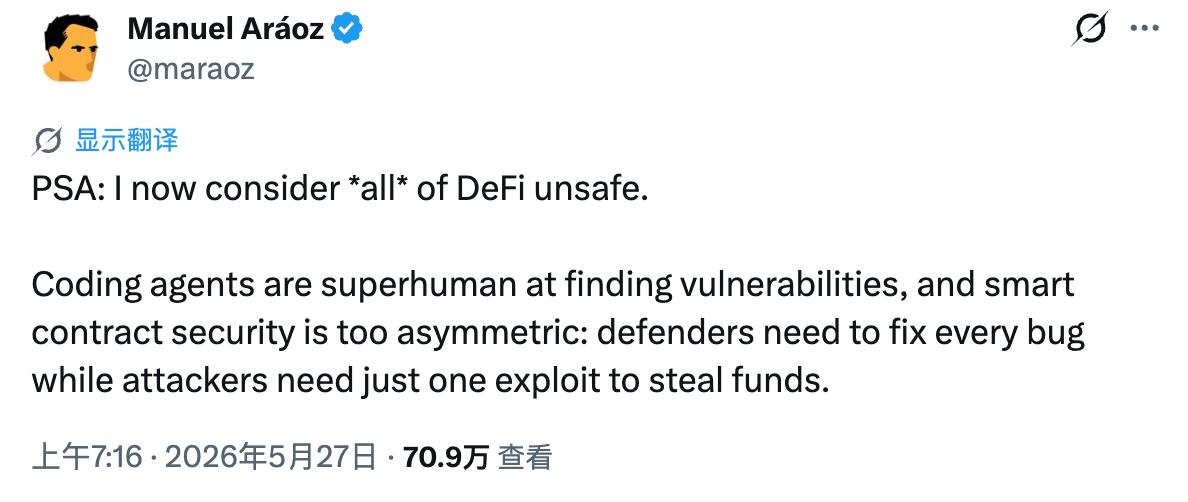
Manuel even stated that he has started advising friends and family to withdraw funds from major DeFi protocols, including blue-chip protocols like Aave, MakerDAO, and Compound, which were once considered low-risk.

This is not alarmist talk from an outsider. On the contrary, Manuel himself is one of the core builders of the DeFi security ecosystem, and OpenZeppelin is one of the industry's most mainstream security auditing firms. Its contract libraries, security standards, and auditing frameworks have permeated almost the entire DeFi world.

The reason for Manuel's complete change in attitude lies in AI. Manuel pessimistically believes that the capability of AI Coding Agents to identify and exploit smart contract vulnerabilities is increasing exponentially.

This means that issues which previously took top white-hat teams weeks to discover might now be scanned by AI in minutes; where hackers needed to study protocol logic extensively, AI can now automatically analyze attack paths; where DeFi's "openness and transparency" was once an advantage, it has now become the best training corpus for attackers.

Manuel also mentioned a more fatal problem: smart contract security is essentially an extremely asymmetric game — defenders must patch all vulnerabilities, while attackers only need to find one to steal funds. As AI begins to exponentially enhance attack efficiency, this asymmetry is rapidly tilting out of balance.

The Icy Reality: DeFi Has Become a Hacker's ATM

Looking back at DeFi security incidents over the past few months, you'll find Manuel's concerns are not exaggerated.

April was arguably one of the worst months in DeFi history.

  • On April 1st, April Fool's Day, Drift Protocol suffered a theft of $280 million due to a manager privilege hijacking and multisig execution vulnerability (see April Fool's Joke? Drift Protocol Hacked for Over $280 Million, Possibly Becoming Solana Ecosystem's Second Largest DeFi Heist).
  • Subsequently on April 19th, Kelp DAO lost $292 million due to a breached bridge protocol (see Another $292 Million Stolen from DeFi, Is Even Aave Unsafe Now?). The hacker later escaped via lending protocols like Aave, casting a shadow of bad debts and their ripple effects over the entire DeFi space.

And since entering May, incidents have not decreased but rather further proliferated.

  • On May 15th, THORChain was attacked. A newly added node operator exploited a vulnerability in the GG20 threshold signature scheme (TSS) to reconstruct the vault's private key and directly execute outbound transactions, causing a loss exceeding $10 million.
  • On May 18th, Verus's bridge protocol was attacked. The attacker forged cross-chain import payloads to bypass verification and extract assets from the Ethereum reserves, stealing approximately $11.58 million.
  • On May 19th, Echo Protocol on Monad was attacked due to a private key leak. The attacker minted 1,000 eBTC (worth $76.7 million) and extracted funds via a previously tested attack path through Curvance.
  • On May 24th, StablR, a compliant stablecoin issuer under the MiCA regulatory framework, was attacked. The hacker profited over $2.8 million by minting EURR and USDR, causing EURR and USDR to depeg.
  • On May 25th, the SquidRouter module was attacked, resulting in the theft of approximately $3 million in assets from 86 Gnosis Safe wallets.
  • On May 27th, the StakeDAO deployer's private key was leaked on Arbitrum. The attacker minted about 5.45 trillion vsdCRV and partially exchanged them for 43.7 ETH to escape.

Frequently occurring security incidents have sounded the alarm. From on-chain code to off-chain management, DeFi seems to be losing ground across the board.

AI Has Become the Hacker's Nuclear Weapon

Why has the DeFi offensive-defensive balance suddenly collapsed this summer? Beyond the evolution of traditional hacking techniques, the rapid advancement of AI large language model capabilities is becoming the ultimate factor tipping the scales.

In the past, finding a complex smart contract vulnerability (especially one involving cross-chain interactions, multi-layer nesting, or extremely hidden reentrancy logic) required top-tier hackers weeks or even months of code analysis. However, with the maturation of AI agents possessing ultra-long context, strong logical reasoning, and autonomous tool-calling abilities, this has undergone a qualitative change.

  • Second-level Scanning and Global "Zero-day Vulnerability" Mining: Attackers only need to feed open-source code repositories to new-generation AI reasoning models, and AI can, within seconds, deduce hundreds of extreme interaction scenarios like a seasoned security expert, precisely identifying boundary conditions that human auditors might miss due to fatigue.
  • Automated Attack Script Generation: AI can not only discover vulnerabilities but also automatically write, test, and deploy "hacker smart contracts" designed to extract funds.
  • Perfect Orchestration of Off-chain DevOps and Social Engineering: AI can impersonate a perfect developer for phishing or monitor a DeFi team's GitHub commits 24/7. Once the team uploads code containing sensitive information or unverified fixes, AI can launch an attack within seconds—far faster than any human security personnel can respond.

In this AI-augmented security war, hackers, armed with AI, possess nearly unlimited ammunition and attack speeds measured in seconds. In contrast, DeFi, constrained by slow-paced governance voting, multisig confirmations, and delayed security audits, struggles to mount a corresponding defense.

Last month, Anthropic, the AI development company behind Claude, officially announced its new-generation model, Mythos (see Anthropic Develops the Most Powerful AI Model in History, But Dares Not Release It...). This is the first model in human history to exceed ten trillion parameters (in contrast, current mainstream models range from hundreds of billions to one trillion parameters), with a staggering training cost of $10 billion.

However, due to Mythos's specialized capabilities in cybersecurity (Anthropic disclosed that they identified thousands of zero-day vulnerabilities using Mythos in just a few weeks), the company even dares not release the model publicly directly, fearing malicious use by hacker groups. Instead, they plan to allow leading tech giants to test it first through a "Project Glasswing" to patch potential vulnerabilities in advance.

If the current DeFi security landscape is already this severe, it's hard to imagine what new threats industry security defenses will face once Mythos is publicly released.

The Biggest Problem: The Risk-Reward Ratio Has Long Been Out of Balance

For ordinary DeFi participants, liquidity providers (LPs), and whales, the most important issue now is to sit down and do the math.

For a long time, the reason users chose to deposit funds into DeFi was the pursuit of annualized yields several times higher than those in traditional finance. During bull markets or frenzied periods of liquidity mining, yields of 10%, 20%, or even higher were enough to cover people's psychological expectations for "potential technical risks."

But today, this underlying logic has long been shaken, even overturned. The risk-reward ratio of DeFi is already out of balance. On the reward side, as the market enters a phase of stock game competition and security cushions thicken, the real yields of most mainstream, relatively reliable DeFi protocols have fallen back to single-digit percentages. On the risk side, users' principal is exposed to a black box that could be breached by AI at any moment, emptied by flash loans in an instant. Once a protocol is hacked, token prices plummeting to zero and liquidity pools being drained often happen within minutes, with no legal recourse, insurance, or central bank to cover the losses.

The gamble of risking 100% principal loss for an annualized return of around 5% is clearly not a worthwhile bet.

Manuel's words may be somewhat absolute, but they tear off DeFi's final fig leaf. In the face of the reality where hackers have made AI a conventional weapon and security incidents keep erupting in the industry, if you are not mentally prepared to risk losing 100% of your principal for a certain return, then "withdrawing funds as soon as possible and securing profits" might be the most rational, most risk-control-compliant choice in the current market cycle.


İlgili Sorular

QAccording to the article, who is Manuel Aráoz and why is his warning about DeFi security considered significant?

AManuel Aráoz is the founder of OpenZeppelin, a leading security audit firm in the crypto industry. His warning is significant because he is a core builder of the DeFi security system, and his company's contract libraries, security standards, and audit frameworks are widely used across the DeFi ecosystem. His shift in stance carries substantial weight due to his deep expertise and role in the industry.

QWhat is the primary reason cited by Manuel Aráoz for his belief that all DeFi is now insecure?

AThe primary reason is the exponential improvement in AI (specifically AI Coding Agents) in identifying and exploiting smart contract vulnerabilities. AI can now find issues in minutes that once took top security teams weeks, automate the analysis of attack paths, and leverage the public nature of DeFi code as training data. This massively amplifies the inherent asymmetry in security where attackers need only find one flaw while defenders must patch all of them.

QWhat is the 'Mythos' model mentioned in the article, and why is it considered a potential threat?

AMythos is a new AI model developed by Anthropic, the company behind Claude. It is the first model to surpass 10 trillion parameters, with a training cost of $10 billion. It is considered a potential threat because Anthropic disclosed that in just a few weeks, Mythos identified thousands of zero-day vulnerabilities. Due to its specialized capabilities in cybersecurity, Anthropic is hesitant to release it publicly for fear it could be maliciously used by hackers to exploit vulnerabilities at an unprecedented scale.

QThe article argues that the risk-reward ratio for DeFi participation has become unbalanced. What is the core of this argument?

AThe core argument is that the potential rewards (returns) from mainstream DeFi protocols have fallen to single-digit percentages in the current market, while the risks have skyrocketed. Users now risk losing 100% of their principal in minutes due to AI-enhanced hacks, with no legal recourse, insurance, or central bank backstop. The article frames this as an irrational trade-off: risking total loss for a relatively low annual yield.

QBesides smart contract code, what other aspects of DeFi infrastructure have been targeted in recent hacks according to the article's examples?

ARecent hacks have targeted vulnerabilities beyond just smart contract code. Examples include bridge protocols (Kelp DAO, Verus), management/private key compromises (Drift Protocol, StakeDAO, Echo Protocol), threshold signature schemes (THORChain), and wallet management modules (SquidRouter). This indicates that security weaknesses exist across the entire DeFi stack, from on-chain code to off-chain operational and key management practices.

İlgili Okumalar

After Three Consecutive Quarters of Decline, Can the Crypto Market Find a Window for Stabilization in Q3?

The cryptocurrency market has just concluded its worst-performing quarter since 2022, with total capitalization dropping 12.6% to $2.1 trillion. All core metrics indicate capital is leaving the sector, not just rotating within it. Bitcoin fell 14.2% and Ethereum dropped 25.4% in Q2, breaking their previous correlation with US tech stocks. A key driver is the reversal in US spot Bitcoin ETF flows, which saw a net outflow of approximately $4.67 billion in Q2, including a record monthly outflow near $4.5 billion in June. While recent data suggests long-term holders are accumulating again, sustained ETF outflows mean continued selling pressure. Market focus is now singularly on the Federal Reserve. The upcoming July FOMC meeting is seen as the most critical event for Q3. A dovish signal could support Bitcoin reclaiming a $68,000-$84,000 range, while a hawkish stance might establish a new trading band around $50,000-$56,000. Additionally, regulatory uncertainty persists, with the progress of the crucial *CLARITY Act* stalling in the Senate, reducing its perceived 2026 passage probability to 40-45%. Despite the broad downturn, a few sectors showed growth. Prediction markets saw nominal volume surge 48.7% year-over-year to $113.8 billion, and tokenized collectibles transaction volume rose 143% quarterly to $1.4 billion. The Real-World Asset (RWA) tokenization sector also continued steady growth, now representing ~$28.1 billion in on-chain value. The market's foundation for an extreme crash appears limited, with Bitcoin price hovering near its 200-week moving average. However, the trading paradigm has shifted from narrative-driven speculation to decisions based on price action, policy developments, and interest rate expectations, making a broad sentiment-driven rally unlikely in the near term.

marsbit5 dk önce

After Three Consecutive Quarters of Decline, Can the Crypto Market Find a Window for Stabilization in Q3?

marsbit5 dk önce

BIT Trading Moment: BTC Still Suppressed by Weekly 200 EMA, Rejection May Restart Decline; Storage and Semiconductors that Surged Last Night Begin Falling in Evening Trading

**Crypto & Stock Market Wrap: Bitcoin Tests Resistance, Stocks Retreat After AI Surge** Bitcoin consolidates around $66,000, facing key resistance near $68,000—an area seen as a major psychological and technical hurdle where previous rallies have failed. Analysts note the cryptocurrency is caught between its 200-week moving average (~$63,333) and 200-week EMA (~$68,328). A clear break above $68k is needed to signal a stronger bullish trend, while a rejection could lead to a retest of $63k support. Market sentiment remains cautious, with low futures open interest pointing to a low-liquidity rebound rather than a full bull market. Bitcoin spot ETFs saw another $203 million inflow. US stock futures pointed lower after a strong Tuesday session led by a massive rebound in semiconductors and memory stocks. The rally was fueled by renewed optimism about AI-driven hardware demand, with Micron, SanDisk, and SK Hynix surging. However, those gains reversed in pre-market trading. Super Micro Computer (SMCI) soared over 20% after hours on strong guidance and a record backlog. Other standouts included Rocket Lab and nuclear energy plays Oklo and X-Energy. Rising oil prices (Brent above $91) and climbing Treasury yields (10-year near 4.64%), however, are reigniting inflation concerns and acting as a headwind for equities. In Asia, markets were mixed. South Korea's KOSPI pared early gains to close slightly higher as semiconductor stocks like SK Hynix gave back initial surges. Japan's Nikkei edged lower as the yen hit a fresh 38-year low against the dollar, raising fears of potential market intervention. Key events to watch include the Samsung Galaxy launch, AMD's AI event, and a slew of major tech earnings from Alphabet, Tesla, and IBM after the close on Wednesday, followed by the ECB meeting and Intel's earnings on Thursday.

marsbit13 dk önce

BIT Trading Moment: BTC Still Suppressed by Weekly 200 EMA, Rejection May Restart Decline; Storage and Semiconductors that Surged Last Night Begin Falling in Evening Trading

marsbit13 dk önce

Former CFTC Chairman, Circle President Tarbert: Preaching Long-Termism While Cashing Out $30 Million Himself

Former CFTC Chairman and Circle President Heath Tarbert has consistently advocated for a long-term vision in public, urging patience from investors as Circle’s stock price has fallen significantly from its peak. However, it has been revealed that since Circle’s IPO, Tarbert has continuously sold his CRCL shares through pre-arranged trading plans, cashing out approximately $30 million, without making any public market purchases. This contrast between his public messaging and personal actions has drawn criticism. Tarbert joined Circle in July 2023 as Chief Legal Officer, leveraging his regulatory experience to help guide the company through its IPO and expansion. Despite promoting stablecoins as long-term infrastructure, he established a 10b5-1 trading plan just before Circle went public, leading to substantial stock sales over the following year. In March 2026, he initiated another plan to sell more shares. His career trajectory highlights a pattern of moving between high-level regulatory roles and influential positions in the financial sector. After resigning as CFTC Chairman in early 2021, he joined Citadel Securities as Chief Legal Officer just 27 days later, during a period of intense regulatory scrutiny for the firm. He later joined Circle, aiding its efforts to navigate regulatory challenges for its public listing. While Tarbert's expertise in policy and compliance is valuable to companies like Circle, his actions—advocating long-term confidence while personally divesting—raise questions about the alignment between his public statements and his private financial decisions, leaving investors who followed his advice to bear the market risks.

marsbit36 dk önce

Former CFTC Chairman, Circle President Tarbert: Preaching Long-Termism While Cashing Out $30 Million Himself

marsbit36 dk önce

Gate Research Institute: The 'Wall Street-ization' Wave of Crypto Financial Products – Competition or Integration?

The article titled "Gate Research Institute: Are Crypto Financial Products Sparking a 'Wall Street' Wave—Competition or Convergence?" explores the evolving relationship between the crypto ecosystem and traditional finance (TradFi). The piece begins by reflecting on Bitcoin's original 2009 vision of decentralization, disintermediation, and moving away from banks. It then contrasts this with the 2024 landscape, where key crypto assets like Bitcoin are increasingly held through Wall Street products like ETFs issued by giants like BlackRock. The article questions whether this signifies that TradFi is systematically taking over the rights to issue, price, custody, and distribute crypto financial assets. The core argument is that this is not a zero-sum takeover but rather a bidirectional convergence where each side addresses the other's weaknesses. Crypto offers 24/7 global markets, programmable settlement, and open access but lacks compliant channels, institutional-grade custody, deep fiat liquidity, and mainstream distribution. TradFi possesses these but is constrained by legacy systems, limited operating hours, and slow settlement. Two primary convergence paths are highlighted: * **Path A (CEX to TradFi):** Exemplified by Gate, which has progressed from offering tokenized stocks and CFDs to providing direct, real stock trading (US, Hong Kong, South Korea) within its platform, using USDT. * **Path B (TradFi to Crypto):** Exemplified by Robinhood, which has integrated crypto trading, acquired exchanges like Bitstamp, and is moving traditional assets like stocks onto the blockchain via tokenization and its own Layer 2. Both paths are ultimately competing to become the next-generation, unified financial account—a "super account" where users can seamlessly trade cryptocurrencies, stocks, ETFs, RWA (Real World Assets), and tokenized treasury products in one interface. The growth of RWA and tokenized treasuries (e.g., BlackRock's BUIDL) is presented as the asset-layer fusion, providing stable, yield-bearing assets on-chain and acting as a bridge between the two worlds. In conclusion, the "Wall Street-ization" of crypto is framed as a mutual transformation. Decentralized ideals persist in the protocol layer, while at the application layer, a more efficient, global, and accessible unified capital market is emerging from this convergence. The future competition lies not between crypto exchanges and stockbrokers, but between platforms vying to offer the most comprehensive asset coverage, liquidity, and user experience within a single account.

marsbit40 dk önce

Gate Research Institute: The 'Wall Street-ization' Wave of Crypto Financial Products – Competition or Integration?

marsbit40 dk önce

İşlemler

Spot
活动图片




