TON Enters the Telegram Era: The On-Chain Experiment of Super Apps is Unfolding

marsbit2026-05-08 tarihinde yayınlandı2026-05-08 tarihinde güncellendi

Özet

The TON token recently surged nearly 120% in 4 days, approaching $3. This rally is primarily driven by Telegram founder Pavel Durov's announcement that Telegram will become the core driver of the TON network, replacing the TON Foundation and serving as its largest validator. This move signals a fundamental shift: Telegram is no longer just supporting TON from a distance but is formally taking over its governance and operations. This changes TON's valuation narrative from being a crypto project with Telegram's user base to becoming the foundational blockchain infrastructure for Telegram's future commercial ecosystem—transitioning from a crypto narrative to an internet-platform-level story. TON's recent technical upgrades focus on 10x faster speeds, 6x lower fees, and near-instant confirmations. These optimizations target Telegram's internal high-frequency, micro-transaction scenarios like tipping, bot services, and Mini App purchases. The goal is to enable seamless, near-zero-cost transactions for its nearly 1 billion users, making blockchain usage almost invisible—akin to platforms like WeChat Pay. TON's path is unique: it already has a massive user base and is building the blockchain system to serve it, aiming to onboard users into Web3 without them realizing it. The vision is to integrate wallet, payment, bot, and Mini App functionalities into a closed loop within Telegram, positioning TON as the value-exchange infrastructure for a super-app. In essence, this surge refl...

Author: Climber, CryptoPulse Labs

Recently, the TON token has experienced consecutive increases, rising approximately 120% over 4 days and approaching the $3 mark. The primary reason behind this surge is the public endorsement by Pavel Durov, the founder of Telegram.

He stated that Telegram will replace the TON Foundation, becoming the core driving force behind TON, and will serve as the largest validator for the TON network. Meanwhile, the TON network has also been continuously advancing technical upgrades, such as announcing a 10x increase in network speed performance and a 6x reduction in transaction fees.

On the surface, this appears to be a round of technical upgrades and narrative revival for TON. However, what the market is truly reassessing is not TON itself, but the fact that Telegram has begun, for the first time, to fully embark on a comprehensive on-chain transformation in a real sense.

I. Telegram Takes the Helm: TON's Valuation Logic Begins to Shift

Over the past few years, TON has occupied a very unique position. It is deeply intertwined with Telegram, yet the two have always maintained a certain distance.

The reason is quite simple. Early on, Telegram launched the Gram fundraising plan, which ultimately faced regulatory intervention from the U.S. SEC, forcing the project to be terminated. The community subsequently took over the project, gradually evolving into the current TON ecosystem.

Therefore, for a long time, although Telegram continued to support TON—including gradually integrating its wallet, bots, mini-apps, and advertising system with TON—it never truly assumed the role of the official driver of TON publicly.
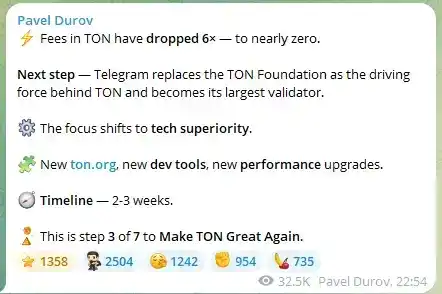
Pavel Durov's recent statements fundamentally alter market expectations. Particularly, the key points of Telegram replacing the TON Foundation and becoming the largest validator directly clarify that Telegram is now beginning to participate directly in the underlying governance and network operation of TON.

This is no longer just ecosystem support; it signifies Telegram formally reclaiming dominant control over TON's roadmap.

This shift is crucial because, in the past, the biggest question the market had about TON was not its technical capability but whether Telegram would truly go all-in on TON. Now, this question has a clear answer.

Simultaneously, this also means TON's valuation logic is changing. Previously, the market priced TON essentially as a public chain with Telegram's traffic support. But now, the market is beginning to reassess TON, as it is likely becoming the on-chain infrastructure within Telegram's future commercial ecosystem.

The difference between the two is significant. The former still belongs to the Crypto narrative, while the latter is beginning to enter the narrative of an internet-platform scale. This is also why TON's recent rise is not merely driven by sentiment but resembles a round of long-term expectation restructuring.

II. TON Reconstructs the Internet Payment Structure

Examining TON's recent rounds of upgrades closely reveals that its optimization direction is actually very clear: faster speed, lower fees, shorter confirmation times, and transaction fees approaching zero.

On the surface, these upgrades are optimizing chain performance, but what they are truly serving is not traditional DeFi but the large-scale payment application scenarios within Telegram.

Because Telegram itself has nearly 1 billion users, it inherently generates a vast amount of high-frequency, small-value transaction demand. Examples include content tipping, bot services, mini-app purchases, cross-border transfers, and digital goods consumption, among others.

These scenarios share a common need: users require extremely low costs and prioritize high speed.

If a payment takes tens of seconds to wait or incurs fees of several dollars, the entire user experience deteriorates significantly. Traditional blockchains have been particularly ill-suited for this type of scenario in the past.
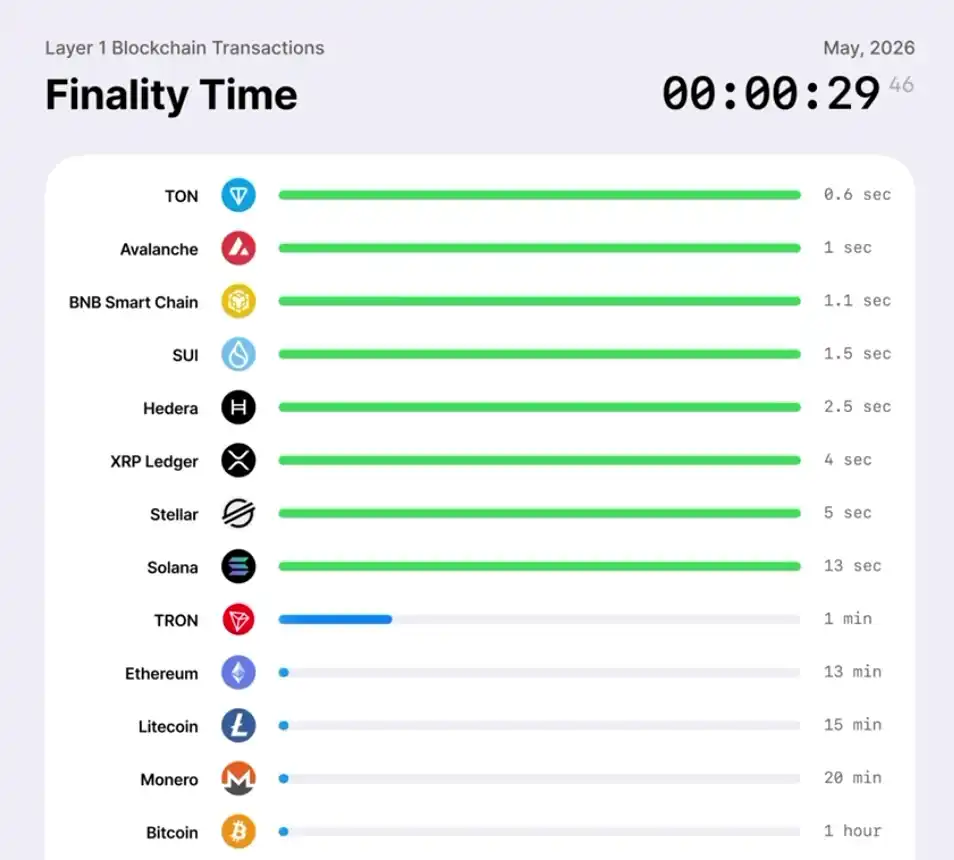
Therefore, TON's recent emphasis on fixed low fees and sub-second confirmations essentially revolves around redesigning blockchain for internet product experience. In other words, TON is attempting to solve a problem that Crypto has long failed to address: how to enable ordinary users to utilize on-chain systems almost imperceptibly.

This shift in logic is actually increasingly approaching the model of WeChat Pay.

Users don't need to understand blockchain, nor do they need to understand wallets, gas, or validation mechanisms. They only need to complete tipping, payments, purchases, transfers, and subscriptions, with all underlying settlements handled by TON.

This suggests that what TON truly aims to achieve may not be competition in the traditional L1 sense. What it is genuinely competing for is the global internet payment gateway.

Additionally, there is another crucial change. The logic of many public chains in the past has been: first build the infrastructure, then find users. But TON is the complete opposite. It first possesses a massive user base and then begins constructing the on-chain system.

Therefore, TON's challenge has never been how to get users into Web3, but rather how to enable users to complete on-chain actions without even realizing they are entering Web3. This represents a completely different development path.

III. TON's Future Blueprint: The On-Chain Transformation of Super Apps

Looking at all of TON's recent actions together, it becomes apparent that Telegram is gradually forming a complete closed loop. Functions that were originally separate—such as wallet, payments, bots, mini-apps, and on-chain settlements—are now gradually being integrated by TON.
This also signifies that TON is no longer just an independent public chain; it is becoming the infrastructure for value circulation within Telegram. The true significance of this lies in the fact that, for the first time, the crypto industry is approaching the on-chain transformation of super applications.

Because over the past decade, the crypto industry has always lacked a genuine mass-market entry point. Most public chains have been striving to attract users into the crypto world, but Telegram itself already possesses global-scale traffic.

Especially in markets like the Middle East, Russia, Eastern Europe, Southeast Asia, and Latin America, Telegram often functions not merely as a messaging tool but also as a community platform, commercial platform, payment tool, and more.

Therefore, TON's true strategic focus is not DeFi but rather global digital commercial scenarios.

Areas such as low-cost cross-border payments, the creator economy, on-chain micro-payments, and similar directions are likely the true sources of large-scale growth for TON in the future.

Of course, this path is not easy. TON's ecosystem remains in its early stages, with many applications still lingering in phases like mini-games, airdrops, and short-term traffic acquisition. Additionally, after Telegram's renewed deep involvement with TON, it may once again face regulatory pressure in the future.

Nevertheless, the market has now begun to realize one thing: TON's competitors may never have been traditional L1s, but rather the global internet payment systems.

Conclusion

This round of TON's rise is not essentially the market speculating on a simple upgrade. What truly drives the repricing of capital is the growing awareness that the world's first on-chain ecosystem with a genuine super-app entry point may have already begun to take shape.

And this time, Pavel Durov is no longer just an observer. Telegram is finally preparing to take the field itself.


Trend Kriptolar

İlgili Sorular

QAccording to the article, what was the main reason for the recent significant price surge of the TON token?

AThe primary reason for TON's recent price surge was Telegram founder Pavel Durov's public announcement that Telegram will become the core driver behind the TON network, replacing the TON Foundation and becoming its largest validator.

QHow has Pavel Durov's statement fundamentally changed the market's perception of TON's valuation logic?

AHis statement shifted TON's valuation logic from being a crypto-native public chain with Telegram's traffic support to potentially becoming the on-chain infrastructure for Telegram's future commercial ecosystem, moving from a crypto narrative to an internet platform-level narrative.

QWhat specific user needs is TON's recent technical optimization targeting, and what payment system is this approach compared to?

ATON's recent optimizations (faster speeds, lower fees, sub-second confirmation, near-zero costs) target the need for low-cost, high-speed, small-value transactions within Telegram (e.g., tipping, Bot services). This approach is compared to systems like WeChat Pay, aiming for users to use the on-chain system almost without awareness.

QWhat key advantage does TON possess compared to many other public blockchains regarding its development path?

AUnlike other blockchains that build infrastructure first and then seek users, TON already possesses a massive user base (Telegram's near 1 billion users) first, and is now building the on-chain system around that existing traffic.

QWhat does the article suggest is the true long-term competitor for TON, and what is its ultimate envisioned role?

AThe article suggests TON's true competitor is not traditional Layer 1 blockchains, but the global internet payment system. Its ultimate envisioned role is to become the on-chain value circulation infrastructure for the Telegram super-app, enabling global digital commercial scenarios like low-cost cross-border payments and the creator economy.

İlgili Okumalar

Dialogue with Jia Hang | Looking Back at Two Decades of Chinese Payment Going Global

**Summary: A Conversation with Jia Hang on Two Decades of China's Payment Globalization** Jia Hang, a veteran with over twenty years in payments, reflects on China's attempts to build a global payment network through three key phases: UnionPay (card networks), Alipay+ (digital wallets), and now, stablecoins. His journey began at UnionPay International, aiming to establish China's card network abroad. While successful in following Chinese tourists ("where Chinese go, UnionPay goes"), it struggled to achieve true global scale. The core lesson: card networks like Visa/Mastercard's unassailable advantage isn't just technical standards, but their deeply entrenched **governance and profit-sharing models** that create powerful network effects. Competing as the "same species" is nearly impossible. At Ant Group, he led Alipay+, a strategy to bypass card networks by interconnecting local e-wallets worldwide. While innovative, it faced a similar ceiling. Mobile QR payments and card swipes were essentially **the same species competing for the same pie**, lacking a disruptive value proposition for users or a sustainable new incentive model to replace the card networks' established flywheel. Today, at Singapore's DCS, Jia focuses on stablecoin-based payments. He argues stablecoins represent a fundamental shift. They are not competing with Visa for consumer payments but challenging the **traditional banking and account system for value movement**. Products like "U Cards" (stablecoin-linked payment cards) are transitional, leveraging existing card networks for acceptance while building new rails. The real potential lies in stablecoins enabling seamless, low-cost global value transfer, potentially reorganizing the financial infrastructure around **accounts rather than cards**. Jia believes stablecoin adoption for local retail payments, cross-border transactions, and as high-yield savings vehicles is becoming irreversible. This could gradually reduce reliance on traditional fiat channels, especially in regions with weak currencies or capital controls. The quest for the "next global payment network" continues, now centered on whether stablecoins can successfully bridge Web2 and Web3, establish new governance, and create compelling user value beyond mere cost reduction.

marsbit14 dk önce

Dialogue with Jia Hang | Looking Back at Two Decades of Chinese Payment Going Global

marsbit14 dk önce

Circle's Stock Price Plunges 76%, Hong Kong Dollar Stablecoin Set to Launch Within Two Weeks

Circle's stock price has plunged approximately 76% from its 2023 peak, reflecting a major market revaluation. Despite this, Circle President Heath Tarbert emphasized the company's focus on long-term execution and its dominant position with USDC's $73 billion circulation across 34 blockchains. The competitive landscape is intensifying. A new consortium-backed stablecoin, Open USD, is attempting to challenge incumbents by sharing reserve yields with partners. More significantly, Visa's new stablecoin platform, initially supporting Open USD while also being compatible with USDC, could erode Circle's network effects. In response, Circle is expanding into real-world payments through partnerships like the one with Japan's JCB. Separately, Tether (USDT) faces a two-year compliance window under new U.S. regulations, requiring it to adjust its reserve composition away from assets like Bitcoin and loans towards cash and U.S. Treasuries. Meanwhile, in Hong Kong, Standard Chartered-backed fintech firm Dian Dian is poised to launch a licensed HKD-pegged stablecoin (HKDAP), moving the industry into a phase where the real test is integrating licensed stablecoins into actual payment flows and corporate treasury systems. The sharp decline in Circle's stock underscores a broader shift: the stablecoin market is moving from a winner-takes-all dynamic to a multi-player competitive arena where execution, compliance, and real-world utility are becoming paramount.

marsbit15 dk önce

Circle's Stock Price Plunges 76%, Hong Kong Dollar Stablecoin Set to Launch Within Two Weeks

marsbit15 dk önce

Amidst Capital's Encirclement, Decentralization is the Sole Defense for Public Blockchains

In a landscape dominated by power and profit motives, the author argues that decentralization is not merely one desirable feature among many in blockchain design—it is the singular, non-negotiable defense against corporate and capital capture. The article adopts a Machiavellian, realist perspective on human institutions, positing that businesses will inevitably attempt to co-opt any valuable network to protect their profits and dominance. While external attacks like 51% forks are often discussed, the greater existential risk is internal capture—the gradual erosion of a protocol’s neutrality by vested interests, as seen historically with platforms like Visa and Google. The piece critiques permissioned chains, highly centralized “permissionless” layer-1s, and layer-2s without sufficient decentralization (e.g., single sequencers) as inherently vulnerable. These compromised systems, promoted by established financial players, are framed as delaying tactics to stifle truly open networks that threaten existing high-fee, inefficient business models. Real-world examples, such as closed enterprise consortiums that exclude competitors, illustrate how such systems cement oligopolies rather than foster innovation. The author concludes that while decentralized protocols like Ethereum are imperfect and costly to operate, they represent the only viable long-term equilibrium. In a market where value naturally flows to the most secure and neutral settlement layer, only maximally decentralized public blockchains can resist being subsumed by capital and powerful incumbents.

Foresight News25 dk önce

Amidst Capital's Encirclement, Decentralization is the Sole Defense for Public Blockchains

Foresight News25 dk önce

İşlemler

Spot

Popüler Makaleler

ERA Nasıl Satın Alınır

HTX.com’a hoş geldiniz! Caldera (ERA) satın alma işlemlerini basit ve kullanışlı bir hâle getirdik. Adım adım açıkladığımız rehberimizi takip ederek kripto yolculuğunuza başlayın. 1. Adım: HTX Hesabınızı OluşturunHTX'te ücretsiz bir hesap açmak için e-posta adresinizi veya telefon numaranızı kullanın. Sorunsuzca kaydolun ve tüm özelliklerin kilidini açın. Hesabımı Aç2. Adım: Kripto Satın Al Bölümüne Gidin ve Ödeme Yönteminizi SeçinKredi/Banka Kartı: Visa veya Mastercard'ınızı kullanarak anında Caldera (ERA) satın alın.Bakiye: Sorunsuz bir şekilde işlem yapmak için HTX hesap bakiyenizdeki fonları kullanın.Üçüncü Taraflar: Kullanımı kolaylaştırmak için Google Pay ve Apple Pay gibi popüler ödeme yöntemlerini ekledik.P2P: HTX'teki diğer kullanıcılarla doğrudan işlem yapın.Borsa Dışı (OTC): Yatırımcılar için kişiye özel hizmetler ve rekabetçi döviz kurları sunuyoruz.3. Adım: Caldera (ERA) Varlıklarınızı SaklayınCaldera (ERA) satın aldıktan sonra HTX hesabınızda saklayın. Alternatif olarak, blok zinciri transferi yoluyla başka bir yere gönderebilir veya diğer kripto para birimlerini takas etmek için kullanabilirsiniz.4. Adım: Caldera (ERA) Varlıklarınızla İşlem YapınHTX'in spot piyasasında Caldera (ERA) ile kolayca işlemler yapın.Hesabınıza erişin, işlem çiftinizi seçin, işlemlerinizi gerçekleştirin ve gerçek zamanlı olarak izleyin. Hem yeni başlayanlar hem de deneyimli yatırımcılar için kullanıcı dostu bir deneyim sunuyoruz.

581 Toplam GörüntülenmeYayınlanma 2025.07.17Güncellenme 2026.06.02

ERA Nasıl Satın Alınır

Tartışmalar

HTX Topluluğuna hoş geldiniz. Burada, en son platform gelişmeleri hakkında bilgi sahibi olabilir ve profesyonel piyasa görüşlerine erişebilirsiniz. Kullanıcıların ERA (ERA) fiyatı hakkındaki görüşleri aşağıda sunulmaktadır.

活动图片