Tom Lee Signals Market Bottom: Why Smart Money is Rotating into Quantum Security and BMIC

bitcoinist2026-02-09 tarihinde yayınlandı2026-02-09 tarihinde güncellendi

Özet

Tom Lee of Fundstrat signals a crypto market bottom, citing cooling inflation and Bitcoin's resilience. He suggests the narrative is shifting from survival to expansion, with new liquidity likely flowing into infrastructure that addresses existential threats like quantum computing. This creates a risk for traditional encryption and an opportunity for quantum-resistant solutions. BMIC ($BMIC) is highlighted as a project building a full quantum-secure finance stack, using post-quantum cryptography and ERC-4337 smart accounts to protect assets against future attacks. Its presale has raised over $444K, indicating early investor confidence. The token fuels a 'Quantum Meta-Cloud' and features a 'Burn-to-Compute' mechanism. The thesis is that as the market matures, the premium for quantum security will grow, and BMIC aims to become the standard for secure digital asset storage.

Fundstrat’s Head of Research, Tom Lee, is known for calling market reversals while everyone else is still panic-selling. His recent analysis suggests the crypto market bottom is already in, or at least dangerously close. Lee points to a ‘perfect storm’ of indicators: cooling inflation, the market finally absorbing the supply overhang from major bankruptcies, and Bitcoin’s surprising resilience during geopolitical tension. The ‘purge’ phase of the cycle, it seems, has concluded.

But staring at price action alone misses the point. The significance of a market bottom isn’t just that prices stop falling; it’s that the narrative shifts from survival to expansion. When liquidity returns (driven by the Fed’s inevitable pivot and ETF inflows), it doesn’t just flow back into the same old coins.

It seeks new infrastructure that solves existential threats. In previous cycles, we saw this capital flood into scaling solutions and DeFi primitives. This time? The next major rotation could prioritize security layers capable of handling institutional-grade value.

That matters because the ‘next leg up’ faces a technological cliff that previous bull runs didn’t: the looming threat of quantum computing. As asset values swell, the incentive to break current encryption standards grows exponentially.

This creates a massive blind spot where traditional wallets are essentially undervalued risks, and quantum-resistant infrastructure is the undetected alpha. Investors tracking Tom Lee’s ‘risk-on’ signals are now hunting for projects that secure the digital future against next-generation threats.

Enter BMIC ($BMIC), a project positioning itself as the fortified layer for this new liquidity cycle.

Institutional Inflows Demand Post-Quantum Armor

The ‘harvest now, decrypt later’ attack vector is perhaps the industry’s elephant in the room. State actors and sophisticated hacking groups are currently scraping encrypted data from blockchains, storing it, and simply waiting for quantum computing power to shatter standard RSA and Elliptic Curve Cryptography (ECC).

If Tom Lee’s prediction of Bitcoin reaching six figures holds true, the ‘honeypot’ for these attackers becomes worth trillions.

BMIC addresses this by offering what it claims to be the only platform with a full quantum-secure finance stack. Unlike legacy wallets that rely on encryption methods from the 1990s, BMIC uses post-quantum cryptography to ensure that assets stored today remain secure against tomorrow’s computational brute-force attacks. (And no, this isn’t just paranoia; it’s a mathematical necessity for any enterprise planning to hold digital assets for more than five years).
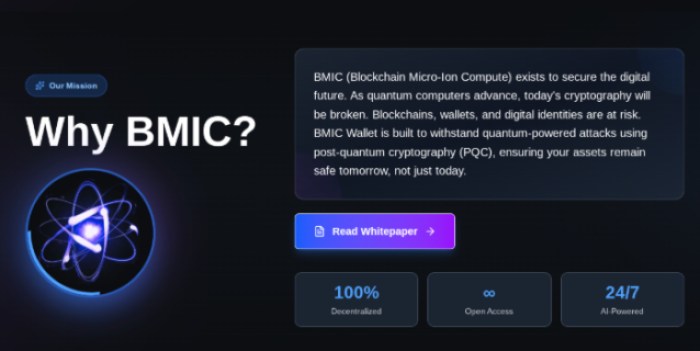
Beyond the encryption layer, the project integrates ERC-4337 smart accounts. This standard allows for ‘account abstraction,’ meaning users get the robust security of quantum resistance without the headache of managing complex seed phrases, often the biggest barrier for institutional clients. By combining AI-enhanced threat detection with zero public-key exposure, the protocol effectively creates a moat around user assets that even a quantum computer can’t cross.

LEARN MORE ABOUT THE $BMIC PRESALE

BMIC Presale Metrics Signal Early Adopter Confidence

While the herd waits for confirmation of the reversal Tom Lee predicts, smart money often moves into presales to maximize asymmetry. The current data from the BMIC raise indicates a disconnect between general market apathy and the high conviction of security-focused investors. $BMIC has raised over $444K, with tokens currently priced at $0.049474.

This capital raise is notable not just for the total, but for the utility of its funding. The $BMIC token isn’t merely a governance instrument; it acts as ecosystem fuel for the ‘Quantum Meta-Cloud’ and powers a unique ‘Burn-to-Compute’ mechanism. As the network grows, the demand for quantum-secure processing power drives token velocity. With what it’s offering its not surprising that we feel $BMIC is one of the best long-term crypto investments.

Investors analyzing the risk-reward ratio here are betting on a simple premise: as the crypto market matures, security premiums will likely skyrocket. The gap between a standard wallet and a quantum-secure wallet is currently priced at zero by the market. If BMIC succeeds in becoming the standard for post-quantum storage, that gap closes rapidly. With the presale still active, the entry point remains pegged to early development rather than the immense speculative value of the security narrative.

BUY YOUR $BMIC FROM THE OFFICIAL PRESALE PAGE

This article is for informational purposes only and does not constitute financial advice. Cryptocurrency investments, particularly in presale stages, carry high risks including total loss of capital. Always conduct your own due diligence.


İlgili Sorular

QAccording to Tom Lee, what are the key indicators suggesting the crypto market bottom is in or near?

ATom Lee points to a 'perfect storm' of indicators: cooling inflation, the market finally absorbing the supply overhang from major bankruptcies, and Bitcoin's surprising resilience during geopolitical tension.

QWhat is the 'harvest now, decrypt later' attack vector mentioned in the article?

AIt is an attack where state actors and sophisticated hacking groups scrape encrypted data from blockchains, store it, and wait for quantum computing power to become available to break the current encryption standards like RSA and ECC.

QHow does the BMIC project claim to protect assets against future quantum computing threats?

ABMIC uses post-quantum cryptography to secure assets against future computational brute-force attacks and integrates ERC-4337 smart accounts for account abstraction, eliminating the need to manage complex seed phrases.

QWhat is the current status of the BMIC presale as described in the article?

AThe BMIC presale has raised over $444K, with tokens currently priced at $0.049474, indicating high conviction from security-focused investors despite general market apathy.

QWhat role does the $BMIC token play within its ecosystem beyond governance?

AThe $BMIC token acts as ecosystem fuel for the 'Quantum Meta-Cloud' and powers a unique 'Burn-to-Compute' mechanism, where demand for quantum-secure processing power drives token velocity as the network grows.

İlgili Okumalar

Within Strategy's Framework, STRC's Dividend Yield Remains at 12% as Share Price Stays Below Par Value

Michael Saylor, Executive Chairman of Strategy (MSTR), confirmed that the dividend rate for its STRC perpetual preferred shares will remain at 12.00% through August 2026. The rate has increased from 9% at its July 2025 launch to the current high via a "ratchet" mechanism, which permanently raises the rate by 0.5% whenever the share price falls below $95. This mechanism is intended to push the price back toward its $100 par value and support Strategy's "at-the-market" (ATM) program for issuing new shares to fund Bitcoin purchases. However, the mechanism has not worked as intended. STRC shares closed at $89.46 on July 31, remaining about 10-11% below par value despite the record-high dividend. Competition from rival Strive's higher-yielding SATA securities has pressured demand. The persistent discount has forced Strategy to suspend new STRC issuances via its ATM program, limiting this funding channel for Bitcoin acquisitions. STRC's struggles reflect Bitcoin's own volatility, as the preferred shares historically move in tandem. Analysts have warned the ratchet structure carries long-term, one-way risk. A law firm is investigating Strategy's ability to maintain dividend payments if Bitcoin's price stays low. Retail investors own roughly 83% of outstanding STRC shares, a group seen as prone to panic selling during downturns. In response, Strategy has established financial reserves, including a liquidity cushion covering about 26 months of dividend/interest obligations, and a $2 billion share buyback program alongside a Bitcoin monetization framework, though the company emphasized it is not obligated to sell any Bitcoin.

cryptonews.ru8 dk önce

Within Strategy's Framework, STRC's Dividend Yield Remains at 12% as Share Price Stays Below Par Value

cryptonews.ru8 dk önce

Analyst: Bitcoin's Price Will Drop to $60k in August, Then Rebound to $70k

Financial analyst Andrey Poroshin has provided a new forecast for Bitcoin's price dynamics in August. Poroshin, an analyst at the Bitbanker exchange, expects the cryptocurrency market to experience a downturn this month, with prices retesting the $60,000 level due to a lack of supportive macroeconomic catalysts. He noted that the recent US Federal Reserve decision to hold interest rates did not significantly impact the market, while inflation remains above the 2% target. Poroshin stated that Bitcoin is ending July under pressure from moderate volatility and a lack of new macroeconomic stimuli, leading to continued market caution. According to his base scenario, Bitcoin will drop to a range of $60,000 to $62,000 before recovering to $70,000. He pointed out that even $70,000 remains below the cost of mining in the US, which has prompted some miners to shift towards AI data center operations. Poroshin cited the winding down of BitMEX's operations as a potential catalyst for a price rebound, suggesting the exit of weaker players often coincides with market reversals and reduced short-term selling pressure. He believes Bitcoin is currently less susceptible to geopolitical shocks, such as the Iran-US conflict, and does not expect significant market changes in August related to the pending CLARITY Act. Looking ahead, Poroshin forecasts that September will bring more active price fluctuations driven by potential Fed rate decisions and possible discussions or approval of the CLARITY Act.

cryptonews.ru9 dk önce

Analyst: Bitcoin's Price Will Drop to $60k in August, Then Rebound to $70k

cryptonews.ru9 dk önce

İşlemler

Spot
活动图片




