Tom Lee Signals Market Bottom: Why Smart Money is Rotating into Quantum Security and BMIC

bitcoinist2026-02-09 tarihinde yayınlandı2026-02-09 tarihinde güncellendi

Özet

Tom Lee of Fundstrat signals a crypto market bottom, citing cooling inflation and Bitcoin's resilience. He suggests the narrative is shifting from survival to expansion, with new liquidity likely flowing into infrastructure that addresses existential threats like quantum computing. This creates a risk for traditional encryption and an opportunity for quantum-resistant solutions. BMIC ($BMIC) is highlighted as a project building a full quantum-secure finance stack, using post-quantum cryptography and ERC-4337 smart accounts to protect assets against future attacks. Its presale has raised over $444K, indicating early investor confidence. The token fuels a 'Quantum Meta-Cloud' and features a 'Burn-to-Compute' mechanism. The thesis is that as the market matures, the premium for quantum security will grow, and BMIC aims to become the standard for secure digital asset storage.

Fundstrat’s Head of Research, Tom Lee, is known for calling market reversals while everyone else is still panic-selling. His recent analysis suggests the crypto market bottom is already in, or at least dangerously close. Lee points to a ‘perfect storm’ of indicators: cooling inflation, the market finally absorbing the supply overhang from major bankruptcies, and Bitcoin’s surprising resilience during geopolitical tension. The ‘purge’ phase of the cycle, it seems, has concluded.

But staring at price action alone misses the point. The significance of a market bottom isn’t just that prices stop falling; it’s that the narrative shifts from survival to expansion. When liquidity returns (driven by the Fed’s inevitable pivot and ETF inflows), it doesn’t just flow back into the same old coins.

It seeks new infrastructure that solves existential threats. In previous cycles, we saw this capital flood into scaling solutions and DeFi primitives. This time? The next major rotation could prioritize security layers capable of handling institutional-grade value.

That matters because the ‘next leg up’ faces a technological cliff that previous bull runs didn’t: the looming threat of quantum computing. As asset values swell, the incentive to break current encryption standards grows exponentially.

This creates a massive blind spot where traditional wallets are essentially undervalued risks, and quantum-resistant infrastructure is the undetected alpha. Investors tracking Tom Lee’s ‘risk-on’ signals are now hunting for projects that secure the digital future against next-generation threats.

Enter BMIC ($BMIC), a project positioning itself as the fortified layer for this new liquidity cycle.

Institutional Inflows Demand Post-Quantum Armor

The ‘harvest now, decrypt later’ attack vector is perhaps the industry’s elephant in the room. State actors and sophisticated hacking groups are currently scraping encrypted data from blockchains, storing it, and simply waiting for quantum computing power to shatter standard RSA and Elliptic Curve Cryptography (ECC).

If Tom Lee’s prediction of Bitcoin reaching six figures holds true, the ‘honeypot’ for these attackers becomes worth trillions.

BMIC addresses this by offering what it claims to be the only platform with a full quantum-secure finance stack. Unlike legacy wallets that rely on encryption methods from the 1990s, BMIC uses post-quantum cryptography to ensure that assets stored today remain secure against tomorrow’s computational brute-force attacks. (And no, this isn’t just paranoia; it’s a mathematical necessity for any enterprise planning to hold digital assets for more than five years).
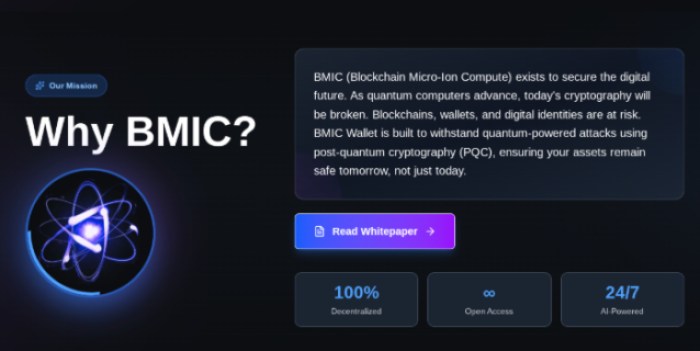
Beyond the encryption layer, the project integrates ERC-4337 smart accounts. This standard allows for ‘account abstraction,’ meaning users get the robust security of quantum resistance without the headache of managing complex seed phrases, often the biggest barrier for institutional clients. By combining AI-enhanced threat detection with zero public-key exposure, the protocol effectively creates a moat around user assets that even a quantum computer can’t cross.

LEARN MORE ABOUT THE $BMIC PRESALE

BMIC Presale Metrics Signal Early Adopter Confidence

While the herd waits for confirmation of the reversal Tom Lee predicts, smart money often moves into presales to maximize asymmetry. The current data from the BMIC raise indicates a disconnect between general market apathy and the high conviction of security-focused investors. $BMIC has raised over $444K, with tokens currently priced at $0.049474.

This capital raise is notable not just for the total, but for the utility of its funding. The $BMIC token isn’t merely a governance instrument; it acts as ecosystem fuel for the ‘Quantum Meta-Cloud’ and powers a unique ‘Burn-to-Compute’ mechanism. As the network grows, the demand for quantum-secure processing power drives token velocity. With what it’s offering its not surprising that we feel $BMIC is one of the best long-term crypto investments.

Investors analyzing the risk-reward ratio here are betting on a simple premise: as the crypto market matures, security premiums will likely skyrocket. The gap between a standard wallet and a quantum-secure wallet is currently priced at zero by the market. If BMIC succeeds in becoming the standard for post-quantum storage, that gap closes rapidly. With the presale still active, the entry point remains pegged to early development rather than the immense speculative value of the security narrative.

BUY YOUR $BMIC FROM THE OFFICIAL PRESALE PAGE

This article is for informational purposes only and does not constitute financial advice. Cryptocurrency investments, particularly in presale stages, carry high risks including total loss of capital. Always conduct your own due diligence.


İlgili Sorular

QAccording to Tom Lee, what are the key indicators suggesting the crypto market bottom is in or near?

ATom Lee points to a 'perfect storm' of indicators: cooling inflation, the market finally absorbing the supply overhang from major bankruptcies, and Bitcoin's surprising resilience during geopolitical tension.

QWhat is the 'harvest now, decrypt later' attack vector mentioned in the article?

AIt is an attack where state actors and sophisticated hacking groups scrape encrypted data from blockchains, store it, and wait for quantum computing power to become available to break the current encryption standards like RSA and ECC.

QHow does the BMIC project claim to protect assets against future quantum computing threats?

ABMIC uses post-quantum cryptography to secure assets against future computational brute-force attacks and integrates ERC-4337 smart accounts for account abstraction, eliminating the need to manage complex seed phrases.

QWhat is the current status of the BMIC presale as described in the article?

AThe BMIC presale has raised over $444K, with tokens currently priced at $0.049474, indicating high conviction from security-focused investors despite general market apathy.

QWhat role does the $BMIC token play within its ecosystem beyond governance?

AThe $BMIC token acts as ecosystem fuel for the 'Quantum Meta-Cloud' and powers a unique 'Burn-to-Compute' mechanism, where demand for quantum-secure processing power drives token velocity as the network grows.

İlgili Okumalar

The AI Agent Era Accelerates Its Arrival: Questflow Defines a New Paradigm of Financial Intelligence with On-Chain AI Brokerage

The AI Agent era is accelerating, with the CB Insights AI 100 list highlighting global investment confidence. The focus has shifted from whether AI works to its speed of deployment and ability to manage complex workflows, with autonomous AI Agents driving this transformation. At the forefront is Questflow, a Singapore-based startup redefining financial intelligence through its on-chain AI brokerage. Unlike tools that merely provide data dashboards, Questflow deploys AI Agents that proactively scan markets, form judgments, and execute trades via a conversational interface—operating 24/7 without requiring manual confirmation for each decision. This embodies the new AI paradigm of agents capable of executing multi-step workflows autonomously. Questflow's mission is to democratize institutional-grade trading intelligence. Historically reserved for the ultra-wealthy, this capability is now accessible starting from just $1 through Questflow's "AI Clone + Copy Trade" model. The platform charges only a 1% execution fee, aligning its incentives directly with users and eliminating traditional management or performance fees. The timing is opportune, aligning with key trends identified by CB Insights: the scalable deployment of AI Agents, accelerated AI adoption in financial services, and the maturation of on-chain infrastructure. With robust liquidity on platforms like Hyperliquid and Polymarket, alongside advancements in AI reasoning and non-custodial wallet security, Questflow is positioned to merge the roles of broker, fund, and exchange into a single, accessible platform for millions.

链捕手17 dk önce

The AI Agent Era Accelerates Its Arrival: Questflow Defines a New Paradigm of Financial Intelligence with On-Chain AI Brokerage

链捕手17 dk önce

Why Pricing Social Interactions is Doomed to Fail?

Titled "Why Putting a Price on Social Interaction Is Doomed to Fail," this article critiques attempts to monetize social networks directly through SocialFi models, arguing their inevitable failure stems from a fundamental misunderstanding of media dynamics. Using Marshall McLuhan's theory of "hot" and "cold" media, the author posits that social networks are inherently "cold" media. Their value isn't contained in individual posts but is co-created through user participation, interpretation, and fragmented, ongoing interaction (e.g., replies, shares). This ambiguity and need for user involvement are core to their function. The article asserts that SocialFi projects like Friend.tech failed because introducing real-time, tradable financial pricing (a definitive "hot" signal) into this "cold" environment doesn't add a layer—it replaces the medium's essence. The unambiguous price signal overshadows and nullifies the nuanced, participatory social signal. Users become traders, not participants, and when speculative profits vanish, the underlying social ecosystem—never genuinely cultivated—collapses entirely. This principle extends beyond crypto. The author argues platforms like Twitter have gradually "heated up" through metrics (likes, retweets counts, algorithmically defined value), shifting users from participants to performers and eroding organic engagement. The solution isn't to abandon capital but to manage its entry point. Successful models like Substack, Patreon, or Bandcamp allow capital to "condense" at specific, isolated nodes (e.g., subscriptions, one-time payments) without permeating and "heating" every social interaction. They preserve the core "cold," participatory medium while enabling monetization at designated boundaries. The NFT boom and bust serves as a stark parallel: the ancient "cold" medium of collecting (valued for story, community, gradual accumulation) was rapidly destroyed by platforms that introduced real-time floor prices, rarity scores, and trading dashboards, transforming collectors into speculators and vaporizing cultural value when prices fell. The core lesson: "Liquidity equals heat." Injecting high liquidity and definitive pricing into a "cold" participatory medium doesn't optimize it; it fundamentally alters and destroys its value-creating mechanism. The future lies not in pricing every social gesture but in finding precise, non-invasive points for capital to condense without overheating the entire ecosystem.

marsbit25 dk önce

Why Pricing Social Interactions is Doomed to Fail?

marsbit25 dk önce

Jensen Huang's CMU Speech: In the AI Era, Don't Just Watch, Build

Jensen Huang, CEO of NVIDIA and a first-generation immigrant, delivered the commencement address to Carnegie Mellon University's class of 2026. He shared his personal journey from a humble background to founding NVIDIA, emphasizing resilience, learning from failure, and the responsibility that comes with leadership. Huang framed the present moment as the dawn of the AI revolution, a shift he believes is more profound than previous computing waves. He described AI as fundamentally resetting computing—moving from human-written software to machines that understand, reason, and use tools. This will create a new industry for generating intelligence and transform every sector. While acknowledging AI's potential to automate tasks and displace some jobs, Huang distinguished between the *tasks* of a job and its core *purpose*. He argued AI will augment human capability, not replace humans. The real risk, he stated, is not AI itself, but people being left behind by those who effectively use AI. He presented AI as a generational opportunity for massive infrastructure investment—in chip factories, data centers, energy grids, and advanced manufacturing—that could re-industrialize nations like the U.S. and bridge the digital divide by making computing and intelligent tools accessible to all. Huang called for a balanced approach: advancing AI safely and responsibly, establishing prudent policies, ensuring broad access, and encouraging universal participation. He urged the graduates not to fear the future but to engage with optimism and ambition, reminding them of CMU's motto, "My heart is in the work." His core message was clear: this is their moment to actively build and shape the AI-powered future, not merely observe it.

marsbit1 saat önce

Jensen Huang's CMU Speech: In the AI Era, Don't Just Watch, Build

marsbit1 saat önce

İşlemler

Spot
Futures
活动图片




