Tokens as Assets: Which Type of Tokenized Stock Is Right for You?

Foresight News2026-06-29 tarihinde yayınlandı2026-06-29 tarihinde güncellendi

Özet

**Tokenized Stocks: Three Models, Which Suits You?** For investors outside the US, accessing stocks like SpaceX or NVIDIA is often difficult, requiring compliant brokers and cross-border transfers. Blockchain offers an alternative through tokenized stocks, but this term encompasses three distinct models with vastly different ownership, voting rights, and economic benefits. The first model offers full, direct ownership. Platforms like Superstate register shares directly on-chain (e.g., Solana), with holders listed on the official shareholder registry, granting full voting rights, dividends, and legal status. The second model sacrifices direct ownership for DeFi composability. Issuers like Backed and Ondo use offshore Special Purpose Vehicles (SPVs) to issue tokens 1:1 backed by real shares. Holders gain price exposure and automated dividend accruals (via token balance increases), and tokens can be used as collateral in DeFi protocols. However, this introduces SPV counterparty risk, as seen in the PreStocks collapse. The third model abandons ownership entirely for pure price speculation. Perpetual futures platforms like TradeXYZ (on Hyperliquid) and Ostium create synthetic markets using price oracles and funding rates to track stock prices. They require no underlying shares, enabling rapid listing (e.g., SpaceX pre-IPO) and high leverage, which explains their trading volumes being 4-5x higher than tokenized spot markets. The core insight is that tokens derive value without...


Author: Prathik Desai

Compiled by: Saoirse, Foresight News


If you live overseas and want to buy SpaceX or Nvidia stock, it's not easy. You need a brokerage that allows account opening for residents of your country, a compliant cross-border transfer channel, and often must meet qualified investor requirements. The vast majority of ordinary people cannot directly trade US stocks.


Blockchain offers an alternative: today you can gain exposure to US-listed companies through tokenized stocks, but "tokenized stock" is just a broad term. It actually encompasses three completely different products.


The first is native equity registered on-chain by the issuing company. The second is a collateralized token backed 1:1 by real stocks held by an offshore entity. The third is a perpetual futures contract with no underlying stock support at all. The ownership, voting rights, and price return rights enjoyed by holders of these three types of products are vastly different.


Currently, Nvidia has all three types of token products. The first two categories have over 650,000 real shares as underlying backing. However, the trading volume of perpetual contracts with absolutely no stock backing is 4 to 5 times that of the other two spot token categories.


Last week, Vaidik outlined some industry background: since 1973, the vast majority of stocks (whether tokenized or not) have operated under a single custody structure. He also explained a core fact — most people who nominally "hold stocks" do not actually own the corresponding shares. For details, see "Who Really Holds Your US Stocks? 83% of the Market's Stocks Are Nominally Held by This Institution".


In this article, I will dissect the ownership structures of different on-chain stock tokens and analyze the underlying logic of why the market is still willing to trade these tokens even when investors are completely detached from real equity.


What is Stock Tokenization?


Tokenized stocks are digital representations of corporate shares on a blockchain. These tokens are programmable, can be freely transferred between wallets, traded 24/7, and integrated into various decentralized finance protocols. Economic attributes of the stock, such as price appreciation and corporate dividends, are embedded within the token's mechanism.


The market for tokenized stocks has grown significantly: over the past year, the sector's total market capitalization has surged nearly fivefold, from $327 million to $1.5 billion.


The most noteworthy aspect of this tokenization wave is the experimentation by traditional giants. DTCC, the clearing, settlement, and custody institution for the vast majority of US and global securities transactions, announced last month that it will launch a tokenized securities pilot project in October 2026. The New York Stock Exchange also revealed earlier this year that it is building a 24/7 tokenized stock trading platform. These established institutions, with decades of experience in securities infrastructure, are re-evaluating the existing trading system.


Currently, various stock tokenization solutions have emerged. Different on-chain products make trade-offs in ownership, redemption mechanisms, DeFi composability, and price return rights. Let's break them down one by one.


The Trade-offs of Tokenized Products


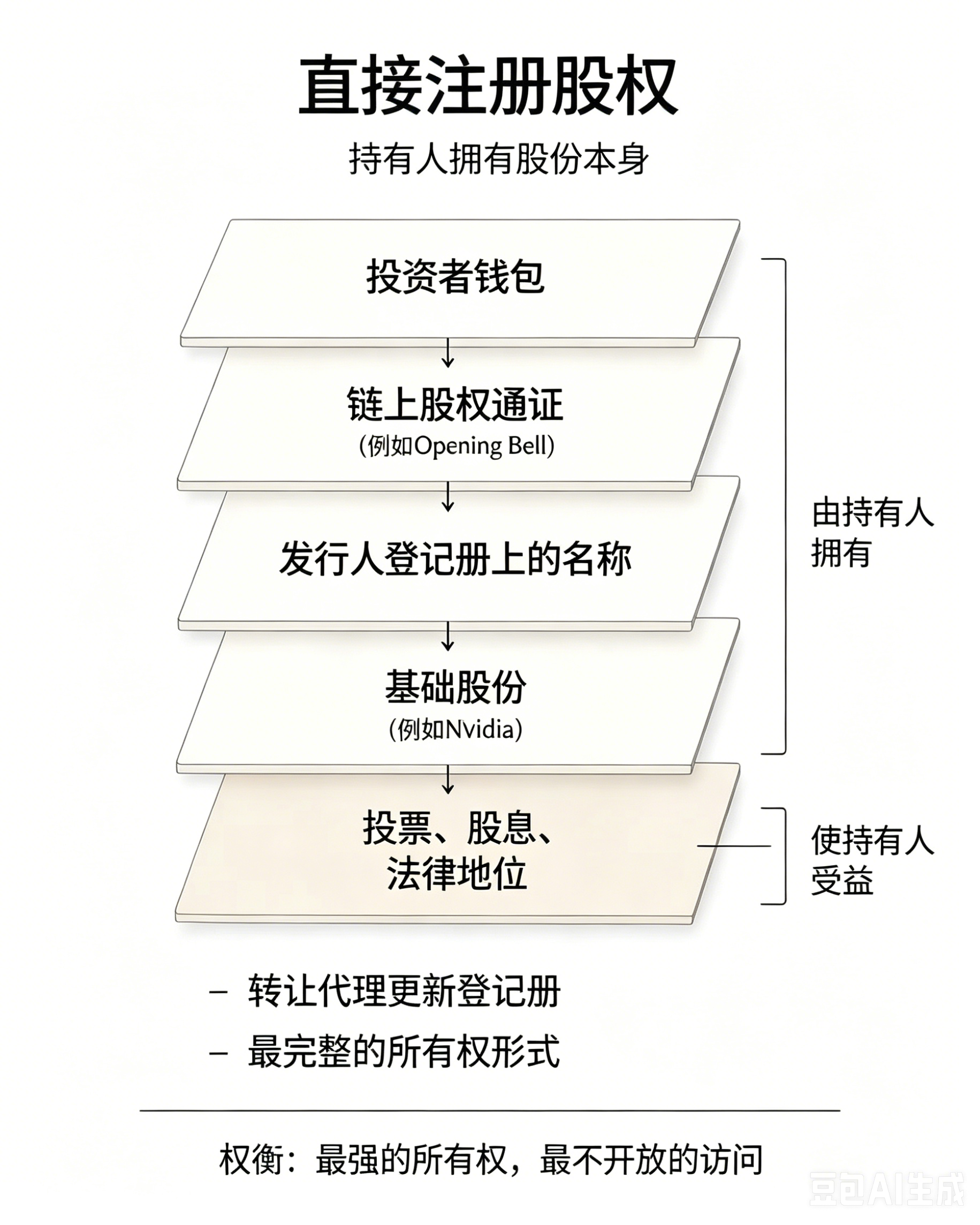
Model One: Complete Real Equity, Holders Enjoy Full Ownership


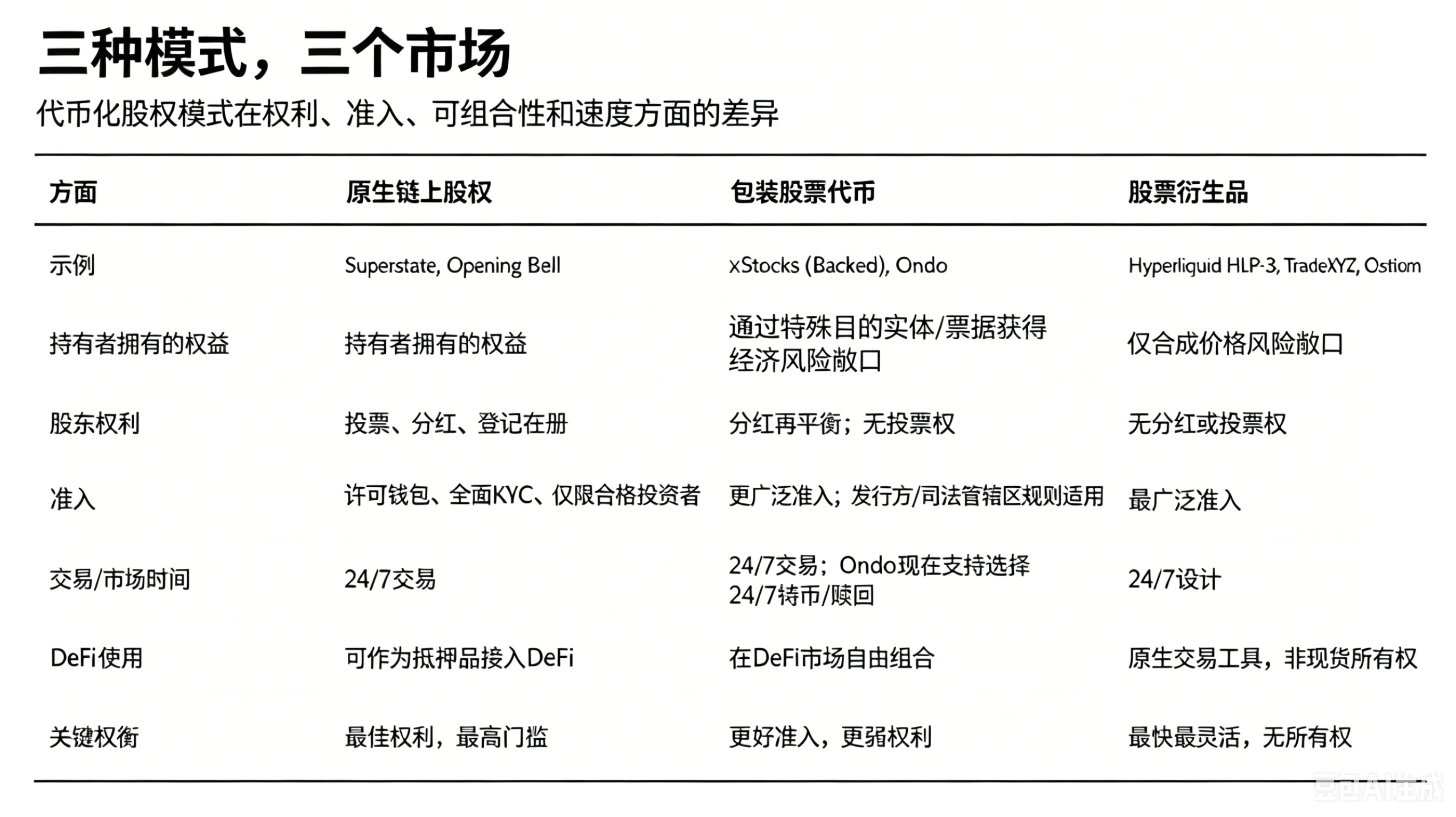
SEC-registered transfer agent Superstate directly registers equity on the Solana public chain. Holders' names are recorded in the company's official shareholder register, granting them full voting rights, dividend eligibility, and legal shareholder status.


In May 2026, Galaxy adopted this model to complete equity tokenization and achieved on-chain proxy voting through Broadridge. As early as December 2025, Superstate's compliant equity tokens were listed on Kamino, becoming the first registered equity usable as collateral in DeFi protocols.


Model Two: Surrendering Full Ownership for DeFi Composability


Backed's xStocks issues tracking certificates through a Jersey-based Special Purpose Vehicle (SPV), covering over 160 stocks, with underlying stocks matched 1:1. Ondo issues Total Return Notes through a British Virgin Islands SPV, supporting over 200 tokenized stocks, with Total Value Locked exceeding $1 billion within just 8 months of launch. Both products allow investors to enjoy stock price appreciation and dividends, but dividends are not paid in cash; instead, they are automatically added to your token balance.


The biggest advantage of this model is high composability: xStocks can be used as collateral for lending on Kamino and Morpho. Less than 24 hours before this article's publication, Ondo opened 24/7 minting and redemption channels for its mainstream tokenized stocks, making primary market access available around the clock.
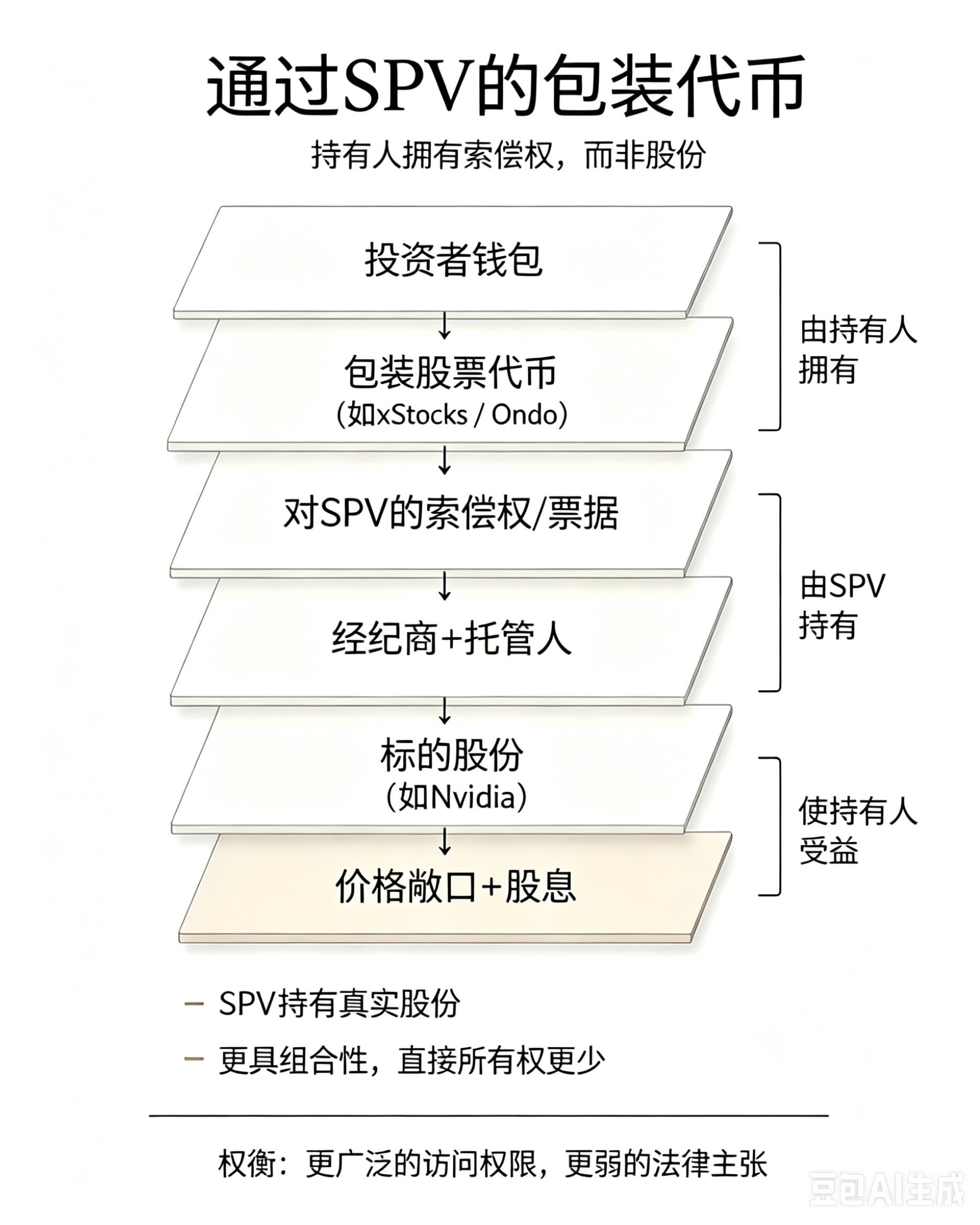


However, risks are also prominent: you only hold a claim against the SPV, not direct ownership of the underlying stock. The PreStocks collapse serves as a cautionary tale: in May 2026, the transfer of its underlying shares was deemed invalid. Tokens valued at a staggering $1.3 trillion were backed by only $23 million in real stock, ultimately leading to the product's complete collapse. Although Backed and Ondo mitigate risk through segregated custody and proof-of-reserves, the risk is not eliminated; it's merely transferred from the corporate entity to the SPV wrapper layer.


Model Three: Completely Abandoning Equity Ownership, Purely a Price Speculation Tool


Hyperliquid's HIP-3 framework allows anyone to build a perpetual contract market, requiring only a price oracle and a funding pool to operate. The leading project, TradeXYZ, accounts for over 90% of the open interest within the HIP-3 framework, listing perps for Nvidia, Tesla, Google, Amazon, and the Nasdaq 100 index. Ostium, deployed on Arbitrum, also offers similar products.


The platform charges a funding rate hourly to balance long and short positions, thereby anchoring the perpetual contract price to the spot stock price.
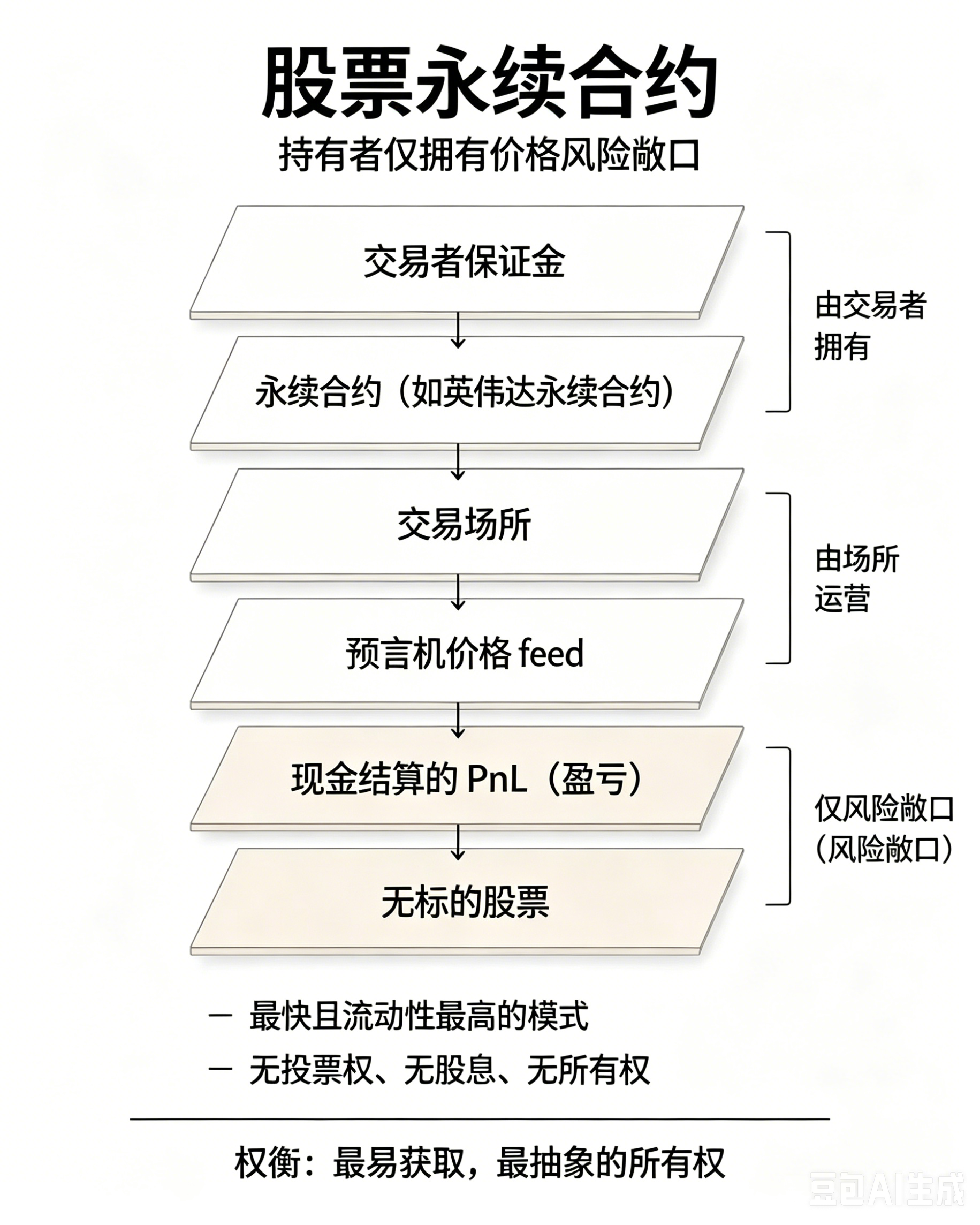


Perpetual contracts' trading volume far exceeds that of spot tokens for practical reasons: building a spot token market requires a supporting system of SPV, broker, custodian, and proof-of-reserves. Launching a perpetual contract only requires connecting to a price data source. TradeXYZ even listed a SpaceX perpetual contract before the company filed its S-1 registration statement, with open interest reaching $50 million directly. Spot tokens relying on an SPV simply cannot match this speed because the entity cannot quickly purchase sufficient underlying stock.


The Core Value of Tokens: Not Needing to Attach to Real Shares


The vast majority of retail investors never exercise their voting rights. Research data from the Harvard Law School Forum shows that, on average, only 12% of retail accounts in a company participate in shareholder meeting votes. For global traders looking to gain exposure to blue-chip stocks like Nvidia, Google, SpaceX, and Tesla, giving up a voting right they would never use is irrelevant.


Tokens themselves possess independent asset value and do not need to be completely equivalent to native stock. The three types of tokenized products cater to three types of investment needs: long-term institutional capital seeking full shareholder rights, on-chain users valuing DeFi collateral and liquidity, and short-term speculators preferring high leverage and 24/7 trading. Tokenization is not a replacement for traditional stocks; it is a new type of financial tool layered to adapt to different needs.


İlgili Sorular

QWhat are the three main types of tokenized stocks discussed in the article, and how do they differ in terms of underlying asset backing?

AThe three main types are: 1. Native on-chain equities (e.g., by Superstate), where the token holder is the registered owner on the company's official share register. 2. Backed tokens (e.g., by Backed and Ondo), where an offshore Special Purpose Vehicle (SPV) holds the real shares 1:1, and the token represents a claim on that SPV. 3. Perpetual futures contracts (e.g., on Hyperliquid or Ostium), which are purely synthetic derivatives with no underlying share backing, tracking the price via funding rates.

QAccording to the article, why is the trading volume for perpetual futures contracts (like for Nvidia) significantly higher than for tokenized spot stocks?

AThe trading volume for perpetual futures is much higher (4-5 times for Nvidia) because they are much easier and faster to launch. They only require a price oracle and liquidity pools, whereas launching a tokenized spot stock requires a full infrastructure of SPVs, brokers, custodians, and proof-of-reserves. Futures can also be launched for companies not yet public (like SpaceX pre-IPO), which spot tokens cannot do.

QWhat key trade-off do tokenized products like xStocks (Backed) and Ondo's products make, and what is the primary benefit of this choice?

AThey trade away full, direct ownership of the underlying shares (the token holder is not on the company's official register) in exchange for high DeFi composability. The primary benefit is that these tokens can be easily used as collateral in lending protocols (like Kamino, Morpho) and offer features like 24/7 minting and redemption, making them highly liquid and programmable within the DeFi ecosystem.

QWhat was the cause of the PreStocks collapse mentioned in the article, and what does it illustrate about the risks of the SPV-backed token model?

APreStocks collapsed because the transfer of its underlying shares was deemed invalid. It had only $23 million worth of real shares backing tokens valued at $1.3 trillion. This illustrates that the risk in the SPV model shifts from the company itself to the integrity of the SPV wrapper and its custodial arrangements. Even with safeguards like segregated custody and proof-of-reserves, the risk of a mismatch or failure in the backing structure remains.

QWhat is the article's central argument regarding the inherent value of a token, and how does it relate to the three types of tokenized stocks?

AThe article argues that a token itself is an asset with independent value and does not need to be a perfect substitute for a native stock. The three types of tokenized products serve three distinct investor needs: 1) Full shareholder rights for long-term institutional capital, 2) DeFi composability and liquidity for on-chain users, and 3) High leverage and 24/7 trading for short-term speculators. Tokenization is not just a replacement but a new layer of financial tools catering to different requirements.

İlgili Okumalar

Is Bitcoin's Recent Surge a Blessing or a Trap?

Bitcoin recently surged from around $63,000 to almost $80,000. According to Glassnode, this rally is not solely due to low liquidity but driven by real capital inflows. Key factors include aggressive spot market buying, increased trading volumes, improved market depth, and significant institutional demand, as evidenced by high volumes and inflows into spot Bitcoin ETFs. Derivatives market data shows investors adopting more aggressive risk management, with strong perpetual futures buying. However, a substantial increase in futures open interest points to heightened speculative activity and leverage use. On-chain metrics support the bullish activity, with growth in active addresses and asset-adjusted transfer volume, indicating accelerated user and economic activity within the network. Investor profitability has also improved significantly, with both unrealized and realized profits rising well above historical averages. This is shifting investor behavior toward profit-taking rather than loss-selling. However, Glassnode cautions that the current market structure is not yet fully based on long-term capital accumulation. It notes that "hot capital," representing short-term, price-sensitive funds, is elevated, while macroeconomic-scale capital inflows remain relatively limited. The rally appears to be supported more by active short-term investors, tactical positioning, and growing speculative appetite than by sustained, long-term accumulation.

cryptonews.ru2 saat önce

Is Bitcoin's Recent Surge a Blessing or a Trap?

cryptonews.ru2 saat önce

Bitcoin Reaches $80,000: Three Arguments Against a Bull Market

Bitcoin reached $80,000 on August 24, 2026, a 38% rise from its July low of $57,800. While this surge is notable, analyst Rekt Capital presents three arguments against it signaling a true bull market reversal, suggesting it may instead be a rally within a broader bear market. First, if July 2026 was the bear market bottom, its formation time was 27% shorter than historical averages, a conclusion only valid if no new lower low forms by year-end. Second, Bitcoin broke down from a macro triangle pattern in July, but the subsequent ~30% drop was significantly smaller than the 48-62% declines seen after similar breakdowns in past cycles. Third, and crucially, the price has failed to break the long-term descending trendline from early 2025 highs, meaning Bitcoin is still making lower highs on macro timeframes, indicating underlying weakness. Rekt Capital notes the dynamic trendline resistance is near $79,000 this month, dropping to ~$76,300 next month. A monthly close below it could open the door for a correction. On weekly charts, resistance sits at $74.5k-$83.5k, with support at $62.5k-$68.5k. Adding another perspective, Crypto Rover highlights two key liquidation levels on Bitcoin's heatmap: a cluster of short positions at $80k-$90k (which could fuel a squeeze higher) and a concentration of long positions at $48k-$60k, acting as competing price "magnets." The article contrasts Rekt Capital's current cautious stance with his past calls in 2025, noting he correctly identified market direction but underestimated the scale of both the subsequent spring rally and the following autumn/winter decline. His current analysis again emphasizes macro weakness despite the recent price rise.

cryptonews.ru2 saat önce

Bitcoin Reaches $80,000: Three Arguments Against a Bull Market

cryptonews.ru2 saat önce

İşlemler

Spot
活动图片