Tokenized stocks may be onchain, but the SEC still wants the keys

cointelegraph2025-12-18 tarihinde yayınlandı2025-12-18 tarihinde güncellendi

Özet

The US Securities and Exchange Commission (SEC) has issued guidance allowing broker-dealers to custody tokenized stocks and bonds under existing customer protection rules, specifically Rule 15c3-3. This means tokenized securities will be treated under traditional frameworks rather than as a new asset class. Broker-dealers must maintain exclusive control over private keys, ensuring that only authorized parties can move the assets. They are also required to prepare for risks like 51% attacks, hard forks, and legal restrictions. The guidance emphasizes that tokenized securities must behave like traditional securities, regardless of blockchain technology. Meanwhile, platforms like Nasdaq and Securitize are advancing plans for compliant onchain trading of tokenized equities.

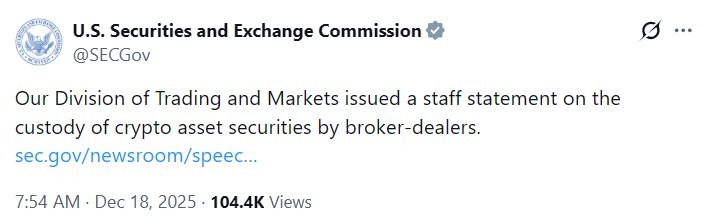
The US Securities and Exchange Commission’s Trading and Markets Division on Wednesday laid out how broker-dealers can custody tokenized stocks and bonds under existing customer protection rules, signaling that blockchain-based crypto asset securities will be slotted into traditional securities safeguards rather than treated as a new category.

The division said it would not object to broker-dealers deeming themselves in possession of crypto asset securities under existing customer protection rules, as long as they meet a set of operational, security and governance conditions. This applies only to crypto securities, including tokenized stocks or bonds.

While the statement is not a rule, it provides clarity on how US regulators expect tokenized securities to fit within traditional market safeguards.

The guidance suggests that tokenized securities are not treated as a new asset class with unique rules. Instead, they are being placed into existing broker-dealer frameworks, even if they settle within blockchain networks.
Source: US SEC

TradFi on a blockchain: Tokenized securities’ custody rules

At the core of the statement is Rule 15c3-3, the regulator’s consumer protection rule. This requires broker-dealers to maintain control or physical possession of fully paid customer securities.

The division said that crypto asset securities recorded in blockchains may satisfy the “physical possession” requirements under certain circumstances. This means broker-dealers must retain exclusive control over the private keys used to access and transfer the assets.

Despite being on a blockchain, customers and third parties, including affiliates, should not have the ability to move the security without the authorization of the broker.

The statement draws a clear boundary between tokenized securities and crypto-native self-custody models. It prioritizes customer protection over crypto’s permissionless ethos.

Broker-dealers are expected to prepare for scenarios like 51% attacks, hard forks, airdrops and other disruptions. They must also maintain plans that account for seizure, freezing or transfer restrictions under lawful orders.

The guidance reinforces that, regardless of the technologies used to issue or settle tokenized stocks or bonds, they are expected to behave like securities first.

Trading tokenized securities inside regulated market rails

In a separate statement issued the same day, SEC Commissioner Hester Peirce highlighted the trading-side challenges that remain for crypto asset securities.

Peirce raised questions focusing on national securities exchanges and alternative trading systems that facilitate trading crypto asset securities, including pairs where one asset is a security and the other is not.

The questions reflect growing pressure to settle blockchain-based assets with market-structure rules originally designed for traditional equities.

Peirce’s request raises whether existing frameworks and related disclosures and reporting requirements impose costs that outweigh their benefits when applied to crypto trading platforms.

Related: US Fed pulls guidance blocking its banks from engaging with crypto

Platforms jumping into tokenized equities

The statements come as crypto platforms and trading institutions have increasingly begun to tokenize securities.

On Nov. 30, Nasdaq's head of digital assets strategy, Matt Savarese, said the exchange plans to move fast on tokenized stocks. He said the exchange plans to work with the SEC as quickly as possible to make the feature available in the trading platform.

On Tuesday, Securitize, which focuses on tokenizing securities, announced that it plans to launch compliant, onchain trading for tokenized stocks. The company said that it will be presented in a swap-style interface familiar to decentralized finance (DeFi) users.

On Thursday, crypto exchange Coinbase launched a stock trading feature as part of its push to become an “everything exchange.”

Magazine: Koreans ‘pump’ alts after Upbit hack, China BTC mining surge: Asia Express


İlgili Okumalar

STRC Breaks Below $95: Why Does It Continue to Depeg? Is There Default Risk?

"STRC Falls Below $95: Why the Persistent Depegging and Is There Default Risk?" The article discusses the recent decline in the price of STRC, a perpetual preferred stock issued by Strategy (MSTR) designed to trade around a $100 par value. As of publication, STRC traded at $94.65, raising market concerns. STRC is described as a high-yield cash flow product, offering an 11.50% annual dividend paid monthly. Its "preferred" status grants it priority over common stock for dividends and in liquidation. Key reasons cited for the price depegging include: 1. **Bitcoin's Price Drop:** MSTR's assets are heavily tied to Bitcoin (BTC), which fell over 21% from its recent high, pressuring all Strategy-related products. 2. **Competitive Pressure:** Rival Strive Asset Management's similar product, SATA, offers daily dividends and has maintained its $100 par value with a ~13% yield. In response, Strategy has proposed changing STRC's dividend frequency from monthly to bi-weekly, pending shareholder vote. 3. **Technical Selling:** A break below $100 may have triggered algorithmic selling and stop-losses, exacerbating the decline. Regarding default risk, the analysis suggests it is currently low. Strategy founder Michael Saylor confirmed the June 2026 dividend rate remains at 11.50% with no cuts or suspensions. The company's massive reserve of 843,706 BTC provides a significant backstop for its obligations. Industry opinions are mixed. Some analysts view the BTC holdings as reliable support for dividends, while critics like Peter Schiff warn of potential dividend cuts leading to price crashes and lawsuits. Others highlight inflation risk and the company's ability to reduce dividends without a formal default. In summary, STRC's drop is attributed to BTC volatility, competition, and technical factors. While immediate default risk appears contained, the product faces challenges from market conditions and competitive dynamics.

marsbit3 dk önce

STRC Breaks Below $95: Why Does It Continue to Depeg? Is There Default Risk?

marsbit3 dk önce

AI Trading Cools, South Korean Stocks Plunge 1.8%, Spot Gold Rises 1%, Bitcoin Dives

A sell-off in AI-related stocks, triggered by Broadcom's disappointing earnings forecast, sent shockwaves through global markets. South Korea's KOSPI led Asia's decline, plunging 1.8% as the risks from concentrated chip stock gains and surging leveraged investments came to the fore. The tech-heavy Nasdaq 100 futures fell 0.5% following Broadcom's 14% after-hours plunge, which signaled a slower-than-expected transition to AI clients. This pullback extended Wall Street's weakness, halting the S&P 500's nine-day rally amid hawkish Fed signals and renewed Middle East tensions. South Korean authorities convened an emergency meeting, pledging "immediate measures" against market volatility and warning of record-high stock margin debt. The adjustment rippled across assets: Bitcoin fell to around $64,000, its lowest since February, while safe-haven gold rose 1% on bargain hunting. Oil prices dipped on Middle East ceasefire news. Market analysts noted the sell-off was driven by profit-taking after massive gains, particularly in chip stocks like Samsung and SK Hynix, which now dominate the KOSPI. Wall Street banks are divided on Korea's outlook, with Goldman Sachs raising its target while Citigroup and others warn of overvaluation and a potential bubble. Bridgewater's Ray Dalio noted that great technological shifts often create bubbles. Meanwhile, Fed officials' hints at potential future rate hikes added to the cautious mood ahead of key U.S. jobs data.

华尔街日报29 dk önce

AI Trading Cools, South Korean Stocks Plunge 1.8%, Spot Gold Rises 1%, Bitcoin Dives

华尔街日报29 dk önce

Seeking Alpha's Hot Article: Why Might the U.S. Stock Market Crash in June?

In a recent Seeking Alpha article, financial professor and analyst Damir Tokic argues that the US stock market may be poised for a significant crash in June 2026. The core thesis centers on a "mega-bubble" in equities, particularly within the technology sector, which has driven the S&P 500 to near-record valuations, with a Shiller P/E ratio exceeding 40—a level comparable to the 2000 dot-com bubble. Tokic identifies two primary catalysts for a potential collapse. First, he points to unsustainable market exuberance fueled by what he terms the "Trump Stimulus"—massive AI capital expenditure by tech giants, which he believes is politically driven and cannot last. Second, and more urgently, he highlights the escalating Iran war as a critical threat. The ongoing closure of the Strait of Hormuz has created a severe global energy supply crunch. Strategic petroleum reserves are projected to hit critically low operational levels by June, potentially causing oil prices to spike above $200 per barrel and triggering a severe, supply-driven inflationary shock. This scenario, Tokic warns, would force the Federal Reserve's hand. Despite currently maintaining a dovish bias, the Fed would likely be compelled to officially pivot to a hawkish stance at its June FOMC meeting to combat soaring inflation and bond yields. He contends that such a shift—or even a failure to act, which would destroy Fed credibility—could be the trigger that punctures the market bubble. The resulting downturn, he concludes, could rival the bear markets of 2000 and 2008, advising investors to prepare for a major correction.

marsbit51 dk önce

Seeking Alpha's Hot Article: Why Might the U.S. Stock Market Crash in June?

marsbit51 dk önce

AI PC Battle: Bet on the Toll Booth, Not the Camp

**Title:** The AI PC Battle: Don't Bet on Sides, Bet on the Tollbooth **Summary:** The AI PC competition is moving beyond simple "x86 vs. Arm" narratives. The core investment thesis should focus on identifying which players can sustain margins, cash flow, and pricing power throughout the upgrade cycle, rather than backing a particular architecture. The opportunity is analyzed in three layers: 1. **The Advanced Foundry Tollbooth:** TSMC is positioned to collect "tolls" regardless of which chip designer wins, due to its dominant ~70% share in advanced semiconductor manufacturing, which is essential for high-end AI PC chips. 2. **Compute & Platform Spillover:** AMD represents an offensive in the x86 CPU+GPU space, while NVIDIA leverages its GPU and CUDA software stack dominance. Both benefit from the demand for increased local AI compute. 3. **Architecture Diffusion & Turnaround Plays:** ARM and Intel offer potential for significant upside (elasticity), but investments here require stricter discipline due to higher execution risks and competitive challenges. The industry is transitioning from concept to shipment validation. While short-term forecasts for AI PC adoption have been revised down slightly due to tariffs and procurement delays, the long-term trend towards AI becoming a standard PC feature remains intact. The key driver for upgrade cycles will be whether compelling enterprise applications (e.g., privacy-sensitive computing, low-latency inference) emerge beyond consumer-focused features like meeting summarization. Investment strategy should prioritize companies with platform-level advantages and recurring revenue streams. TSMC offers high certainty as the foundational tollbooth. AMD presents a strong offensive play within the established ecosystem. ARM and Intel are higher-risk, higher-potential-reward turnaround bets. The report cautions against chasing short-term hype and emphasizes a disciplined, long-term approach focused on buying ecosystem strength and cash-flow certainty after market enthusiasm subsides. **Key Risks:** Underwhelming AI PC applications slowing upgrade cycles; slow improvement in Windows on Arm compatibility; macro/tariff impacts on PC demand; potential advanced node supply-demand mismatches affecting TSMC; high overall AI sector valuations making stocks vulnerable to a risk-off shift in markets.

marsbit1 saat önce

AI PC Battle: Bet on the Toll Booth, Not the Camp

marsbit1 saat önce

İşlemler

Spot
Futures

Popüler Makaleler

MAY Nasıl Satın Alınır

HTX.com’a hoş geldiniz! Mayflower (MAY) satın alma işlemlerini basit ve kullanışlı bir hâle getirdik. Adım adım açıkladığımız rehberimizi takip ederek kripto yolculuğunuza başlayın. 1. Adım: HTX Hesabınızı OluşturunHTX'te ücretsiz bir hesap açmak için e-posta adresinizi veya telefon numaranızı kullanın. Sorunsuzca kaydolun ve tüm özelliklerin kilidini açın. Hesabımı Aç2. Adım: Kripto Satın Al Bölümüne Gidin ve Ödeme Yönteminizi SeçinKredi/Banka Kartı: Visa veya Mastercard'ınızı kullanarak anında Mayflower (MAY) satın alın.Bakiye: Sorunsuz bir şekilde işlem yapmak için HTX hesap bakiyenizdeki fonları kullanın.Üçüncü Taraflar: Kullanımı kolaylaştırmak için Google Pay ve Apple Pay gibi popüler ödeme yöntemlerini ekledik.P2P: HTX'teki diğer kullanıcılarla doğrudan işlem yapın.Borsa Dışı (OTC): Yatırımcılar için kişiye özel hizmetler ve rekabetçi döviz kurları sunuyoruz.3. Adım: Mayflower (MAY) Varlıklarınızı SaklayınMayflower (MAY) satın aldıktan sonra HTX hesabınızda saklayın. Alternatif olarak, blok zinciri transferi yoluyla başka bir yere gönderebilir veya diğer kripto para birimlerini takas etmek için kullanabilirsiniz.4. Adım: Mayflower (MAY) Varlıklarınızla İşlem YapınHTX'in spot piyasasında Mayflower (MAY) ile kolayca işlemler yapın.Hesabınıza erişin, işlem çiftinizi seçin, işlemlerinizi gerçekleştirin ve gerçek zamanlı olarak izleyin. Hem yeni başlayanlar hem de deneyimli yatırımcılar için kullanıcı dostu bir deneyim sunuyoruz.

355 Toplam GörüntülenmeYayınlanma 2025.07.01Güncellenme 2026.06.02

MAY Nasıl Satın Alınır

Tartışmalar

HTX Topluluğuna hoş geldiniz. Burada, en son platform gelişmeleri hakkında bilgi sahibi olabilir ve profesyonel piyasa görüşlerine erişebilirsiniz. Kullanıcıların MAY (MAY) fiyatı hakkındaki görüşleri aşağıda sunulmaktadır.

活动图片