Tokenized stocks may be onchain, but the SEC still wants the keys

cointelegraph2025-12-18 tarihinde yayınlandı2025-12-18 tarihinde güncellendi

Özet

The US Securities and Exchange Commission (SEC) has issued guidance allowing broker-dealers to custody tokenized stocks and bonds under existing customer protection rules, specifically Rule 15c3-3. This means tokenized securities will be treated under traditional frameworks rather than as a new asset class. Broker-dealers must maintain exclusive control over private keys, ensuring that only authorized parties can move the assets. They are also required to prepare for risks like 51% attacks, hard forks, and legal restrictions. The guidance emphasizes that tokenized securities must behave like traditional securities, regardless of blockchain technology. Meanwhile, platforms like Nasdaq and Securitize are advancing plans for compliant onchain trading of tokenized equities.

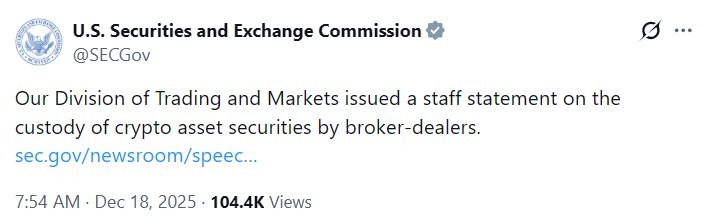
The US Securities and Exchange Commission’s Trading and Markets Division on Wednesday laid out how broker-dealers can custody tokenized stocks and bonds under existing customer protection rules, signaling that blockchain-based crypto asset securities will be slotted into traditional securities safeguards rather than treated as a new category.

The division said it would not object to broker-dealers deeming themselves in possession of crypto asset securities under existing customer protection rules, as long as they meet a set of operational, security and governance conditions. This applies only to crypto securities, including tokenized stocks or bonds.

While the statement is not a rule, it provides clarity on how US regulators expect tokenized securities to fit within traditional market safeguards.

The guidance suggests that tokenized securities are not treated as a new asset class with unique rules. Instead, they are being placed into existing broker-dealer frameworks, even if they settle within blockchain networks.
Source: US SEC

TradFi on a blockchain: Tokenized securities’ custody rules

At the core of the statement is Rule 15c3-3, the regulator’s consumer protection rule. This requires broker-dealers to maintain control or physical possession of fully paid customer securities.

The division said that crypto asset securities recorded in blockchains may satisfy the “physical possession” requirements under certain circumstances. This means broker-dealers must retain exclusive control over the private keys used to access and transfer the assets.

Despite being on a blockchain, customers and third parties, including affiliates, should not have the ability to move the security without the authorization of the broker.

The statement draws a clear boundary between tokenized securities and crypto-native self-custody models. It prioritizes customer protection over crypto’s permissionless ethos.

Broker-dealers are expected to prepare for scenarios like 51% attacks, hard forks, airdrops and other disruptions. They must also maintain plans that account for seizure, freezing or transfer restrictions under lawful orders.

The guidance reinforces that, regardless of the technologies used to issue or settle tokenized stocks or bonds, they are expected to behave like securities first.

Trading tokenized securities inside regulated market rails

In a separate statement issued the same day, SEC Commissioner Hester Peirce highlighted the trading-side challenges that remain for crypto asset securities.

Peirce raised questions focusing on national securities exchanges and alternative trading systems that facilitate trading crypto asset securities, including pairs where one asset is a security and the other is not.

The questions reflect growing pressure to settle blockchain-based assets with market-structure rules originally designed for traditional equities.

Peirce’s request raises whether existing frameworks and related disclosures and reporting requirements impose costs that outweigh their benefits when applied to crypto trading platforms.

Related: US Fed pulls guidance blocking its banks from engaging with crypto

Platforms jumping into tokenized equities

The statements come as crypto platforms and trading institutions have increasingly begun to tokenize securities.

On Nov. 30, Nasdaq's head of digital assets strategy, Matt Savarese, said the exchange plans to move fast on tokenized stocks. He said the exchange plans to work with the SEC as quickly as possible to make the feature available in the trading platform.

On Tuesday, Securitize, which focuses on tokenizing securities, announced that it plans to launch compliant, onchain trading for tokenized stocks. The company said that it will be presented in a swap-style interface familiar to decentralized finance (DeFi) users.

On Thursday, crypto exchange Coinbase launched a stock trading feature as part of its push to become an “everything exchange.”

Magazine: Koreans ‘pump’ alts after Upbit hack, China BTC mining surge: Asia Express


İlgili Okumalar

Huang Renxun Dramatically 'Saves' South Korean Stock Market

In early June, South Korea's stock market experienced a sharp decline, with the KOSPI index dropping over 5% and triggering a trading halt. Amid this volatility, NVIDIA CEO Jensen Huang's visit to Seoul provided a dramatic boost to market sentiment. During his trip, Huang held a dinner meeting with SK Group Chairman Chey Tae-won and SK Hynix CEO Kwak Noh-Jung. He announced that NVIDIA's new Vera CPU would utilize SK Hynix DRAM and confirmed a multi-year technical collaboration between the two companies. This partnership aims to co-develop next-generation memory for NVIDIA's AI infrastructure roadmap, covering products from data center supercomputers to personal AI devices. Huang also publicly commented that AI company stocks were attractively priced. A key announcement was that NVIDIA's upcoming Vera Rubin AI supercomputer systems will use HBM4 memory, with supply qualifications granted to all three major suppliers: SK Hynix, Samsung Electronics, and Micron Technology. Despite this multi-sourcing strategy, Huang warned that the industry-wide chip shortage, affecting everything from wafers to packaging, is expected to persist for several years due to relentless demand from global AI factory construction. The collaboration extends beyond memory supply. SK Hynix will employ NVIDIA's AI platforms and Omniverse digital twin technology to enhance its own semiconductor design, simulation, and manufacturing processes, aiming for more autonomous factory operations. This visit builds upon a prior October 2025 agreement for SK Group to build a large-scale AI data center using over 50,000 NVIDIA GPUs. Huang's itinerary also included meetings with other Korean giants like Hyundai, LG, and Samsung, indicating NVIDIA's broader strategy to deepen ties with South Korea's tech industry.

链捕手3 saat önce

Huang Renxun Dramatically 'Saves' South Korean Stock Market

链捕手3 saat önce

When Inference Becomes a Scarce Resource, Who Captures the Value?

When Inference Becomes the Scarce Resource, Who Captures the Value? The core AI bottleneck has shifted from model training to inference (runtime execution). While concerns persisted about an "AI compute gap"—initially a $200B, now a $600B problem—the market is now recognizing that the solution and value lie in the inference layer. Nvidia's financial restructuring around "serving tokens" and Cerebras's successful IPO highlight this shift. Inference is a recurring, usage-based cost, estimated to be 10-50x larger than the one-time training market, especially with the rise of agentic AI. The inference stack spans six layers: silicon (e.g., Nvidia), bare metal (e.g., CoreWeave), GPU rental/aggregation, deployment/optimization, model APIs, and end applications. Most companies operate in one layer. However, Hyperbolic uniquely spans three layers (GPU rental, deployment, and model APIs) without owning any hardware. It aggregates fragmented GPU supply from multiple cloud providers into a standardized pool, offering developers the cheapest available compute through intelligent routing. Its multi-cloud aggregation creates a data moat and a flywheel: more supply leads to better pricing data and liquidity, attracting more developers and providers. In contrast, applications like Venice operate at the top of the stack, reselling privacy-wrapped inference but remaining dependent on and constrained by the underlying compute costs they purchase. As inference demand explodes, value accrues not just to consumer applications but increasingly to the aggregation and routing layer that captures their cost of revenue. The coming potential GPU oversupply reinforces this dynamic. While hardware owners may suffer from depreciation, asset-light aggregators like Hyperbolic benefit from price arbitrage, routing workloads to the cheapest available capacity. The ultimate winner in the inference economy may not be the entity with the most GPUs, but the one that can most efficiently discover, aggregate, and route the world's fragmented compute.

链捕手3 saat önce

When Inference Becomes a Scarce Resource, Who Captures the Value?

链捕手3 saat önce

İşlemler

Spot
Futures

Popüler Makaleler

MAY Nasıl Satın Alınır

HTX.com’a hoş geldiniz! Mayflower (MAY) satın alma işlemlerini basit ve kullanışlı bir hâle getirdik. Adım adım açıkladığımız rehberimizi takip ederek kripto yolculuğunuza başlayın. 1. Adım: HTX Hesabınızı OluşturunHTX'te ücretsiz bir hesap açmak için e-posta adresinizi veya telefon numaranızı kullanın. Sorunsuzca kaydolun ve tüm özelliklerin kilidini açın. Hesabımı Aç2. Adım: Kripto Satın Al Bölümüne Gidin ve Ödeme Yönteminizi SeçinKredi/Banka Kartı: Visa veya Mastercard'ınızı kullanarak anında Mayflower (MAY) satın alın.Bakiye: Sorunsuz bir şekilde işlem yapmak için HTX hesap bakiyenizdeki fonları kullanın.Üçüncü Taraflar: Kullanımı kolaylaştırmak için Google Pay ve Apple Pay gibi popüler ödeme yöntemlerini ekledik.P2P: HTX'teki diğer kullanıcılarla doğrudan işlem yapın.Borsa Dışı (OTC): Yatırımcılar için kişiye özel hizmetler ve rekabetçi döviz kurları sunuyoruz.3. Adım: Mayflower (MAY) Varlıklarınızı SaklayınMayflower (MAY) satın aldıktan sonra HTX hesabınızda saklayın. Alternatif olarak, blok zinciri transferi yoluyla başka bir yere gönderebilir veya diğer kripto para birimlerini takas etmek için kullanabilirsiniz.4. Adım: Mayflower (MAY) Varlıklarınızla İşlem YapınHTX'in spot piyasasında Mayflower (MAY) ile kolayca işlemler yapın.Hesabınıza erişin, işlem çiftinizi seçin, işlemlerinizi gerçekleştirin ve gerçek zamanlı olarak izleyin. Hem yeni başlayanlar hem de deneyimli yatırımcılar için kullanıcı dostu bir deneyim sunuyoruz.

358 Toplam GörüntülenmeYayınlanma 2025.07.01Güncellenme 2026.06.02

MAY Nasıl Satın Alınır

Tartışmalar

HTX Topluluğuna hoş geldiniz. Burada, en son platform gelişmeleri hakkında bilgi sahibi olabilir ve profesyonel piyasa görüşlerine erişebilirsiniz. Kullanıcıların MAY (MAY) fiyatı hakkındaki görüşleri aşağıda sunulmaktadır.

活动图片




