Tokenized markets reach $2.3B – Why utility matters more than TVL

ambcrypto2026-07-19 tarihinde yayınlandı2026-07-19 tarihinde güncellendi

Özet

Tokenized financial markets have reached a $2.3 billion market capitalization, driven by growing institutional adoption of on-chain funds and equities. While Ethereum leads in custody value, holding 34% of the total, Solana processes the vast majority (95-97%) of tokenized equity trading. This highlights a key industry shift where execution and utility—measured by trading volume, transaction activity, and settlement efficiency—are becoming more critical than Total Value Locked (TVL) alone. Platforms like Arbitrum and Solana lead in holder growth, supported by established issuers such as Ondo Finance, underscoring that issuer reputation and robust liquidity channels are central to attracting institutional capital. The evolving landscape suggests blockchain networks will compete increasingly on real economic activity and capital efficiency.

Tokenized U.S. funds continue drawing institutional capital as regulated on-chain finance expands beyond early adoption. That pattern emerges because institutions still favor issuers with established liquidity and distribution channels.

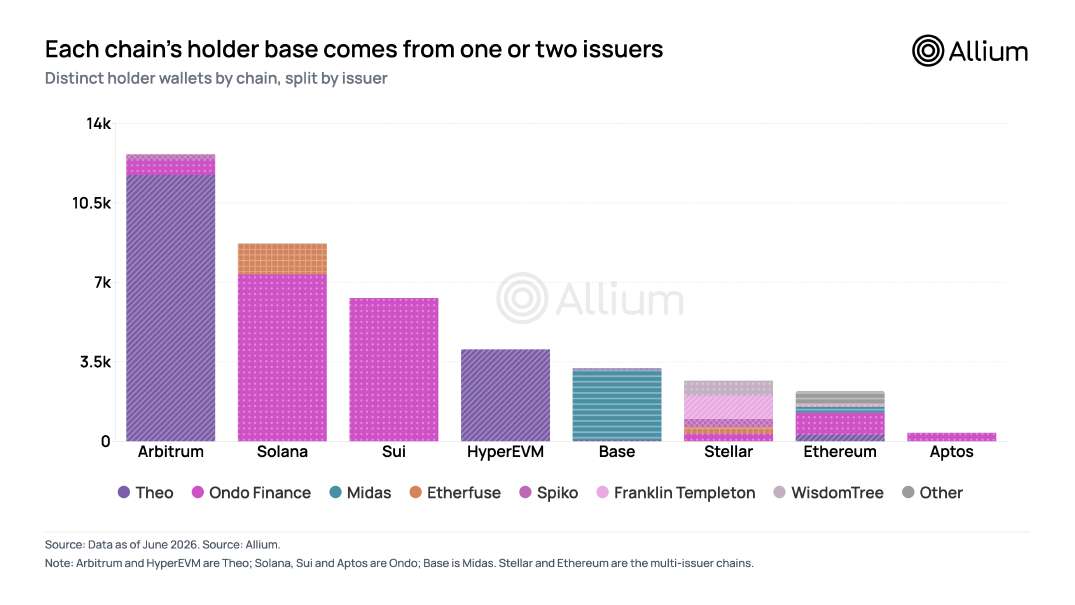
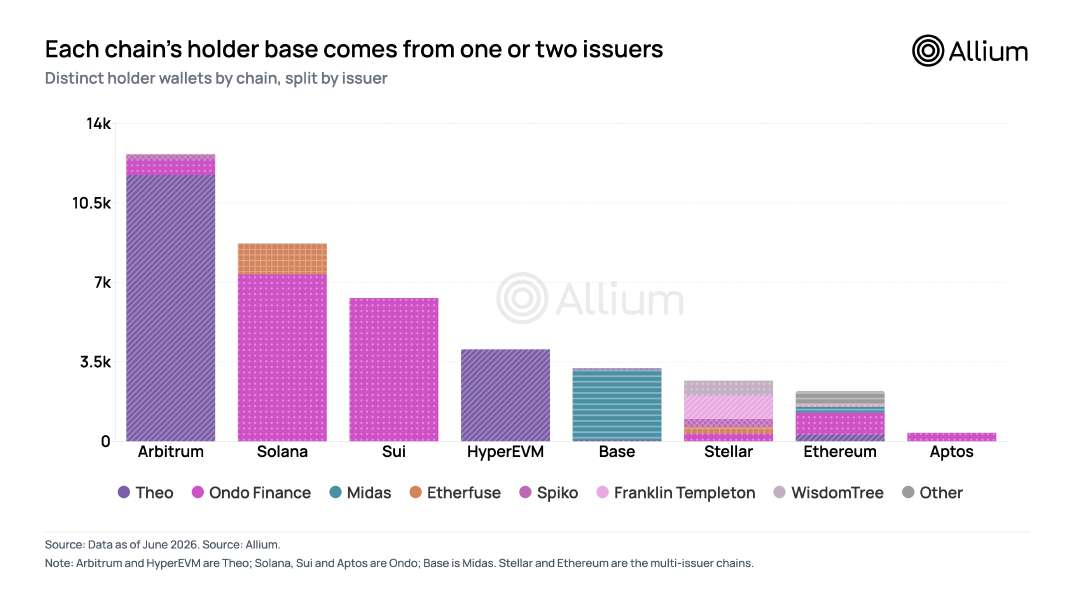
As a result of this preference, Arbitrum [ARB] leads with roughly 12,500 distinct holder wallets, largely through Theo. Solana [SOL] follows with about 8,200 wallets, supported mainly by Ondo Finance [ONDO] and Etherfuse.
Source: Allium

Meanwhile, Sui [SUI] approaches 6,000 holders, reinforcing Ondo’s growing cross-chain footprint. In addition, HyperEVM and Base add nearly 4,000 and 3,200 holders, further extending institutional reach.

Yet Ethereum [ETH] hosts only around 2,000 holders despite supporting several issuers. This suggests issuer reputation, rather than chain availability alone, is the key driver of liquidity, user growth, and future competition across tokenized fund markets.

Tokenized stocks redefine blockchain utility

Institutional momentum is no longer limited to tokenized funds. Market participants are also investing in equities, which have expanded their presence on various blockchain platforms.

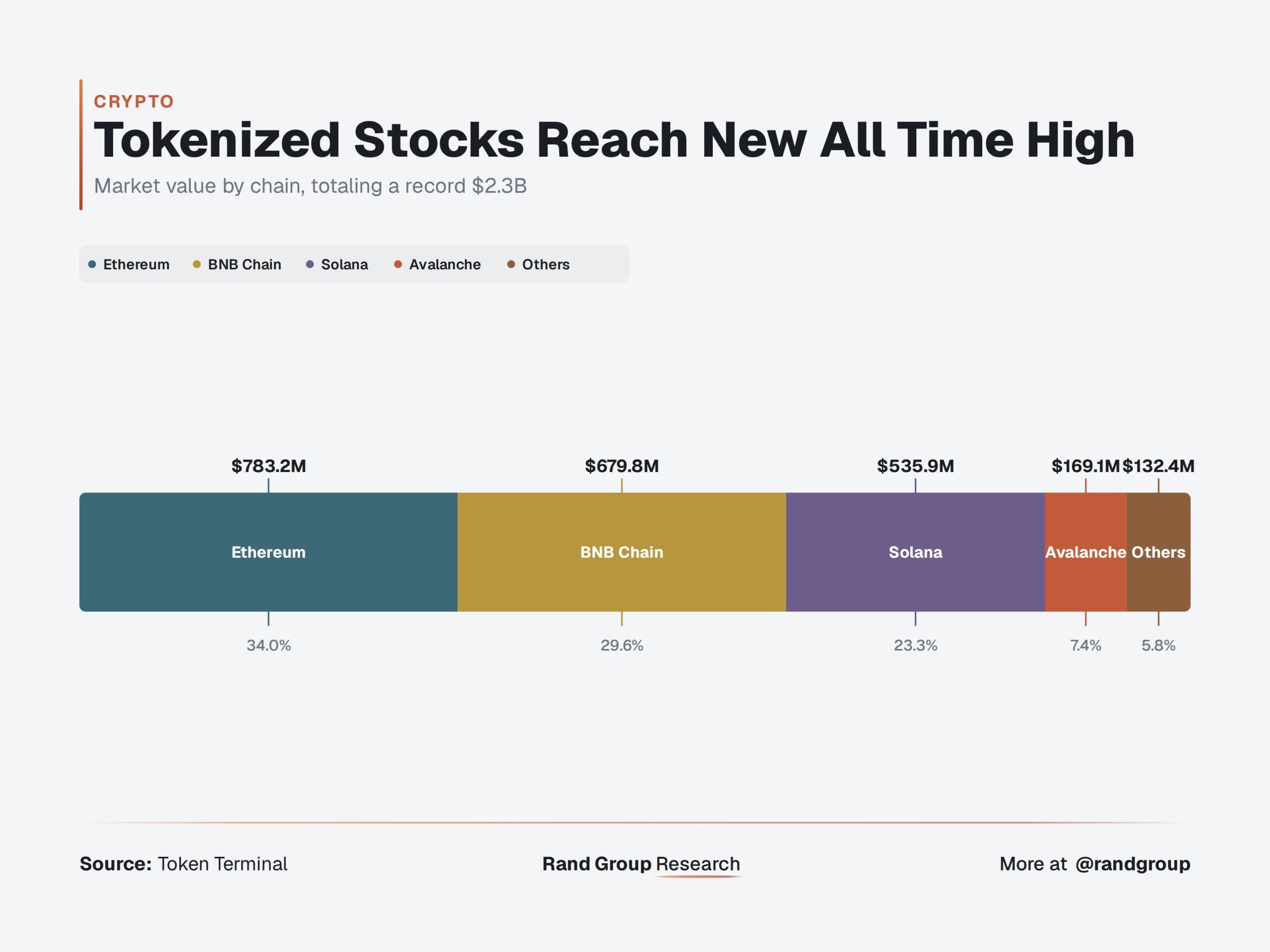
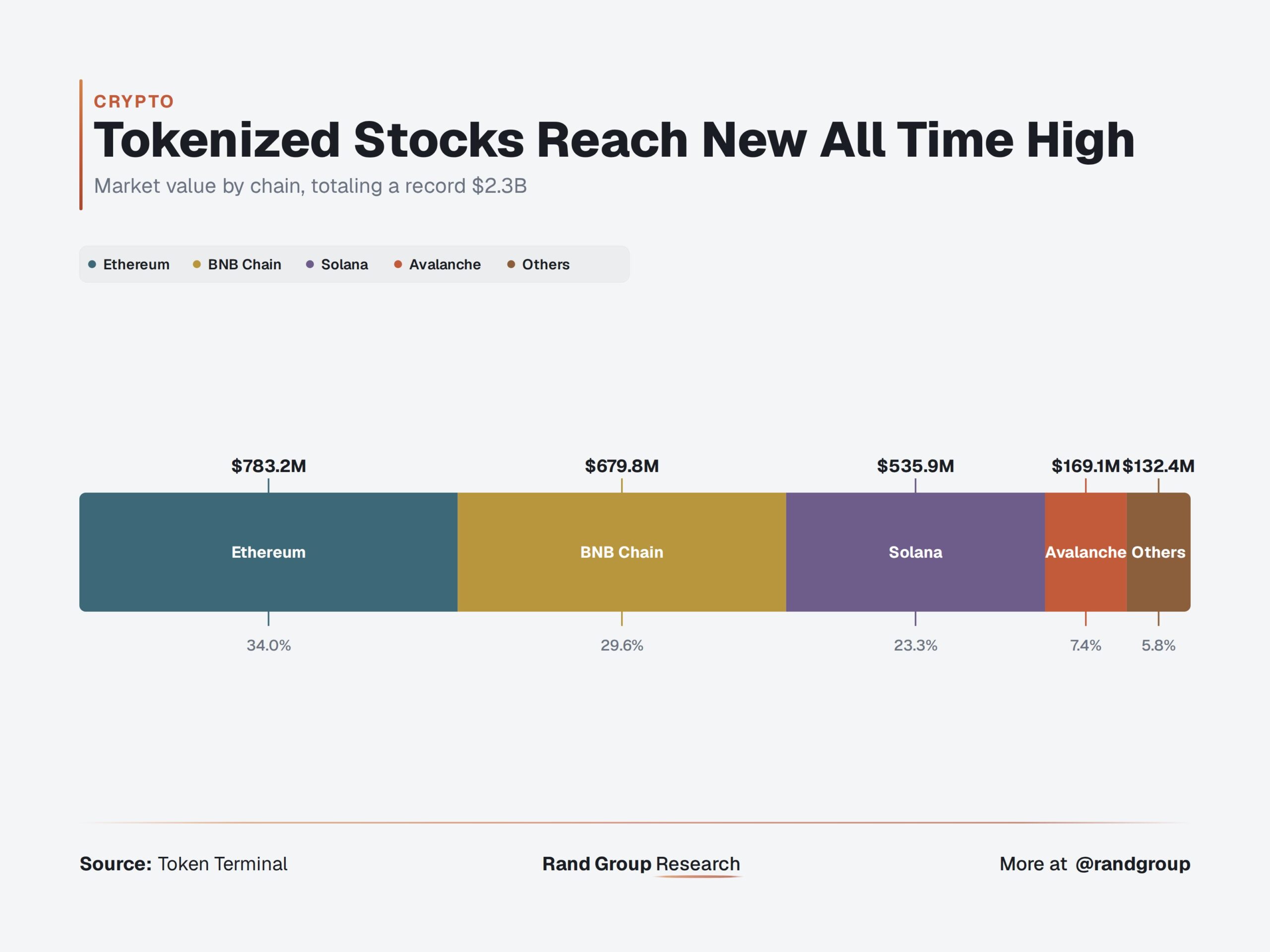
The industry has reached an all-time high of $2.3 billion in market capitalization, demonstrating increasing interest in on-chain financial products.

Ethereum leads with $783.2 million. This translates into 34% of total value, reflecting its role as the primary custody layer. BNB Chain follows with $679.8 million, while Solana holds $535.9 million. However, market value tells only part of the story.
Source: X

Moreover, Solana processes roughly 95%–97% of tokenized equity trading. This indicates that execution is increasingly shifting away from where assets are stored.

This divergence implies that institutions are beginning to separate custody and trade functions, potentially redefining blockchain leadership by emphasizing liquidity, settlement efficiency, and user activity rather than value locked alone.

Utility emerges as blockchain’s competitive edge

That shift reflects an industry-wide change in how blockchain competitors attract institutional investment capital. Investors increasingly evaluate execution quality and real economic activity rather than prioritizing TVL alone.

DEX volume, transaction activity, and fee generation have now become the key measures of network utility, replacing passive liquidity as the primary benchmark. Institutional investors continue to favor platforms that deliver rapid settlement at low cost while maintaining regulatory‐compliant token architectures.

As tokenization expands, networks delivering stronger capital efficiency and operational resilience will likely attract greater liquidity, reinforcing utility as blockchain’s primary competitive advantage.


Final Summary

  • Tokenized U.S. funds and tokenized stocks are expanding, signaling stronger institutional adoption of on-chain financial assets.
  • Blockchain competitiveness is increasingly defined by execution quality, liquidity, and utility rather than TVL alone.

İlgili Sorular

QWhat is the main reason cited in the article for why Arbitrum leads in holder wallets for tokenized funds?

AArbitrum leads because institutions favor issuers with established liquidity and distribution channels, with Theo being a major driver on the network.

QWhy does the article suggest Ethereum has a relatively low number of tokenized fund holders compared to other chains?

AIt suggests that issuer reputation, rather than chain availability alone, is the key driver. Despite supporting several issuers, Ethereum's lower holder count indicates reputation is more important for attracting users.

QAccording to the article, what portion of tokenized equity trading does Solana process, and what does this indicate?

ASolana processes roughly 95%–97% of tokenized equity trading. This indicates that execution is increasingly shifting away from where assets are stored, and institutions are beginning to separate custody and trade functions.

QWhat metrics have become the key measures of network utility, replacing passive liquidity (TVL)?

ADEX volume, transaction activity, and fee generation have become the key measures of network utility, replacing passive liquidity (TVL) as the primary benchmark.

QWhat does the article identify as blockchain's primary competitive advantage as tokenization expands?

AThe article identifies utility, driven by factors like capital efficiency and operational resilience, as blockchain's primary competitive advantage.

İlgili Okumalar

9.42 Million Retail Investors Compete for Changxin Technology, Who Got Allotted?

Evergreen Technology's IPO subscription results are now available. On July 20, the domestic memory chip giant announced the offline preliminary allotment results and online lottery results for its IPO. A total of approximately 9.43 million retail investors participated in the online subscription, generating 770,000 winning lots with a final winning rate of about 0.4714%, setting a record for new shares on the STAR Market. After triggering a clawback mechanism from institutional to retail investors, the online retail allocation was significantly increased to 3.851 billion shares. Simultaneously, 285 institutional investors participated in the offline subscription, ultimately receiving 2.173 billion shares at an allotment rate of approximately 0.1756%. Leading insurers and public funds were among the major recipients. Notably, Liang Wenfeng, founder of the major AI model company DeepSeek, through his quantitative investment firms Ningbo Huanfang Quantitative and Zhejiang Jiuzhang Asset, secured the largest share among private funds, with a total allotment worth approximately 175 million yuan. Estimates suggest potential profits could reach 730 million yuan if Evergreen Technology's market capitalization reaches 3 trillion yuan post-listing. The company is expected to list on July 27 and could become the highest-valued tech stock on the A-share market, with various brokerages providing valuations ranging from 1 trillion to over 4 trillion yuan. However, recent significant corrections in global tech stocks may impact its post-listing performance. (Character count: 1,196)

marsbit40 dk önce

9.42 Million Retail Investors Compete for Changxin Technology, Who Got Allotted?

marsbit40 dk önce

L2 'Recalibration': When L1 Becomes Its Own Rollup, What Is Ethereum's Endgame?

The article discusses the evolving relationship between Ethereum's Layer 1 (L1) and Layer 2 (L2) solutions, moving beyond the initial "L2 for scaling" model. As Ethereum L1 itself scales (increasing Gas Limit, statelessness, zkEVM), the unique value proposition of L2s shifts from merely providing cheap execution to offering differentiated features like application-specific optimization, privacy, and flexible governance. The piece explores three key themes: 1. **L2's New Role:** L2s are transitioning from a pure scaling technology to a spectrum of execution environments with varying degrees of security inheritance from Ethereum L1. 2. **Interoperability as State Trust:** Solving L2 fragmentation is less about cross-chain bridges and more about enabling faster, trust-minimized state verification between environments. This involves initiatives like faster L1 finality, intent-based architectures (Open Intents Framework), and native account abstraction. 3. **Blurring Layers:** With the potential integration of zk-proofs into L1 validation (making L1 akin to its own "Rollup") and the concept of "Native Rollups," the rigid boundary between L1 and L2 may fade. The future could be a unified system with multiple execution domains (for DeFi, gaming, privacy, etc.) sharing a common security, settlement, and state framework. In conclusion, Ethereum's goal is not to abandon L2s or re-centralize everything on L1, but to re-integrate the fragmented user experience—liquidity, accounts, applications—while preserving the scaling benefits of a multi-environment ecosystem. The endgame is a cohesive "one chain" feeling for users, powered by diverse but securely interconnected execution layers.

marsbit1 saat önce

L2 'Recalibration': When L1 Becomes Its Own Rollup, What Is Ethereum's Endgame?

marsbit1 saat önce

İşlemler

Spot
活动图片