Tian Yuandong Announces Startup Venture After Leaving Meta

marsbit2026-05-14 tarihinde yayınlandı2026-05-14 tarihinde güncellendi

Özet

After leaving Meta, Tian Yuan Dong has announced his new venture. The startup Recursive_SI has officially launched with a list of founders including Tian Yuan Dong. The founding team also comprises Richard Socher (CEO), Tim Rocktäschel, Jeff Clune, Tim Shi, Caiming Xiong, and Alexey Dosovitskiy, among others. These members have experience building AI research labs at companies like Salesforce and Uber, and have held leadership roles at OpenAI, DeepMind, Google Brain, and Meta. Recursive_SI aims to develop artificial intelligence capable of conducting experiments autonomously and safely improving itself through an open-ended, automated scientific discovery process. This is seen as a promising path toward superintelligence. The company has raised $650 million at a valuation of $4.65 billion, led by GV (Google Ventures) and Greycroft, with significant investments from AMD Ventures and NVIDIA. The team has grown to over 25 members, including new additions like Zhuge Mingchen. Zhuge, a Founding Member, holds a Ph.D. in Computer Science from KAUST under Professor Jürgen Schmidhuber. His research focuses on Coding Agents, Recursive Self-Improvement (RSI), and next-generation machine paradigms, with contributions including early RSI systems like GPTSwarm and work on agentic AI frameworks. The founders shared their vision on X: building AI that can automatically discover knowledge and recursively self-improve, fundamentally changing the way science and technology advance. The team ...

After leaving Meta, Tian Yuandong has also started his entrepreneurial journey.

Just now, the startup company Recursive_SI officially debuted and disclosed its list of founders, which includes Tian Yuandong.

In addition to Tian Yuandong, the founding team includes Richard Socher (CEO), Tim Rocktäschel, Jeff Clune, Tim Shi, Caiming Xiong, and Alexey Dosovitskiy, among others.
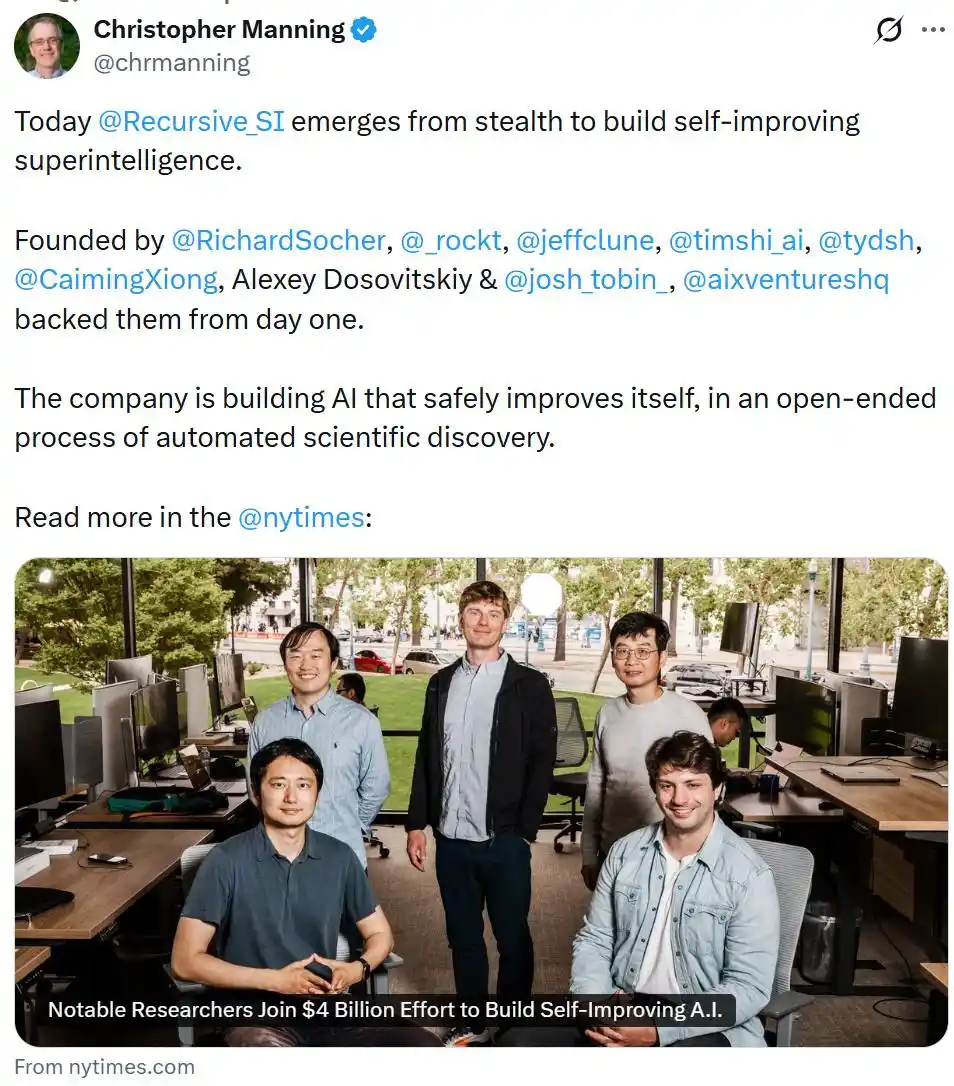
These founding members have previously been involved in establishing AI research labs at Salesforce and Uber, and have held leadership positions at teams such as OpenAI, DeepMind, Google Brain, and Meta, possessing extensive research and entrepreneurial experience.

Recursive_SI is committed to building an artificial intelligence that can autonomously conduct experiments and safely self-improve—continuously evolving within an open-ended, automated scientific discovery process, which is considered the most likely path towards superintelligence.

Currently, Recursive has raised $6.5 billion with a valuation of $46.5 billion, led by GV (Google Ventures) and Greycroft, with significant investments from AMD Ventures and NVIDIA.

The team has grown to over 25 members and continues to expand, having attracted many outstanding talents, including Zhuge Mingchen, who is set to join soon.

Zhuge Mingchen is currently a Founding Member at Recursive. He holds a Ph.D. in Computer Science from King Abdullah University of Science and Technology (KAUST), where he studied under Professor Jürgen Schmidhuber, known as the "Father of LSTM." His research focuses primarily on Coding Agents, Recursive Self-Improvement (RSI), and Next-generation Machine Paradigms.

Since 2023, Zhuge Mingchen has been systematically exploring the direction of Recursive Self-Improvement (RSI).

During the MetaGPT period, he proposed that agents should possess mechanisms for continuous self-optimization and capability evolution, advancing this research direction in subsequent work. Among these, GPTSwarm is considered one of the earliest RSI system paradigms in the LLM era. It was the first to systematically propose and validate a Graph-based Agents framework for self-organizing collaboration, enabling coordination, feedback, and capability evolution among agents through dynamic graph structures. Its core concepts have since been widely adopted by numerous subsequent multi-agent and Agentic AI projects. Agent-as-a-Judge further explored continuous feedback and self-evaluation mechanisms in long-term tasks, attempting to address issues of continuity and stable optimization for agents in complex missions. Research on NeuralComputer further advanced towards next-generation AI system architectures, exploring new machine paradigms that integrate memory, reasoning, and autonomous evolution capabilities.

It can be seen that the research team joining Recursive possesses profound academic experience in the field of recursive self-improvement.

Tian Yuandong and several other founders have promoted the venture on X: "We are building an artificial intelligence that can autonomously discover knowledge and recursively self-improve—this open-ended process will fundamentally change the way science and technology advance."
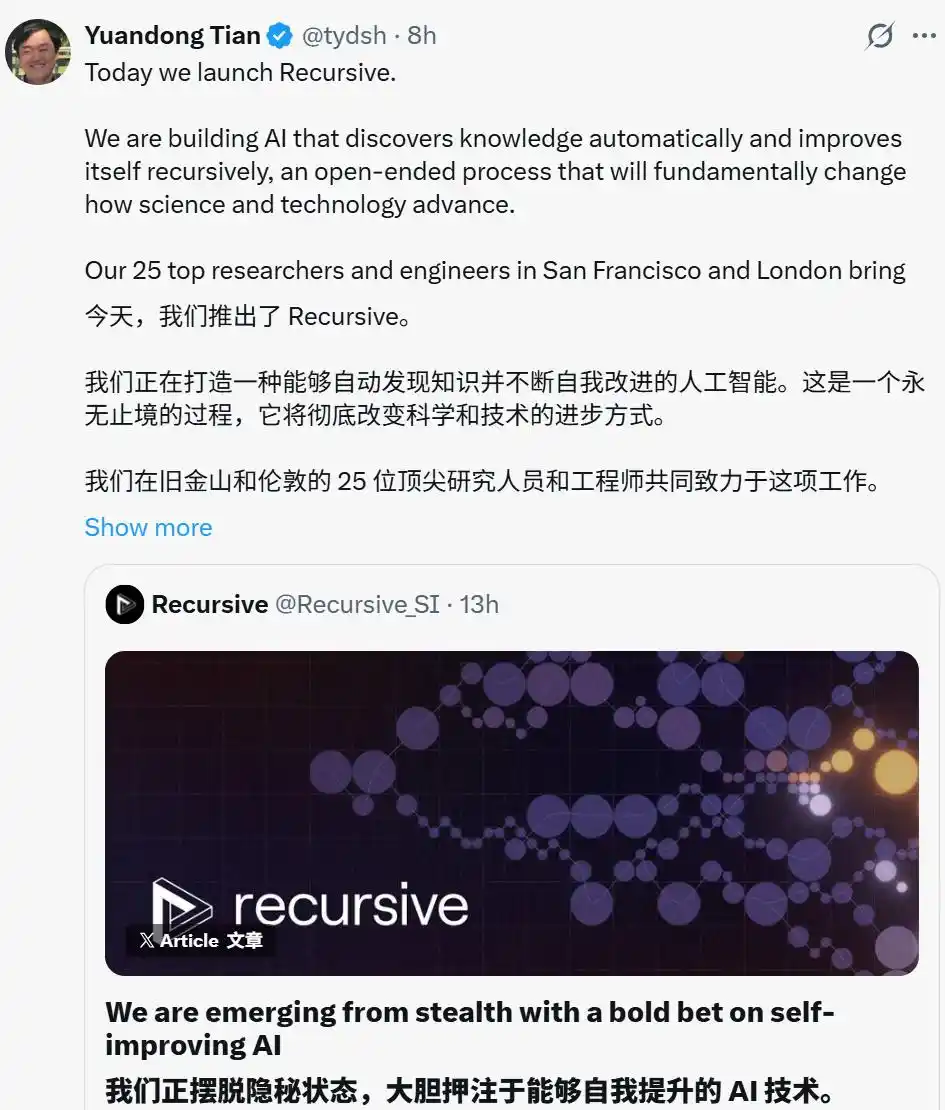
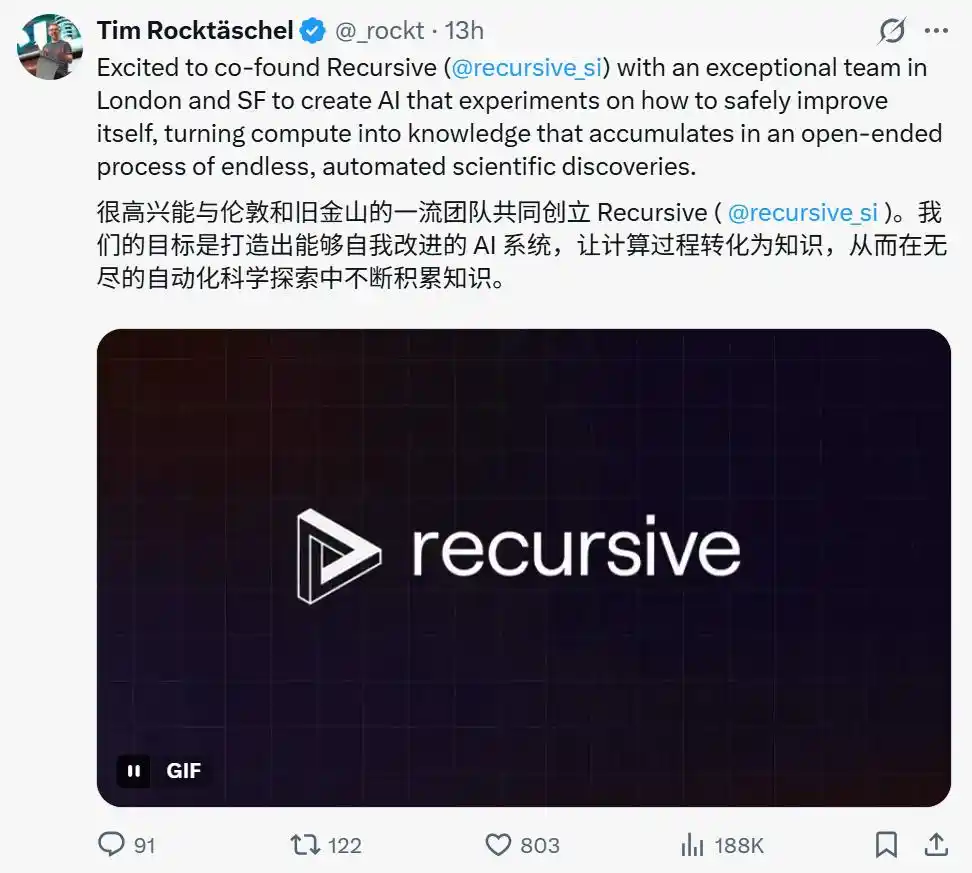
In several core areas of recursively self-improving artificial intelligence, the team is at the industry forefront.

Members have previously achieved major breakthroughs in fields such as open-ended algorithms, quality-diversity algorithms, AI-generated algorithms, self-improving programming agents, automated red teaming and capability discovery, prompt engineering and its automation, learning challenges and environment generation, foundational world models, deep learning for natural language processing, vision transformers, retrieval-augmented generation, and AI scientists.

Therefore, we are truly filled with anticipation for the upcoming research from Recursive_SI.

This article is from the WeChat public account "机器之心" (Machine Heart), author: 机器之心 (Machine Heart), editor: 机器之心编辑部 (Machine Heart Editorial Department)


İlgili Sorular

QWhat is the name of the startup co-founded by Tian Yuan Dong after leaving Meta, and what is its primary mission?

AThe startup is called Recursive_SI. Its primary mission is to build an artificial intelligence that can autonomously conduct experiments and safely self-improve through an open-ended process of automated scientific discovery.

QWho are the key investors in Recursive_SI, and what is the current valuation and funding amount mentioned in the article?

AKey investors include GV (Google Ventures) and Greycroft, with AMD Ventures and NVIDIA also participating in significant funding. The company has raised $6.5 billion with a valuation of $46.5 billion.

QWho is Zhuge Mingchen and what is his research focus, particularly in relation to Recursive Self-Improvement (RSI)?

AZhuge Mingchen is a Founding Member of Recursive_SI, holding a Ph.D. in Computer Science from KAUST under Professor Jürgen Schmidhuber. His research focuses on Coding Agents, Recursive Self-Improvement (RSI), and Next-generation Machine Paradigms. Since 2023, he has systematically explored RSI, contributing to early RSI system paradigms like GPTSwarm and Agent-as-a-Judge.

QWhat are some of the core AI research areas where the Recursive_SI founding team is said to be at the industry forefront?

AThe team is at the forefront in areas including open-ended algorithms, quality-diversity algorithms, AI-generated algorithms, self-improving programming agents, automated red teaming and capability discovery, prompt engineering and automation, learning challenge and environment generation, foundational world models, deep learning for natural language processing, vision Transformers, retrieval-augmented generation, and AI scientists.

QWhich major tech companies' AI research labs have the founders of Recursive_SI been involved in establishing or leading, according to the article?

AThe founding members have been involved in establishing or leading AI research labs at Salesforce and Uber, and have held leadership positions at OpenAI, DeepMind, Google Brain, and Meta.

İlgili Okumalar

A 134% Surge, 75 P/E Ratio: Why Is the Market Paying Up for Murata's 'Zero Growth'?

Murata Manufacturing, the world's largest passive components maker, saw its stock price surge 134% over the past year and hit a record high on May 28th, despite reporting nearly zero growth in operating profit for its latest fiscal year. This has pushed its valuation to a P/E ratio of approximately 75x. The disconnect is driven by a fundamental market re-rating. The catalyst was a late-May meeting where management upgraded the AI investment cycle outlook to "lasting until around 2030" and noted that demand for its components is roughly double its supply capacity, with customers prioritizing securing volume over price. While Murata's revenue grew only 5.0% and operating profit stagnated at ¥281.8 billion for the fiscal year ending March 2026, its guidance for the current fiscal year projects a 34.8% jump in operating profit to ¥380 billion. This sharp growth is underpinned by expectations that its AI/data center-related revenue will nearly double from ¥170 billion to ¥325 billion, becoming a key pillar of its business. Analysts highlight that this growth stems not from broad price hikes but from a shift towards higher-value, cutting-edge MLCCs for AI servers, where Murata holds over 70% market share. The market is now pricing Murata not as a cyclical component maker but as a critical "AI pick-and-shovel" supplier with structural pricing power. However, the high valuation also carries risk if future AI demand or quarterly guidance falls short of the elevated expectations.

marsbit23 dk önce

A 134% Surge, 75 P/E Ratio: Why Is the Market Paying Up for Murata's 'Zero Growth'?

marsbit23 dk önce

a16z: Why Do Prediction Markets Matter?

Prediction markets, which allow users to trade on the outcome of future events, have gained significant traction, especially in the U.S. At their core, these markets function like any other market by aggregating information from all participants and translating it into a price signal—in this case, the perceived probability of a specific event occurring. Unlike polls or surveys that offer static snapshots, prediction markets provide dynamic, quantifiable probability estimates that update in real-time as new information and participants enter. A key advantage is the incentive structure: participants risk their own capital, which encourages serious research and trading based on genuine knowledge. This can surface information that traditional methods might miss. Furthermore, prediction markets can be created for a vast array of specialized questions—from geopolitical events to AI model performance—that aren't covered by traditional financial markets. However, several challenges remain. Infrastructure issues include reliably determining event outcomes and resolving disputes. Market design must ensure participation from well-informed individuals while preventing manipulation, such as insider trading or attempts to sway public perception by artificially moving prices. Addressing these concerns around rules, participation, and contract design is crucial. If these hurdles are overcome, prediction markets could evolve into a powerful, widely-used tool for forecasting and navigating uncertainty.

marsbit33 dk önce

a16z: Why Do Prediction Markets Matter?

marsbit33 dk önce

Interview with 7 Ordinary Professionals: After AI Arrived, How Are You Doing?

This article interviews seven professionals from diverse fields like Web3, bulk chemical trading, digital agriculture, and traditional wholesale to examine the impact of AI on their work. Key themes emerge from the discussions. AI has become integral to their workflows, primarily for increasing efficiency in tasks such as coding, content creation, research, and data analysis. Individuals across roles, from developers to managers, report that AI tools like ChatGPT and Claude have significantly reduced workloads and accelerated learning, creating opportunities for "super individuals" or one-person teams. However, this efficiency comes with a double-edged sword. It intensifies competition, pushing professionals to constantly learn new tools and adapt, leading to widespread anxiety about job security and a heightened pressure to keep pace. Interviewees anticipate significant job reductions in roles like administrative support, finance, HR, customer service, and some creative fields. A recurring view is that AI acts as a "great equalizer," amplifying the capabilities of those who use it effectively while leaving others behind, potentially deepening polarization. Despite AI's capabilities, interviewees identify enduring human strengths. AI struggles with tasks requiring deep contextual understanding, complex judgment in areas like risk assessment and system stability (especially in finance/Web3), nuanced human communication, and handling exceptions in logistics and manufacturing. These areas remain firmly in the human domain. Consequently, many professionals are refocusing their career strategies. They plan to evolve from task executors into "complex system owners," "super coordinators" managing AI agents, or specialists in high-level areas like business context, risk control, product design, and personal branding. In summary, the article portrays AI not as an optional tool but as a transformative force reshaping job demands. While it automates routine work, it also creates new forms of pressure and competition. The future, as seen by these professionals, belongs to those who can strategically integrate AI to augment uniquely human skills like judgment, responsibility, and strategic oversight.

marsbit49 dk önce

Interview with 7 Ordinary Professionals: After AI Arrived, How Are You Doing?

marsbit49 dk önce

Satoshi Nakamoto Sued? $83.7 Billion Worth of BTC Up for 'Legal Claim'

An anonymous individual known as Noah Doe, along with two Wyoming LLCs, has filed a lawsuit in the New York Supreme Court. They are attempting to use New York's "lost and found" laws to claim legal ownership of approximately 837 billion USD worth of Bitcoin held in 39,069 dormant addresses. Crucially, this list includes addresses believed to belong to Bitcoin's creator, Satoshi Nakamoto (holding around 837 billion USD), alongside other long-inactive addresses from Mt. Gox and early Bitcoin holders. The plaintiff's legal strategy hinges on classifying these public Bitcoin addresses as "lost property." They submitted a USB drive containing only the public addresses to the New York Police Department, sent OP_RETURN notifications on the Bitcoin blockchain, and issued press releases. Their argument is that after these efforts and a waiting period, they should be granted ownership. A key, and highly controversial, claim is an unnamed "independent expert" valuing each address at under 10 USD, allowing for a faster legal process. Analysts from Galaxy point out major flaws in the case. The plaintiff never physically possessed the Bitcoin or private keys. The "under 10 USD" valuation is considered unrealistic, and allowing anonymous companies to claim such vast assets is highly unusual. Even if the plaintiff wins, they would only receive a court declaration of ownership, not the actual private keys to move the Bitcoin. The real danger lies in this court document acting as a "cloud on title." If any of these Bitcoins are later transferred to a regulated exchange or custodian, the plaintiff could present the judgment to freeze the assets, forcing the true owner into lengthy and de-anonymizing litigation to prove ownership. The outcome is uncertain, but the case highlights potential legal risks for dormant cryptocurrency holdings.

marsbit54 dk önce

Satoshi Nakamoto Sued? $83.7 Billion Worth of BTC Up for 'Legal Claim'

marsbit54 dk önce

İşlemler

Spot
Futures
活动图片




