Those Who Wanted to Buy Have Already Bought: SpaceX Retail Frenzy Subsides, Real Selling Pressure Arrives in August

marsbit2026-06-23 tarihinde yayınlandı2026-06-23 tarihinde güncellendi

Özet

SpaceX (SPCX) debuted on June 12 at $150, soared to a record $225 by June 16 in a retail-fueled frenzy, then collapsed, losing over $600 billion in market cap in a single day this week and crashing back near its IPO price. Analysts note the initial surge was driven by record retail inflows exceeding those for major tech stocks, but momentum evaporated swiftly after the peak. The sell-off occurred with only 5% of shares freely tradable. The real pressure is yet to come: lock-up expirations starting in August could release up to 44% of insider shares by early September, potentially increasing the float ninefold. With retail buying exhausted and massive supply looming, analysts warn the path higher is now severely challenged, posing a broader risk to a market sustained by speculative momentum.

Original Author: Tyler Durden (ZeroHedge pseudonym)

Original Compilation: Source: ZeroHedge

Guide: SpaceX fell for three consecutive days, plummeting 16.4% on Monday alone, erasing $600 billion in market value, dropping back to the $150 opening price. This analysis bluntly argues that those who wanted to buy have already done so, and more critically, the selling pressure hasn't truly arrived yet. This pump-and-dump used only 5% of the float. Insiders could sell up to 44% of the shares by early September.

It began with a bang. SpaceX went public on June 12, opening at $150 per share, well above the $135 IPO price. Within two days, aggressive traders started furiously buying 380-strike call options expiring two days later, trying to launch the stock price into the stratosphere, creating a gamma squeeze.

@zerohedge tweet: They're really going to do it
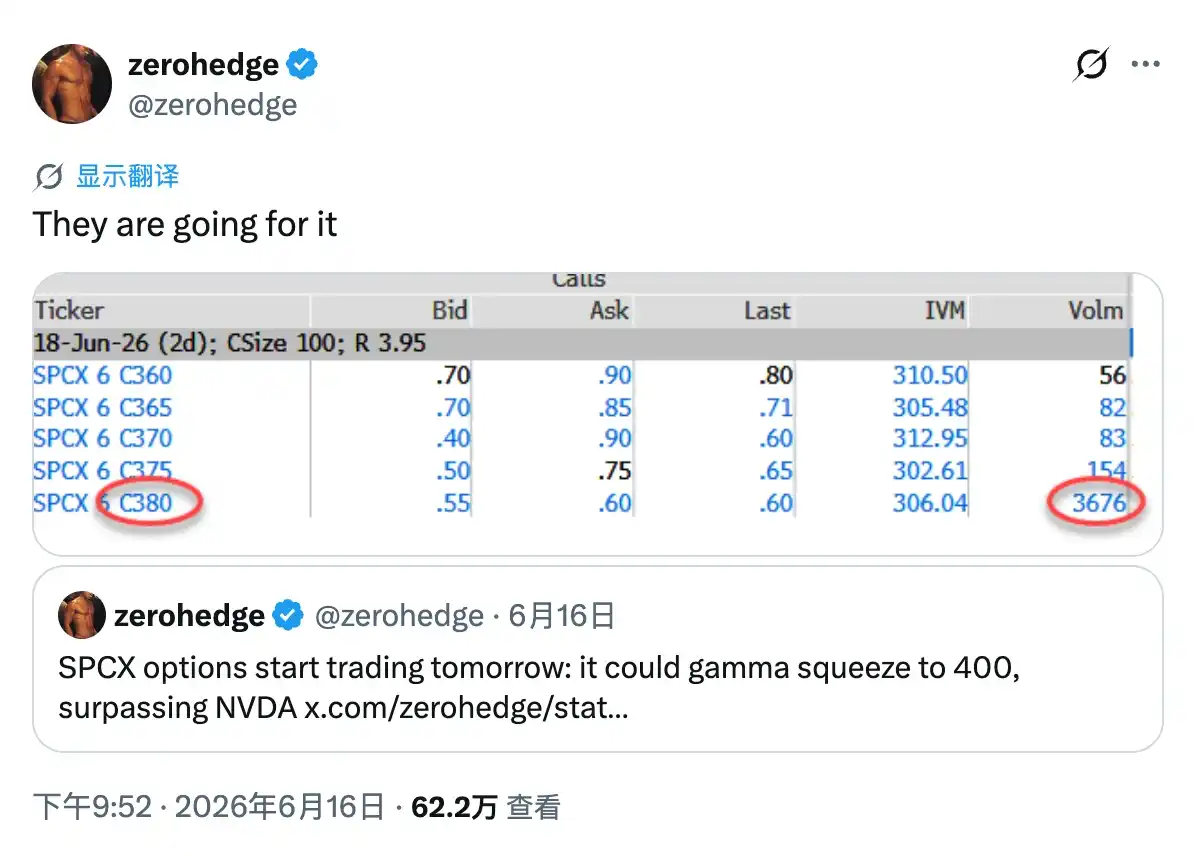
In a report this morning, Canaccord described the "new wave of optimism" accompanying SpaceX's listing:

"The SPCX tape shows the market has entered a new phase of euphoria. Prior to this historic IPO, we felt AI optimism was already full, sometimes excessive, but buying was primarily from rational (albeit exuberant) institutions—large, well-funded public companies and PE investors. In our view, SPCX has turned a new page, with dramatically heightened retail participation, propelling the stock into the global top six by market cap and adding the equivalent of half of META's market value in its first week. Its market cap far surpasses that of its sister company TSLA, while revenue is only about one-fifth. Despite the company being named SpaceX, revenue is actually skewed towards connectivity—Starlink contributed $113.9B, launch services only $41B, and AI compute capacity was $32B in 2025."

Vanda Track put it even more starkly. In a review published earlier Monday, it wrote: "SpaceX's debut week set records. Retail investors net bought $405 million of SPCX in the first five trading days, the strongest retail participation in an IPO in recent years. Buying was extremely aggressive in the first few days, cooling somewhat towards the week's end. The flow characteristics increasingly resemble building a long-term position, not chasing a short-term meme stock."
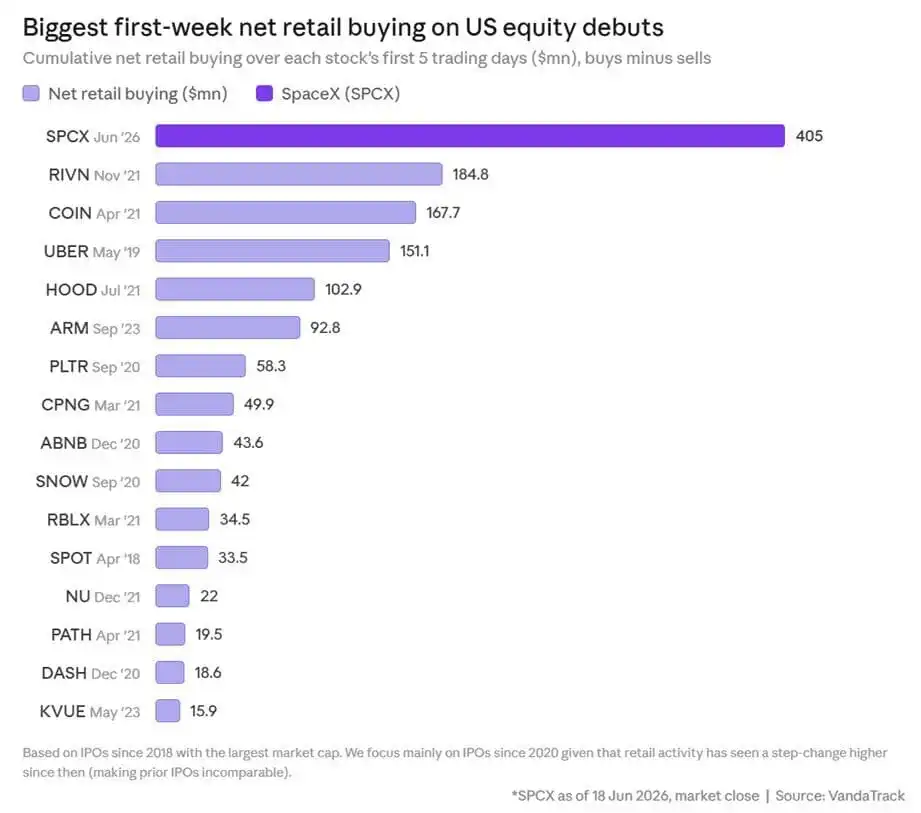
Caption: Retail flow for SPCX in its first five trading days

Source: Vanda Track

The scale of retail buying in SPCX becomes even more staggering in context. Last week's retail purchases of SPCX exceeded their combined buying of all other Mag 7 stocks—NVDA, MSFT, AMZN, META, GOOGL, and GOOG totaled only $278 million over those five days. Retail buying of SPCX also surpassed the combined retail flow into the SPY and QQQ ETFs ($352 million). A stock that began trading just last week is already competing with the market's largest individual stocks and ETFs for retail dollars.
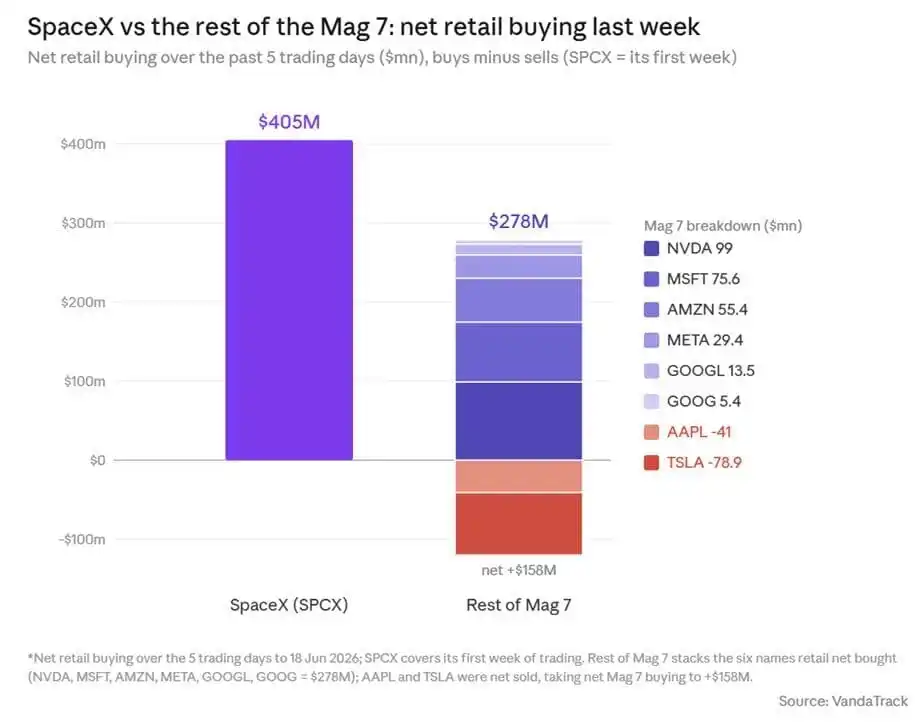
Caption: SPCX retail buying vs. Mag 7 stock retail buying

Source: Vanda Track

The old playbook unfolded again. Alongside the explosive buying of the stock, retail investors rapidly poured into various SpaceX leveraged products, with similarly strong demand. In the first few trading days, retail bought $65.8 million worth of the Leverage Shares 2x Long SPCX Daily ETF—a significant number, but still well below typical levels during speculative retail manias. Even so, it crushed recent thematic new issues: Roundhill's Memory ETF (DRAM) attracted only $5.6 million in its first four days. It took DRAM 22 trading days to surpass the cumulative retail buying that the SpaceX leveraged ETF had already absorbed.
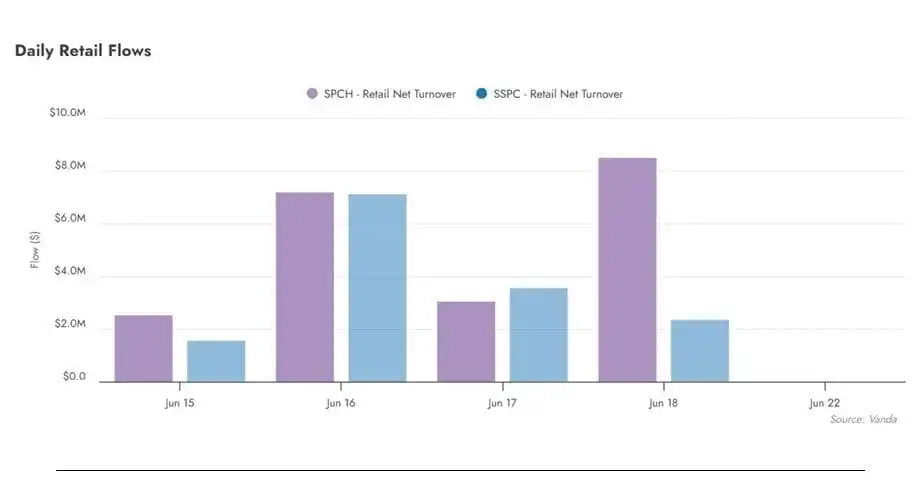
Caption: SPCX leveraged ETF retail flow vs. contemporaneous thematic ETF retail flow

Source: Vanda Track

Out of the gate, the momentum quickly stalled, and the fantasy of "riding a reusable rocket all the way into orbit via gamma squeeze" evaporated. June 16th was the peak, when SPCX hit a record high of $225, briefly surpassing Microsoft in market cap. Since then, daily retail flows have collapsed, with retail turnover almost vanishing.
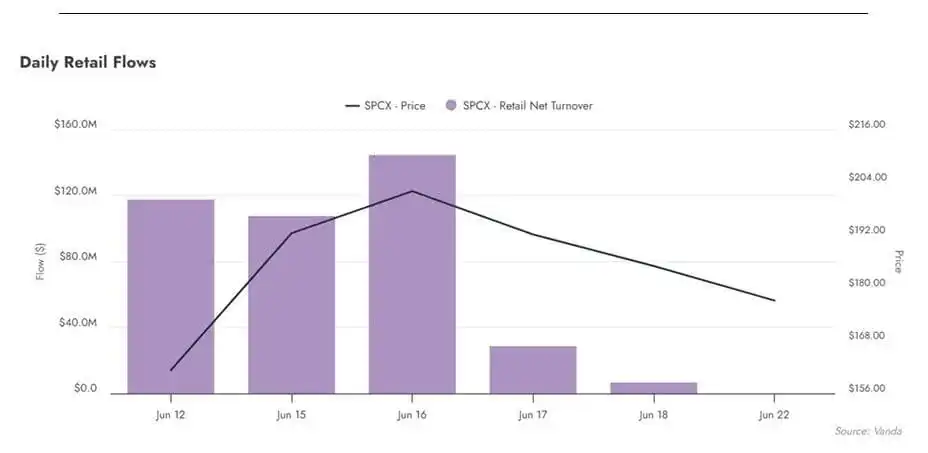
Caption: SPCX daily retail flow—cliff-like drop after peaking on June 16

Source: Vanda Track

This brings us back to Canaccord's statement. Based on SpaceX's early trading, the firm judged that "tech stocks likely have enough momentum to sustain them in the near term," but it also warned: "There's now an added layer of dangerous vacuum beneath these stocks."

Sure enough, once momentum dissipated, coupled with market awareness of trillions of shares about to unlock, the stock fell for three consecutive days, culminating in Monday's crash. On that day, as SpaceX sought to issue over $20 billion in investment-grade bonds for the first time—taking advantage of still-euphoric debt markets to replace a much higher-interest bridge loan before the window closed—SPCX plunged 16.4%, erasing a record $600 billion in market value in a single day. Including Wednesday's 5% drop and Thursday's 3.5% decline, the stock is now only slightly above its $150 opening price from two weeks ago.
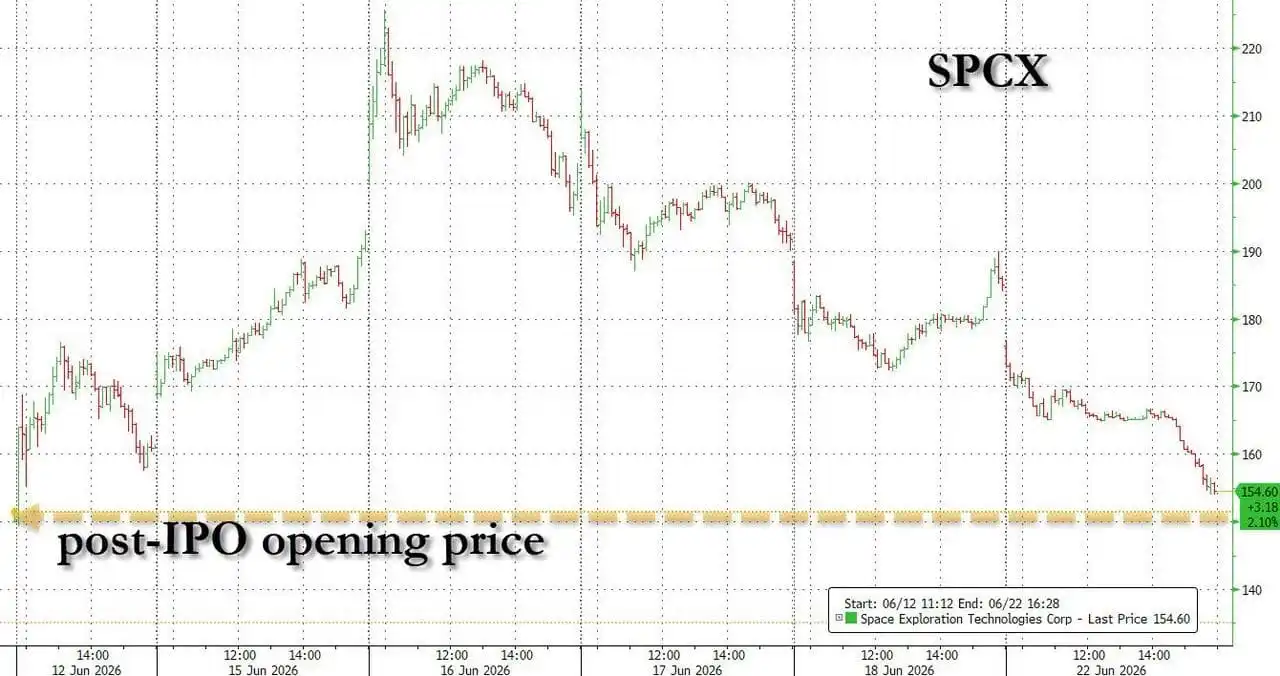
Caption: SPCX price action since IPO—retreat from $225 high to around $150

Source: ZeroHedge

Worse, after hours, SPCX briefly touched the $150 IPO opening price. If it opens below that level tomorrow, everyone who bought and held in the secondary market will be underwater.
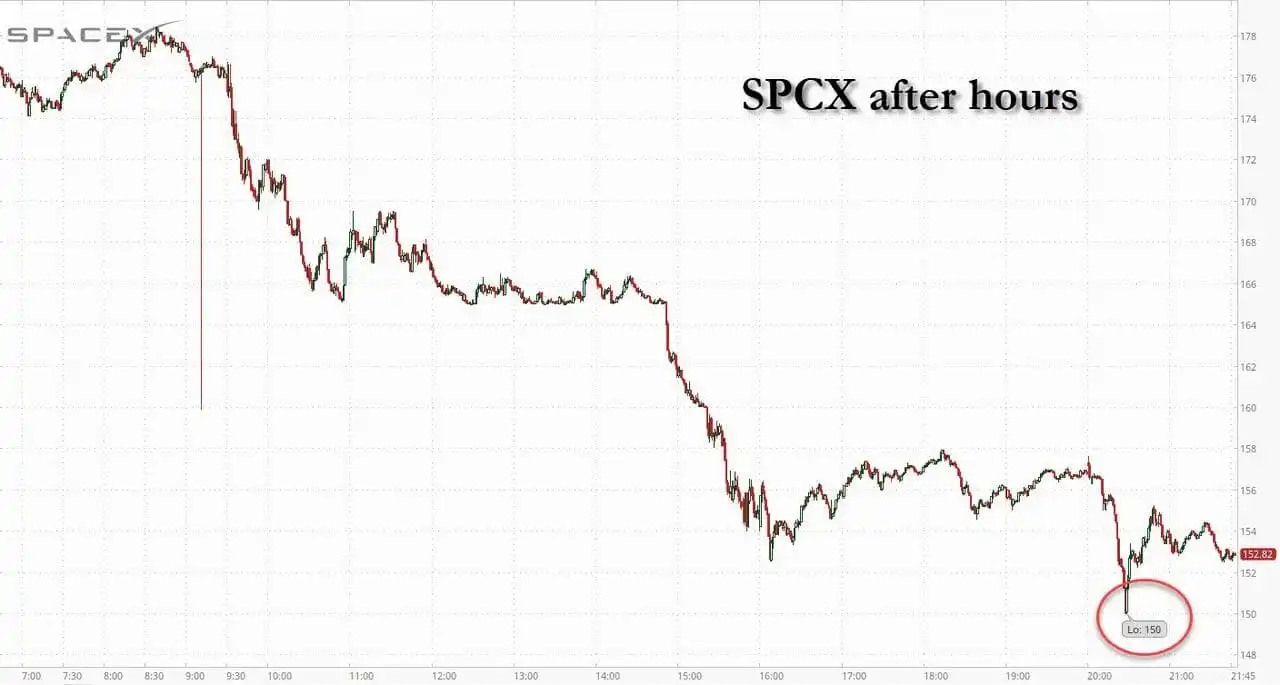
Caption: SPCX after-hours drop to near $150 IPO opening price

Source: ZeroHedge

Particularly noteworthy is that this pump-and-dump occurred with only 5% of the float available for trading—95% of shares are still locked up. But that will change soon.
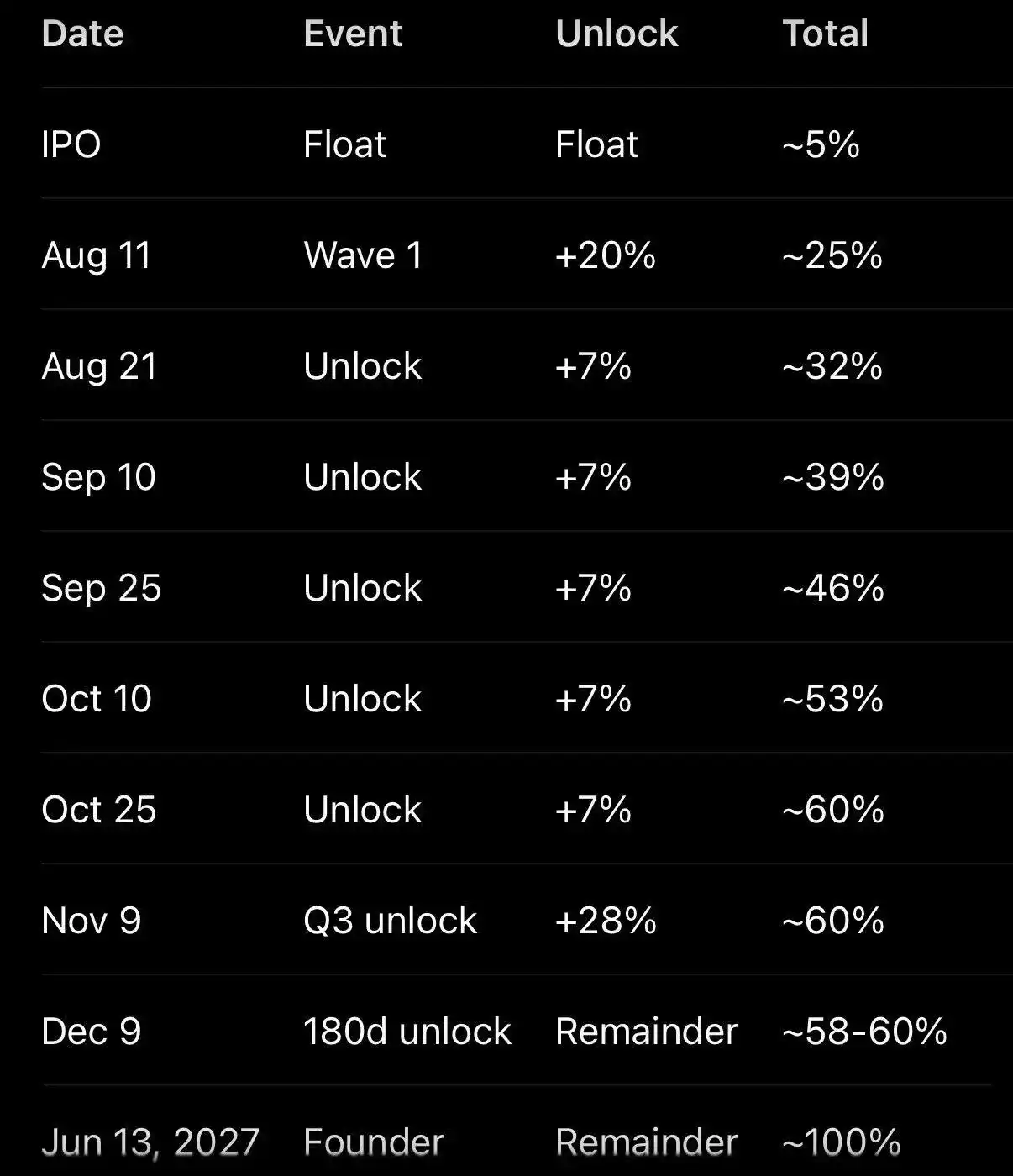
Caption: SPCX lock-up structure—currently only 5% float, 95% locked

Source: ZeroHedge

22V Research strategist Jeff Jacobson says that after SpaceX reports earnings in early to mid-August, a 20% block of insider shares will unlock. Additionally, if the stock price remains 30% above the IPO price, a further 10% will unlock. Another 7% unlocks around August 21st and September 10th.
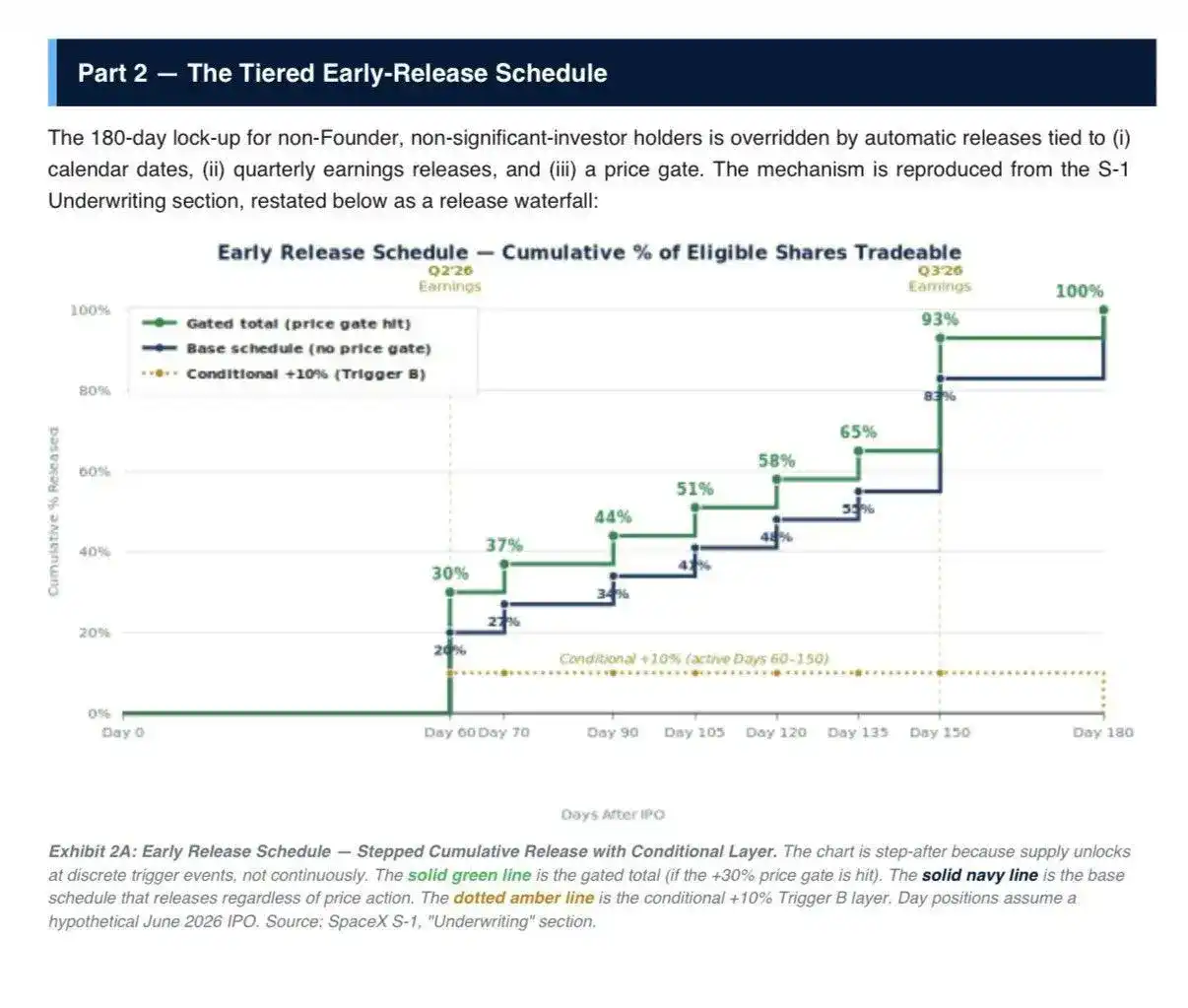
Caption: SPCX lock-up expiration schedule

Source: 22V Research

Jacobson says insiders could potentially sell up to 44% of SpaceX shares by early September, expanding the current float by approximately 900%.

In other words, lifting the stock price from here will only become increasingly difficult. Meanwhile, JonesTrading chief market strategist Michael O'Rourke says "the sellers have regained control," adding: "Everyone in the world who wanted to buy, has already bought."

Bloomberg, commenting on today's decline, wrote that SpaceX's slide today "dragged down most of the market."

Whether that's truly the case remains to be seen. But in this market—which has run almost entirely on retail euphoria and momentum-chasing since the March lows—once retail truly gets cold feet, starting with SpaceX, then the memory bubble, and finally the semiconductor stocks that have feasted on the AI trade...

@zerohedge tweet: The divergence between hyperscale cloud providers and semiconductors is unsustainable: massive capital expenditure is the key variable.
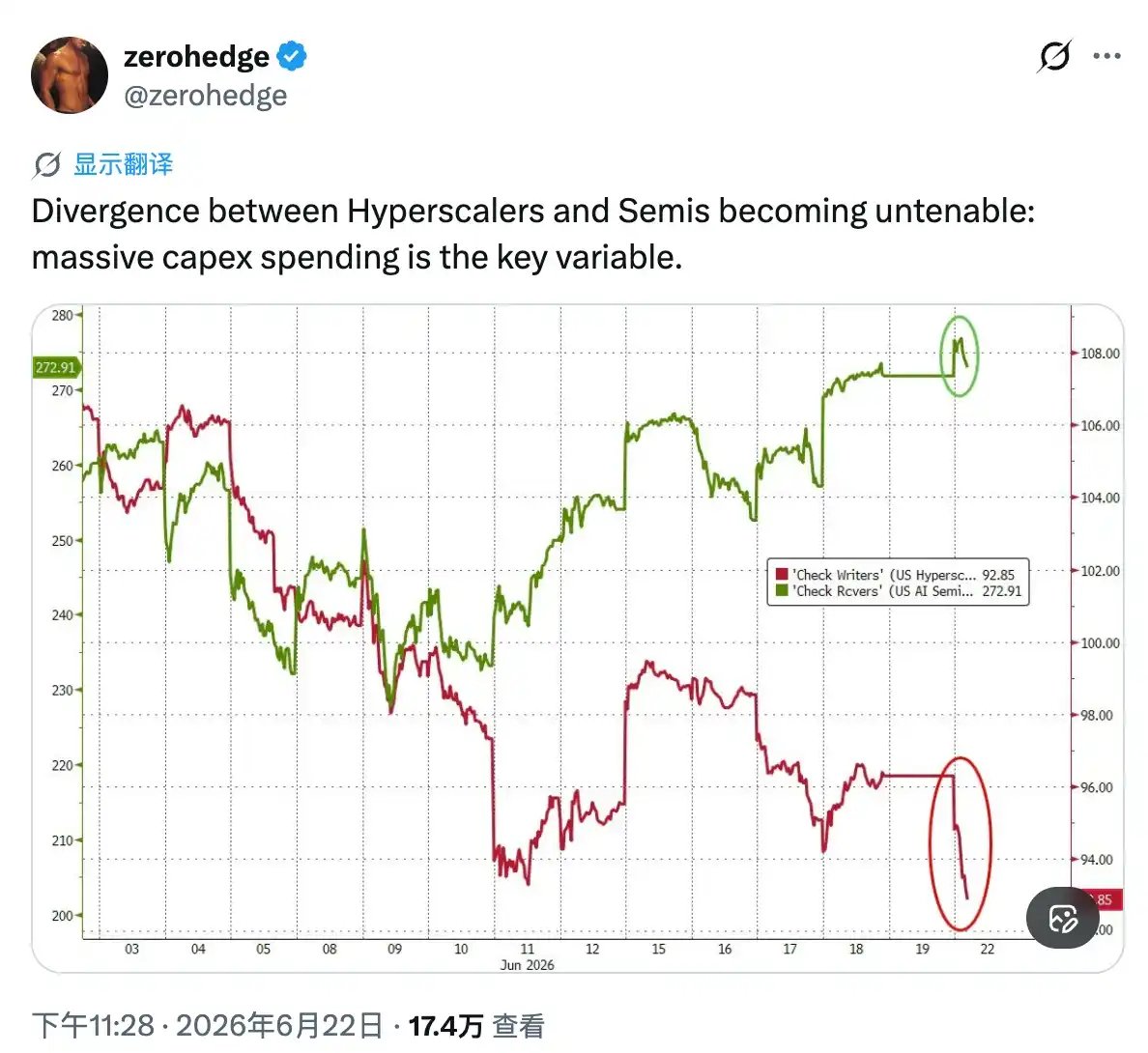
...then, it will be time to invert Eliot's line: The whimper of selling will become a bang.


İlgili Sorular

QWhat are the main reasons for the sharp decline in SpaceX's stock price after its initial spike?

AThe main reasons for the sharp decline are the rapid exhaustion of retail investor buying momentum, the company's announcement of a large bond offering, and the looming threat of significant share lock-up expirations (up to 44% of shares potentially becoming available for sale by early September).

QHow significant was retail investor participation in the first week of SpaceX's trading, according to Vanda Track?

AAccording to Vanda Track, retail investors were extremely significant, with a record net purchase of $405 million in SPCX shares in the first five trading days. This surpassed their combined purchases in all other Mag 7 stocks and even exceeded their combined flows into SPY and QQQ ETFs.

QWhat percentage of SpaceX shares are currently freely tradable, and what will happen to this figure by September?

ACurrently, only about 5% of SpaceX shares are freely tradable, with 95% locked up. However, according to 22V Research, insiders could potentially sell up to 44% of the company's shares by early September, which would increase the available float by approximately 900%.

QWhat was the 'gamma squeeze' strategy mentioned in the context of SpaceX's early trading, and what happened to it?

AThe 'gamma squeeze' strategy involved aggressive traders buying short-dated, extremely out-of-the-money call options (like $380 strike) shortly after the IPO. The goal was to force market makers to buy the underlying stock to hedge their positions, thereby driving the stock price up dramatically. This momentum-based strategy failed as buying interest faded and the stock price reversed.

QWhat broader market risk does the article suggest might follow if retail investor enthusiasm continues to fade?

AThe article suggests that a continued fade in retail investor enthusiasm could lead to a broader market sell-off. It speculates that the weakness could spread from SpaceX to other speculative areas like the memory bubble, and ultimately to the semiconductor stocks that have benefited most from the AI trade boom.

İlgili Okumalar

L2 'Recalibration': When L1 Becomes Its Own Rollup, What Is Ethereum's Endgame?

The article discusses the evolving relationship between Ethereum's Layer 1 (L1) and Layer 2 (L2) solutions, moving beyond the initial "L2 for scaling" model. As Ethereum L1 itself scales (increasing Gas Limit, statelessness, zkEVM), the unique value proposition of L2s shifts from merely providing cheap execution to offering differentiated features like application-specific optimization, privacy, and flexible governance. The piece explores three key themes: 1. **L2's New Role:** L2s are transitioning from a pure scaling technology to a spectrum of execution environments with varying degrees of security inheritance from Ethereum L1. 2. **Interoperability as State Trust:** Solving L2 fragmentation is less about cross-chain bridges and more about enabling faster, trust-minimized state verification between environments. This involves initiatives like faster L1 finality, intent-based architectures (Open Intents Framework), and native account abstraction. 3. **Blurring Layers:** With the potential integration of zk-proofs into L1 validation (making L1 akin to its own "Rollup") and the concept of "Native Rollups," the rigid boundary between L1 and L2 may fade. The future could be a unified system with multiple execution domains (for DeFi, gaming, privacy, etc.) sharing a common security, settlement, and state framework. In conclusion, Ethereum's goal is not to abandon L2s or re-centralize everything on L1, but to re-integrate the fragmented user experience—liquidity, accounts, applications—while preserving the scaling benefits of a multi-environment ecosystem. The endgame is a cohesive "one chain" feeling for users, powered by diverse but securely interconnected execution layers.

marsbit9 dk önce

L2 'Recalibration': When L1 Becomes Its Own Rollup, What Is Ethereum's Endgame?

marsbit9 dk önce

The Encryption Bill Clarity's Challenge: A Thorny Path of Bipartisan Compromise in the U.S.

U.S. lawmakers are attempting to advance the Clarity Act, a significant crypto market structure bill, but its path is fraught with partisan hurdles. The process has been rocky since January, when a prior bipartisan deal in the Senate Banking Committee was upended. A key compromise in May on "yield" issues allowed the bill to move forward in committee, but only with the conditional support of two Democratic senators, Angela Alsobrooks and Ruben Gallego. They emphasized that their final vote depends on reaching an agreement on ethics provisions for elected officials. Ultimately, the Senate Agriculture Committee passed its version along party lines without Democratic support. As Republicans push for a full Senate vote in July, the demand for strong ethics language has expanded beyond Democrats. Additional controversies surround provisions related to yields (aligning some Republicans with large banks) and developer protections (opposed by enforcement agencies). Core concerns about illicit finance and consumer protection remain central to the debate. Despite consensus on the need for legislation, achieving the necessary bipartisan compromise is proving difficult. While momentum exists—including recent meetings between senators and White House officials—a reconciled bill text faces skepticism. Senator Gallego has stated that without ethics terms acceptable to Democrats, they will not provide the needed votes. The immediate goals for the crypto community in Congress are unclear: a symbolic Senate vote before the August recess, eventual passage into law by 2026, or forging a final compromise framework. The arduous, vote-by-vote effort to build bipartisan support continues, mirroring the traditional legislative grind the industry must now navigate.

Foresight News1 saat önce

The Encryption Bill Clarity's Challenge: A Thorny Path of Bipartisan Compromise in the U.S.

Foresight News1 saat önce

İşlemler

Spot
活动图片