This New Generation of US Stock Trading Gods No Longer Read Financial Reports

marsbit2026-05-27 tarihinde yayınlandı2026-05-27 tarihinde güncellendi

Özet

The new generation of "stock gods" in the 2026 US AI bull market are not analyzing traditional financial reports. Instead of focusing on giants like NVIDIA, figures like the 22-year-old Leopold Aschenbrenner (who reportedly turned $200M into $14B) and influencers like Serenity on platforms like Reddit's WallStreetBets, X, and Substack are gaining fame and returns by targeting obscure, low-cap "micro-cap" stocks. Their strategy, dubbed "supply chain sniping," involves identifying critical, often monopolistic, bottlenecks in the AI hardware supply chain—such as specific materials or components essential for giants like Google and NVIDIA—that are missed by mainstream Wall Street analysts. Serenity's call on AXTI, a $700M company supplying indium phosphide substrates crucial for photonics and optical interconnects, saw the stock soar from ~$12 to nearly $150. Similarly, accounts like KawzInvests and PhotonCap focus on thematic, supply-chain-driven research in areas like AI infrastructure, optics, and cloud services for SMEs, bypassing traditional valuation metrics. This shift represents a cultural move away from Warren Buffett-style value investing based on deep financial statement analysis. The new approach thrives on low liquidity, early narratives, and strong community propagation on social media, similar to meme stocks or crypto. However, this "attention economy" strategy carries risks: it depends on sustained information gaps, the underlying companies' ability to deliver f...

In the 2026 AI wave of the US stock market, the real money wasn't made by holding familiar names like NVIDIA, Microsoft, Amazon, and Google. While these trillion-dollar giants are rising, it's hard for elephants to dance gracefully.

A new breed of 'supply chain snipers' is emerging en masse from Reddit, X, and Substack, leaving the far-behind returns of old-school Buffett-style value investors in the dust. Their holdings? A collection of micro-cap stocks with market caps ranging from a few hundred million to several billion dollars—names Wall Street analysts can't be bothered with and that average investors can't even pronounce.

The person who turned these micro-cap stocks into a trading consensus and trend is Leopold Aschenbrenner, a 22-year-old German who turned a starting fund of $200 million into $14 billion through stock trading, becoming the new synonym for a 'stock trading god'.

Following Leopold, the demystification of the Buffett school is accelerating. A wave of new trading gods focusing on 'supply chain sniping' is proliferating on Reddit, X, and Substack. They barely look at financial reports; instead, they focus on the 'chokepoint' micro-cap stocks in the upstream supply chain. Following this logic, our editorial team has found some of these new gods for analysis.

Are the 'New Trading Gods' All From Reddit?

Among this new generation of trading gods, the hottest and most prominent lately is Serenity, hailing from the WallStreetBets channel on Reddit.
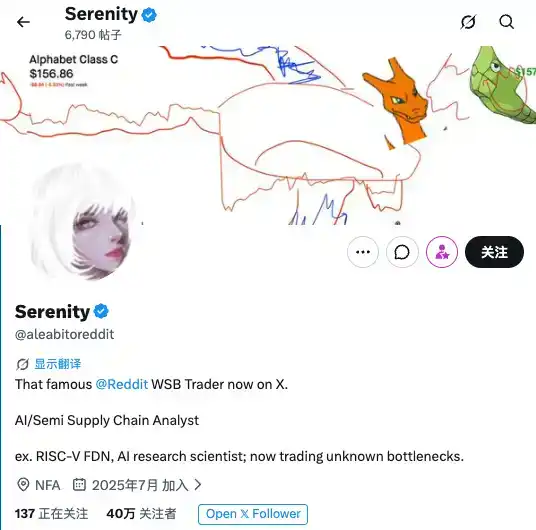
Many US stock traders are likely familiar with Serenity's personal story. In short, he was once an AI research scientist, participated in the RISC-V Foundation, published a Nature paper, and even joked about rejecting an offer from NVIDIA's AI team when the stock was at $6.

What solidified Serenity's 'new trading god' narrative wasn't these self-described credentials, but his call on a stock called AXTI on WSB. His core argument was straightforward: the entire AI industry's construction relies on this $700 million market cap monopoly company, including players like Google, NVIDIA, and Microsoft—all dependent on its indium phosphide substrates and materials. He argues the entire AI industry is shifting from Google TPUs to photonics, adopting optical interconnect technology. Without indium phosphide substrates, the entire AI 'growth' story will end in 2026.
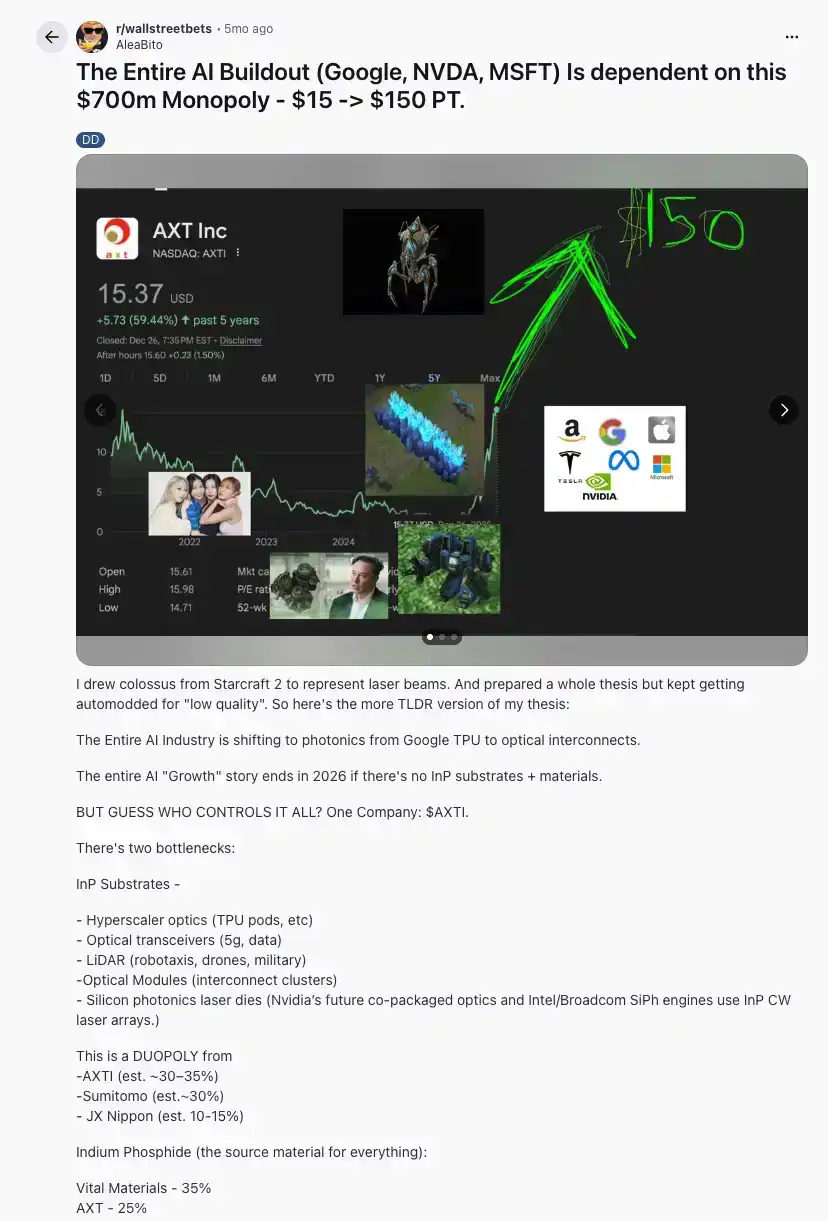
In that viral AXTI post, he directly called for a target price from $15 to $150, with a very direct title.

Related reading: "Rejecting NVIDIA's Offer at $6, He Says He Can Make More Trading Stocks."

The stock price gave Serenity the best endorsement. When Serenity discussed AXTI, the price was around $12. After that, AXTI rose continuously, first to $70, which Serenity himself claimed was a single-trade floating profit of 1000%. At the time of writing, public market data shows AXTI closing at $140.83, just a step away from his initial $150 target price.

This made Serenity's image more complex and three-dimensional; he's not just a lucky gambler on WSB but a deep researcher of the new-tech AI industry chain.

Why do such people first emerge from the WallStreetBets Reddit channel?

We need to spend some time on WallStreetBets' history.

WallStreetBets, abbreviated as WSB, is Reddit's most famous community for US stock retail investors. Its notoriety isn't because everyone here is rational or because it always finds the correct answers.

On the contrary, WSB first became famous by putting the two most extreme sides of US retail investors on full display: one side is short-term options expiring worthless, all-in bets going bankrupt, and mutual mockery; the other side is the occasional post that can change market narratives.

The 2021 "retail vs. Wall Street" battle originated from WSB. Mass retail investors directly confronted short-selling institutions around GameStop, turning a game retail stock considered a relic of the old era into global financial news. Since then, WSB is no longer just a forum. It became a trading culture: rough, exaggerated, risky, chaotic, but occasionally unearthing something real amidst the noise.

WSB has always been an extremely fertile ground for "non-consensus trades" to sprout. And Serenity is a new variant of WSB in the AI bull market.

It used to be GameStop, AMC, short-term options, and memes; now, more posts discuss cloud infrastructure, enterprise automation, AI agents, HBM, optical modules, data center power, photonics, and supply chain bottlenecks.

WSB's stock-pumping culture remains, but what's being pumped has changed.

This Generation of Trading Gods Never Reads Financial Reports

And this culture has spread from Reddit to X.
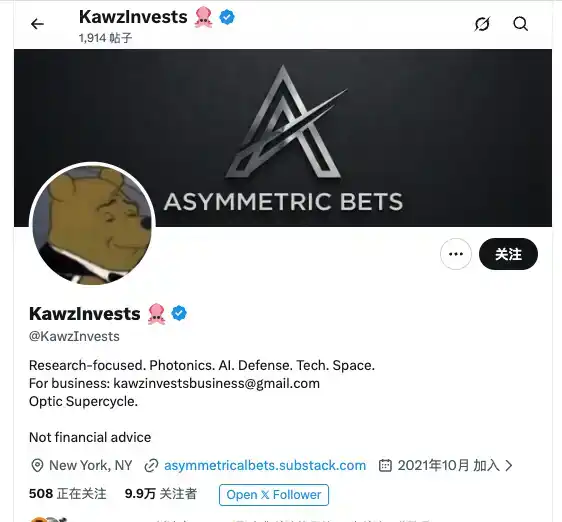
KawzInvests is also representative of the new generation of trading gods, an account focused on US stock trading views and thematic research. Similar to Serenity, his content is more "theme-driven" than traditional financial report analysis.

KawzInvests typically focuses on high-volatility areas like AI infrastructure, optical communication, defense robotics, biotech, in-vehicle software, and small-cap growth stocks, then finds logic in supply chain positioning, order clues, partnerships, management changes, M&A potential, and valuation re-rating space.
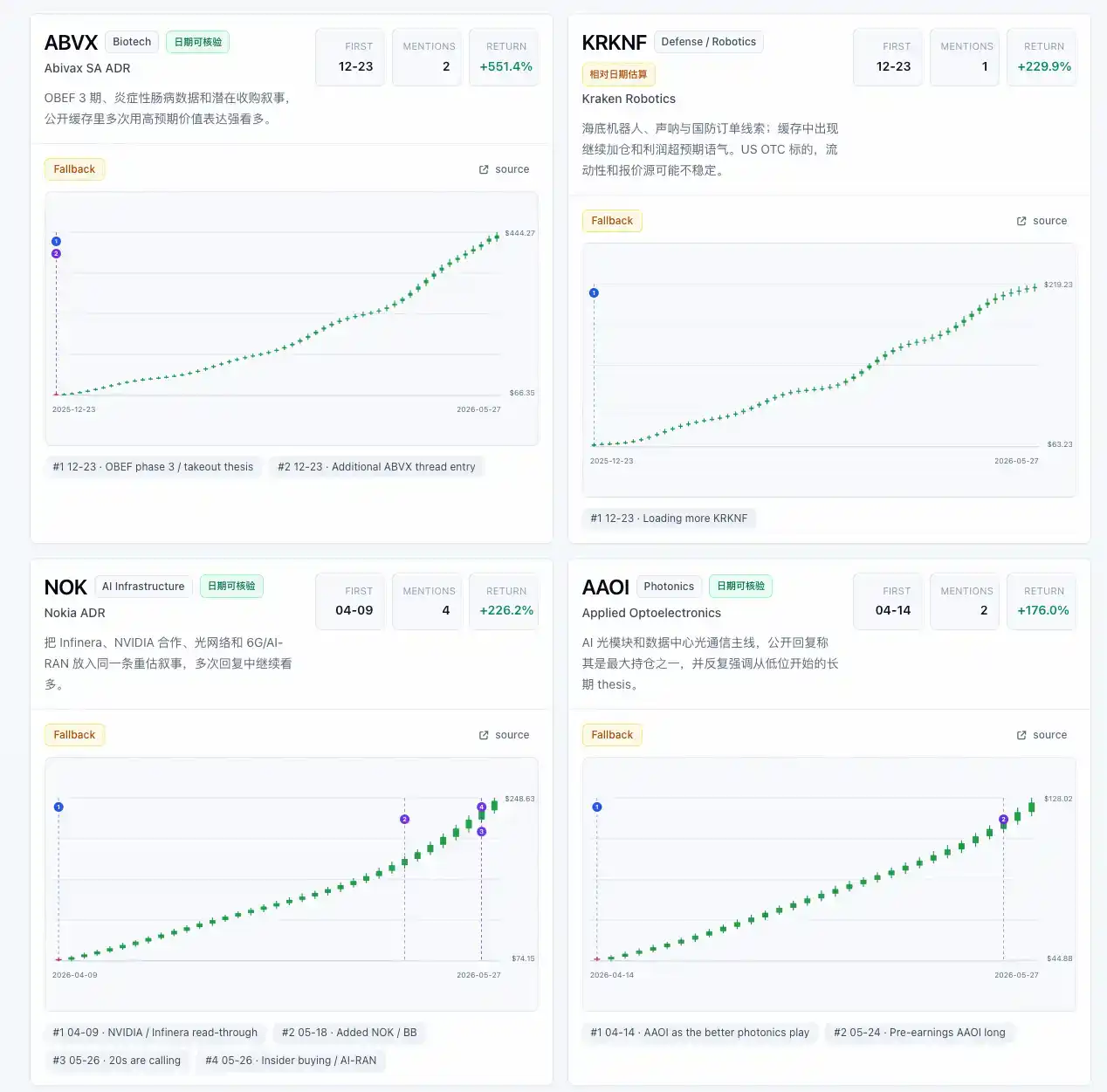
KawzInvests' stock call

PhotonCap is another typical example.
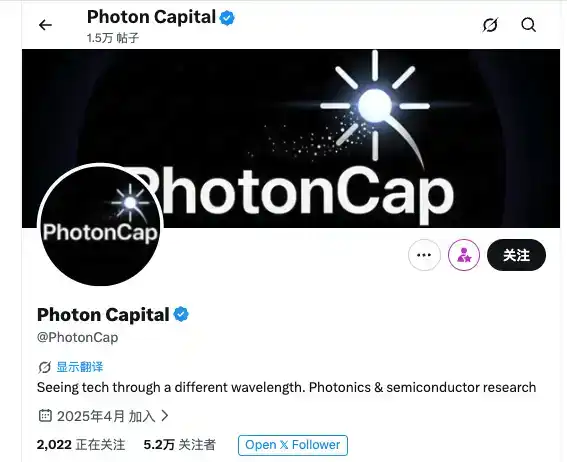
There are market rumors that PhotonCap might be the institutional account behind Serenity, or another shell for Serenity. This theory has a certain mystique, fitting the imagination of anonymous gurus. However, public information currently doesn't show this relationship. PhotonCap wrote in its Substack that it's a research account run by an optical and photonics engineer, daily working with lasers, optical fibers, transceivers, hence wanting to research how these are priced in the stock market. It also thanked Serenity for inspiration in a portfolio disclosure article.

Returning to where Serenity first gained fame, there are several similar "trading gods" on Reddit.

For example, the user with the ID u/imacompnerd.
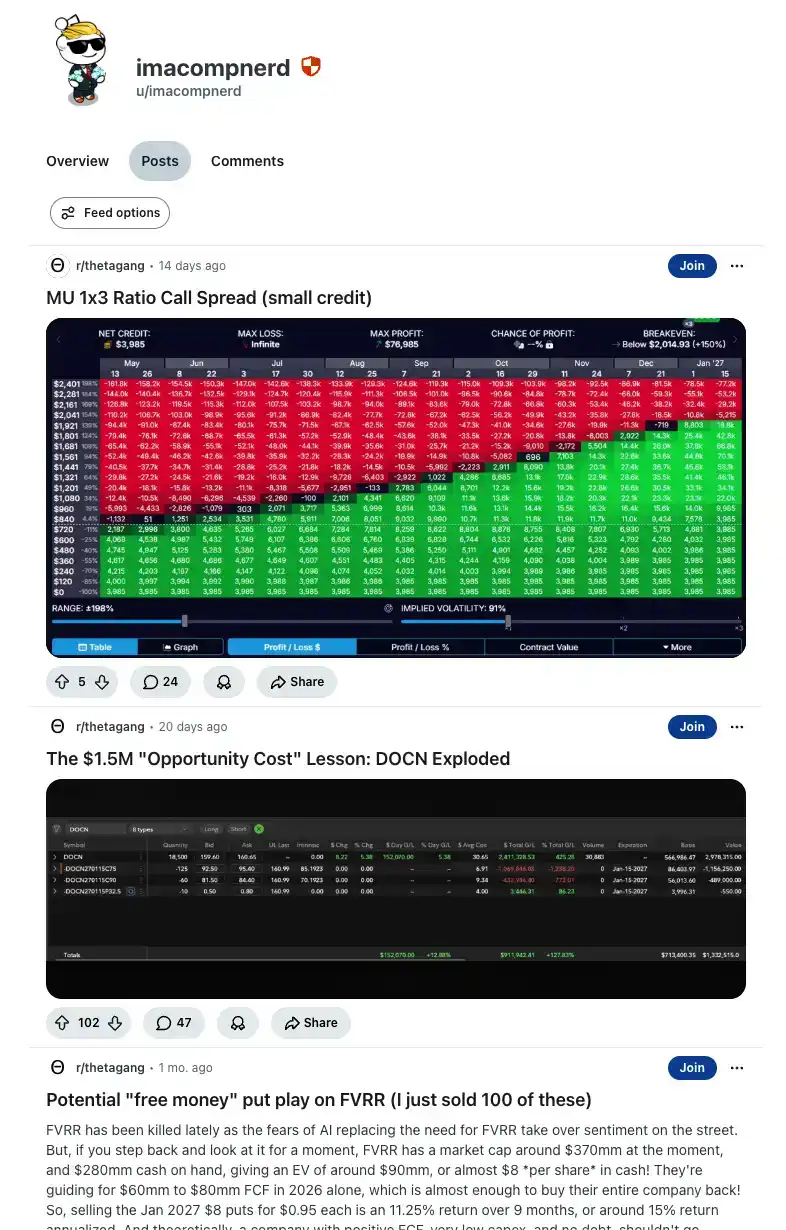
u/imacompnerd's most prominent trade was also DOCN DigitalOcean. This company isn't the market's most familiar AI leader, but it fits into the mid-layer narrative of 2026 AI trading: not every developer and SME directly uses AWS, Azure, or GCP, and not all AI/ML deployments need the complex systems of giant cloud providers.
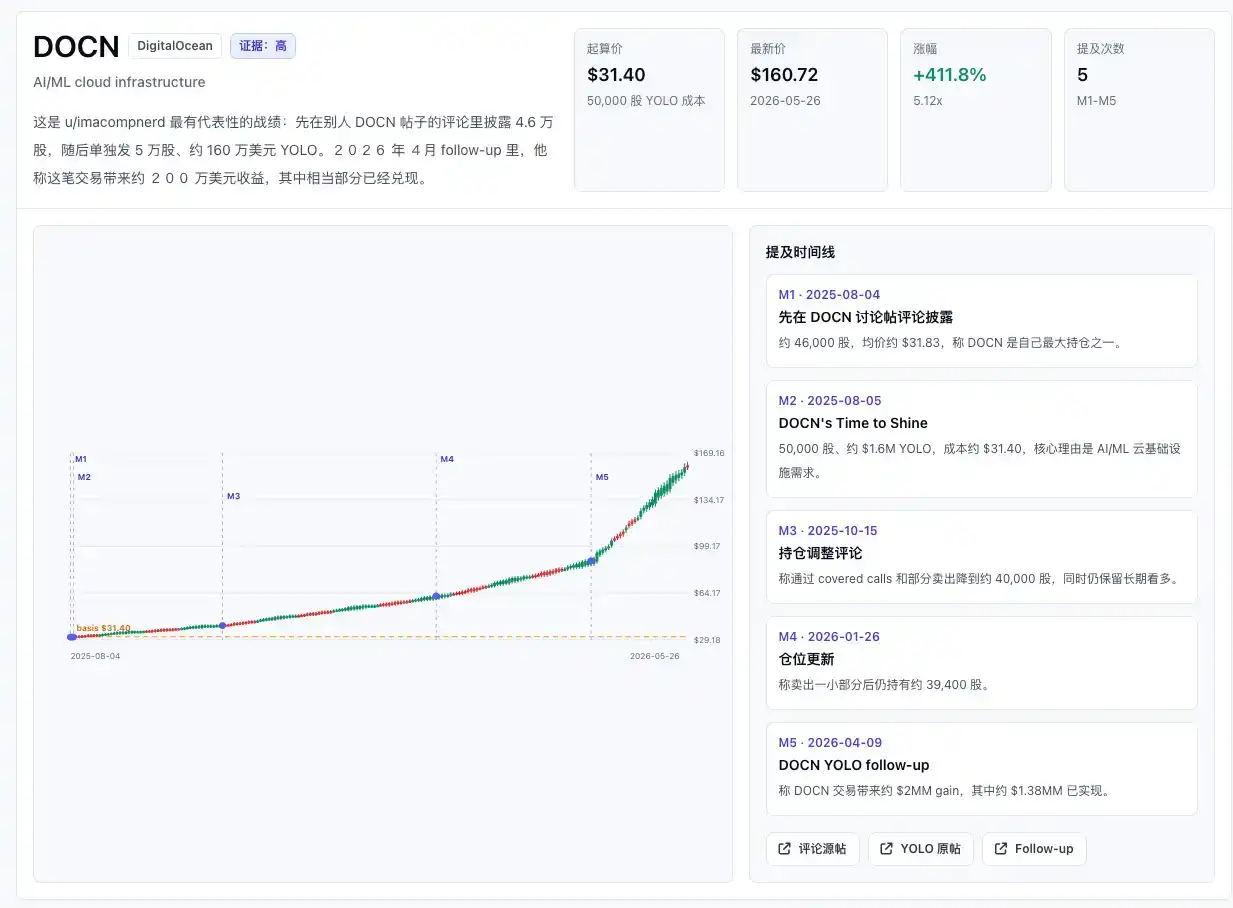
DigitalOcean's story lies in potentially becoming a lighter, cheaper, more user-friendly entry point for AI cloud infrastructure. imacompnerd bet on this position. He publicly disclosed holding 50,000 shares of DOCN, a position worth about $1.6 million, with a cost basis around $31.4; later, he posted a follow-up claiming this trade brought about $2 million in profit. At the current price, this is no longer ordinary "bullishness" but a significant concentrated investment with clear wealth effect.
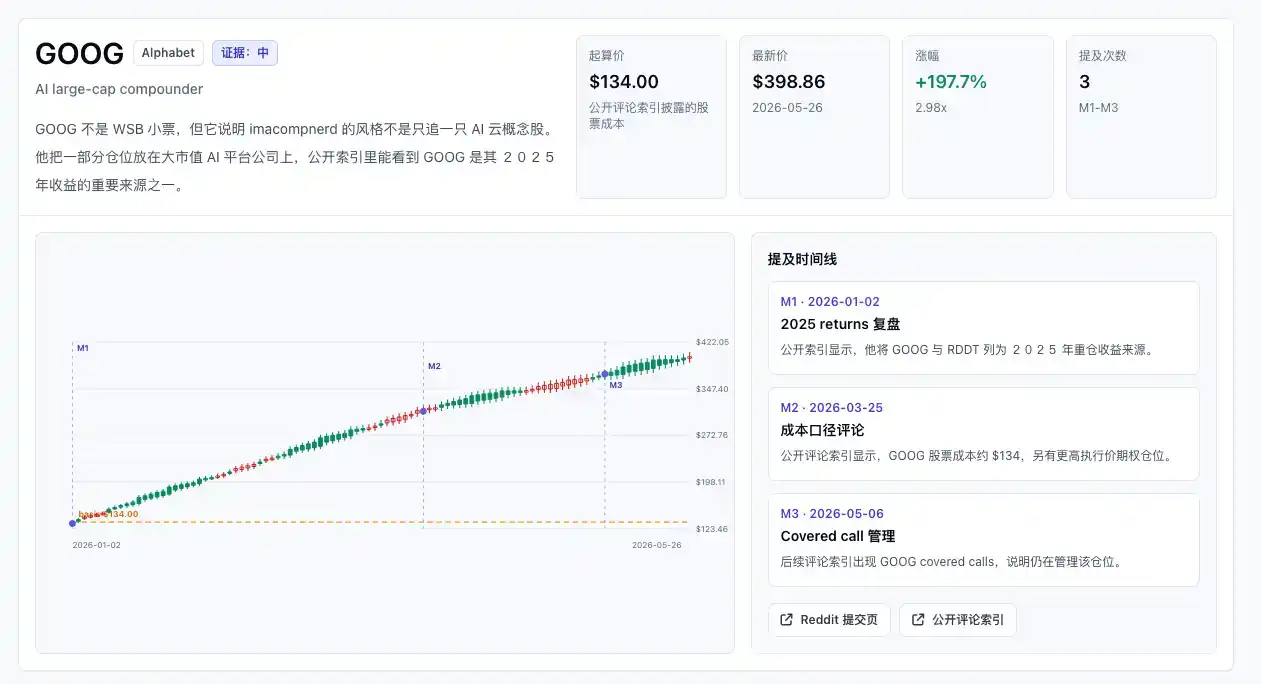
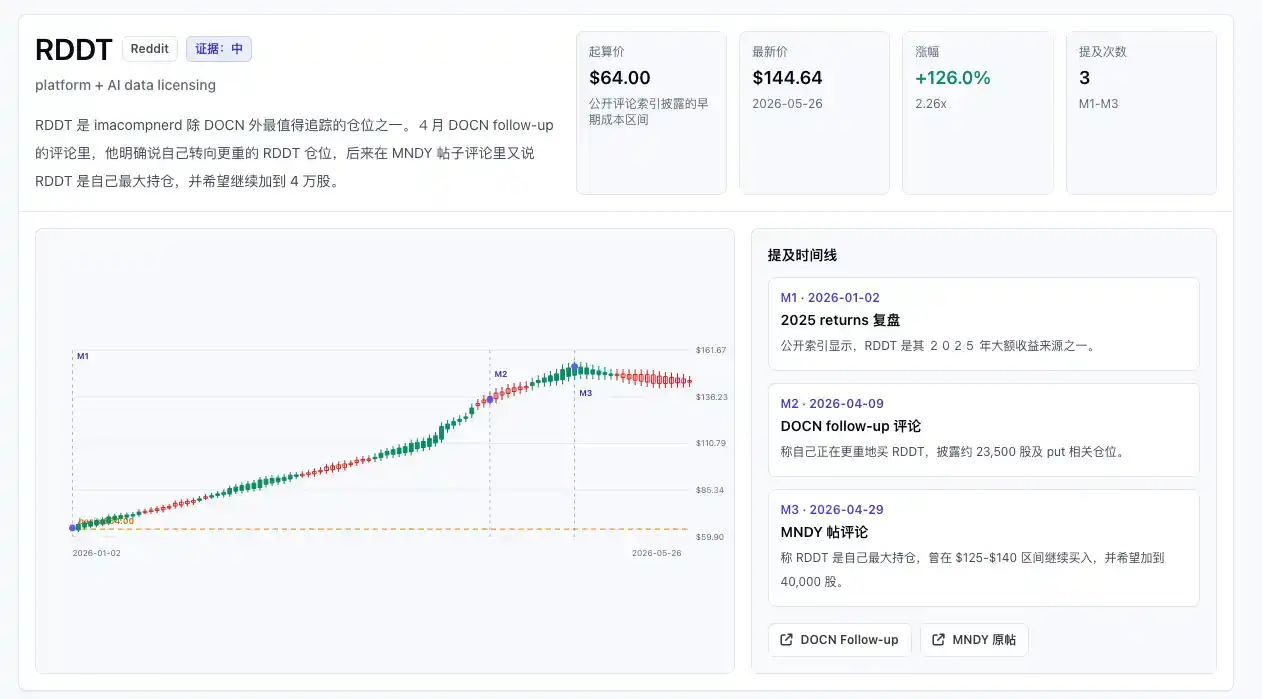
More interestingly, he didn't become a legend based on just one DOCN trade. Public records also show his heavy positions in and reviews of RDDT, GOOG, and MNDY. RDDT corresponds to Reddit's platform traffic, community, and AI data licensing potential; GOOG is a more traditional large AI platform company; MNDY is another re-rating attempt in enterprise software. The MNDY trade is particularly noteworthy because it wasn't a beautiful victory screenshot: he disclosed a position of about $1.9 million, but his cost basis was higher than the price when he posted, showing a temporary paper loss. Precisely because of this, this person feels more authentic than ordinary "profit-showing accounts." His account has big wins and floating losses; AI cloud infrastructure, platform stocks, and enterprise software; concentrated bets and position management.

The 2026 AI sector is fiercely contested in the market.

When the US stock AI sector intraday corrects for half an hour, money quickly rushes in to buy the dip; when memory stocks like Micron and SK Hynix move, the Korean market follows, and then China's A-share semiconductors, memory, communications, CPO, and optical modules move in turn. The rally spreads like fire from one AI market to another.

On the other side, traditional assets are becoming increasingly awkward. Baijiu, real estate, insurance, pharmaceuticals, high dividends—these were all assets that could be argued logically in the past. Now, they often represent another kind of psychological torment: they don't rise when AI rises, but they fall together when the market falls. In the past, buying the wrong sector, you could comfort yourself waiting for style rotation; now, the stronger the AI theme rises, the more it seems to be sucking blood from other sectors.

In such times, what people fear most isn't losing money, but being on the wrong side of history. Watching others continuously make money from memory, optical modules, CPO, AI cloud, and semiconductor small-caps, holders of traditional assets can't help but doubt their life choices. Once anxiety forms, it pushes more capital into the AI theme.

And when the most prominent AI leaders become too expensive, the most aggressive money will continue flowing into more niche sectors, further upstream, and more obscure parts of the supply chain.

This is also the biggest characteristic of this generation of 'trading gods,' and the greatest distinction from the previous generation.

Buffett's working method was reading 500 pages of material daily, feeding on financial reports, 10-Ks, and 10-Qs. He once held up a thick stack of papers to a reporter, saying knowledge accumulates like compound interest. He looked at ROE, free cash flow, debt-to-equity ratios, whether management honestly admitted mistakes in shareholder letters. His targets were companies operating for decades, with complete financial statements and stable cash flows. After buying, he was willing to hold for ten or twenty years.

The entire art of value investing is built on the premise that "financial reports are the soul of a company."

But Leopold Aschenbrenner, Serenity, and this generation of 'new gods' basically don't read that. This generation of 'trading gods' looks at: all details of earnings calls, customer certification cycles, industry chain and production line rhythms, whether upstream materials are monopolized, whether a certain tech path is moving from paper to mass production, whether a company is being treated by the market as an old-cycle business.

They are also different from traditional sell-side analysts. Sell-side analysts look at DCF, EPS, guidance, target price. This generation of trading gods directly bypasses financial reports, jumping to the upstream industry chain to find that 'chokepoint' node—like a small company with a market cap of a few hundred million dollars whose client list includes NVIDIA and Google, a substrate material monopolized by a certain company, a certification cycle not yet covered by sell-side analysts.

Not reading financial reports but analyzing industry chain and supply chain logic—this is the signature move of this generation of stock-pumpers from WallStreetBets.

This group emerged from the same era's climate, collectively forming a new school in the 2026 AI bull market.

An Attention Economy Bull Market

Low-liquidity assets, early-stage narratives, strong communication symbols, community diffusion, and the sense of "not yet discovered by mainstream capital."

Listing these terms together, you'll find they can describe both meme coins and the hottest batch of micro-cap stocks in today's US stock market. The difference is that meme coins always admit they are attention games, while micro-cap stocks wear the cloak of "hard tech supply chain research."

But the essence is the same. Small market cap, thin trading volume, little institutional coverage, yet often positioned within an industry story that sounds sufficiently grand. A $700 million market cap company is portrayed as a chokepoint in the AI era; a $3 billion market cap cloud provider is portrayed as the AI entry point for SMEs; an unknown substrate manufacturer is portrayed as the common upstream for NVIDIA, Google, and Microsoft. Once the narrative is established, the price moves first; whether fundamentals truly materialize will be known only several quarters later.

The most interesting aspect of micro-cap stocks is that they aren't inherently a field where institutions excel. On the contrary, the smaller the market cap and lower the liquidity, the more Wall Street's advantages can become constraints.

For an asset management firm managing hundreds of billions or even trillions of dollars, looking at a small company worth $300-400 million, the first thought isn't "Is this the best opportunity?" but "Can I get in, and can I get out?" They have position limit rules, liquidity rules, risk committees, disclosure requirements, and transaction impact costs. For a retail investor, a small-cap stock with a $300 million market cap and daily trading volume of tens of millions might be sufficiently large; for an institution like BlackRock, this might be a negligible position. Buying too little is meaningless; buying too much might directly push up the price, even trigger position disclosures. When it's time to sell, shallow liquidity might cause significant slippage.

So, they aren't blind to it; often, they simply can't play. The larger the institutional money, the more powerful it is in large-cap assets; but in micro-cap stocks, scale becomes a cage. The micro-cap pond is too shallow for big ships.

But the attention economy has its own physical laws.

So, whether this cross-market alpha can persist depends on three things.

First, whether the information gap still exists. If only a few FinTwit accounts can clearly explain the photonics supply chain, CT (presumably Crypto Twitter) following them might indeed provide early access to a batch of under-covered assets. But once mainstream sell-side analysts, ETFs, and quant funds start covering, the narrative premium will quickly be compressed.

Second, whether fundamentals can keep up with attention. AI optical communication isn't an empty narrative, but the biggest problem with small-caps is order uncertainty, customer concentration, financing dilution, and long capacity verification cycles. A company might be in the right sector but fail to capture real economic value.

Third, the speed of dissemination itself creates exit congestion. Rising prices in low-liquidity assets can easily be interpreted as "the market validating the narrative," but it might just be short-term attention influx. The more it resembles a meme coin, the more one must be wary of meme coin-style liquidity withdrawal—the story remains, but the buying pressure is gone.

This also hints at a market migration: crypto traders are applying their on-chain-trained narrative sense to US micro-caps, AI hardware, energy, power, and supply chain assets. This might be one of the most notable changes in trading culture within the crypto space this year.

The attention economy nature of US stock micro-caps existed long before meme coins emerged.

An era creates heroes, and an era is never short of new gods.

Trend Kriptolar

İlgili Sorular

QAccording to the article, what is the main characteristic that distinguishes the new generation of stock gods from traditional value investors like Warren Buffett?

AThe main characteristic is that the new generation of stock gods do not focus on reading traditional financial reports (like 10-Ks, 10-Qs). Instead, they analyze industrial supply chains, looking for 'bottleneck' companies in upstream materials and technology that are critical to major trends like AI, regardless of their small market capitalization or low coverage by mainstream analysts.

QWho is Leopold Aschenbrenner, and what is his significance in the context of the article?

ALeopold Aschenbrenner is a 22-year-old German investor mentioned as a symbolic figure of the 'new stock gods.' He reportedly turned $200 million in starting capital into $14 billion through stock trading. His success exemplifies the accelerated disenchantment with the traditional Buffett-style value investing approach.

QWhat is the core investment thesis behind Serenity's recommendation of the stock AXTI?

ASerenity's core thesis is that the entire AI industry's construction depends on AXTI, a company with a monopoly on indium phosphide substrates and materials. He argues that as the AI industry shifts from Google TPU to photonics and optical interconnect technology, companies like NVIDIA, Google, and Microsoft all rely on AXTI's products, making it a critical 'chokepoint' in the supply chain.

QWhy does the article suggest that large institutional investors are often at a disadvantage when it comes to micro-cap stocks?

ALarge institutions face disadvantages with micro-cap stocks due to their size. They have constraints like position limits, liquidity rules, and risk committees. The low liquidity and small market cap of these stocks make it difficult for large funds to build meaningful positions without significantly moving the price (high slippage), and they may struggle to exit positions without causing a sharp price decline.

QWhat are the three factors the article states will determine the sustainability of the 'attention economy' alpha in micro-cap AI stocks?

AThe three factors are: 1) Whether the information edge still exists or if mainstream coverage flattens the narrative premium. 2) Whether the company's fundamental business performance can keep up with the heightened attention and validate the story. 3) The risk of 'exit congestion' created by the speed of narrative传播, where buying interest can vanish quickly despite the story remaining intact, similar to meme coins.

İlgili Okumalar

After Three Consecutive Quarters of Decline, Can the Crypto Market Find a Window for Stabilization in Q3?

The cryptocurrency market has just concluded its worst-performing quarter since 2022, with total capitalization dropping 12.6% to $2.1 trillion. All core metrics indicate capital is leaving the sector, not just rotating within it. Bitcoin fell 14.2% and Ethereum dropped 25.4% in Q2, breaking their previous correlation with US tech stocks. A key driver is the reversal in US spot Bitcoin ETF flows, which saw a net outflow of approximately $4.67 billion in Q2, including a record monthly outflow near $4.5 billion in June. While recent data suggests long-term holders are accumulating again, sustained ETF outflows mean continued selling pressure. Market focus is now singularly on the Federal Reserve. The upcoming July FOMC meeting is seen as the most critical event for Q3. A dovish signal could support Bitcoin reclaiming a $68,000-$84,000 range, while a hawkish stance might establish a new trading band around $50,000-$56,000. Additionally, regulatory uncertainty persists, with the progress of the crucial *CLARITY Act* stalling in the Senate, reducing its perceived 2026 passage probability to 40-45%. Despite the broad downturn, a few sectors showed growth. Prediction markets saw nominal volume surge 48.7% year-over-year to $113.8 billion, and tokenized collectibles transaction volume rose 143% quarterly to $1.4 billion. The Real-World Asset (RWA) tokenization sector also continued steady growth, now representing ~$28.1 billion in on-chain value. The market's foundation for an extreme crash appears limited, with Bitcoin price hovering near its 200-week moving average. However, the trading paradigm has shifted from narrative-driven speculation to decisions based on price action, policy developments, and interest rate expectations, making a broad sentiment-driven rally unlikely in the near term.

marsbit12 saat önce

After Three Consecutive Quarters of Decline, Can the Crypto Market Find a Window for Stabilization in Q3?

marsbit12 saat önce

BIT Trading Moment: BTC Still Suppressed by Weekly 200 EMA, Rejection May Restart Decline; Storage and Semiconductors that Surged Last Night Begin Falling in Evening Trading

**Crypto & Stock Market Wrap: Bitcoin Tests Resistance, Stocks Retreat After AI Surge** Bitcoin consolidates around $66,000, facing key resistance near $68,000—an area seen as a major psychological and technical hurdle where previous rallies have failed. Analysts note the cryptocurrency is caught between its 200-week moving average (~$63,333) and 200-week EMA (~$68,328). A clear break above $68k is needed to signal a stronger bullish trend, while a rejection could lead to a retest of $63k support. Market sentiment remains cautious, with low futures open interest pointing to a low-liquidity rebound rather than a full bull market. Bitcoin spot ETFs saw another $203 million inflow. US stock futures pointed lower after a strong Tuesday session led by a massive rebound in semiconductors and memory stocks. The rally was fueled by renewed optimism about AI-driven hardware demand, with Micron, SanDisk, and SK Hynix surging. However, those gains reversed in pre-market trading. Super Micro Computer (SMCI) soared over 20% after hours on strong guidance and a record backlog. Other standouts included Rocket Lab and nuclear energy plays Oklo and X-Energy. Rising oil prices (Brent above $91) and climbing Treasury yields (10-year near 4.64%), however, are reigniting inflation concerns and acting as a headwind for equities. In Asia, markets were mixed. South Korea's KOSPI pared early gains to close slightly higher as semiconductor stocks like SK Hynix gave back initial surges. Japan's Nikkei edged lower as the yen hit a fresh 38-year low against the dollar, raising fears of potential market intervention. Key events to watch include the Samsung Galaxy launch, AMD's AI event, and a slew of major tech earnings from Alphabet, Tesla, and IBM after the close on Wednesday, followed by the ECB meeting and Intel's earnings on Thursday.

marsbit12 saat önce

BIT Trading Moment: BTC Still Suppressed by Weekly 200 EMA, Rejection May Restart Decline; Storage and Semiconductors that Surged Last Night Begin Falling in Evening Trading

marsbit12 saat önce

Former CFTC Chairman, Circle President Tarbert: Preaching Long-Termism While Cashing Out $30 Million Himself

Former CFTC Chairman and Circle President Heath Tarbert has consistently advocated for a long-term vision in public, urging patience from investors as Circle’s stock price has fallen significantly from its peak. However, it has been revealed that since Circle’s IPO, Tarbert has continuously sold his CRCL shares through pre-arranged trading plans, cashing out approximately $30 million, without making any public market purchases. This contrast between his public messaging and personal actions has drawn criticism. Tarbert joined Circle in July 2023 as Chief Legal Officer, leveraging his regulatory experience to help guide the company through its IPO and expansion. Despite promoting stablecoins as long-term infrastructure, he established a 10b5-1 trading plan just before Circle went public, leading to substantial stock sales over the following year. In March 2026, he initiated another plan to sell more shares. His career trajectory highlights a pattern of moving between high-level regulatory roles and influential positions in the financial sector. After resigning as CFTC Chairman in early 2021, he joined Citadel Securities as Chief Legal Officer just 27 days later, during a period of intense regulatory scrutiny for the firm. He later joined Circle, aiding its efforts to navigate regulatory challenges for its public listing. While Tarbert's expertise in policy and compliance is valuable to companies like Circle, his actions—advocating long-term confidence while personally divesting—raise questions about the alignment between his public statements and his private financial decisions, leaving investors who followed his advice to bear the market risks.

marsbit12 saat önce

Former CFTC Chairman, Circle President Tarbert: Preaching Long-Termism While Cashing Out $30 Million Himself

marsbit12 saat önce

Gate Research Institute: The 'Wall Street-ization' Wave of Crypto Financial Products – Competition or Integration?

The article titled "Gate Research Institute: Are Crypto Financial Products Sparking a 'Wall Street' Wave—Competition or Convergence?" explores the evolving relationship between the crypto ecosystem and traditional finance (TradFi). The piece begins by reflecting on Bitcoin's original 2009 vision of decentralization, disintermediation, and moving away from banks. It then contrasts this with the 2024 landscape, where key crypto assets like Bitcoin are increasingly held through Wall Street products like ETFs issued by giants like BlackRock. The article questions whether this signifies that TradFi is systematically taking over the rights to issue, price, custody, and distribute crypto financial assets. The core argument is that this is not a zero-sum takeover but rather a bidirectional convergence where each side addresses the other's weaknesses. Crypto offers 24/7 global markets, programmable settlement, and open access but lacks compliant channels, institutional-grade custody, deep fiat liquidity, and mainstream distribution. TradFi possesses these but is constrained by legacy systems, limited operating hours, and slow settlement. Two primary convergence paths are highlighted: * **Path A (CEX to TradFi):** Exemplified by Gate, which has progressed from offering tokenized stocks and CFDs to providing direct, real stock trading (US, Hong Kong, South Korea) within its platform, using USDT. * **Path B (TradFi to Crypto):** Exemplified by Robinhood, which has integrated crypto trading, acquired exchanges like Bitstamp, and is moving traditional assets like stocks onto the blockchain via tokenization and its own Layer 2. Both paths are ultimately competing to become the next-generation, unified financial account—a "super account" where users can seamlessly trade cryptocurrencies, stocks, ETFs, RWA (Real World Assets), and tokenized treasury products in one interface. The growth of RWA and tokenized treasuries (e.g., BlackRock's BUIDL) is presented as the asset-layer fusion, providing stable, yield-bearing assets on-chain and acting as a bridge between the two worlds. In conclusion, the "Wall Street-ization" of crypto is framed as a mutual transformation. Decentralized ideals persist in the protocol layer, while at the application layer, a more efficient, global, and accessible unified capital market is emerging from this convergence. The future competition lies not between crypto exchanges and stockbrokers, but between platforms vying to offer the most comprehensive asset coverage, liquidity, and user experience within a single account.

marsbit12 saat önce

Gate Research Institute: The 'Wall Street-ization' Wave of Crypto Financial Products – Competition or Integration?

marsbit12 saat önce

İşlemler

Spot

Popüler Makaleler

GODS Nasıl Satın Alınır

HTX.com’a hoş geldiniz! Gods Unchained (GODS) satın alma işlemlerini basit ve kullanışlı bir hâle getirdik. Adım adım açıkladığımız rehberimizi takip ederek kripto yolculuğunuza başlayın. 1. Adım: HTX Hesabınızı OluşturunHTX'te ücretsiz bir hesap açmak için e-posta adresinizi veya telefon numaranızı kullanın. Sorunsuzca kaydolun ve tüm özelliklerin kilidini açın. Hesabımı Aç2. Adım: Kripto Satın Al Bölümüne Gidin ve Ödeme Yönteminizi SeçinKredi/Banka Kartı: Visa veya Mastercard'ınızı kullanarak anında Gods Unchained (GODS) satın alın.Bakiye: Sorunsuz bir şekilde işlem yapmak için HTX hesap bakiyenizdeki fonları kullanın.Üçüncü Taraflar: Kullanımı kolaylaştırmak için Google Pay ve Apple Pay gibi popüler ödeme yöntemlerini ekledik.P2P: HTX'teki diğer kullanıcılarla doğrudan işlem yapın.Borsa Dışı (OTC): Yatırımcılar için kişiye özel hizmetler ve rekabetçi döviz kurları sunuyoruz.3. Adım: Gods Unchained (GODS) Varlıklarınızı SaklayınGods Unchained (GODS) satın aldıktan sonra HTX hesabınızda saklayın. Alternatif olarak, blok zinciri transferi yoluyla başka bir yere gönderebilir veya diğer kripto para birimlerini takas etmek için kullanabilirsiniz.4. Adım: Gods Unchained (GODS) Varlıklarınızla İşlem YapınHTX'in spot piyasasında Gods Unchained (GODS) ile kolayca işlemler yapın.Hesabınıza erişin, işlem çiftinizi seçin, işlemlerinizi gerçekleştirin ve gerçek zamanlı olarak izleyin. Hem yeni başlayanlar hem de deneyimli yatırımcılar için kullanıcı dostu bir deneyim sunuyoruz.

167 Toplam GörüntülenmeYayınlanma 2024.12.13Güncellenme 2026.06.02

GODS Nasıl Satın Alınır

Tartışmalar

HTX Topluluğuna hoş geldiniz. Burada, en son platform gelişmeleri hakkında bilgi sahibi olabilir ve profesyonel piyasa görüşlerine erişebilirsiniz. Kullanıcıların GODS (GODS) fiyatı hakkındaki görüşleri aşağıda sunulmaktadır.

活动图片













