The White House Did the Math: How Much More Could Banks Lend If Stablecoin Interest Is Banned?

marsbit2026-04-13 tarihinde yayınlandı2026-04-13 tarihinde güncellendi

Özet

The White House Council of Economic Advisers (CEA) refuted a previous claim that interest-bearing stablecoins could reduce bank lending by $1.5 trillion, estimating the actual impact at just $2.1 billion—nearly 700 times smaller. The key argument centers on where stablecoin reserves are allocated. Most major issuers, like Tether and Circle, hold the majority of reserves in U.S. Treasuries and repurchase agreements, not bank deposits. Only a small portion (around 12% for USDC) is held in bank deposits subject to 100% reserve requirements—the only scenario that meaningfully reduces bank lending capacity. Even if a ban on stablecoin interest payments drove an estimated $54.4 billion back to banks, only 12% of that would affect lending capacity. After accounting for reserve requirements and banks’ existing excess liquidity, the net increase in lending would be minimal. The report also highlights negative side effects: an $800 million annual welfare loss for stablecoin holders and potential reduced foreign demand for U.S. Treasuries, which could raise borrowing costs. The cost-benefit ratio of an interest ban is estimated at 6.6, making it an inefficient policy with clear costs and uncertain benefits.

Written & Compiled by: KarenZ, Foresight News

Last summer, during the debate over the "GENIUS Act" in the U.S. Congress, economist Andrew Nigrinis threw out a number—if stablecoins could pay interest, bank loans could evaporate by $1.5 trillion.

This number spread quickly in Washington. Banking lobby groups used it as an argument, some lawmakers used it as a reason, and ultimately a clear prohibition was added to the bill: any stablecoin issuer is prohibited from paying interest or returns to holders. The logic is straightforward—if you can earn more money on-chain, who would still deposit money in banks? With fewer deposits, banks have no ammunition, and borrowers suffer as a result.

Sounds reasonable, right?

However, the "GENIUS Act" did not explicitly restrict third-party platforms from offering interest-like yields. But parts of the currently proposed "CLARITY Act" attempt to plug this loophole.

In April this year, the White House Council of Economic Advisers (CEA) released a research report saying: wait, this claim might be a bit overblown. The CEA directly responded to this logic using a full set of equilibrium models and reached a possibly unexpected conclusion: banning stablecoins from distributing yields has a very small effect on protecting bank lending.

The number they calculated is: $2.1 billion, not $1.5 trillion—a difference of nearly 700 times.

Where Does a Dollar Go After Entering a Stablecoin?

The statement "stablecoins suck away deposits" sounds very visual, but it skips a key step—what does the issuer do with that money after it's used to buy the stablecoin?

The CEA breaks it down into three scenarios:

Scenario 1: The issuer buys Treasury bonds with the reserves:

A user withdraws $1 from Bank A to buy a stablecoin. The issuer takes this $1 and immediately buys a Treasury bond from a dealer. The dealer, after selling the bond, deposits the received $1 into Bank B. The final result: Bank A has one less deposit, Bank B has one more deposit. The total amount of deposits in the entire banking system remains unchanged; it just changed which bank owns it.

Scenario 2: The issuer deposits the reserves as cash in a bank, but the bank is required to hold 100% reserves:

Again, $1 enters the stablecoin system, and the issuer deposits it into Bank C. The book deposit of Bank C remains unchanged, but regulations require Bank C to back this deposit with 100% central bank reserves—meaning this $1 is "locked up" and cannot be expanded into loans via the credit multiplier. This is the true meaning of loss of bank lending capacity.

Scenario 3: Reserves flow into a money market fund:

If the fund then buys Treasury bonds, the logic returns to Scenario 1.

If the fund deposits the cash into the Fed's overnight reverse repo facility (ON RRP), this money becomes a liability of the Fed and is no longer a commercial bank deposit—but the CEA points out that this phenomenon is common to the entire non-bank financial system, not unique to stablecoins.

Therefore, the core of the issue is not the total amount of deposits, but the structure of the deposits—what proportion of stablecoin reserves actually enter that "100% reserved, un-lendable" pocket?

The CEA breaks this down. The two largest issuers in the current market, Tether and Circle, together account for over 80% of the stablecoin market share. What they do with the USD they receive from users is basically one thing: buying U.S. short-term Treasury bonds. Circle's reserve report for the end of 2025 shows that 88% of USDC reserves are held in Treasury bonds and repurchase agreements, with only 12% held in the form of bank deposits. Tether is even more extreme; out of its $147.2 billion in reserves, bank deposits are only $34 million, not even a fraction.

The only scenario that truly affects bank lending capacity is when the issuer deposits the reserves in a bank, and regulations require that bank to hold 100% reserves against that money. That is, for Circle's USDC reserves, only 12% of the reserves take this path. The remaining 88% continues to circulate within the banking system.

Even If It Leaks Out, It Has to Be Caught by Three Nets

Assume stablecoins no longer pay interest, and users start moving money back to banks. But for this capital to become actual bank loans, it must pass through three checkpoints.

First checkpoint: How much capital would actually flow back to banks? The report, referencing historical elasticity data from money market funds for calibration, estimates that under the baseline scenario, approximately $54.4 billion would shift from stablecoins back to traditional deposits due to the yield dropping to zero. This number itself is already high—a significant portion of stablecoin holders are not in it for the yield at all; they want the speed of cross-border transfers or a dollar account independent of their local banking system. Whether it pays interest or not has little impact on their decision.
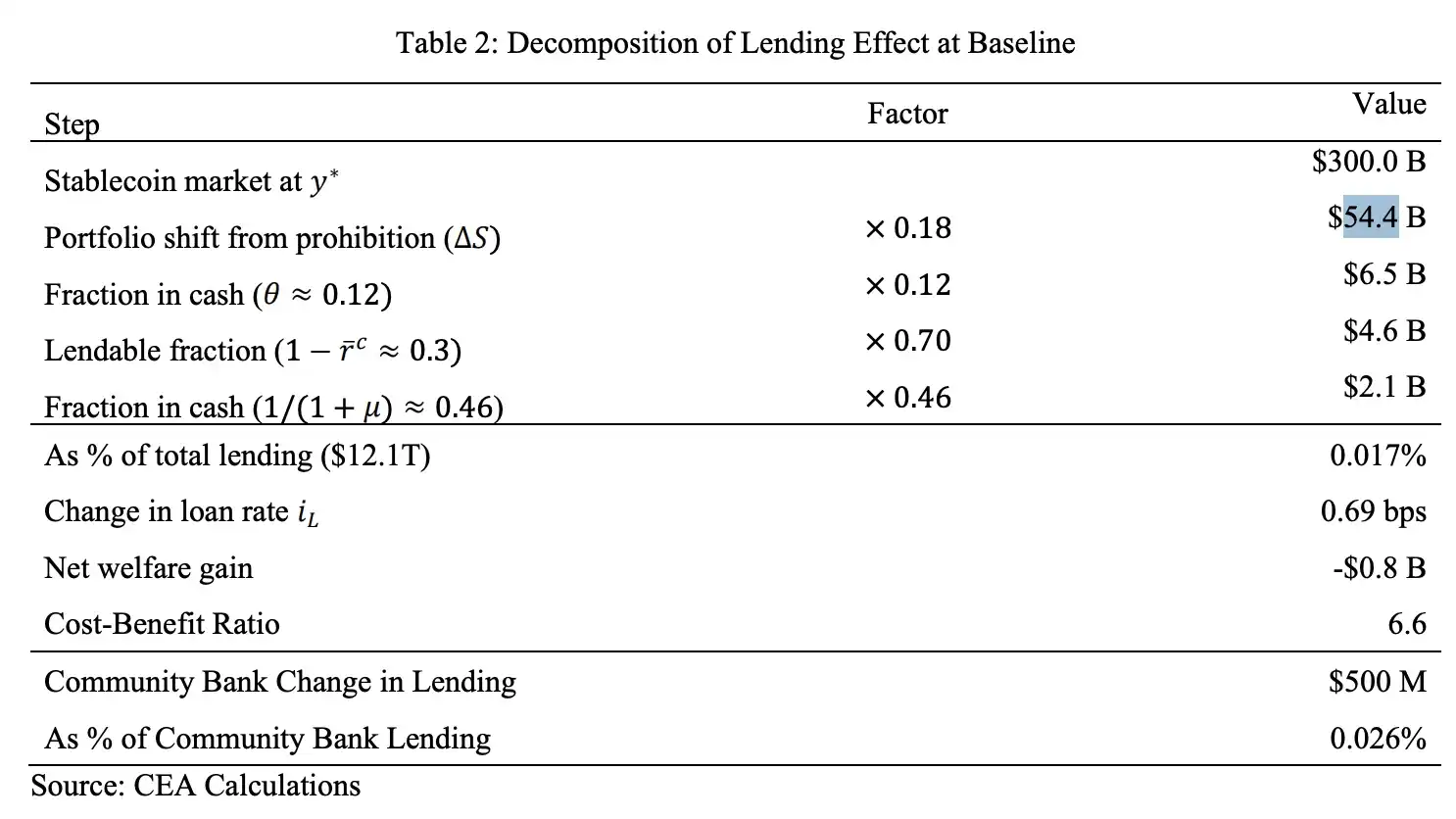
Second checkpoint: Out of this $54.4 billion, how much actually changes bank lending capacity? Only the 12% (in the case of USDC) portion, which is about $6.5 billion. The other 88% was circulating in the Treasury market before and after the ban, having no net impact on bank lending capacity.

Third checkpoint: Can the $6.5 billion entering banks be fully lent out? No. Banks need to hold reserves. The current effective reserve ratio in the U.S. banking system is about 30%, leaving 70% as lendable funds. Moreover, the Fed currently maintains an "ample reserves" framework, with banks collectively holding over $1 trillion in excess liquidity buffers—for every new dollar of lending capacity, ultimately less than 50 cents becomes a real loan, with the rest being actively absorbed by banks into their liquidity buffers.

After passing through these three checkpoints, $54.4 billion becomes $2.1 billion, only 0.02% of total loans (about $12 trillion).

Then calculate the cost on the other side: stablecoin holders lose the approximately 3.5% annualized yield they could have obtained, resulting in a net welfare loss of about $800 million per year.

In the CEA's words, the cost-benefit ratio of this ban is 6.6, meaning the cost is 6.6 times the benefit, making it very inefficient.

How Was That $1.5 Trillion Calculated?

Since the White House model gives $2.1 billion, where did the original $1.5 trillion come from?

The CEA traces its origins in the report. Nigrinis's (2025) estimate directly borrowed the model established by Whited, Wu, and Xiao (2023) for Central Bank Digital Currency (CBDC)—CBDC, as a liability of the Fed, would directly withdraw deposits from the commercial banking system; for every dollar entering, bank loans decrease by about 20 cents. Nigrinis directly applied this multiplier to the stablecoin scenario, while assuming stablecoins would expand massively after offering competitive yields, ultimately推算 (推算 - calculated/derived) the $1.5 trillion loan contraction.

The problem is, there is an essential difference between CBDC and stablecoins: CBDC is a central bank liability; deposits entering it leave the commercial banking system. The reserves of stablecoins mostly flow back to commercial banks through the Treasury market. Nigrinis's model did not track where this money went; it only saw deposits decreasing at one bank, not increasing at another.

This is the fundamental difference between partial equilibrium and general equilibrium. Mistaking the loss of one bank for the loss of the entire system naturally leads to an error of orders of magnitude.

Another Overlooked Account

The report specifically points out an effect not covered by the model but working in the opposite direction: stablecoins' overseas demand for U.S. Treasury bonds.

Over 80% of stablecoin transactions occur outside the U.S.,背后是 (behind which are) ordinary users in countries with unstable currencies using dollar stablecoins as savings tools. This group supports real demand for U.S. Treasury bonds; IMF data shows that the scale of U.S. Treasury bonds held by stablecoin issuers has surpassed that of Saudi Arabia. BIS research shows that every $3.5 billion inflow into stablecoins can depress the 3-month Treasury yield by 5 to 8 basis points. If the ban suppresses stablecoin adoption, this overseas demand channel contracts, U.S. Treasury financing costs rise, and this cost might directly offset that tiny increment on the bank lending side.

So, what does all this actually illustrate?

It's not that stablecoins have no impact on banks, but rather that the source of that impact, to a very large extent, is not "whether they can pay interest." The真正关键的 (truly crucial) thing is what proportion of the stablecoin issuer's reserves are placed in that must-be-100%-reserved lockbox. If regulations push this proportion higher in the future, the impact would才开始变得显著 (begin to become significant).

Regarding the ban on paying interest, for bank lending, the cost-benefit ratio is 6.6; for the stablecoin ecosystem, it cuts off its ability to provide competitive yields to ordinary users; for U.S. Treasury financing, it might even be counterproductive.

One piece of legislation, with no clear beneficiary, but with clear losers. This is what is truly thought-provoking about this report.


İlgili Sorular

QWhat was the original claim made by economist Andrew Nigrinis regarding stablecoin interest and bank lending?

AAndrew Nigrinis claimed that if stablecoins could pay interest, bank loans could be reduced by $1.5 trillion.

QAccording to the White House CEA report, what is the estimated impact on bank lending from banning stablecoin interest payments?

AThe CEA report estimates that banning stablecoin interest payments would only increase bank lending by $2.1 billion, not $1.5 trillion.

QWhat is the key difference between a CBDC and a stablecoin that the CEA report highlights to explain the discrepancy in the estimates?

AThe key difference is that a CBDC is a central bank liability that removes deposits from the commercial banking system, while stablecoin reserves largely flow back into the commercial banking system through the Treasury market.

QWhat percentage of Circle's USDC reserves are held in Treasury bonds and repurchase agreements, according to the article?

A88% of Circle's USDC reserves are held in Treasury bonds and repurchase agreements.

QWhat unintended consequence does the article suggest could result from suppressing stablecoin adoption through an interest ban?

ASuppressing stablecoin adoption could reduce foreign demand for U.S. Treasury bonds, potentially increasing U.S. Treasury financing costs.

İlgili Okumalar

Anthropic Cries Wolf: Is the AGI Threat Real, or Just an IPO Story?

Anthropic has published an article titled "When AI builds itself," discussing the emerging concept of "recursive self-improvement," where AI begins to actively participate in designing, training, testing, and optimizing its own subsequent versions. The company presents internal data showing that by May 2026, over 80% of code merged into its codebase was written by Claude, its AI model. Claude's capabilities have expanded to handling complex, open-ended engineering tasks, achieving a 76% success rate in such areas, and even contributing to research processes, such as optimizing code performance and conducting AI safety experiments. Anthropic outlines an evolution from human-driven development to AI-assisted workflows, culminating in the current stage where AI agents can autonomously write, run, and delegate code. The company cautions that the path toward a "closed loop," where AI continuously improves itself, is becoming visible. It calls for coordinated global mechanisms to potentially slow or pause frontier AI development to allow safety research and societal structures to catch up. However, the timing of this warning coincides with Anthropic's preparations for an IPO, framing the narrative not just as a safety concern but also as a demonstration of Claude's advanced capabilities and its integral role in accelerating Anthropic's own R&D—creating a potential "flywheel" effect for competitive advantage. This contrasts with OpenAI's recent, more policy-oriented discussion of the same risks, highlighting the competitive dynamics in the AI industry as companies position themselves in both the technological and regulatory landscape.

marsbit20 dk önce

Anthropic Cries Wolf: Is the AGI Threat Real, or Just an IPO Story?

marsbit20 dk önce

BIT Research: ETF Purchases Have Slowed, Strategy (MicroStrategy) Has Slowed, What Else Can Drive Bitcoin's Rise?

Market Refocus on Inflation and Rate Expectations Weighs on Bitcoin Currently, the market is in a phase of macro-repricing dominated by inflation and interest rate expectations. Bitcoin, which previously benefited from easy liquidity and low inflation, is seeing its core bullish drivers weaken. These drivers were market expectations for interest rate cuts and strong inflows from Bitcoin ETFs and institutions like MicroStrategy (referred to as "Strategy" in the text). The logic has shifted. Recent high inflation data (e.g., CPI hitting 3.8% in a May 2026 report) has caused the market to sharply reduce its rate cut expectations for 2025 and even price in potential hikes. This is a key constraint for Bitcoin, as it lacks cash flows and is highly sensitive to rate expectations. Concurrently, institutional capital flows have slowed significantly. Following the hot CPI data, Bitcoin ETFs saw accelerated outflows, with around $4.3 billion leaving over a period. MicroStrategy's ability to keep adding substantial Bitcoin to its balance sheet is also diminishing. Together, ETF and MicroStrategy holdings total roughly $110 billion, but their momentum as growth engines is cooling. In summary, Bitcoin's current pressure stems not from its own fundamentals but from a changing macro environment. As long as inflation stays elevated, Bitcoin is likely to remain in a consolidating phase. However, historically, inflation eventually peaks. Once it recedes and rate cut expectations rebuild, institutional capital could return, potentially fueling a new and more robust recovery phase for Bitcoin.

marsbit28 dk önce

BIT Research: ETF Purchases Have Slowed, Strategy (MicroStrategy) Has Slowed, What Else Can Drive Bitcoin's Rise?

marsbit28 dk önce

Earning 1000 Trillion in Half a Year, 'Pocketing' 20 Million per Capita: This Round of Wealth Creation in the Korean Stock Market is Unprecedented in Scale

The South Korean stock market is experiencing an unprecedented wealth surge in 2026, with household equity and fund asset values soaring by over 1,000 trillion KRW (~$730bn) year-to-date. This translates to an average per capita wealth increase of roughly 20 million KRW, fueled by a historic 109% rally in the KOSPI index. The boom is driven by three converging forces: an AI-driven semiconductor supercycle boosting giants like Samsung and SK Hynix; the government's "Value-Up" market reforms addressing long-standing corporate governance issues; and aggressive real estate regulations that have locked capital within financial markets, preventing profits from flowing back into property. This has triggered a wealth effect, boosting high-end consumption significantly. However, the gains are highly concentrated. The two semiconductor behemoths account for over half the index's value, but retail investors own relatively low stakes in them, systematically missing the biggest rallies. Wealth and consumption benefits are skewed towards luxury goods and imported cars, bypassing mainstream retail. Further risks stem from excessive leverage, with high trading volume in leveraged ETFs, and a market sentiment heavily reliant on the AI sector's fortunes and speculative rumors. While this cycle marks a potential shift from real estate to equities as a primary wealth generator for Koreans, its sustainability, amid structural imbalances and leverage, remains a critical test.

marsbit33 dk önce

Earning 1000 Trillion in Half a Year, 'Pocketing' 20 Million per Capita: This Round of Wealth Creation in the Korean Stock Market is Unprecedented in Scale

marsbit33 dk önce

Behind ZEC's Over 30% Plunge: An 'Unlimited Minting' Vulnerability with No Way to Prove if It Was Ever Exploited

A critical vulnerability was discovered in Zcash's Orchard privacy pool, allowing for the theoretical creation of undetectable counterfeit ZEC. Researcher Taylor Hornby found the flaw on May 29th, 2024, within the Orchard circuit's cryptographic constraints, which could let an attacker bypass asset conservation rules. Although a rapid emergency fix was deployed within days via a coordinated soft and hard fork, a core uncertainty remains: due to Orchard's privacy features, it is impossible to cryptographically prove whether this "unlimited mint" flaw was exploited in the nearly four years since the pool's 2022 launch. This uncertainty, rather than the patched flaw itself, triggered a market panic, causing ZEC's price to drop over 30%. While the Zcash Foundation stated no evidence of exploitation was found, independent entity Shielded Labs emphasized the impossibility of definitively proving no counterfeit ZEC was ever created. The incident highlights the unique trust challenge in privacy systems. To address this, developers are proposing a new network upgrade with enhanced auditing to allow verifiable proof of supply integrity. Notably, the researcher utilized the newly released AI model Claude Opus 4.8 as a tool during the security review, signaling the growing role of advanced AI in uncovering complex cryptographic vulnerabilities.

marsbit35 dk önce

Behind ZEC's Over 30% Plunge: An 'Unlimited Minting' Vulnerability with No Way to Prove if It Was Ever Exploited

marsbit35 dk önce

İşlemler

Spot
Futures

Popüler Makaleler

HOUSE Nasıl Satın Alınır

HTX.com’a hoş geldiniz! Housecoin (HOUSE) satın alma işlemlerini basit ve kullanışlı bir hâle getirdik. Adım adım açıkladığımız rehberimizi takip ederek kripto yolculuğunuza başlayın. 1. Adım: HTX Hesabınızı OluşturunHTX'te ücretsiz bir hesap açmak için e-posta adresinizi veya telefon numaranızı kullanın. Sorunsuzca kaydolun ve tüm özelliklerin kilidini açın. Hesabımı Aç2. Adım: Kripto Satın Al Bölümüne Gidin ve Ödeme Yönteminizi SeçinKredi/Banka Kartı: Visa veya Mastercard'ınızı kullanarak anında Housecoin (HOUSE) satın alın.Bakiye: Sorunsuz bir şekilde işlem yapmak için HTX hesap bakiyenizdeki fonları kullanın.Üçüncü Taraflar: Kullanımı kolaylaştırmak için Google Pay ve Apple Pay gibi popüler ödeme yöntemlerini ekledik.P2P: HTX'teki diğer kullanıcılarla doğrudan işlem yapın.Borsa Dışı (OTC): Yatırımcılar için kişiye özel hizmetler ve rekabetçi döviz kurları sunuyoruz.3. Adım: Housecoin (HOUSE) Varlıklarınızı SaklayınHousecoin (HOUSE) satın aldıktan sonra HTX hesabınızda saklayın. Alternatif olarak, blok zinciri transferi yoluyla başka bir yere gönderebilir veya diğer kripto para birimlerini takas etmek için kullanabilirsiniz.4. Adım: Housecoin (HOUSE) Varlıklarınızla İşlem YapınHTX'in spot piyasasında Housecoin (HOUSE) ile kolayca işlemler yapın.Hesabınıza erişin, işlem çiftinizi seçin, işlemlerinizi gerçekleştirin ve gerçek zamanlı olarak izleyin. Hem yeni başlayanlar hem de deneyimli yatırımcılar için kullanıcı dostu bir deneyim sunuyoruz.

342 Toplam GörüntülenmeYayınlanma 2025.04.27Güncellenme 2026.06.02

HOUSE Nasıl Satın Alınır

Tartışmalar

HTX Topluluğuna hoş geldiniz. Burada, en son platform gelişmeleri hakkında bilgi sahibi olabilir ve profesyonel piyasa görüşlerine erişebilirsiniz. Kullanıcıların HOUSE (HOUSE) fiyatı hakkındaki görüşleri aşağıda sunulmaktadır.

活动图片